
This & That
The Port Hudson Campaign
By Gould Hagler · Originally published November-December 2026 · pp. 54–57
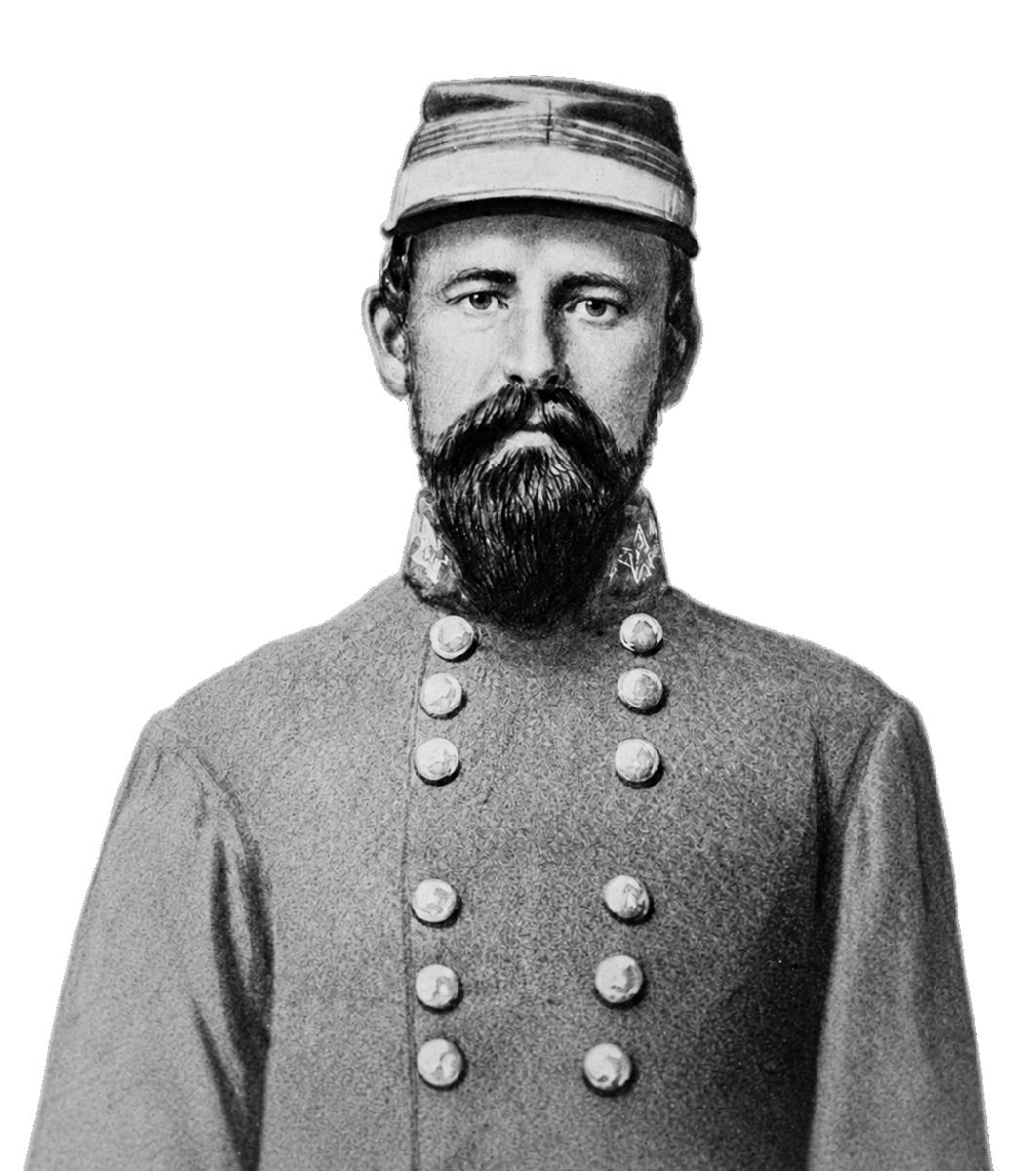
In late 1861, Lincoln identified Vicksburg, Mississippi, as the key for controlling the Mississippi River and winning the war. His army first took aim at the target in October 1862 when Maj. Gen. Ulysses S. Grant moved down the Mississippi Central Railroad, while his subordinate Maj. Gen. William T. Sherman went by river toward Chickasaw Bayou.1
By the spring of 1863, the Federals had taken command of the entire river, save the stretch between Vicksburg and Port Hudson, 220 river miles downstream in Louisiana. The campaign against this citadel began when Maj. Gen. Nathaniel Banks left occupied New Orleans on March 7 of that year. Banks was to demonstrate against the fortress and create a diversion while Rear Adm. David Farragut’s fleet attempted to run past the Confederate guns. Farragut’s ships upstream from Port Hudson would block supplies coming down the Red River.2 Farragut’s effort was only partly successful, with two of the seven warships getting through. In his March 21 report3 to General-in-Chief Henry Halleck, Banks wrote that Farragut’s ships began their run earlier than the agreed upon time. The premature movement caught Banks unprepared, and his guns were not in place to provide support. Banks and his men hung around for several more days and then returned to Baton Rouge and New Orleans. Banks reported that the Confederate force, under Brig. Gen. Franklin Gardner, numbered at least 20,000 men and was protected by strong works. With as great a force as he could bring to bear, Banks would have only 17,000 men. He wrote that it was “not in the power of the troops under my command to carry this position by assault or siege without reenforcements.” On the Confederate side, Gardner advised his superior, Lt. Gen. John C. Pemberton, that Farragut’s naval bombardment had done little damage. The land assault for which he prepared never came. On March 27 he reported that “The whole force of the enemy except four vessels has gone back to Baton Rouge.”4 Banks did not return empty-handed. He collected $300,000 worth of cotton and sugar. He announced his upcoming plans at the end of his March 21 report: “It is my purpose to commence without delay military movements upon the Atchafalaya or the Teche.” Within days Banks set out again, this time in another direction, on a route that eventually took him to Port Hudson. In April he began to push against Confederate Maj. Gen. Richard Taylor’s army in southwestern Louisiana. As the outnumbered Confederates withdrew, the Federals advanced through Brashear City, New Iberia, Vermillionville, Opelousas, and ultimately to Alexandria, arriving there on May 7, 200 miles from their starting point. The Official Records contain a number of interesting dispatches sent and received by Banks, Grant, and Halleck. As Grant moved south along the Mississippi, and as Banks moved north, well to the west of the river, their correspondence with each other and with the generalin-chief in Washington contained much verbiage about cooperation between the two field armies. Would Grant send troops to Banks? Would Banks send troops to Grant? Would they combine? Would they take Vicksburg and then close in on Port Hudson? Would they take Port Hudson and then close in on Vicksburg? There was no clear plan, set forth in advance and dictated by a general superior to the commanders of both field armies. Halleck became more and more frustrated as the coordination he desired never came to be. “Your great object,” Halleck wrote to Banks, “to be kept continually in view, must be to connect with General Grant. He has been written to to do all in his power to connect with you.”5 Later, learning that Banks was in Alexandria and Grant in Jackson, Halleck told Banks that “these operations are too eccentric to be pursued. I must again urge that you cooperate…. Your forces must be united at the earliest possible moment.”6 In a subsequent dispatch to Banks he wrote that he had stated this necessity so often “that is seems useless to repeat it.”7 Earl Hess wrote that neither commander “was willing to give up his campaign completely.”8 A review of their correspondence could lead one to suspect that the reasons Grant and Banks gave for not combining were less than sincere. However, we must keep in mind that communication was slow. Circumstances on the ground could change far more rapidly than dispatches could go back and forth. One historian of the war in Louisiana wrote that “Some of the dispatches [between Banks and Grant] had taken over a month to reach their destination. Misunderstandings [and] undated dispatches…had added to the confusion and had led to the failure of co-operation between the two commanders…. It was not until Banks arrived at Alexandria that he received his first direct communication from Grant. By this time, it was too late. Grant had already crossed the Mississippi and had fully committed himself to the reduction of Vicksburg.”9 When Banks left Alexandria in mid-May to begin his 100-mile march toward Port Hudson, he was as far from his target as he was when he left New Orleans in March. Baton Rouge, where Banks had previously stationed a significant part of this force, was much closer to Port Hudson than New Orleans, only about 20 miles distant. However, Banks had not been on a sightseeing trip. A linkup with Grant west of the river was certainly a possibility, and even more certainly was of the utmost importance to Halleck, Secretary of War Edwin Stanton, and President Lincoln.10 Banks’s campaign succeeded in driving Taylor’s force out of the area, allowing Banks’s men to carry off much of the produce of the region. In his report to Halleck on May 4, Banks wrote that he had taken “possession of mules, horses, cattle and the staple products of the country – cotton, sugar, and tobacco.” His estimate was 20,000 mules, beeves, and horses, “5,000 bales of cotton and many hogsheads of sugar.”11 Banks forwarded the haul to Brashear City and turned his attention to Gardner and Port Hudson. Before he was hemmed in by Banks, Gardner was given conflicting orders during the brief time his force was still able to maneuver. On May 4, Pemberton, who was not yet besieged in Vicksburg, ordered him to leave Port Hudson with 5,000 men and join him in Mississippi. On May 8, as Gardner was en route, Pemberton countermanded the order: President Davis had decreed that both Vicksburg and Port Hudson were to be defended. Later, Gardner received a May 19 order from Gen. Joseph E. Johnston, ordering him to move toward Jackson to join the force Johnston was assembling to break Grant’s siege on Vicksburg.12 It was too late. Gardner’s route was blocked. He returned to Port Hudson, and was on his own, with a force of less than 10,000 against Banks’s 35,000. On May 22 Banks crossed to the east side of the Mississippi, north of Port Hudson, at a crossing secured by a division that had marched there from Baton Rouge. Five days later the Federals launched a major combined assault, with the navy bombarding from the river as Banks’s force struck from the land. The result was a costly repulse. The following day Banks wrote Grant that the enemy’s works were “more formidable than have been represented, and his force stronger. The fight was very bitter, and our losses severe.”13 Banks also asked Grant for assistance but received none. Grant had his own battle to fight upstream. His assaults also were bitter and costly. The Federal commander had difficulties in addition to the terrain, the works, and the determined Confederates: he was facing a near mutiny. A second failed assault on June 14 resulted in 1,792 Federal casualties against Confederate losses of 47.14 Four days later Banks reported to Halleck that “a large portion of my force consists of nine-months’ men, who openly say they do not consider themselves bound to any perilous service…. In proof of this I have only to say that, in the assault…two companies went over the works… and were captured, because the column did not follow, for the reason I have stated. The troops near the end of their enlistments say they do not feel like desperate service; the men enlisted for the war do not like to lead where the rest will not follow.”15 Halleck replied on June 27 with fury. “The defection of your nine-months’ men on the field of battle was a most serious criminal military offense, which should have been promptly and severely punished…. When a column of attack is formed of doubtful troops, the proper mode of curing their defection is to place artillery in their rear loaded with grape and cannister, in the hands of reliable men, with orders to fire at the first moment of disaffection.”16 Banks dealt successfully with the disaffected men, but with more nuance, less fury, and without the grape and canister. There was no third assault. Both sides settled in for the siege that was to last until July 9. Inside the works, Gardner’s food supplies dwindled and hopes for relief faded. Vicksburg surrendered on July 4. Without Vicksburg in Confederate hands, Port Hudson was of no value. When Gardner got word of Pemberton’s surrender, he did the same. The Confederate officers were sent to prison camps; the enlisted men were paroled; the Federals controlled the entire course of the Mississippi River; and the vital TransMississippi was severed from the rest of the Confederacy.
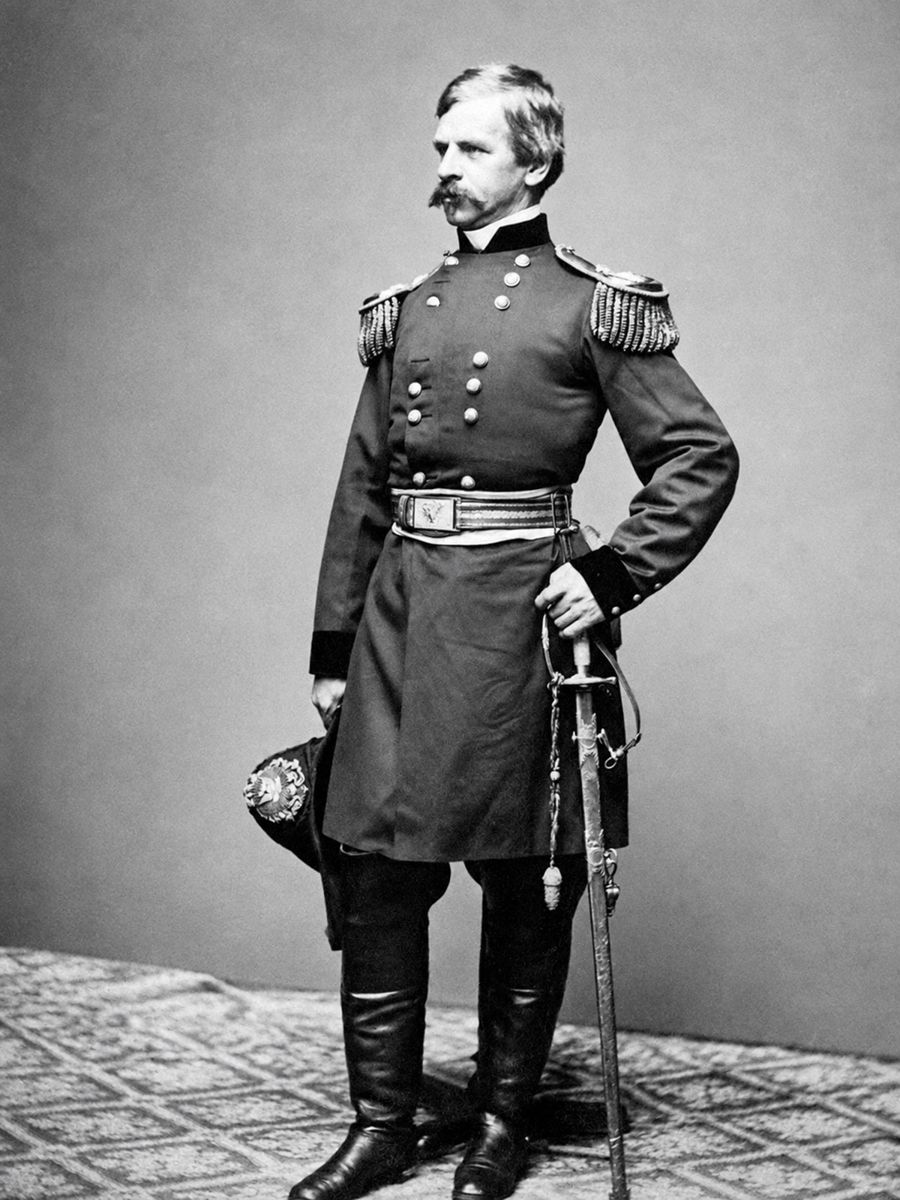
Gen. Nathaniel P. Banks, U.S.A. (Library of Congress)
Endnotes:
-
Smith, p. xiii.
-
Hess, p. 361.
-
Banks’s report is found at OR v. 15, p. 251ff.
-
OR v. 15, p. 279.
-
OR v. 15, p. 1116, April 3.
-
OR v. 26, pt. 1, p. 494, May 19.
-
OR v. 26, pt. 1, p. 503, May 25.
-
Hess, p. 361.
-
Winters, pp. 238–39.
-
On June 3 the president sent a query to Grant. “Are you in communication with General Banks? Is he coming toward you or going farther off? Is there anything to hinder his coming directly to you by water from Alexandria?” (OR v. 24, pt. 1, p. 40).
-
OR v. 15, p. 310.
-
OR v. 24, pt. 3, pp. 828, 845, 896.
-
OR v. 24, pt. 3, p. 353.
-
American Battlefield Trust webpage on Port Hudson, https://www.battlefields.org/learn/civil-war/battles/port-hudson.
-
OR v. 26, pt. 1, p. 565.
-
OR v. 26, pt. 1, p. 603.
Sources: Earl J. Hess, “Vicksburg and Port Hudson,” in The Oxford Handbook of the American Civil War, edited by Lorien Foote and Earl J. Hess, 2021; Timothy B. Smith, Early Struggles for Vicksburg: The Mississippi Central Campaign and Chickasaw Bayou, October 25–December 31, 1862, 2022; John D. Winters, The Civil War in Louisiana, 1963; Official Records, Ser. 1, Vols. 15, 24, 26; American Battlefield Trust.
Gould Hagler is a retired lobbyist living in Dunwoody, Georgia. He has been a regular contributor to CWN since 2016. He can be reached at [email protected]