
The Graphic War
The 14th New York Militia
By Salvatore Cilella · Originally published November-December 2026 · pp. 58–61
They had a long lineage and a superb battle history. They were originally formed in 1847, ostensibly to protect Brooklyn, but they were primarily “a social club composed of men of venerable lineage. The regiment gathered on weekends and evenings for recreation and to demonstrate their readiness to serve in time of need.”1 And they operated under a host of nicknames. Officially, they were designated the “14th New York Militia,” but they also answered to the “Brooklyn Phalanx,” “Brooklyn Chasseurs,” and “Chasseurs A Pied.” Officially yet again, they were the 84th New York Volunteers. Not only did they serve admirably in the Civil War, but they also honorably acquitted themselves in the SpanishAmerican War and World War I. During the Civil War, they participated in every Eastern Theater battle from First and Second Bull Run to Spotsylvania. They went in style. In 1860, amid gathering war clouds, the 14th became enamored of the uniforms of the Ellsworth Chicago Zouaves. The Fourteenth’s Board of Officers, duly impressed with Ellsworth’s sartorial splendor, adopted the French Chasseur uniform, which the regiment wore throughout the war. (Fig. 1) At First Bull Run, they impressed Stonewall Jackson so much that he gave them yet another name: “Red Legged Devils.” Colonel E. B. Fowler wrote in part in 1862: “Little did the officers of that board dream that the uniform that they then adopted would become historic, sung of in poets’ lays and transferred to the artist’s canvas as that of the ‘redlegged devils,’ the Brooklyn Fourteenth.”2 After their heroics at First Bull Run, the State of New York decided it would be a good idea to redesignate the regiment once again, this time as the 84th New York Volunteer Infantry. The rank and file thought otherwise. They appealed to General Irvin McDowell, who supposedly took up the fight with the words: “You were mustered by me into the service of the United States as part of the militia of the State of New York known as the Fourteenth. You have been Baptized by Fire under that number and as such you shall be recognized by the United States government and by no other number.”
Fig. 2. Possibly Pvt. Alonzo F. Thompson, Company C, 14th Regiment. (Library of Congress)
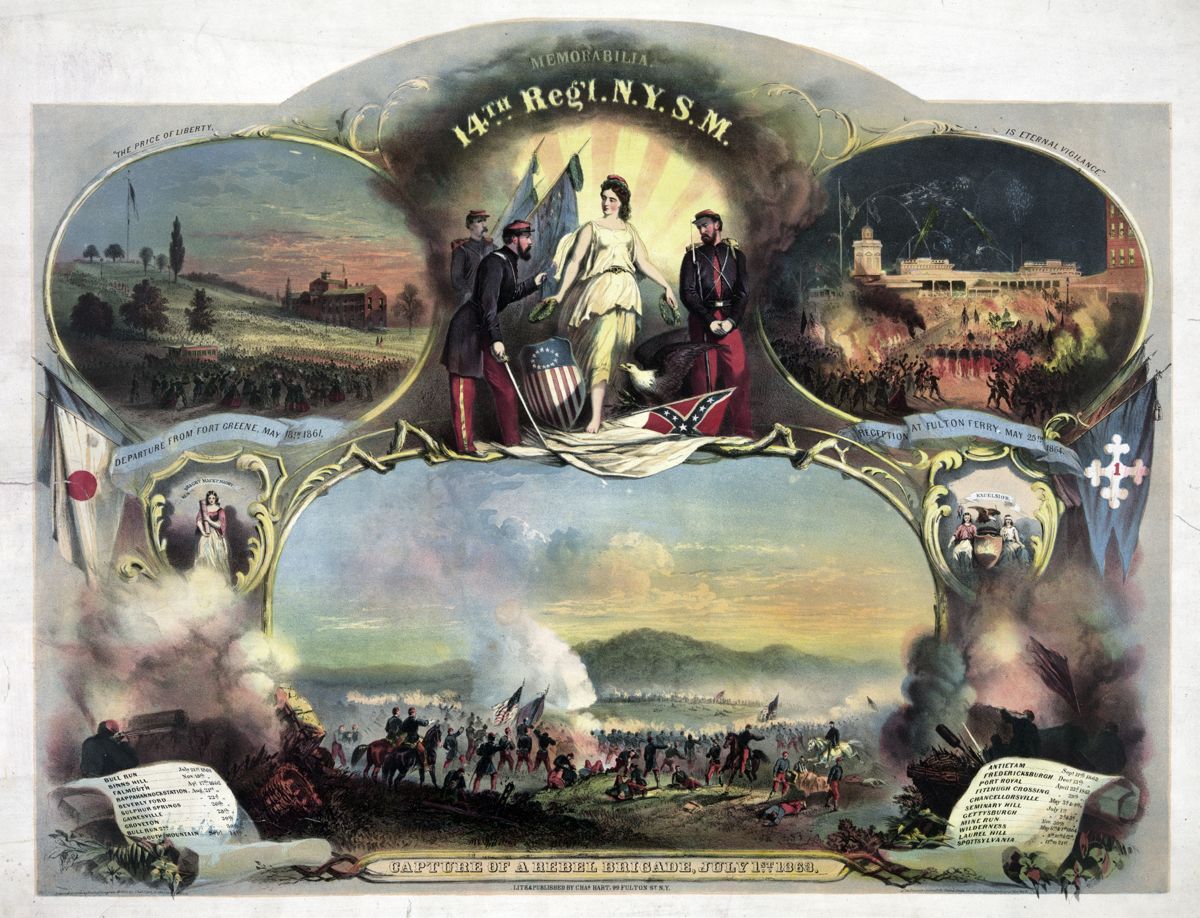
They slogged on through Second Bull Run, losing another 120 casualties on top of the 142 sustained at First Bull Run. It was attached at Antietam to the 1st Brigade, 1st Division, I Corps. It participated in the Battle of Chancellorsville and won honors at Gettysburg. It participated on all three days of the war’s most tragic confrontation. They distinguished themselves on the first day, July 1. As part of Brigadier General Lysander Cutler’s brigade, the 14th was joined by five other regiments from Indiana, New York, and Pennsylvania. They arrived on the field around 10 a.m., north and west of the town, where Brigadier John Buford had chosen to make his stand. In fierce fighting, it relieved Buford’s gallant cavalry. Buford probably saved the Union that day, and the 14th played a part. In coordination with the 6th Wisconsin of the Iron Brigade, the 14th engaged Confederate forces commanded by Major General Joe Davis of Mississippi. Cutler’s brigade straddled the Chambersburg Pike and the railroad cut, with the 14th Brooklyn, the 95th New York, and the 2nd Maine Battery on the southwest side and the 147th, 56th Pennsylvania, and 76th New York on the northeast. They were opposed by the 42nd and 2nd Mississippi and the 55th North Carolina. The Federals formed a battle line facing the railroad cut and attacked Davis with the 14th and 95th New York and the 6th Wisconsin. “All three regiments (1000 Federals) were now in line of battle facing Davis’s Brigade (1700 Confederates), which were down in the railroad cut.”3 The men of the 14th distinguished themselves by charging the Confederates hunkered down in the railroad cut, where they were trapped. The bloodshed on both sides was significant, as more than 300 rebels from Davis’s brigade surrendered. The 14th wasn’t finished, as they moved on with Cutler to participate in all three days of fighting, principally on Culp’s Hill. The 14th continued its fierce commitment to the Union cause until its term of service ended in May 1864, when it mustered out. According to Frederick Phisterer, the 84th (14th) “lost by death, killed in action, 5 officers, 83 enlisted men; of wounds received in action, 3 officers, 61 enlisted men; of disease and other causes, 74 enlisted men; total, 8 officers, 218 enlisted men; aggregate, 226; of whom 17 enlisted men died in the hands of the enemy.”4 According to The Union Army: “The total enrollment of the regiment was 1,305, of whom 153 died from wounds and 74 from other causes. Few regiments could boast such a distinguished reputation as the 84th, which served with unfailing bravery through the most severe tests of courage.”5 Two years after Gettysburg, the 14th employed New York lithographer Charles Hart, who produced a chromolithograph documenting the regiment’s Civil War achievements and history in six vivid scenes and vignettes. The largest and central depiction features the “Capture of a Rebel Brigade, July 1st, 1863.” At top left, the regiment’s departure from Fort Green on May 18, 1861, is shown. The regiment’s return is memorialized in “Reception at Fulton Ferry, May 25th, 1864.” At top center, Union soldiers present the Confederate flag to Columbia. Lists of the battles the 14th Regiment fought in appear in the bottom left and right corners. Little is known of the lithographer Charles Hart. He may have been in business for only six years, from 1862–1868. He is mentioned by print scholar Harry Peters, who devotes an entire page to Hart in his America on Stone. Hart was the brother-in-law of Charles Parsons, a well-known artist who worked for Currier and Ives, and one could only guess that Parsons influenced Hart to become an artist and lithographer. Peters found Hart’s work “amusing and interesting.” He noted that Hart “published a number of rather common shooting and hunting prints,” which he categorized as “crudely colored and drawn, (which) nevertheless express something very American.”6
Endnotes 1. Short History of the 14th Brooklyn, https://web.archive.org/web/20080828201818/http://14thbrooklyn.info/ShortRegtHistory.htm 2. Tevis, C. V.; D. R. Marquis (1911). The History of the Fighting Fourteenth: Published in Commemoration of the Fiftieth Anniversary of the Muster of the Regiment into the United States Service, May 23, 1861. New York, NY: Brooklyn Eagle Press. 3. Short History of the 14th Brooklyn; Noah Andre Trudeau, Gettysburg: A Testing of Courage, NY: Harper Collins, 2002, 174, 194-196. See also James L. McLean, Jr., Cutler’s Brigade at Gettysburg: From McPherson’s Ridge to Culp’s Hill, Savas Beattie, 2023. 4. Frederick Phisterer. New York In the War of The Rebellion, 3rd Ed., Albany: J. B. Lyon Co. 1912. Vol. IV, 2930. 5. The Union Army: A History of Military Affairs in The Loyal States, 1861-65 — Records of The Regiments in the Union Army — Cyclopedia of Battles – Memoirs of Commanders and Soldiers. Madison, WI: Federal Pub. Co., 1908. Vol. II. 6. Harry Peters, America on Stone, NY: Doubleday, 1931, 204-205.
After 43 years in the museum field, Cilella devotes his time to collecting American prints and maps and writing. He has written extensively on Emory Upton: Upton’s Regulars: A History of the 121st New York Volunteers in the Civil War (Kansas, 2009); a twovolume Correspondence of Major General Emory Upton, (Tennessee, 2017), received the 2017–2018 American Civil War Museum’s Founders Award for outstanding editing of primary source materials. He edited Upton’s love letters 1868-70 to his wife–Till Death Do Us Part (Oklahoma, 2020), and The Memoirs of Dewitt Clinton Beckwith of Upton’s Regulars (McFarland, 2023).