
Confederate Cemetery at Pewee Valley, Kentucky
By Charles H. Bogart · Originally published November-December 2026 · pp. 12–15
Located some 10 miles east of Louisville, Kentucky, is Pewee Valley, Kentucky. In 1903, the bankrupt resort Villa Ridge Inn was located there. That year it was purchased by the United Daughters of the Confederacy as a soldiers’ home for Kentucky’s Confederate soldiers and deeded to the Commonwealth of Kentucky. In 1860, Kentucky was a slave state, but she remained a Union state during the Civil War. However, with the passing of the 13th Amendment to the Constitution setting all slaves free, with no compensation for their Union owners, the Commonwealth’s sentiment shifted from pro-Union to proConfederate, and the United Daughters of the Confederacy became a major power bloc within the Commonwealth. Kentucky did not ratify the 13th Amendment until 1976. On March 27, 1902, Governor Beckham signed into law a bill establishing a Home for Needy Kentucky Confederate Veterans to be known as the Kentucky Confederate Home. Interestingly, Kentucky saw no need to provide a home for Needy Kentucky Union Veterans. For the Kentucky Confederate Home to open, the United Daughters of the Confederacy would have to deed to the Commonwealth clear title to 30 acres of land with a facility capable of housing 25 veterans and staff. Once the property was deeded to Kentucky, the Commonwealth would provide $125 a year for each Confederate veteran housed up to a maximum of $10,000 per year. A Confederate veteran to be cared for at the Kentucky Confederate Home had to be from Kentucky and to have been honorably discharged or paroled from the Confederate Army or Navy. After much debate and a very slim vote margin, Villa Ridge Inn, built in 1890 at Pewee Valley, was chosen as the location of the Kentucky Confederate Home. The building contained 72 guest rooms that could house some 200 men. In 1904, the Commonwealth took title to the grounds and buildings from the United Daughters of the Confederacy and began to finance the home. The Kentucky Confederate Home flourished from 1904 until 1920, when the main building caught fire and burned to the ground. No lives were lost in the fire, and the remaining Confederate pensioners were housed in the property’s surviving auxiliary buildings.
The pot-metal Confederate memorial placed by Biscoe Hindman.
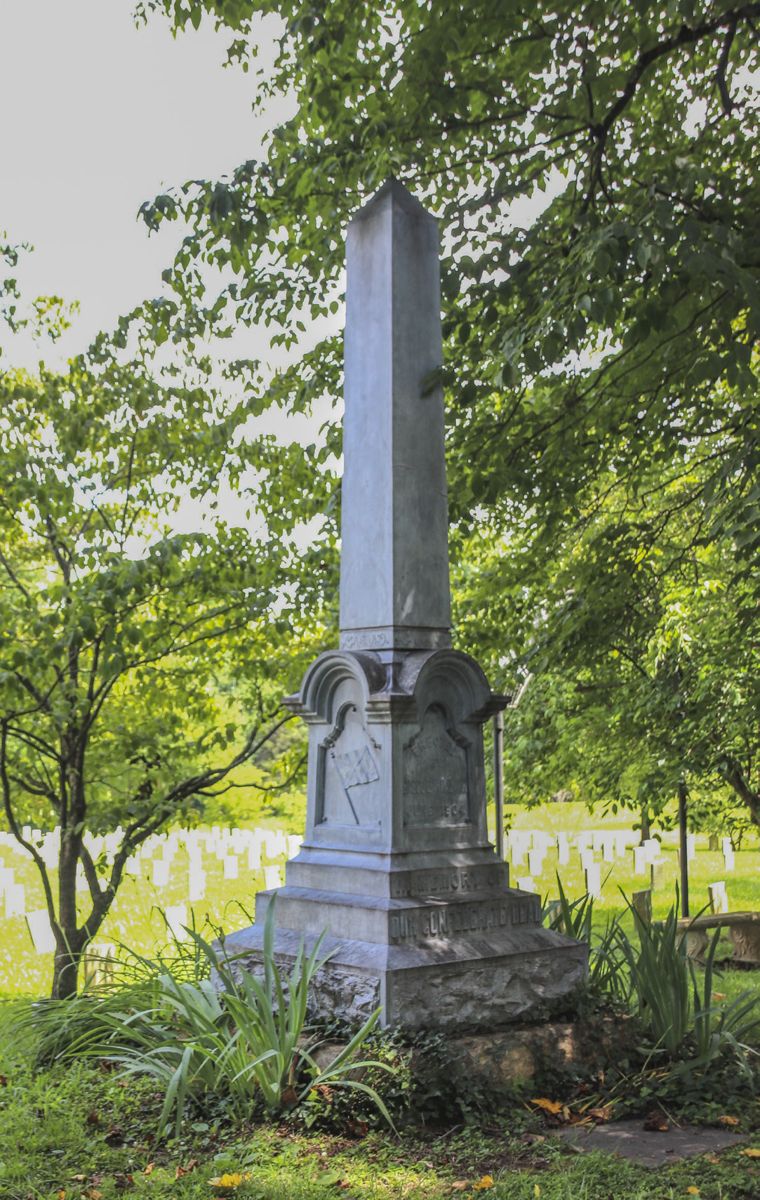
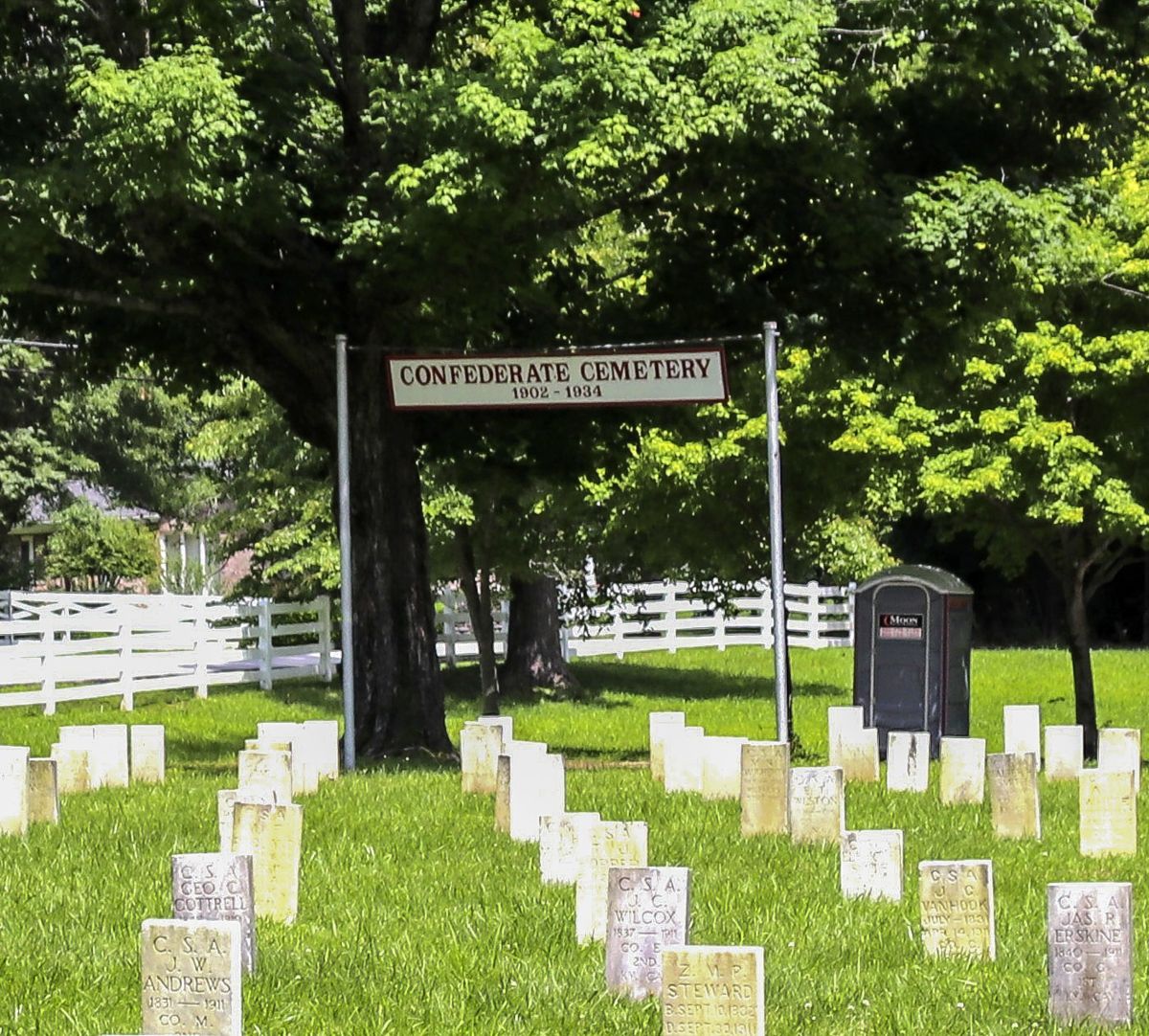
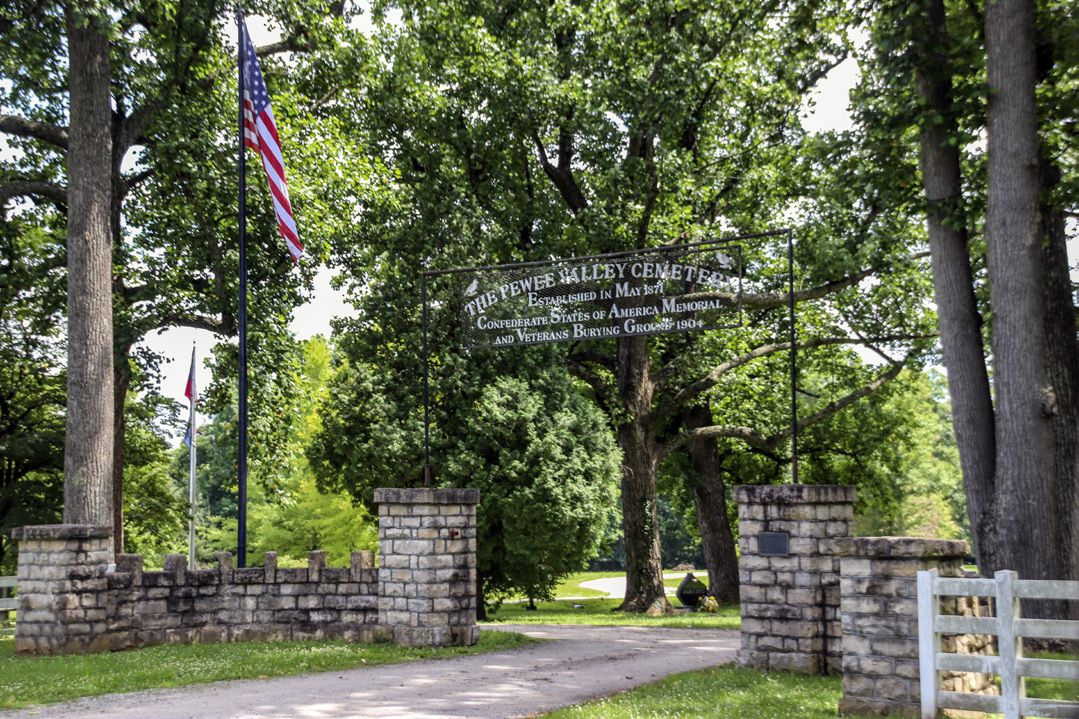
In 1934, the Kentucky Confederate Home was closed by the Commonwealth and its few remaining residents moved to the Pewee Valley Sanatorium. With the Kentucky Confederate Home housing needy Kentucky Confederate veterans, it was obvious that over time these veterans would die and there would be a need to bury them. In 1871, the city of Pewee Valley established the Pewee Valley Cemetery on the south side of town, at the end of Maple Street, for local burials. The cemetery, located one mile from the Kentucky Confederate Home, consisted of two sections, a colored plot on the west side and the remainder of the cemetery for use by the local whites. The cemetery consisted of 14.25 acres. In 1904, the Pewee Valley Cemetery deeded 11,275 square feet of the cemetery to the Kentucky Confederate Home. This deeded plot lay just to the west of the Colored grave plot. Over time, a total of 313 Confederate veterans would be buried within the Kentucky Confederate Home section. Each gravesite in the Confederate section is marked by a small gravestone that provides the soldier’s name, rank, and unit. Numerous Confederates resting in the cemetery did not serve in Kentucky units but called Kentucky home. The entrance to the Pewee Valley Cemetery is under a metal arch that bears the inscription “The Peewee Valley Cemetery established in May 1871 – Confederate States of America Memorial and Confederate Burying Ground 1904.” The Confederate Cemetery is to the immediate left of the entrance, and it is fronted by a flagpole that flies the Commonwealth of Kentucky flag and the Confederate National Stars and Bars flag. At the entrance to Maple Street from Kentucky Highway 146 is a Kentucky historical marker concerning the Confederate Cemetery. To the flagpole’s immediate left is a plaque erected by the United Daughters of the Confederacy that reads: “In this plot are buried 313 Confederate soldiers who were residents of the Kentucky Confederate Home. The home was purchased by the Southern people of the state furnished by the United Daughters of the Confederacy and turned over to the state in 1902. The Commonwealth of Kentucky maintained the home until 1934. The United Daughters of the Confederacy are the guardians of this hallowed site.” Then, to the immediate left of the United Daughters of the Confederacy plaque, is a six-foot-tall monument that bears the inscription: “Erected by Biscoe Hindman June 1904 – In Memory of our Confederate Dead.” This impressive memorial obelisk is not made out of stone but instead is made of pot metal. It is thought to be the only Confederate zinc obelisk memorial in existence. It was commissioned by Colonel Biscoe Hindman, a member of General John Hunt Morgan’s command. His daughter was an active member of the United Daughters of the Confederacy and a major player in seeking to build the Kentucky Confederate Home. At the opposite end of the Confederate cemetery from the flagpole is a metal banner suspended between two poles which reads: “Confederate Cemetery 1902–1934.” Nearby is a visitor log. The cemetery is well cared for, and yearly the Sons of the Confederacy and the United Daughters of the Confederacy hold memorial services at the cemetery. There are today four federal Civil War cemeteries within Kentucky that are operated by the United States Veterans Administration: Camp Nelson, Mill Springs, Lebanon, and Zachary Taylor, located in Louisville. In 2025, the Commonwealth of Kentucky operates five veterans’ cemeteries and one veteran nursing home.
Charles H. Bogart has a BA from Thomas More University and an MCP from Ohio State University. He is employed as a tour guide at the Fort Boone Civil War Battle Site in Frankfort, Ky., Past-President of the Frankfort Civil War Roundtable, and is a board member of the Kentucky Civil War Roundtable. He has written several books and articles on military and naval history.