
The Graphic War The Connecticut Plan
By Salvatore Cilella · Originally published May-June 2026 · pp. 48–51
The lithographic firm of Currier and Ives was not known for its political cartoons. Rather, it chose to document the battles and leaders of the Civil War with an occasional, on-the-spot reporting of a major fire or marine disaster. Politically, it originally opposed the Lincoln administration but fell into line as an administration supporter after First Manassas. The “Connecticut Plan” is a rare example of the firm lampooning one of the leaders of the Union effort and Lincoln cabinet member, Gedeon Welles. The “Connecticut Plan,” refers to Welles’ native state. Currier’s cartoon ridicules the Federal attempt to stop privateers and blockade runners with outdated ships and small cruisers able to intercept them. It also mocks Welles and his ignorance of all things naval. Lincoln called him “Neptune” and occasionally chided him. On one occasion, Lincoln was going down the Potomac and pointed out a sail craft, calling it a ship. He was corrected and told it was a three-masted schooner. “The President laughed at his mistake and added that, being only a prairie lawyer, he had learned” of all things naval since becoming president. “‘But’ he added ‘when I came here, I knew the stern of a vessel from her bow, and that’s more, I reckon, than Mr. Welles did’.”1 In the print, two wooden washtubs representing two federal ships, the Cambridge and the Gemsbok “threaten” the sleek Confederate ship, the Nashville. All three started out life as a different vessel. The Nashville, originally a U.S. Mail Service ship, ran routine routes from 1853, when it was commissioned, until 1861, between New York City and Charleston, S.C. She was captured after Fort Sumter fell, and the Confederate administration fitted her out as a cruiser. “During the Battle of Fort Sumter, the USMS Nashville sailed into Charleston without flying the U.S. national standard and was fired upon by the USRC
The Graphic War The Connecticut Plan The Graphic War highlights prints and printmakers from the Civil War discussing their meaning and the printmaker or artist’s goals.
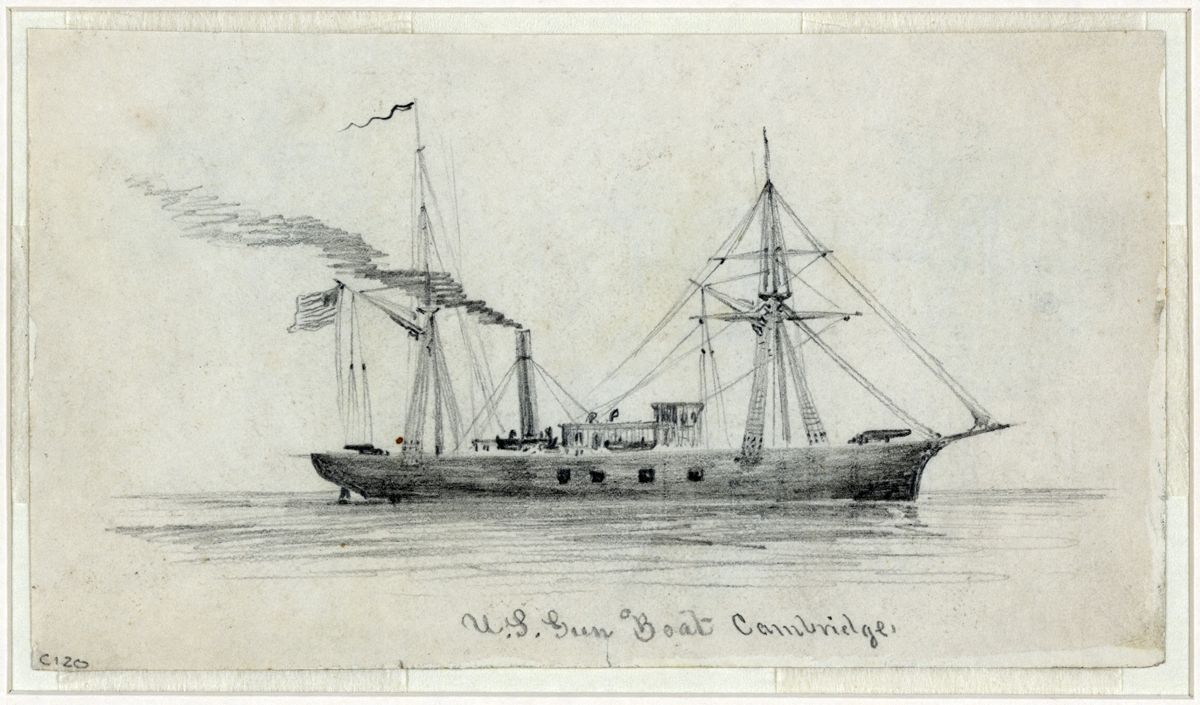
Harriet Lane, which marked the first shot of the naval war in the Civil War. The Nashville raised the American flag, and after the surrender of Sumter, the Nashville docked at Charleston.” The Nashville became the “first ship of war to fly the Confederate flag in English waters. On November 19, 1861, near the British Isles, she boarded and burned an American merchant ship, the Harvey Birch, the first such action by a Confederate commerce raider in the North Atlantic during the war.” “Upon her return to Charleston, she was sold to be used as a blockade runner and renamed. She was re-commissioned as a privateer and met her fate when the USS Montauk destroyed her February 8, 1863.”2 The USS Cambridge started out as a steamship, and then, when war came, outfitted as a gunboat. She was commissioned in August 1861 and did duty assigned to the North Atlantic Blockading Squadron and South Blockading Squadron for the entire war. Decommissioned June 1865, she was sold at Philadelphia.3 The Gemsbok was the lesser of the three. Unlike most ships, she was given an unconventional name. According to the Oxford English Dictionary, a “gemsbok,” is “a large antelope that has a gray coat, distinctive black and white markings, and long straight horns, native to southwestern and East Africa.” Its relation to naval operations is enigmatic, to say the least. In modern baseball terms, the Gemsbok might be called an all-purpose “utility outfielder.” She was built as a bark and commissioned in August 1861 at the Boston Navy Yard as a gunboat. Later, she was used as a collier and a storeship.4 Like the Cambridge, she was assigned to the South Atlantic Blockading Squadron off Wilmington, N.C. As both ships fire their miniature cannon at the Nashville, sailors on all three vessels shoot off their mouths at each other. The print depicts three vignettes—one on the left records the comments of the Cambridge as they boil water
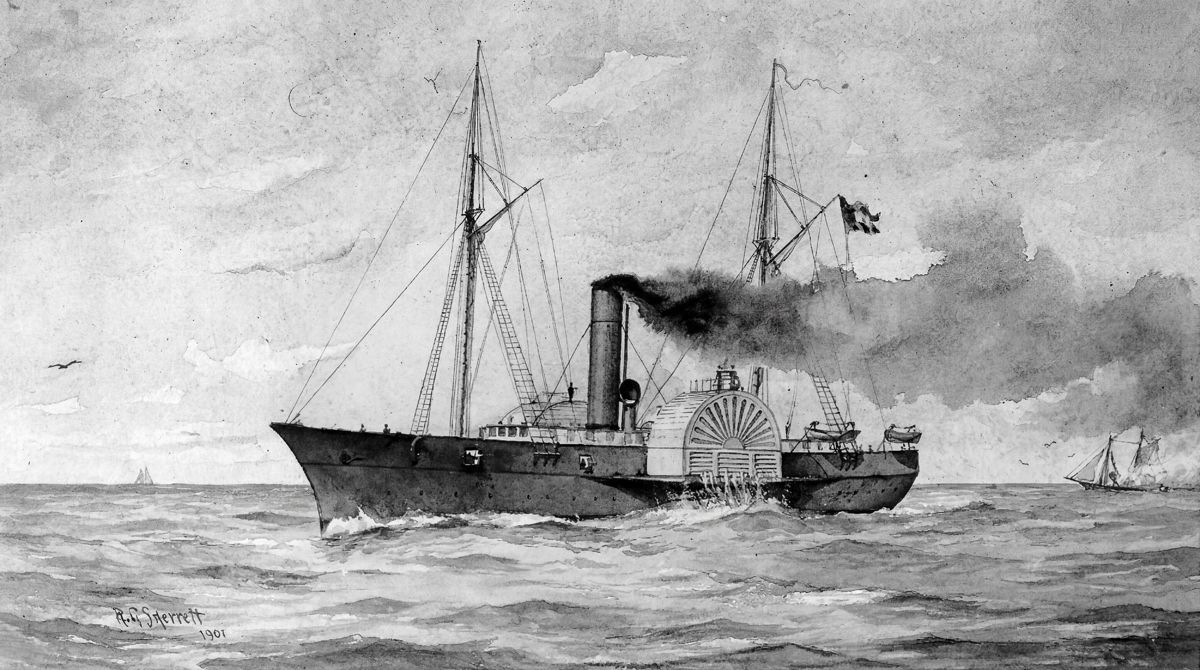
USS Cambridge. (Library of Congress)
using an oversized tea kettle. Its captain yells out to the Nashville: “Ship ahoy! Heave to and surrender!! Don’t you see that the Department have bought and fitted up this magnificent vessel on purpose to catch you?” The Rebel ship responds: “I don’t see it! Nary a catch!!” as another thumbs his nose. The sailor on the far left on board the Cambridge says: “The only way to capture that Ship is to get Morgan to buy her.” According to collection notes on this print in the Library of Congress, “The sailor is most likely talking about Junius Spencer Morgan, a wealthy banker and supporter of the Union effort.” J.S. was the father of John Pierpont (JP) Morgan, and during the war, established financial ties with British financial houses, eventually becoming the largest American bank in London. The captain of the Gemsbok, also calls out to the Nashville: “If you don’t stop, we have instructions to come to anchor, and write the Secretary for further orders.” The Rebels reply: “Give our compliments to the Secretary, and tell him, he shall certainly hear from us by every Northern vessel that we meet.” The last exchange ensues between crewmates on the Gemsbok: “Well Shipmate we’ve done our duty; We were put in this old tub to Watch, and we have Watched. Shiver my timbers my hearty! but it would have been a darned sight better to have put us in a decent Ship and sent us here to catch.” Like the others, the Gemsbok was discarded after the war. She was decommissioned, re-commissioned and finally decommissioned in New York on July 11, 1865, and sold at auction. Welles remained Secretary of the Navy until he retired in 1869. Although he originally opposed a blockade, he expanded the navy during his tenure and in enforcing the blockade, contributed to the Union’s success. Endnotes 1. 2. 3. 4.

Obituary, Hon. Gideon Welles, The New York Times, February 12, 1878. The Nashville, https://en.wikipedia.org/wiki/CSS_Nashville_ (1853) USS Cambridge, https://en.wikipedia.org/wiki/USS_Cambridge_ (1860) A bark or barque is a sailing ship, typically with three masts, in which the foremast and mainmast are square rigged, and the mizzenmast is rigged fore and aft. A gunboat is a small fast ship used in shallow coastal waters and rivers. A collier is a coal carrying ship and stores ships are ships used to deliver supplies— provisions and fuel—to combat ships on extended deployments.
After 43 years in the museum field, Cilella devotes his time to collecting A merican prints and maps and writing. He has written extensively on Emory Upton:
Upton’s Regulars: A History of the 121st New York Volunteers in the Civil War (Kansas, 2009); a twovolume Correspondence of Major General Emory Upton, (Tennessee, 2017), received the 2017–2018 American Civil War Museum’s Founders Award for outstanding editing of primary source materials. He edited Upton’s love letters 1868-70 to his wife–Till Death Do Us Part (Oklahoma, 2020), and The Memoirs of Dewitt Clinton Beckwith of Upton’s Regulars (McFarland, 2023).