
Spared & Shared
By William Griffing · Originally published May-June 2026 · pp. 41–42
At one time I thought I would give up and be taken prisoner. Then I thought I might get hit before I could get out of the woods on their side so I risked the getting out on our side. The balls was cutting up the dirt about me and men falling all around me. The Rebs came out of the woods but was soon drove back by troops that was in line behind us. The fighting was kept up until dark, neither side gaining any ground that night. The wounded was carried off that night. Next morning our artillery shelled the woods but by some means the Rebs out-flanked us and Monday night we was compelled to fall back and recross the river at Banks Ford. We all got over safe at daylight on Tuesday morning. On Sunday, May 31st, we took part in two hard fought battles and marched some 5 or 6 miles.
On Tuesday it began to rain and rained for three days. On Friday, May 8th we took the line of march for our old camp at this place. We arrived here the same day at 5 o’clock, all very tired. But since we have been back, we have not had much to do so now we are pretty well rested. The weather has been very warm since we came back. Some think that the late battles have been a great disaster to our army. I don’t think so. Although it did not accomplish all that was expected it to do, it done well. Men that fought us on Sunday came from Suffolk and other places south. They brought all their forces from Richmond and other points. I think the Rebs loss much greater than ours. They lost some valuable officers. Stonewall Jackson is one of that number. There is no signs of a movement at this time. The loss in our regiment will number about 140. One third of that number, I think, is prisoners and the rest wounded and killed. They can’t account for more than 10 or 12 that was killed. I don’t think the killed will over reach that number. I had a letter from [brother] Cyrus a few days ago—all well. I must close with love to all and hope to hear from you soon. I still remain as ever your affectionate soldier brother, —Josiah Shick. N. B. Remember me to all at home. W. Epehimer came through the fight safe. His regiment lost 160 in all counting wounded and prisoners. Endnotes 1.
The 6th Corps was kept out of view as they started toward Franklin’s Crossing late Tuesday, 28 April. After dark, the men and pontoons were moved to the river from the cover of the woods 1000 yards back. Once at the river, the soldiers lay on their arms and waited. It was after 4 a.m. before 1200 men of the 95th and 119th Pennsylvania were loaded into the pontoon boats and rowed across the river. There were 45 men plus officers transported in each boat. It took only a matter of minutes for the men to scramble up the bank and into the rebel rifle pits once they landed. [Chancellorsville 1863, The Souls of the Brave, page 98, by Ernest B. Ferguson] It was the 119th and 95th Pennsylvania that were detached from the Brigade and hurried onward to overtake the retreating Rebels from Fredericksburg on the Orange Plank Road. It was near Salem
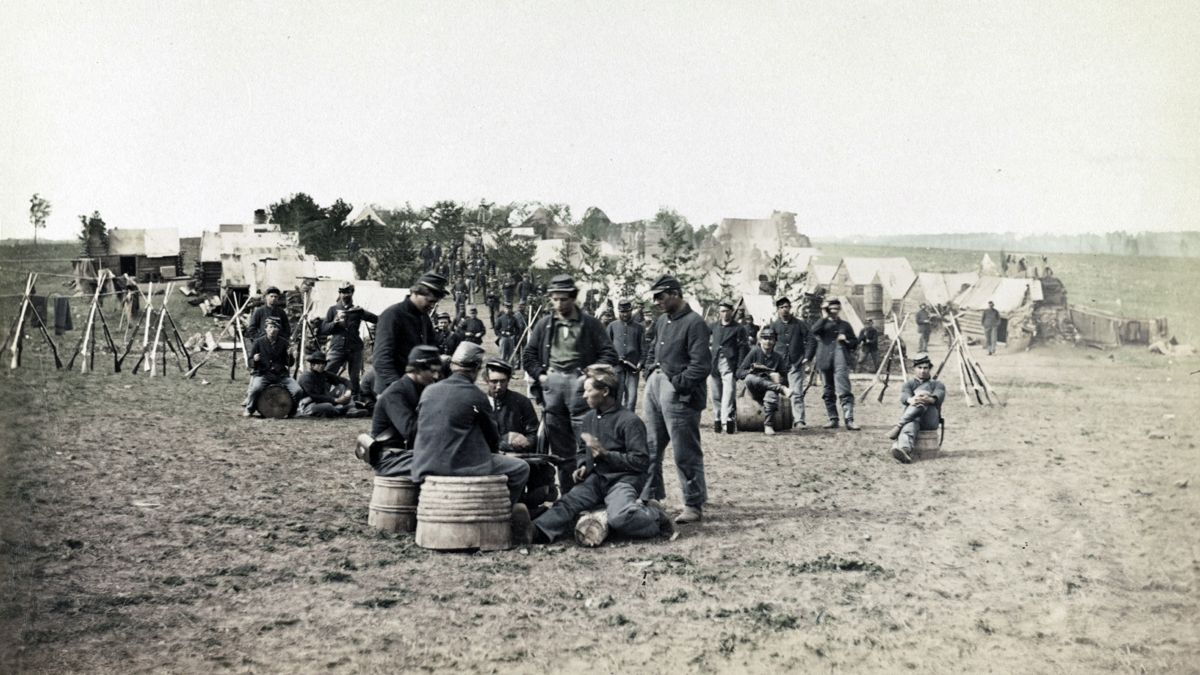
Brooks’s division photographed by Andrew J. Russell on the morning of May 3. Brooks’s men are near the pontoon crossing; the Rappahannock River is in the background near the houses on the horizon. Later in the day, some of these soldiers may have been killed or wounded at Salem Heights.
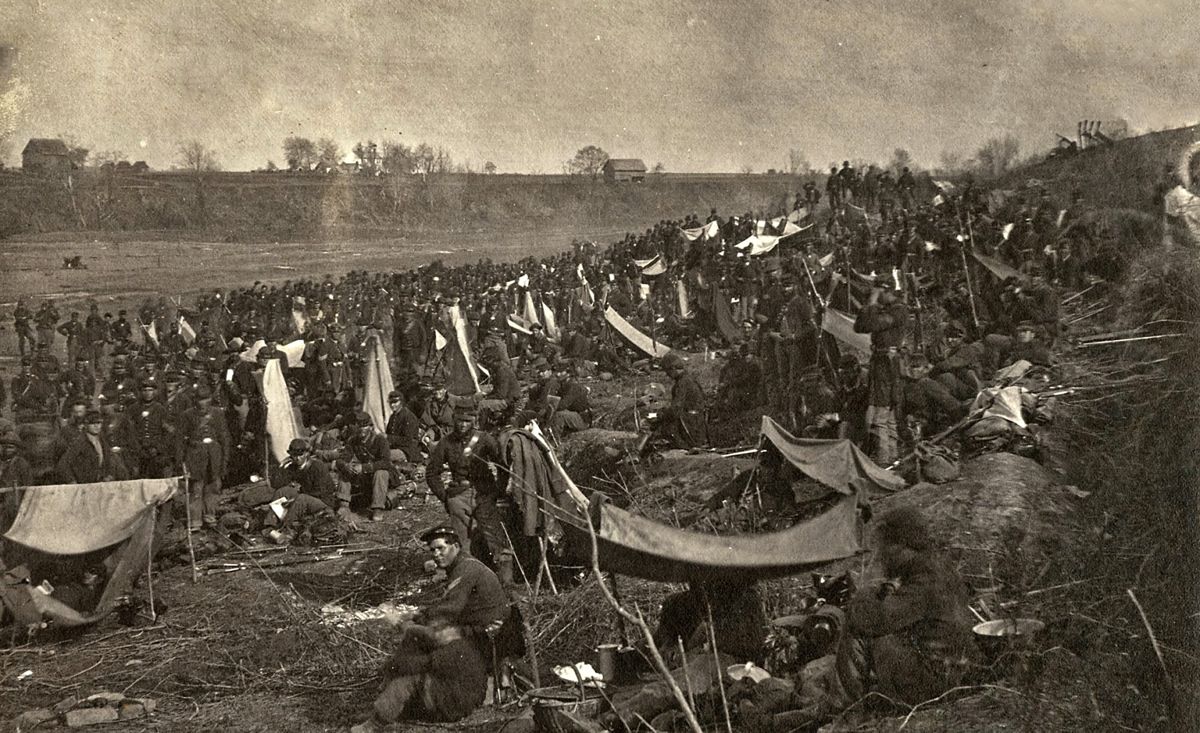
Church that they encountered Cadmus Wilcox’s 5 brigades of Alabamians and Georgians in force, posted in a woods, hidden from view. The Pennsylvanians were aligned in battle formation to the left of the road and with other troops, placed under the immediate command of General Sedgwick. The advance of Federals up the gradual slope to the red brick church was ordered about 5 p.m. They were quickly overwhelmed by a superior force, twice their number, and fell back with heavy losses, Union artillery firing over their heads as they retreated. [Ibid, page 278]
William J. Griffing has worked at the Department of Labor and the Department of Energy, and later as the ES&H Director at the National Renewable Energy Laboratory and Fermi National Accelerator Laboratory. Since his retirement in 2010, he has focused on preserving American history, mainly Civil War letters and diaries that remain unpublished in private collections. His transcribed Civil War soldier and sailor letters are found at: https://tinyurl.com/sparedshared. Updates on newly transcribed letters are available at: facebook.com/Griff.CWLetters. In 2024, he coedited a book titled A Great and Good Man with Jonathan A. White, which includes rare first-hand accounts of Abraham Lincoln, drawn primarily from about 15,000 letters he has transcribed since retiring.