
An Officer and His Sketchbook
Originally published May-June 2026 · pp. 8–11
Growing up in Scotland in the 1820s, young Jimmy could never have imagined that he would one day cross the Atlantic and play a meaningful role in suppressing a rebellion during America’s Civil War. The idea that he would become a Union officer fighting in a foreign land was beyond anything he could have foreseen. Yet a series of unexpected events carried the young Scot to America. In the end, however, leading men on the battlefield would not prove to be his greatest contribution. Today, visitors to Antietam Battlefield leave with admiration not only for his patriotism, but also for the artistic genius of Scottish-born Captain James Hope. Tragedy followed Hope early in life. Disease claimed the life of his mother shortly after his first birthday. After spending the first nine years of his life in Scotland, his father gathered their belongings and left the country for good in 1827. Boarding a sailing ship, they crossed the Atlantic to begin a new life in Canada. Five years later, in 1833, misfortune struck again. At just 13 years old, James watched his father buried after a cholera epidemic swept through Canada. Suddenly orphaned, the boy faced life alone in a foreign country, far from the Scottish Highlands. A good friend of his father, remembered only as Bruce, cared for Jimmy. By the age of 15, however, the teenager realized he would eventually have to make his own way in the world. Bruce suggested that he visit a wagon maker in Vermont who owed Jimmy’s father repayment for an earlier kindness. Determined, as he later put it, to “earn and learn,” the steadfast young man traveled 150 miles to Fairhaven, Vt., where he sought a five-year apprenticeship as a wheelwright. He was hired on the spot. Once again, a new life had begun for James Hope. Another twist of fate soon altered his course dramatically. A few years into the apprenticeship, while chopping firewood, Hope swung an ax that missed its mark and crashed into his ankle. The accident required a long recovery and threatened to derail his training. Yet adversity opened another door. Idle and confined during his recuperation, the apprentice wheelwright decided on a whim to try painting. With time on his hands, James picked up a plank of wood and a can of paint and began to experiment. With every stroke of the brush, a remarkable talent emerged. What began as a pastime quickly revealed a gift. Beauty spread across the rough wooden surface, and those who saw the result urged him to pursue this newly discovered ability. After so much hardship, yet another career change was in the making, one that would ultimately carry him to prominence in the art world and lead to some of the finest Civil War paintings ever produced. Hope had saved money during his years as a wheelwright, and in 1839 he enrolled in painting classes at Castleton Seminary in nearby Vermont. Before long, he was teaching painting in nearby Rutland, where he met and married his wife, Julia. During the mid-1840s, the aspiring artist taught art and painted portraits that drew praise from local admirers and patrons. As commissions increased, so did his income. Rutland, however, offered only limited opportunity for an ambitious portrait painter. In 1848, Hope opened a studio in Montreal, where wealthy clients paid well for his work. With portrait commissions bringing as much as $100 each, the Hope family prospered. Financially successful though he was, the demands of operating the studio took a toll on family life. By this time, the family included three children. James eventually gathered his earnings and returned home. The family settled in Castleton, Vt., where in 1851 Hope built a house large enough to accommodate his growing household. Today, that Gothic-style home is occupied by campus security at what is now Castleton University. Though he continued painting, he served fewer portrait clients and supplemented his income by teaching art at Castleton Seminary. A decade after enrolling there as a student, he had become a teacher, sharing his love of art with others. Portraiture had given Hope financial security and shaped his early career, but his true love of landscape painting could no longer be denied. He loved nature and longed to capture the beautiful scenery of Vermont. This was not so much a career change as a creative evolution, yet it lifted him to another level as an artist. His scenes of waterfalls, brooks, and mountains drew enthusiastic praise and established his reputation even more firmly. Then came the Civil War. Hope loved America and wrestled with the question of whether he should fight for his adopted country. The discussions around the kitchen table with Julia must have been many and no doubt intense. After all, James Hope was no longer a young man, and he now had four children. Still, patriotism ran deep in the Scotsman who had come to see himself as an American. In the end, loyalty to country prevailed. At the age of 43, James Hope enlisted in the Union Army. A respected citizen of Castleton, Hope helped raise a company of men for service in the 2nd Vermont Infantry. His election as captain of Company B was never seriously in doubt. On June 20, 1861, Captain Hope led his men on the march to the train depot, where they boarded cars bound for Washington. Townspeople lined the streets to cheer on the departing soldiers as they passed. Julia wisely advised James to take along his sketchbook. Portraits would have to wait. While serving with the Army of the Potomac, his artistic instinct combined with his love of landscape to produce compelling views of the fields, farms, camps, and battle scenes that defined the war in the East. Hope’s remarkable skill allowed him to merge army life with scenery, creating panoramic visions of bivouacs and combat. He sketched scenes that would later become paintings still admired today.
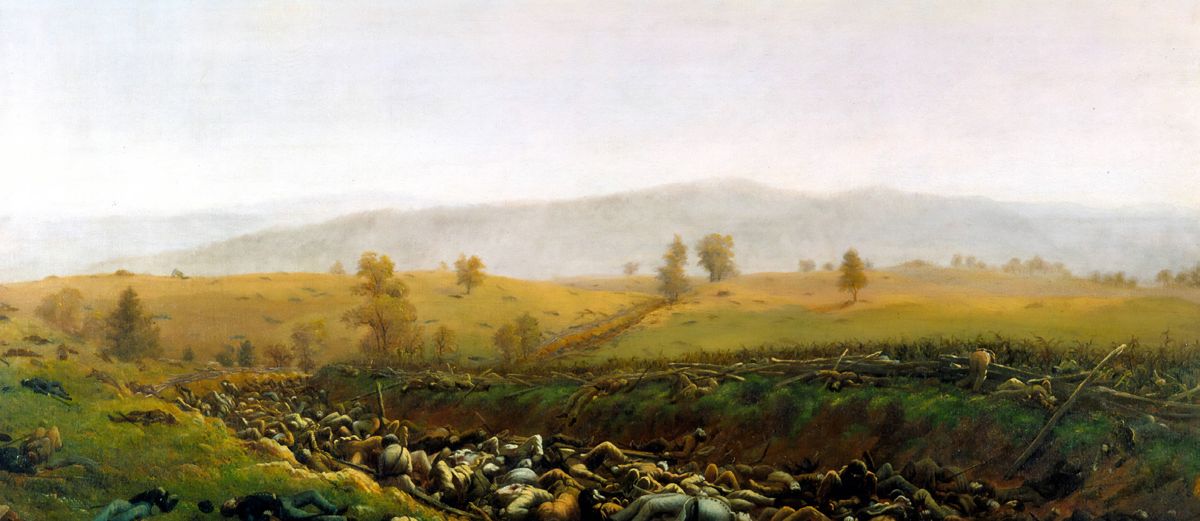
The Aftermath at Bloody Lane, by Captain James Hope. At the end of the day looking east across Bloody Lane. The center of Lee’s defensive line—an 800-yard-long sunken road later called Bloody Lane—as it appeared following the midday battle. By 1 p.m., some 5,000 killed and wounded troops of both sides lay along this farm road. (NPS)
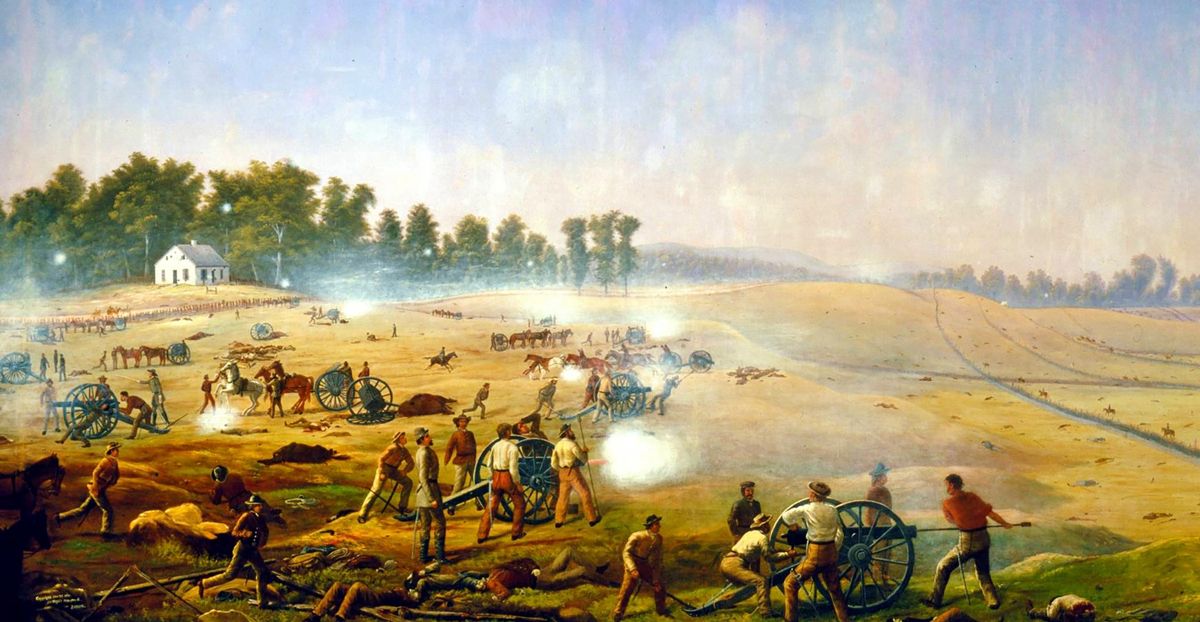
One of his earliest Civil War works, 1st Bull Run, featured his own 2nd Vermont on the skirmish line at the first major battle of the war. He likely drew the scene from memory soon after the engagement before later transferring it to canvas. Another painting, Shadow of a Great Tree in a Weary Land, depicted General Henry Slocum conferring with his staff along the Chickahominy during the Peninsula Campaign of 1862. Soon after the war, Hope completed The Army of the Potomac, which was said to have been “highly praised by all veterans,” including General George B. McClellan. The 2nd Vermont fought in numerous battles, including Antietam. Hope’s sketches from that bloody September day in 1862 remained tucked away for years while life and work intervened. Yet he never forgot them. In time, he would return to those battlefield drawings and transform them into the vast paintings now familiar to generations of visitors to the Antietam Visitor Center. Hope resigned his commission in 1863 because of illness, likely contracted during service in the unhealthy swamps along the Chickahominy in Virginia the year before. His officer’s sword gave way once more to the brush of a fulltime artist. After the war, life resumed for James and Julia, and his artistic career flourished. Critics praised his work, and in his New York studio he sold paintings and portraits that secured his family’s financial future. Yet, he missed Julia and the children while spending so much time away in the city. In 1872, businessman P.W. Wolfe offered Hope the substantial sum of $10,000 to paint Rainbow Falls in Watkins Glen, N.Y., an opportunity too great to ignore. He packed up the family and moved permanently to the scenic gorge, where he built a home and studio. Hope fell in love with the dramatic landscape, and the family was once again together full time. His paintings of the Glen sold well, adding to both his income and reputation. Then, in 1887, Hope finally returned to the idea that had been simmering in his mind for years. For more than two decades, the Antietam sketches had gathered dust. Now, with both financial means and artistic stature, he could devote himself to the ambitious project of bringing them fully to life. Portraits and landscapes were set aside. For the next four years, Hope focused intensely on Antietam. His plan was bold. He intended to paint five massive scenes of the battlefield, each roughly five feet by twelve feet and weighing around 200 pounds. It was a monumental undertaking, one that demanded all his skill and energy. These five great Antietam paintings would bring Hope a new level of admiration and ensure his lasting place in Civil War memory. Many who admire the murals at Antietam today know the paintings well, even if they do not immediately recognize the artist’s name. That has slowly begun to change. Before beginning in earnest, Hope knew he needed to revisit the battlefield itself. It had been twenty-five years since Captain Hope had stood there sketching the scenes of battle, and memory alone was no longer enough. Once more his work would blend landscape and war. Saying goodbye to Julia, the old soldier boarded a train in Watkins Glen and traveled south to Hagerstown. From there, after a wagon ride to Sharpsburg, he reached the field of the bloodiest single day in American history. Much had changed. Buildings had disappeared, new barns had gone up, and the landscape initially seemed unfamiliar. Then something caught his eye: a bluff on a nearby farm. When the farmer working there noticed Hope’s interest and asked about it, Hope explained his purpose. The farmer led him to the crest for a better view. Once there, a rush of memory swept over him. He had found the very place where he had made his wartime sketches. Standing on the old Pry property, where McClellan had established his headquarters, Hope suddenly saw the battlefield as he had seen it in 1862. To his left stood the Dunker Church. Ahead stretched the Cornfield. Slightly to the right lay the Sunken Road, later forever known as Bloody Lane. Now the landscape was peaceful, but in his mind the quiet farms and fields were once again filled with the roar of artillery and musket fire. For the next four years, Hope labored in his studio on the colossal canvases that would become his most celebrated Civil War works. Even as he worked, visitors continued to pay admission to his studio to see his paintings of Watkins Glen, and many left having purchased images of the gorge. Yet Hope had fixed his sights on something bigger: the great 1892 reunion of veterans in Washington, D.C., where he hoped to unveil the Antietam paintings before a national audience.
Everything was prepared. Hope carefully packed the canvases for transport, and a special railcar, paid for at his expense, carried them to Washington. There, a large rented tent on the reunion grounds housed the murals. Veterans crowded inside to study them, and Antietam veterans in particular examined every detail. Sadly, Hope was unable to enjoy the praise. On the first day he became weak and fatigued. For the remaining days of the gathering, the celebrated artist lay in a hospital tent while admiration for his work poured in without him. After returning home to Watkins Glen, his condition worsened. It is believed he contracted the illness while in Washington. Julia urged him to rest, but recovery did not come. On October 17, James Hope died just shy of his seventy-fourth birthday. Julia lived another fourteen years, continuing to operate the gallery and souvenir shop, which eventually moved from within the Glen to the entrance of the gorge. Hope’s descendants continued the business well into the 20th century. Then disaster struck again. In 1935, a flood devastated Watkins Glen, and many of Hope’s paintings suffered serious water damage, including the Antietam murals. The murals were later acquired by a private collector who planned to restore them for a museum that never came to fruition. For the next forty-nine years, the paintings remained neglected in a deteriorating church until the National Park Service intervened in 1979. The work required to save them was extensive. The massive paintings had to be carefully removed from the walls before conservation could begin. Once they were secured, the National Park Service arranged for their restoration, ensuring that they would survive for future generations. Today, the Hope paintings can be seen at the Antietam National Battlefield Visitor Center. Because of their great size, the murals are displayed on a rotating basis, one at a time. Anyone visiting Antietam should make a point to see them. Fate carried a young boy far from Scotland and placed him in the service of a nation torn by civil war. In doing so, it gave America not only a devoted soldier, but also an artist of extraordinary vision. James Hope left behind more than patriotic service. He left a visual record of war and landscape unlike any other. For that, Captain James Hope deserves lasting remembrance. The National Park Service also deserves thanks for rescuing these splendid works before they were lost forever. Until the National Park Service stepped in during 1979, few people had heard of James Hope. Today, his magnificent murals and his name endure, and they will continue to do so for generations to come.
Joseph F. Wilson writes and lectures on various Civil War topics. He is the author of the book Captivating Tales of the Civil War, currently available on Amazon. Contact: [email protected].