
The Graphic War
By Salvatore Cilella · Originally published July-August 2026 · pp. 54–57
The Graphic War Fannie Palmer, Artist The Graphic War highlights prints and printmakers from the Civil War discussing their meaning and the printmaker or artist’s goals.
During the Victorian period in America, a woman’s place was in the home. The Civil War changed all that. With the man of the house off to war, much of the work, particularly in rural areas, which was most of the country, women were thrust into a new role. By default, they became the bread winners and managers of small ecosystems traditionally held by men. At the time, the art world, also dominated by men, thrived in large urban areas. According to Palmer scholar, Charlotte Rubenstein, “beginning in the early nineteenth century, a small group of women, often trained in family workshops, began to enter the fields of engraving, etching and lithography.”1 Their entre into the art world via drawing and painting lent respectability and credibility to their lives. Until Frances Flora (Bond) Palmer, arrived on the lithographic printing scene, the industry was predominantly male-oriented. Major printing houses in New York, Boston, and Philadelphia are bastions of male domination. Fortunately, Frances came from an upper-class English family, which enabled her to have access to teachers who were artistically gifted. Married at twenty and in the printing business with her father, she and her family immigrated to New York City. There, she impressed Nathaniel Currier, who hired “Fanny” in 1851. From then on until her death in 1876 from tuberculosis, she produced at least 200 views and landscapes for Currier and Ives. Her talent was not in portraiture but in vistas of idyllic settings. “Her compositions are characterized by a feeling for deep space, panoramic views, dramatic lighting and sensitive atmospheric effects.”2 As a result, Nathaniel Currier reportedly lent his carriage to the artist for trips into the country “to make firsthand pencil sketches of rural details that could be incorporated into prints.”3
Frances Flora Bond Palmer, referred to as Fanny Palmer. (Public Domain)
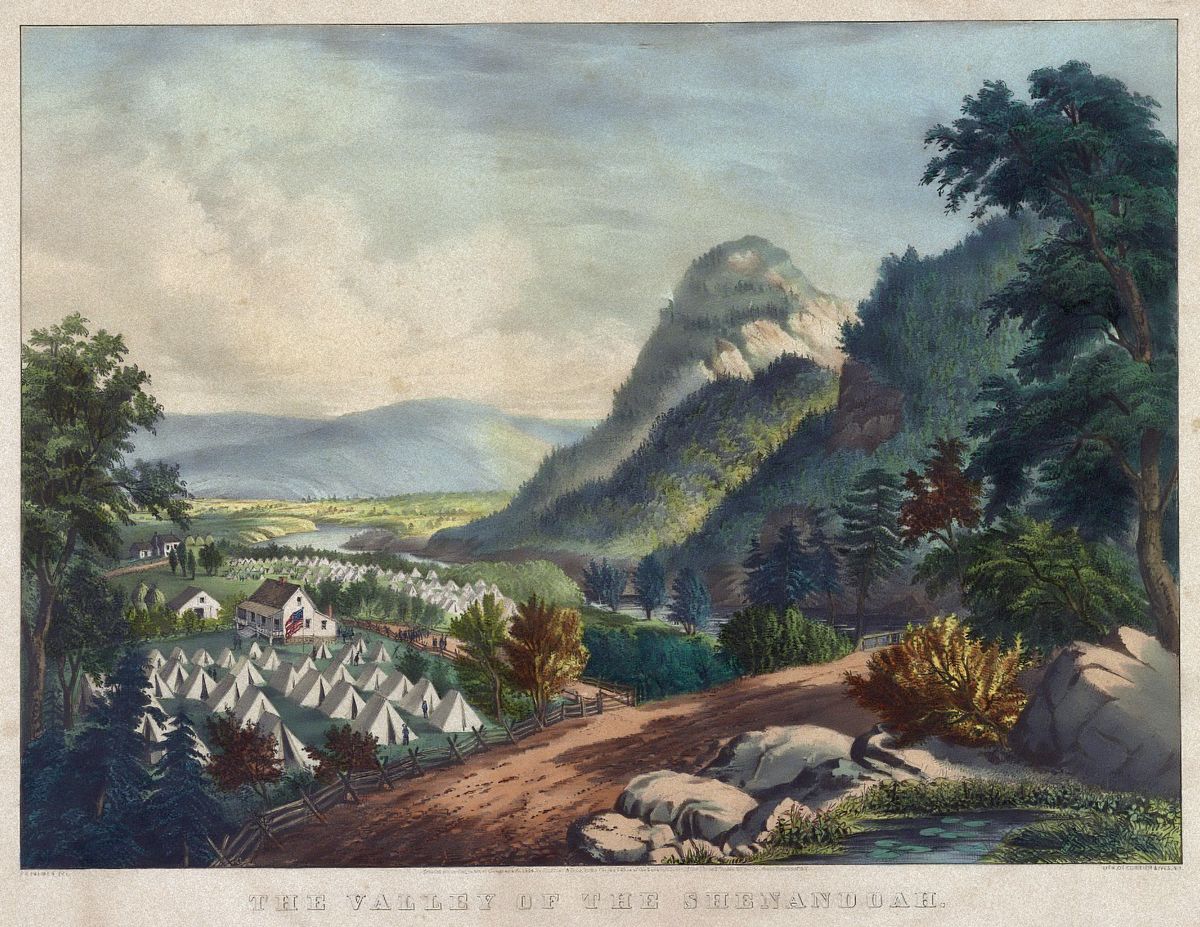
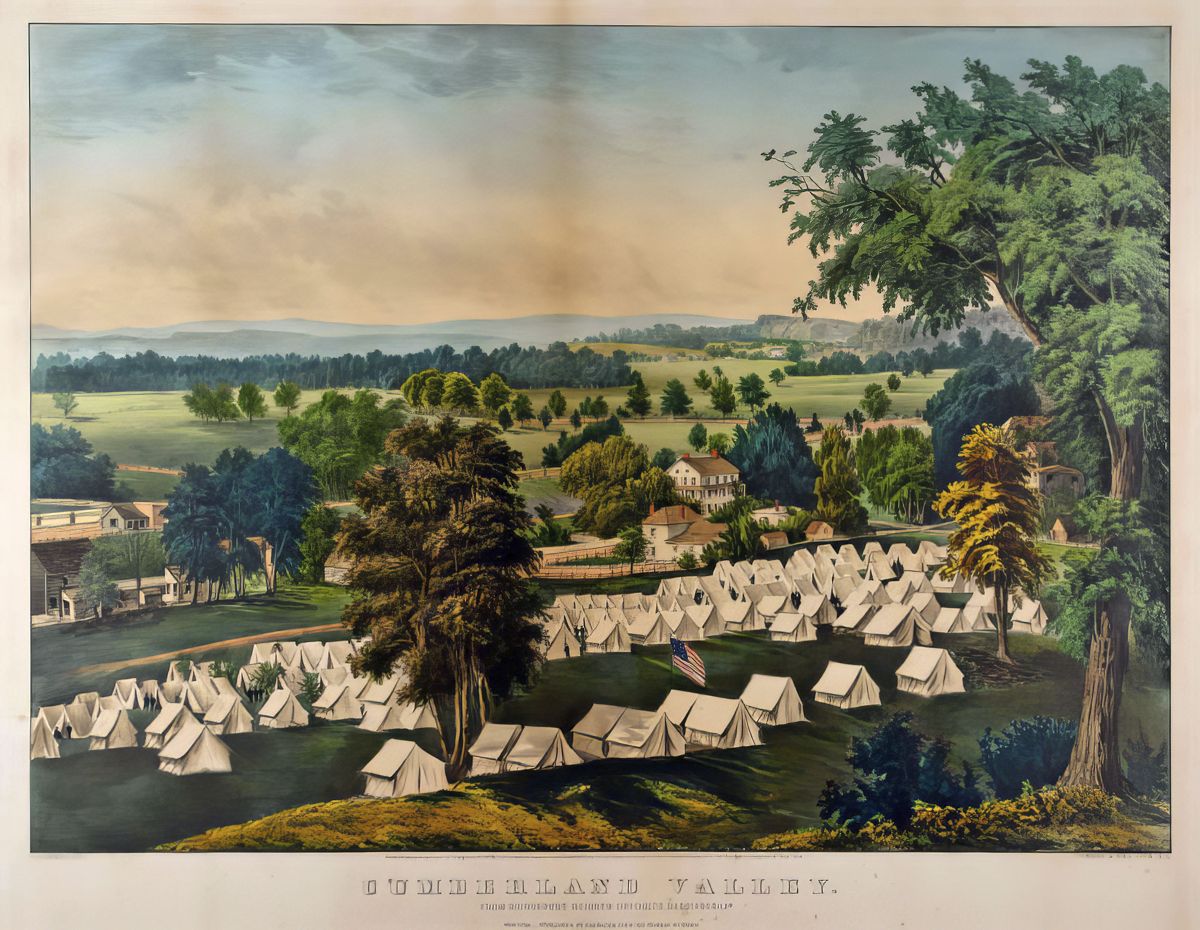
Palmer sketched more than 200 prints produced by Currier and Ives—that we know of. Supposedly she never traveled more than 200 miles from her home on Long Island. Yet she is largely responsible for the idyllic images of mostly rural America in the 19th century. And uncharacteristically, she produced the Mexican War’s Battle of Palo Alto and the Civil War Attack on Fort Fisher. She recorded images of the South, especially on the Mississippi River. All were done from sketches provided by other artists, as she had never been there. Early collectors of Currier prints either ignored her contributions to Currier’s success or gave her faint praise. After all, she was a woman in a man’s world.4 Her two most compelling images of the Civil War are not battle scenes or sieges. They are landscapes one might expect from her. But upon close examination, they are more than that. Into her typical, accomplished landscapes, she has inserted peaceful, placid military encampments. Late in the war, she produced three lithographs of Federal camps: The Valley of the Shenandoah (1864); Cumberland Valley. From Bridgeport Heights Opposite Harrisburg, Pa. (1865); and Harrisburg and the Susquehanna. From Bridgeport Heights (1865). The Valley of the Shenandoah (Fig. 1) depicts an unrealistic moment in the war. The Valley had played a key role in providing the Confederacy with sustenance, cover and mobility up and down its hills and passes. By 1864 Palmer’s unrealistic, peaceable view of the ravaged valley is both beautiful and naïve. As Palmer scholar Rubenstein points out, “Such prints soothed the fears of family members, who…worried about the condition of their absent family members.”5 Unfortunately, the location of this view and the identification of the units occupying the camp are unknown. More is known of the Cumberland Valley. From Bridgeport Heights Opposite Harrisburg, Pa. (1865), (Fig. 2). According to the catalog description of this print in the Metropolitan Museum, “Harrisburg was a strategic target for other reasons as well: it was near a railroad hub at the Susquehanna River—a vital route for shipments of troops and supplies between the mid-Atlantic and Midwest states of the Union. As also suggested by this print, the Pennsylvania state capital hosted the largest Union training camp for thousands of men, in addition to a vast stockpile of weapons and other military gear. Thus, the Union Army could not risk defeat and Confederate occupation in Harrisburg.” Further, the museum reveals that Palmer “based her image on an 1863 photograph of the camp by a photographer named Fred Clark.”6 The view, “opposite Harrisburg includes the area now known as Camp Hill. In June 1863 Confederate scouts reached Lemoyne and prepared for the Confederate Army to capture Harrisburg. General Lee revised his campaign, however, and attacked Gettysburg.”7 Frances Flora Bond Palmer, “Fanny Palmer” went on to a durable career as one of Currier’s most prolific artists. She left Currier in 1868. According to scholar, Mary Bartlett Cowdrey, Palmer found her work constricted by Meritt Ives and, her specialty “depictions of landscapes, were no longer as popular as prints involving people, and according to Louis Maurer, one of Palmer’s colleagues, her inability to draw the human figure was her only flaw.”8 Fanny Palmer passed away in August 1876, America’s centennial year. Endnotes: 1.
Charlotte Stiefer Rubenstein, Fanny Palmer: The Workhorse of Currier & Ives. Society for the Preservation of Long Island Antiquities, nd, 4. Hereafter Rubenstein, Workhorse. Rubenstein, Workhorse, 13. Ibid., 11. Charlotte Stiefer Rubenstein, Fanny Palmer: The Life and Works of a Currier and Ives Artist. Syracuse: Syracuse University Press, 2018, xiii. Hereafter Rubenstein, Palmer. Rubenstein, Palmer, 143.
The Cumberland Valley, The Metropolitan Museum, catalog entry, https://www.metmuseum.org/art/collection/search/813921 Pennsylvania Prints from the Collection of John C. O’Connor and Ralph M. Yeager, Museum of Art, The Pennsylvania State University, January 13 – March 30, 1980. #62. Cowdrey, Mary Bartlett. “Fanny Palmer, An American Lithographer,” in Thirteen Illustrated Essays on the Art of the Print by Carl Zigrosser. New York: Holt, Rinehart, and Winston, 1962.
After 43 years in the museum field, Cilella devotes his time to collecting A merican prints and maps and writing. He has written extensively on Emory Upton:
Upton’s Regulars: A History of the 121st New York Volunteers in the Civil War (Kansas, 2009); a twovolume Correspondence of Major General Emory Upton, (Tennessee, 2017), received the 2017–2018 American Civil War Museum’s Founders Award for outstanding editing of primary source materials. He edited Upton’s love letters 1868-70 to his wife–Till Death Do Us Part (Oklahoma, 2020), and The Memoirs of Dewitt Clinton Beckwith of Upton’s Regulars (McFarland, 2023).
Custom Made
Civil War Muskets
Chickamauga with Quinton Kick, at Chickamauga NMP (Free to BGES members) August 1, 2026 The Philadelphia 1777 Campaign Part II: An Active and Bloody Fall with Mike Harris & Gary Ecelbarger, from Philadelphia, PA August 12–16, 2026 1862 Maryland Campaign: South Mountain, Antietam & More with Kevin Pawlak, from Martinsburg, VA August 19–23, 2026
Hood’s 1864 Tennessee Campaign, Part II: Battle of Nashville, Lyon’s Raid, & Retreat from Nashville with Hal Litchford, from Franklin-Nashville, TN August 26–30, 2026
Revolutionary Williamsburg & Yorktown with Bert Dunkerly, from Williamsburg, VA October 17, 2026
From Fort Lee to Trenton and Princeton, 1776–1777 with Gary Ecelbarger & Bill Welsch September 23–27, 2026
The Vicksburg Campaign with Tim Smith, from Vicksburg, MS November 11–14, 2026
George Washington’s Final Battle-Monmouth Cradle of the Revolution: Boston Courthouse and The Jersey Campaign, June 1778 to Lexington & Concord with Gary Ecelbarger & Scott Patchan, from Princeton, NJ with Mark Malloy & Rob Orrison, from Boston, MA November 5-8, 2026 September 9–13, 2026
Fall 1862 Kentucky Campaign: Richmond, Lexington, Munfordville, and Perryville with Lee White, from Richmond, VA September 30–October 4, 2026