
The Unfinished Fight The Great Atlantic and Pacific Tea Company
By Craig L. Barry · Originally published January-February 2026 · pp. 16–19
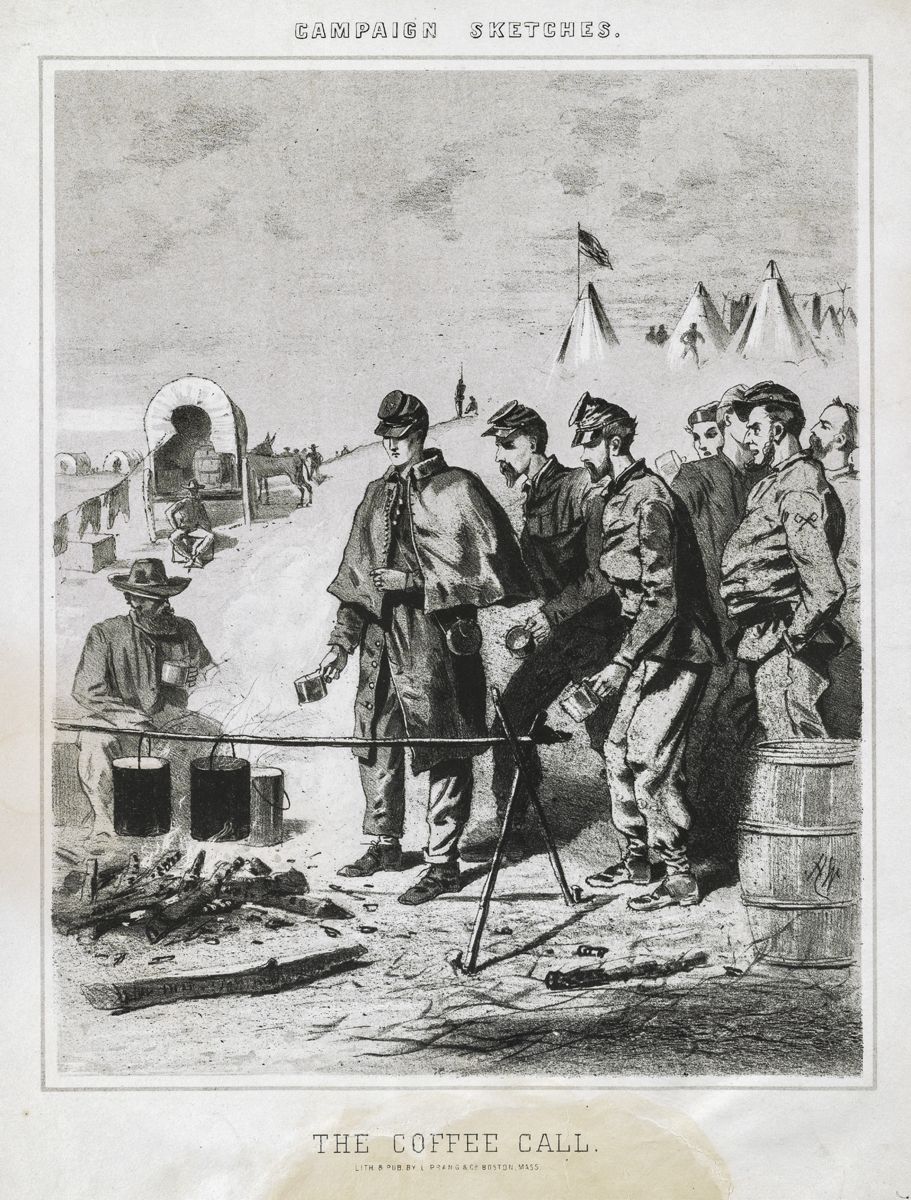
Many American grocers in the mid-19th century began their business in the tea trade. The Antebellum United States was predominantly rural and agrarian. If food prices rose too high, farmers would plant and grow their crops or do without. However, this was not the case with tea, as it could not be successfully grown or was not widely cultivated in America, and it was challenging to find a substitute or do without. Despite the rise of coffee drinking, a significant tea culture persisted in America. This gave merchants a degree of leverage when it came to tea. In the late 1850s, a pound of tea sold at retail for the princely sum of $1. Two Maine men, George Hartford and George Gilman, were operating a finished leather goods shop in New York City. Although both were from Maine, paradoxically, they met in Missouri, decided to work together, and opened shop in New York City in 1856. In 1859, they recognized the potential for profit by buying tea wholesale at $1.75 per five pounds, directly from the Clipper ships it arrived on, and then retailing it at a discounted price. The strategy was twofold: first, to cut out the middleman, and second, to make up for the volume that they surrendered with their lower profit margins. Coffee gained a foothold in post-colonial America when it became unfashionable to drink Tea due to British taxation and their monopolistic control of supply channels, as seen in the Boston Tea Party. However, comparing coffee to tea is difficult purely on a volume basis because a pound of tea goes much farther than a pound of coffee. In addition, they targeted middle-class New Yorkers instead of going after the more fashionable “carriage trade” made up of the city’s upper crust, which was not as pricesensitive. In this, they were shrewd, as the middle class was surging by the late 1850s, and so was the demand for affordable luxury goods. They opened a warehouse at 31-33 Vesey Street, in a location that was “…filled with tea, coffee and grocery houses. The competition is so brisk so that some stores employed solicitors who stand on the street and invite
“8 O’CLOCK BREAKFAST COFFEE.” The Great Atlantic & Pacific Tea Co. (Library of Congress)
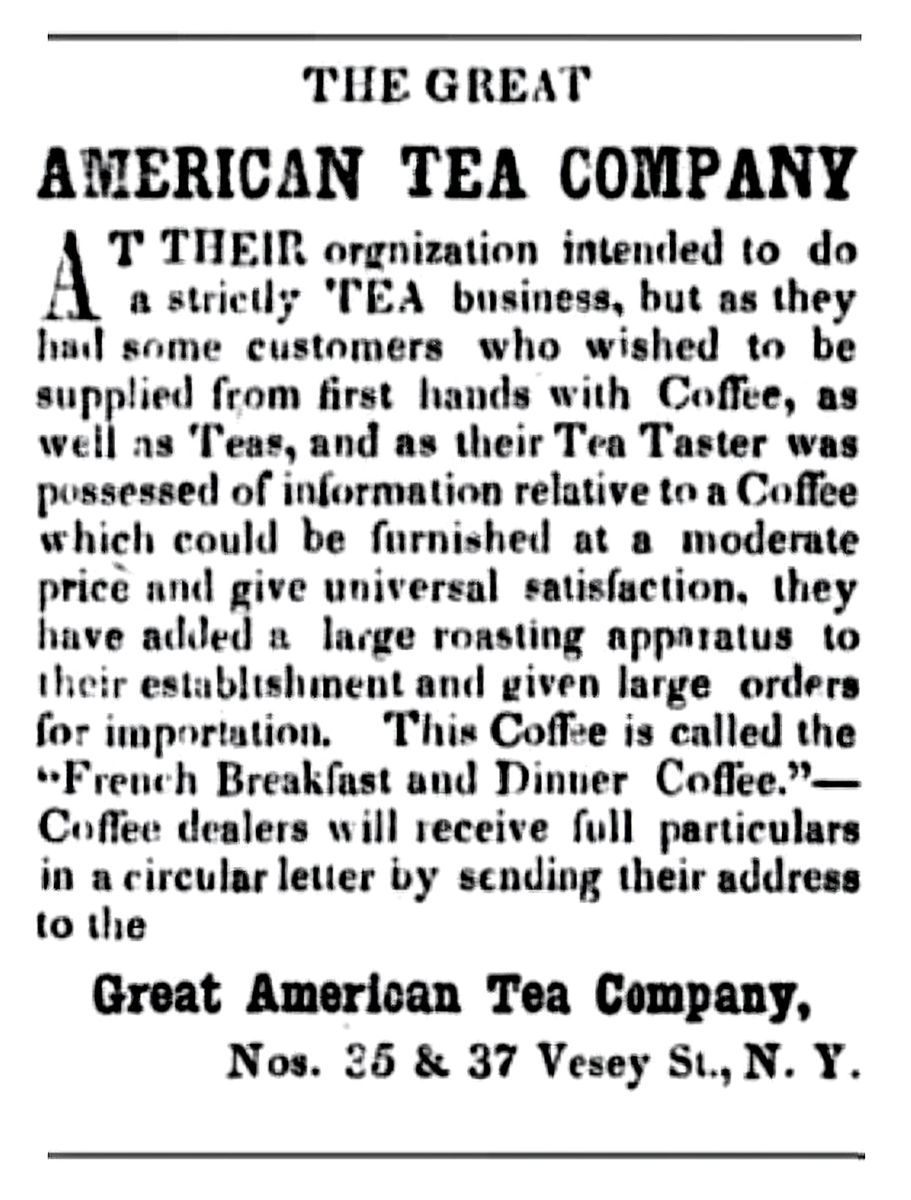
passers-by to step in and purchase. For this reason, goods are generally sold cheaper in Vesey Street than in any other part of the city.” Competitors claimed the Great American Tea Company’s prices were so low because they added adulterants to their tea products, which, of course, they did. And, in likelihood, so did all of their competitors. The Pure Food & Drug Act was not passed into law until fifty years postbellum. It was noted that “if this could be done so successfully with tea…it could be done with other lines of goods of universal demand.” This was soon to be proved correct by those merchants filling Civil War contracts. By the early 1860s, the Great American Tea Company had expanded into the coffee trade, a market that the U.S. Civil War generated significant demand for. Great American filled Union orders for coffee, which were later found to be adulterated with chicory. This is not as shocking as it sounds since the U.S. Government “… was sold thousands of pounds of something called essence of coffee which often did not contain any coffee at all.” This was true. Another study of suppliers from Boston, New York, Philadelphia, and Baltimore found that 255 out of 376 suppliers filled orders with adulterated coffee. The essence of coffee was easily adulterated, being a processed drink made by mixing coffee extract (or something that resembled it) with canned condensed milk. The final product was “likened by some to axle grease.” The coffee and tea business was so full of unscrupulous merchants who sold adulterated products that the Government went back to issuing raw (green) coffee beans. Why was so much ground coffee adulterated? It was easy to do. Ground coffee was sold in paper bags, which quickly went stale. Any blame for diminished flavor from adulterants could be placed there. Demand was high and coffee was always in short supply. The Philadelphia Grocer warned that “charcoal, nuts, shells, bark, saw dust and roasted grains are used…if not on the wholesale end than often by retailers…including restaurants.” Whatever the case, the extent of the practice resulted in one Government supplier, John Stetler of Baltimore, being convicted of supplying adulterated coffee and sentenced as follows:
—”In this ; that the said John K. Stetler, having made a contract in writing with Captain Thomas Sullivan of the Commissary of Subsistence, US Army, to furnish subsistence supplies, to wit: one hundred thousand pounds pure, prime, roasted and ground Rio coffee, to the United States, and to deliver the same at Baltimore on or before the 12th of May, 1863, and having failed to fulfill said contract, or any part thereof, did, at Baltimore, on or about the 28th May, 1863, represent to Captain Thomas C. Sullivan, Commissary of Subsistence, U. S. Army, that he, said Stetler, had on hand a large quantity of pure, prime, roasted and ground Rio coffee, to wit: about one hundred casks thereof: and it was thereupon agreed between the said Captain Thomas C. Sullivan, acting for and on behalf of the United States, and the said John K. Stetler, that the said Stetler should immediately furnish and deliver to the Subsistence Department of the U. S. Army at Baltimore such amount of pure, prime, roasted and ground Rio Coffee, as he, the said Stetler, had on hand, as so represented by him, not exceeding one hundred casks; that the same should be pure and unadulterated —proof of which, by chemical analysis or otherwise, would be required; and that the United States would pay therefor at the price and rate agreed in said written contract above mentioned, to wit: $37.97 for every one hundred pounds; but that the said Stetler did wholly and willfully neglect and refuse to furnish or deliver the coffee so agreed to be furnished and delivered, or any pure, prime, roasted and ground Rio coffee whatever; but that he did deliver at Baltimore, on or about the 5th June, 1863, to said Captain Sullivan, about one hundred casks of adulterated and impure coffee as pure and of the quality agreed, knowing the same to be impure and adulterated, and did attempt to defraud the Government of the United States thereby; and that the said coffee so delivered was proved, by an inspection and chemical analysis thereof, to be impure and adulterated with foreign substances, and was therefore rejected by the Subsistence Department.” “Finding: Guilty, except that the quantity to be delivered was two hundred casks, instead of the quantity stated in this specification. Sentence: And the Court does therefore sentence him, the said John K. Stetler, to be imprisoned in the Penitentiary at Albany, New York, or at such other place as the Secretary of War may direct, for a term of five years.”
Taken on the whole, the addition of some chicory by Great American was the least objectionable coffee adulterant that was in use at the time, or no one in the enterprise was ever charged or convicted of a crime. Great American sold so much coffee that they eventually bought their coffee plantation in Brazil, where most of the coffee consumed in the mid-19th century was grown. It appears that by virtue of being one of the “least-worst” grocers in the coffee and tea trade and less expensive to boot, they built a broad base of retail customers for both coffee and tea products, and sales continued to grow postbellum. The Great American Tea Company was the first to sell products under its own brand name. By the end of the Civil War, they were flourishing, with multiple locations in New York City, and paid taxes on assets exceeding $1 million. By the end of the decade (1869), the enterprise changed its name. It was thereafter known as “The Great Atlantic & Pacific Tea Company” (later A&P), which grew into a massive grocery store chain and remained in business for another hundred years.

Craig L. Barry was born in Charlottesville, Va. H e holds his BA and M asters degrees from UNC (Charlotte). Craig served The Watchdog Civil War Quarterly as Associate Editor and Editor from 2003– 2017. The Watchdog published books and columns on 19th-century material. He is the author of several books including The Civil War Musket: A Handbook for Historical Accuracy (2006, 2011), The Unfinished Fight: Essays on Confederate Material Culture Vol. I and II (2012, 2013). He has also published four books in the Suppliers to the Confederacy series on English Arms & Accoutrements, Quartermaster stores and other European imports.
We Offer FREE Monthly Lectures on the History of the American Civil War Check Out Our Website for Meeting Details & Speakers BECOME A MEMBER TODAY!