
Spared & Shared Battle of Roanoke Island Letter
By William Griffing · Originally published January-February 2026 · pp. 42–45
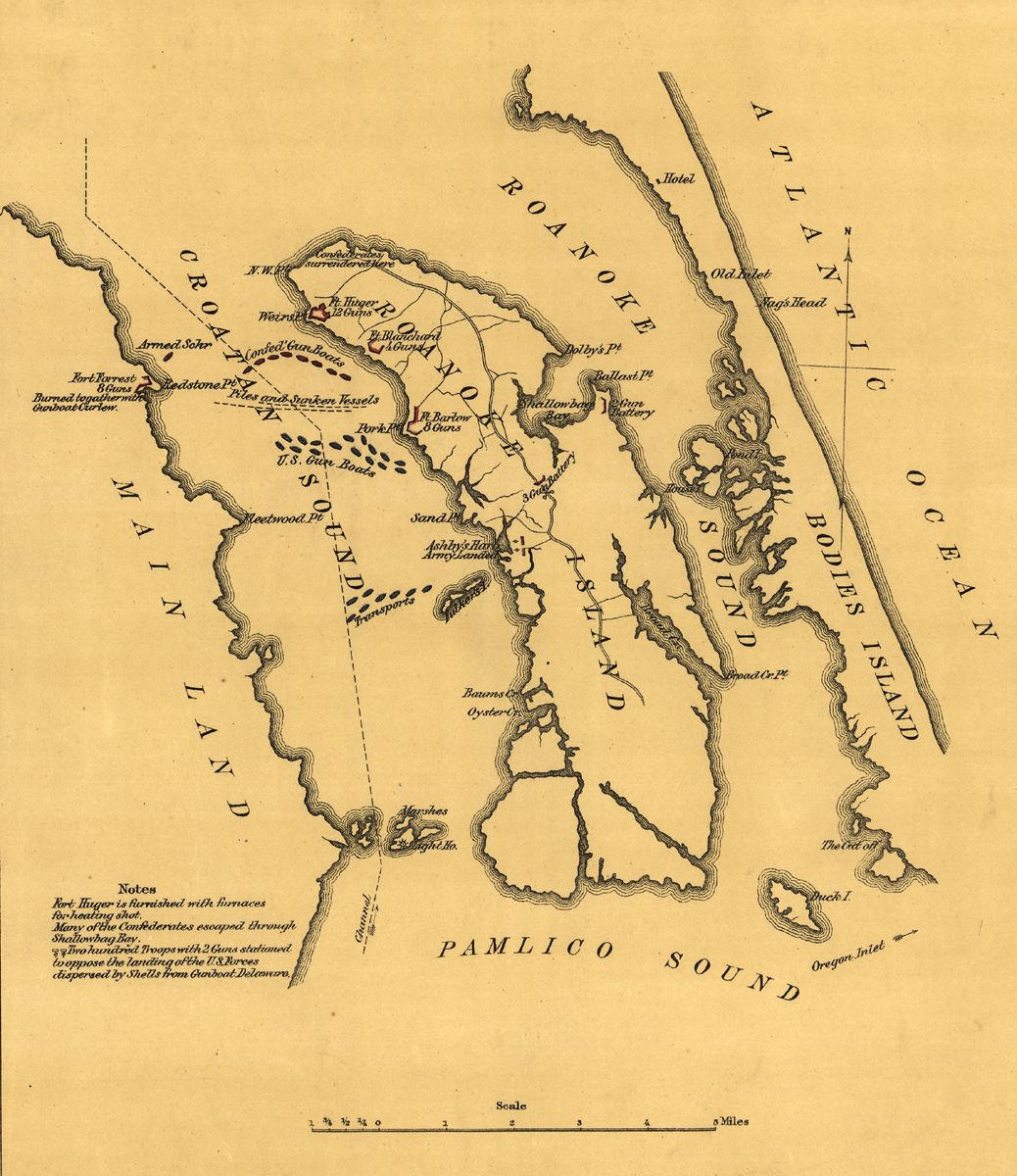
The Union victory in the Battle of Roanoke Island represented a significant threat to the Confederacy, effectively opening eastern North Carolina to invasion and securing control over Albemarle and Pamlico Sounds. The battle was accomplished with relatively few casualties and propelled Union General Ambrose Burnside into the national spotlight. Numerous accounts of the encounter exist from the over 10,000 Union soldiers who took part in the amphibious assault on the island. Among these is a narrative penned by twenty-four-year-old Joseph Herman Vaill of Company E, 8th Connecticut Infantry, who, alongside his comrades, was confronted with the reality of their first engagement in combat. Roanoke Island Sunday P. M. 9:30 o’clock February 9th 1862 Dear Father, You are probably all quiet in church at this present writing, little dreaming of what I have seen and heard for the last eight and forty hours. All is quiet just now and I have begged half a sheet of paper to write to you about our present situation and of the events of the past few days. On Wednesday morning the 5th, we weighed anchor and brought up the rear of the fleet. We were on the Propeller “Sentinel” carrying 4 guns and being in the 3rd Brigade, were ordered to the rear as guard. The weather was fine but rather cool and it was thought that we would reach our destination by 4 p. m. and have warm work before sundown. But our boys were in good spirits and every man was ready to do his duty. At about 4 or 5 p. m. we dropped anchor in the rear of the fleet and about 10 miles from the island. The weather came on thick at evening with rain. The Sentinel and Chasseur were put back about a mile to guard the fleet in the rear and several small gunboats sent ahead to sound and reconnoiter.
The next morning we did not move but the small boats were in advance to lookout the ground. Friday morning the 7th, orders were to move on and so we did—the gunboats in the advance. At about 10 a. m., we saw smoke several miles up the channel which we took to be from the enemy on shore. For an hour or so, firing commenced in earnest from our gunboats and was answered quite rapidly from a fort on shore and by rebel gunboats above the fort. The rebels had previously obstructed the channels by driving in spiles so that our gunboats could not go by the fort without passing directly under the fort. During the whole afternoon the firing was continual by our vessels and answered less rapidly as the day wore on. A dense cloud of black smoke told us that the fort was on fire.
Joseph Herman Vaill was promoted to quartermaster sergeant on May 28, 1862; promoted to 1st sergeant on Feb. 20, 1864; transferred to the 2nd Battalion, Veteran Reserve Corps on May 18, 1864; and mustered out on Sept. 20, 1864. (Matthew E. Reardon collection)
We were anxious to have the Sentinel go ahead and take part in the bombardment but unfortunately the boat was used as a water boat—making fresh water from salt—so that Gen. Burnside was afraid of her being disabled so left her as rear guard to the fleet. The transports were about 3 miles from the fort and at about 3 or 4 o’clock, the troops began to land on the island about 2 miles below the fort. Small steamers would take a load of soldiers and then tow 20 or 30 small boats full so that the troops were landed very rapidly. Company H of the 8th [Connecticut] Regiment went ashore first (from our boat) and our company (E) went later in the evening between 10 and 11 p.m. The 21st Massachusetts Regiment was the first on shore and immediately went out as skirmishers and about a mile from shore directly inland— across a swamp—came upon a masked battery and returned to the shore to wait for more force. At 11 p.m. we lay down upon a sandy cornfield about 100 rods from shore. There must have been 10,000 men on the field before 12 midnight. We lay down on our rubber blankets two together so had one rubber blanket over us which we very much needed for it soon began to rain and kept it up nearly all night. We got wet some but made the best of it for we were in an enemy’s country, and the enemy near us. It was raining some when we got up in the morning and before we had a chance to think of breakfast and before all of the men were out from under their blankets, we were startled by several shots from our pickets who were not more than 80 rods from us and the order was, “Fall in!” We had the order hundreds of times before but under very different circumstances. The rush for guns may be “imagined but not described.” We were soon in line just as the firing from the pickets ceased. We were ordered to stack arms. You may consider that there was some little excitement for it was the first time the most of us were ever invited to face death on the battlefield. At 7:30 the 1st Brigade left the field for a march to the interior to attack the battery discovered the night before. At 8:30 we heard rapid firing of musketry and an occasional field piece or gun from the battery. Regiment after regiment were ordered out from time to time and the firing was kept up with little cessation till 11 a.m. when Hawkins Zouaves (9th N. Y. V.) charged upon the battery and carried it at the point of the bayonet with a loss of only one killed and five wounded. Other regiments had stood and fired at the battery and had lost quite severely—among them one or two Massachusetts regiments. Several regiments were ordered to make an advance on the battery which lay across a terrible swamp but after making the attempt, fell back till the 10th Connecticut were ordered on and went through with a heavy loss—Col. [Charles L.] Russell being among the killed. The enemy were put on the run, our troops close upon them. I believe all the regiments with the expedition were ordered on except the 8th which was held in reserve under arms all day in order to cover the retreat of our troops in case they were driven back. We were in readiness to march to the battlefield at any hour. The regiments that went out into the fight and chase yesterday have not returned as yet but we learned this morning that they had taken between 2 and 3 thousand prisoners— among them Gov. Wise of Virginia, and O[badiah] Jennings Wise who it is reported was shot this morning while attempting to Of course we cannot tell Congress)
![Capture of Roanoke Island [North Carolina]. Charge of Zouaves. (J.J. Crew)](/article-images/cwn-2026-january-february/cwn-2026-january-february-spared-shared-battle-of-roanoke-island-l-03.jpg)
Map of the battlefield of Roanoke Island, Feb. 8, 1862. Confederate positions in red. (Library of Congress)
“Invited to Face Death on the Battlefield”
how much to believe as there are all sorts of reports. But it is very plain we have done a great work although our loss is quite heavy—probably nearly 50 killed and wounded. Our boys are all very well but are not able to write on account of the scarcity of paper; our knapsacks being left on board the boats. But their friends need not be alarmed about them for they are all well. Today the boys are around killing pigs &c, to eat. [Cousin] Ed Vaill came on shore to see us last night. He says if I am wounded he will get me on board the Admiral and take care of me so you may know I shall be well taken care of. The troops will be taken off the island soon except one or two regiments and put aboard the mainland, so Ed says. Lieut. Watham, Seth [Plumb] and Ed Wadham have just arrived from the battlefield with sundry trophies from the rebels— letters, documents, &c. &c. They say the place where our troops had to fight was the most awful swamp they ever saw. We may be called to fight at the next engagement. I hope I may be spared to return to my dear old home and friends but if I fall on the field of battle, I trust that I may be able to meet you all around the throne of God—not through any merits of my own, but through the merits of Christ in whom I put my faith and trust. With love to you all. I remain your affectionate son, — Joseph H. Vaill
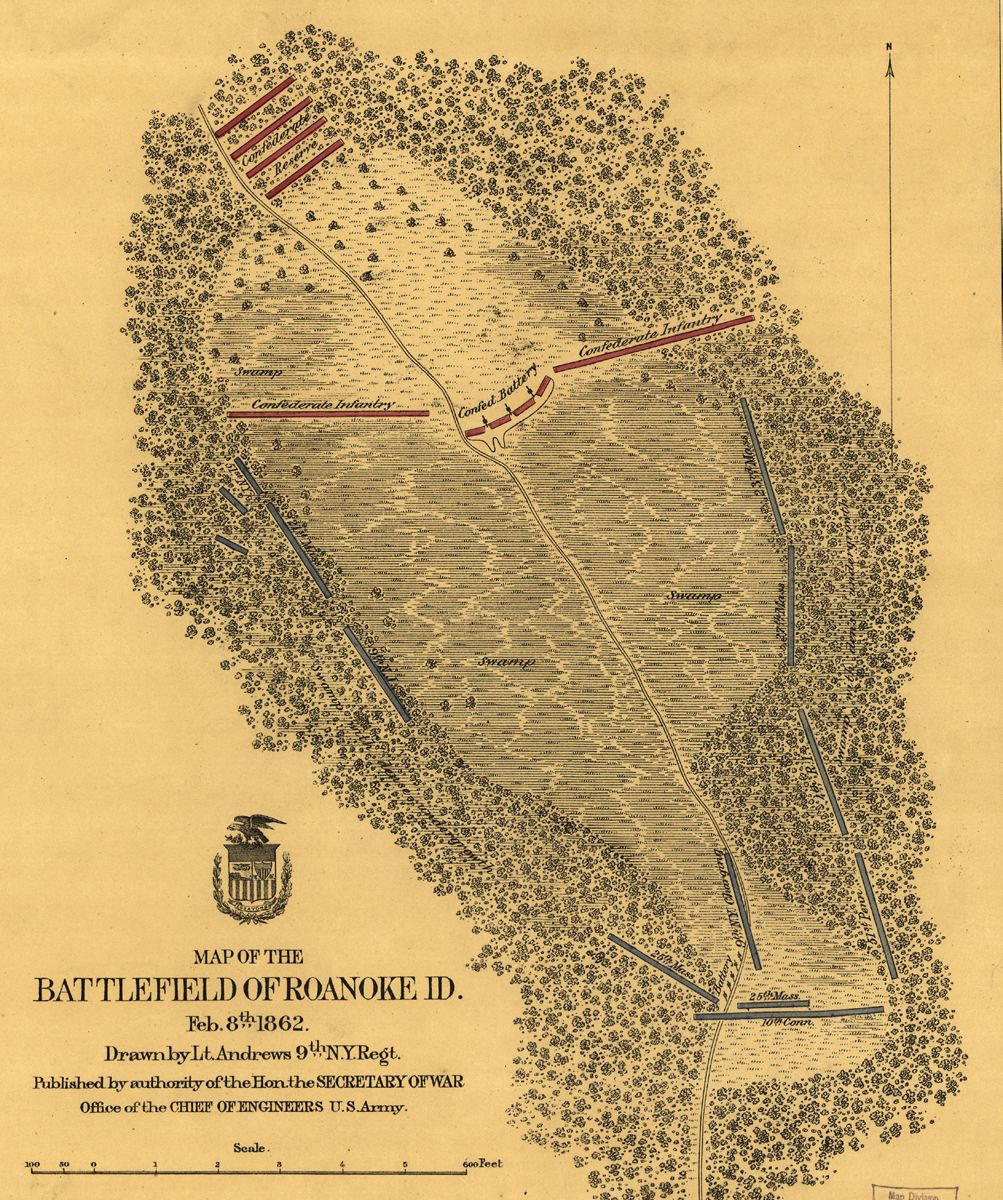
A few days after the battle, another Yank named Eber L. Robinson from Co. B, 11th Connecticut Infantry wrote a friend, sharing his observations of the battlefield and what news he could gather about the Battle of Roanoke Island. “Last Monday I went up to the battle ground where our 10th Connecticut Regiment had a good fight. The rebels had it fixed to shoot down our troops by the hundreds. They had a masked battery with 3 cannon planted [on Supple’s Hill] so as to cut down our troops clean as they came up the road. This battery was built across the road calculated to sweep them clean for it was all mud and water on both sides up to the waist, but our troops with Gen. Burnside had two darkies that went from here down to Hatteras and told him just how it was situated and our troops had the advantage then. They marched about 3 quarters of a mile through the mud, brush, and water up to the waist and they were 2 hours getting through it, and when they did, they give it to them pills and powder to digest them. Our troops flanked them on the right and left in the mud. As I have told before, they throwed their grape shot at our men and it cut down stodels and barked up the trees so it looks like an old wood pile as it were. Our troops, being in the mud on both sides of the road so low that the rebel grape flew over their heads in a great measure. If it had not been for the mud, there must have been more killed.
When we made a charge, our troops set up such a yell that it about scared them to death and they throwed their knapsacks and haversacks and canteens, guns, and knives, and did some fancy running. The road and swamp was all strewed with their duds that they throwed away. Our men did not follow them for an hour afterwards. Then they followed them to the fort [Fort Barstow] and the next day they surrendered and after that they took 700 more that came over after the surrender and made a big thing of it. I should like to have you see this fort that was bombarded to to see how they set the rebel barracks on fire with our shells and burned them up. They cut down large trees and the ground is strewed with cannon shot and shells. I have seen the place where the fight was and a good many never will. I should like to have some of you to see it to know how dreadful war is. I cannot describe it at all.” Right: The Burnside Expedition—The late Lieut.Col. [A.J. Viguier] de Monteil of the D’Epineuil Zouaves, acting as a private in the 9th New York Regiment (Hawkins’s Zouaves), in the attack on the three gun battery, Roanoke Island, February 8 .—From a sketch by our special artist accompanying the expedition. (Leslie’s Illustrated News, March 22, 1862, page 289.)
William J. G riffing has worked at the Department of Labor and the

Department of Energy, and later as the ES&H Director at the National R enewable E nergy L aboratory and F ermi N ational A ccelerator Laboratory. Since his retirement in 2010, he has focused on preserving American history, mainly Civil War letters and diaries that remain unpublished in private collections. His transcribed
Civil War soldier and sailor letters are found at: https://tinyurl.com/sparedshared. Updates on newly transcribed letters are available at :
facebook . com /G riff .CWL etters . In 2024, he co-edited a book titled A Great and Good Man with Jonathan A. White, which includes rare first-hand accounts of Abraham Lincoln, drawn primarily from about 15,000 letters he has transcribed since retiring.