
Emerging Civil War The Book of General Stevenson
By Chris Mackowski, Ph.D. · Originally published January-February 2026 · pp. 50–53
Icracked the book open carefully, conscious of its old spine. I didn’t know what shape its pages might be in, either. The book, an edition of Dennis Hart Mahan’s Treatise on Field Fortification that dated back to 1860, had some years on it. The cover had the weight of a relic under my fingertips. Under any conditions, this book would be a find. Sure, one can easily find it on Archive.org if one wants to read it. I can’t imagine too many people are planning attacks on 19th-century fortifications, though, so I don’t know how much of a readership it might have these days, but the book, first published in 1836, is one of those foundational texts
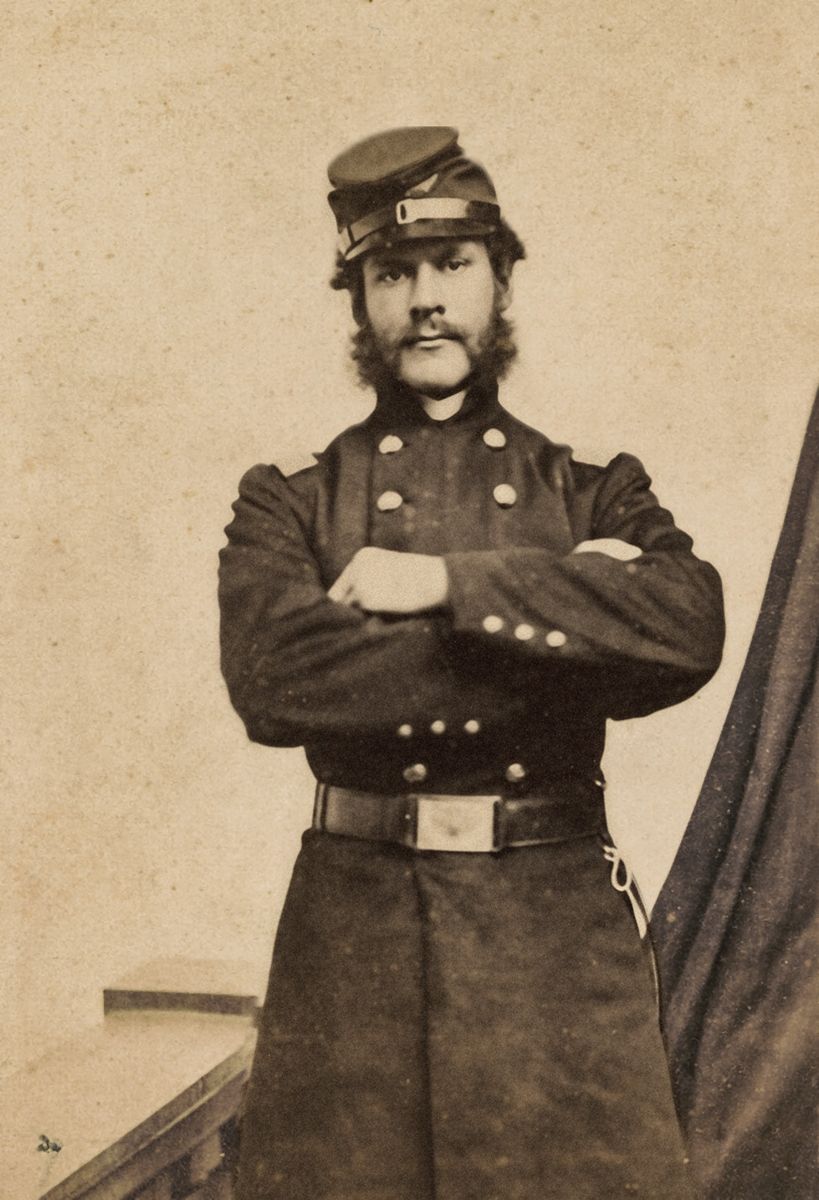
Quartermaster Frank Bush Jr. of the 44th Massachusetts (44th Mass. Regimental History)
that influenced the generation of Civil War officers and the way they waged war. I certainly won’t read this book. It’s too old, too fragile, too meaningful. Once upon a time, the book was a gift from Francis Bush Jr., a regimental quartermaster with the 44th Massachusetts who wrote his name and offered his compliments on the first page. Bush was “a most faithful and diligent officer in a very harassing branch of military service, and secured the hearty good-will of his comrades by his frank and obliging ways,” attests the regimental history of the 44th. Bush has inscribed the book to “Capt. T. G. Stevenson.” That’s “Thomas Greely Stevenson,” for whom my wife’s business, Stevenson Ridge in Spotsylvania, Virginia, is named.
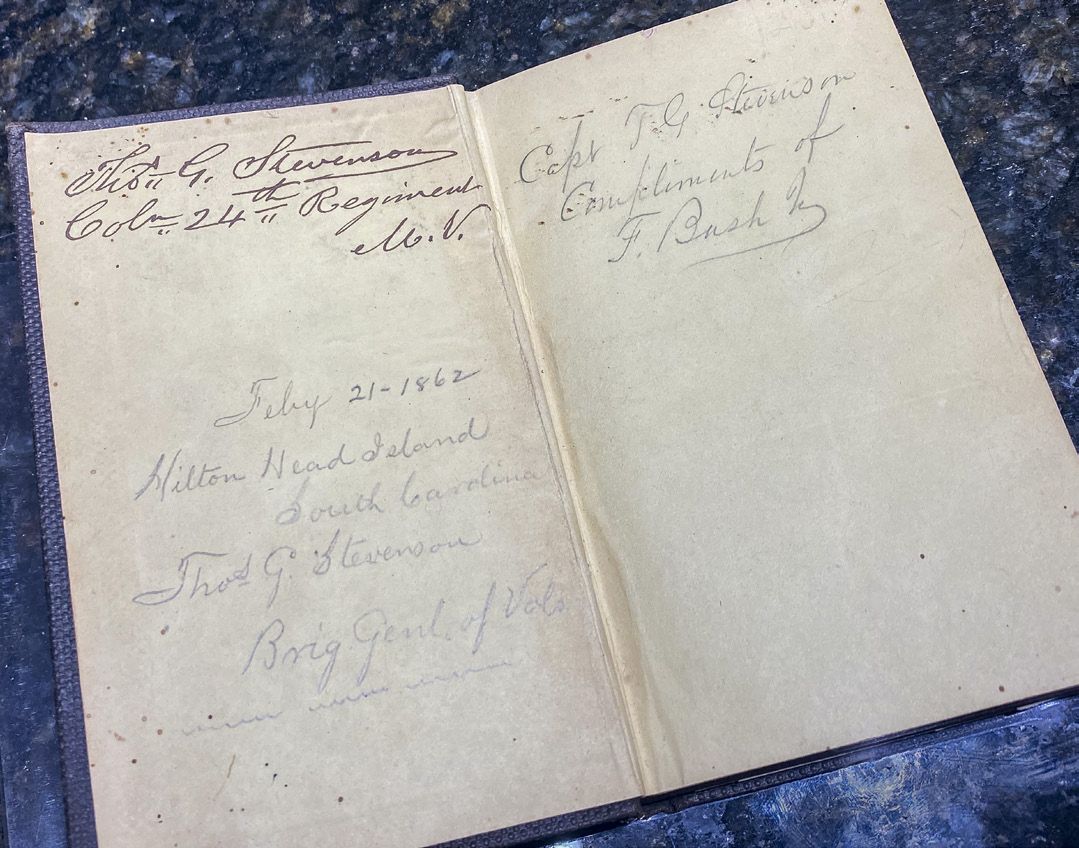
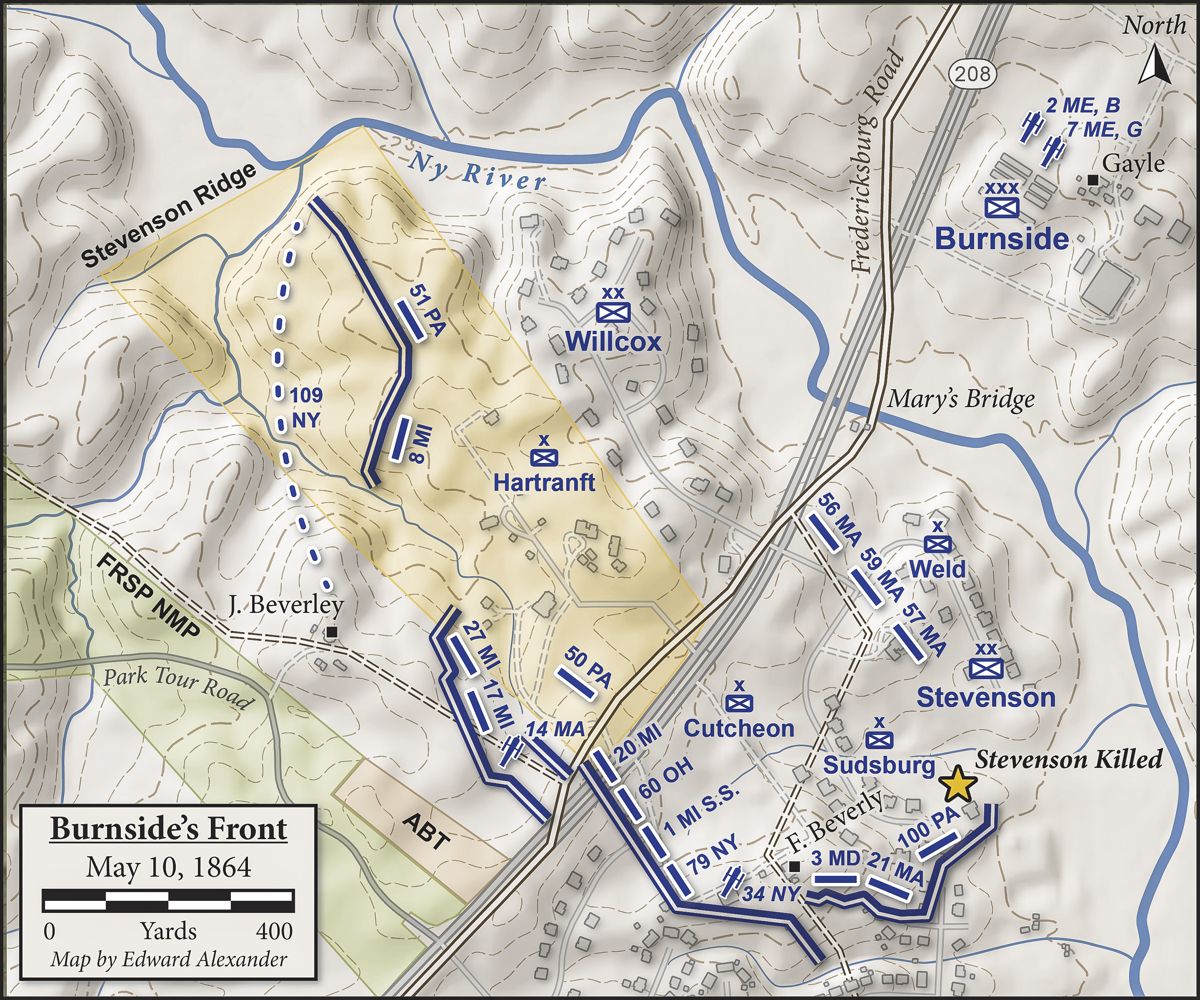
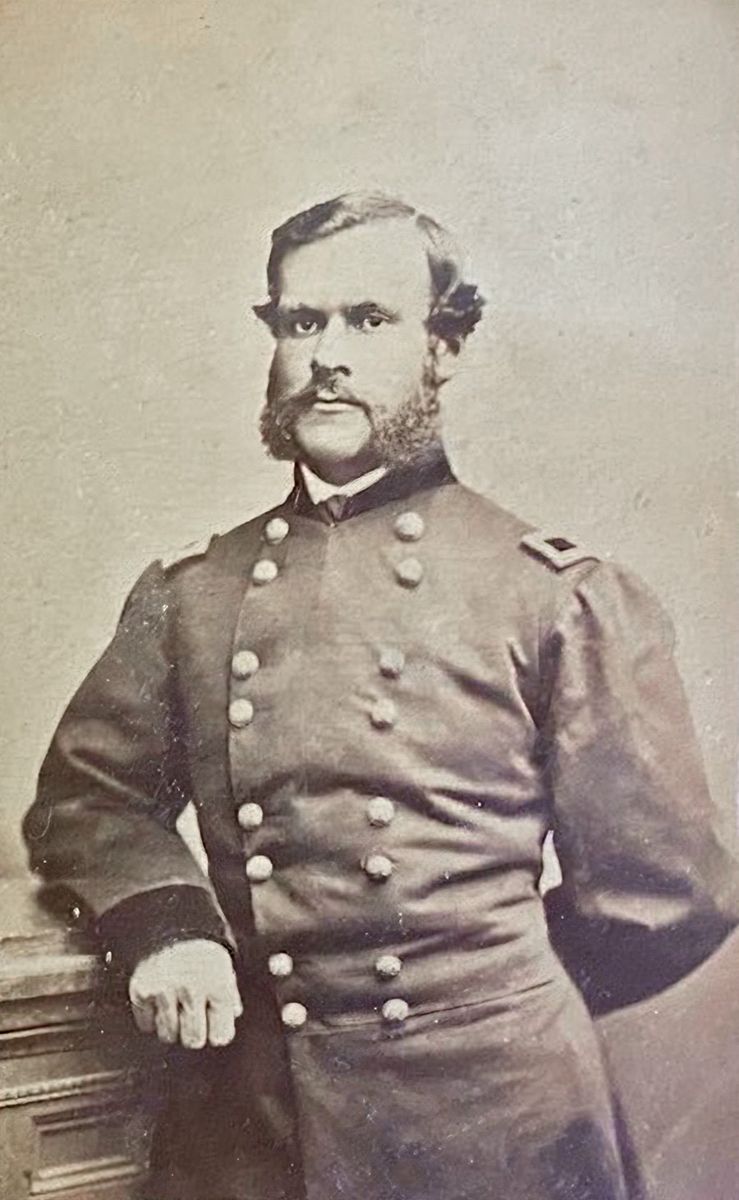
“I HEARD THE BULLET STRIKE WITH A PECULIAR DULL THUD AS IF STRIKING IN A PUMPKIN,” A STAFF MEMBER ATTESTED. The ridgeline from which Stevenson Ridge gets its name runs from the north side of modern State Route 208, where the business is located, to the south side. On the morning of May 10, 1864, Stevenson—then a brigadier general commanding a division in Ambrose Burnside’s IX Corps— died during the battle of Spotsylvania Court House. He had inspected his line, then taken refuge behind that ridge with his staff, settling down for a late breakfast (or, some say, an early lunch) when a random overshot from beyond the crest of the ridge arced down and hit him in the head. “I heard the bullet strike with a peculiar dull thud as if striking in a pumpkin,” a staff member attested. This book, which I now have, once belonged to Stevenson, who had written his name and original unit, the 24th Massachusetts, on the inside front cover. He signs the book as “Col.” At the bottom of the page, he has signed it as “Brig. Gen. of Vols.” Stevenson’s 24th Massachusetts and Francis Bush’s 44th Massachusetts both served in the same brigade, which Stevenson commanded beginning in November 1862 following his promotion to brigadier. But what interests me is that Bush first inscribes the book to “Capt.” Stevenson. Stevenson had once served as a captain of the New England Guards, a Massachusetts militia unit that dated all the way back to 1812. Stevenson had served as the unit’s adjutant and then, in 1861, as a captain, as its commander. The Guards served as the wellspring for both the 24th and 44th, suggesting to me that Stevenson and Bush served in the militia together. The book is still so new to me, so I still have much to research, but this is my initial guess, anyway. I’ve spent a considerable amount of time with Stevenson over the past thirteen years, since marrying into the family
“Thos. G. Stevenson, Col. 24th Regiment, M.V. [Massachusetts Volunteers].” (Chris Mackowski) The Stevenson copy of Mahan’s book includes inscriptions from Frank Bush, who presented the book as a gift, as well as Stevenson, who recorded his promotions on the inside front cover. (Chris Mackowski)
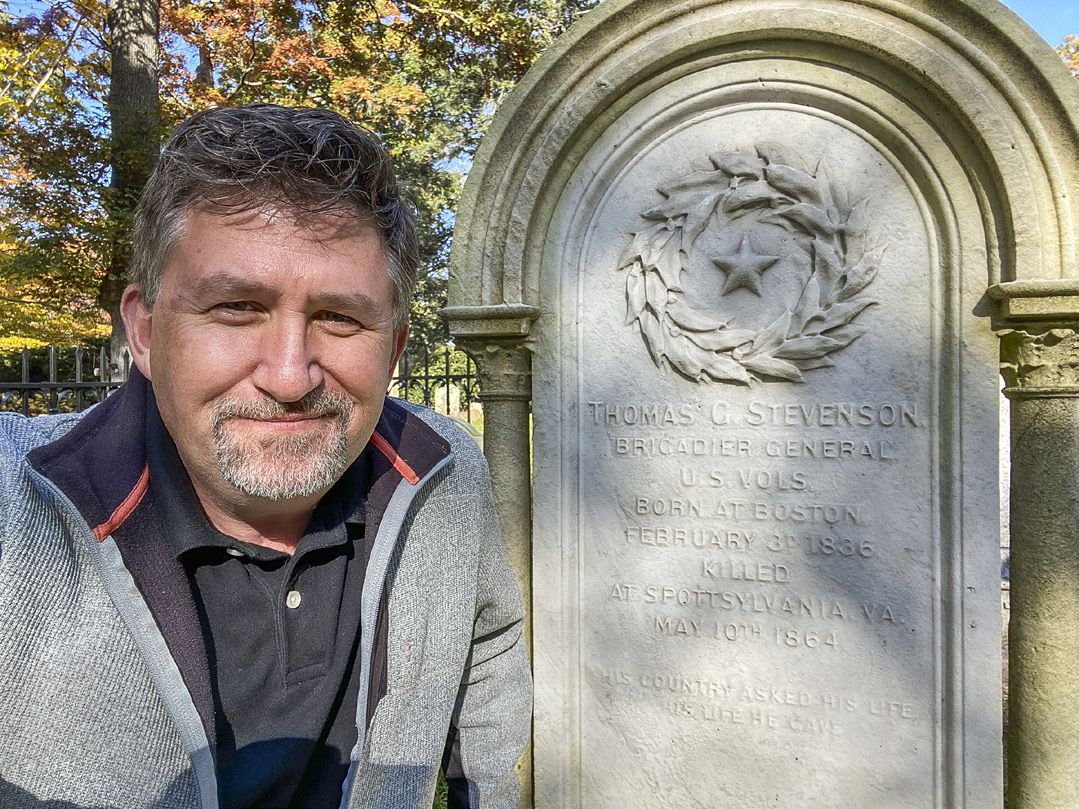
that owns Stevenson Ridge. I’ve explored his life. I’ve paid my respects at his grave in Cambridge’s Mount Auburn Cemetery. I’ve read the privately printed memorial book his family assembled in his honor, complete with a testimonial from Massachusetts Gov. John Andrew himself. “No officer was more devoted to his duty,” Andrew eulogized. “No officer more fully won the respect and love of his men, whom it may be most truly declared that he always led rather than commanded.” By all accounts, the 28-year-old Stevenson was universally loved by the men under him and respected by the commanders above him. “The men of Stevenson’s Brigade will never forget that, after the toilsome march, often late into the night, they always found their General waiting to make sure that everything, which the circumstances permitted, was done for their comfort,” the regimental historian of the 44th Massachusetts wrote, “that the last quarters located were his, and the last weary man relieved from duty was their General—that, however cheerless the bivouac, or however stormy the night, he never left them to avail himself of the proffered comfort of headquarters.” On almost any other battlefield, a dead brigade commander would merit a monument or an upside-down artillery barrel, but the scope of killing at Spotsylvania
Court House overwhelms nearly any attempt to properly memorialize it. And, after all, this was Ambrose Burnside’s front, and few people care about the hapless-if-amiable IX Corps commander. Stevenson suffers from neglect by association. I have devoted substantial effort to determining the exact location of Stevenson’s death and the circumstances that surrounded it. The exact spot has been swallowed by a subdivision at the end of a dead-end road. Dead end, indeed. To have this book that was once his is to have a tangible connection to Stevenson. Under what circumstances did Bush present it to him? Did he ever read it? What occasioned him, on “Feb. 21” at Hilton Head, S.C., to note his rank of brigadier general when his commission had come through the previous November? Did he refer to this book when he oversaw construction of his fortifications along what we now call “Stevenson Ridge” at Spotsylvania? Others might consider it a neat curiosity to have a book signed by a Civil War officer, and indeed it should be. But for me, this book transcends “neat” because Stevenson is someone I know so well, someone whose life and death I’ve tried to document more completely, someone whose story I’ve tried to chronicle and share. This book was his. Just as it once was a gift from Bush to Stevenson, now it has become a kind of gift to myself—and, in a way, a gift from my wife, who gave me the okay to buy it. The bookseller, Chris Herbert from Rock Top Book Shop in Cashtown, Penn., offered a fair price, but it’s nonetheless the most expensive book I’ve ever bought. For Civil War collectors, perhaps it’s no big thing to bat an eye at a unique or personally meaningful artifact, but this was new territory for me. It was hard to explain to my wife why the price was worth it: It’s an old book. An autographed book. A book autographed by Stevenson. Stevenson autographs are apparently pretty rare. I’m a book guy. It’s a book about fortifications, and Stevenson was killed after inspecting his fortifications—fortifications that ran right across our family’s property.
As I articulated them, the reasons all sounded small, even to me, even when piled atop one another. Their cumulative weight may have even made them seem smaller still. Finally, all I could muster: “It would be a really meaningful thing for me to have.” My wife, bless her, seems to understand me, because that at last seemed to do it. And so, I made my way to Cashtown, to the foot of the mountain just before the road rises into the pass, to meet my friend Chris at Rock Top Book Shop and pay more money for a book than I’ve ever paid before. Now I can hold an artifact in my hands that offers a physical connection to a stranger I’ve grown to respect and admire. I am reminded by the weight of it, the responsibility I have to carry on this story.
Chris Mackowski, Ph.D., is the editor in chief of Emerging Civil War (www.emergingcivilwar.com) and a writing professor at St. Bonaventure University’s Jandoli School of Communication.
70TH YEAR 70TH YEAR YEAR THE ORIGINAL 70TH
SATURDAY AND SUNDAY MARCH 21ST & 22ND, 2026 Held At The Maryland State Fairgrounds Cow Palace 2200 York Road, Timonium, MD 21093
Trade Tables - $150 Display Tables - $90 NO AR/AK RIFLES OR ASSOCIATED PARTS ARE PERMITTED FOR SALE TRANSFER AT THE “BALTIMORE SHOW”. NO MD-BANNED WEAPONS ARE ALLOWED. (Go to www.mdsp.org/organization/supportservices/licensingdivision for current list.) MARYLAND LAW MANDATES THAT ALL POST 1898 RIFLES, SHOTGUNS, AND HANDGUNS MUST BE TRANSFERED BY A FEDERAL FIREARMS LICENSED (FFL) DEALER, INCLUDING A NICS CHECK.
All Firearm Sales/Transfers are to Abide by All Federal, State, and Local Mandates.
The Maryland Arms Collectors Assoc.