
Phil Sheridan’s Widow Her Campaign to Protect His Memory
By Jonathan A. Noyalas · Originally published September-October 2025 · pp. 26–33
“I Would Rather be Phil Sheridan’s Widow” Irene Sheridan’s Campaign to Protect Her Husband’s Memory
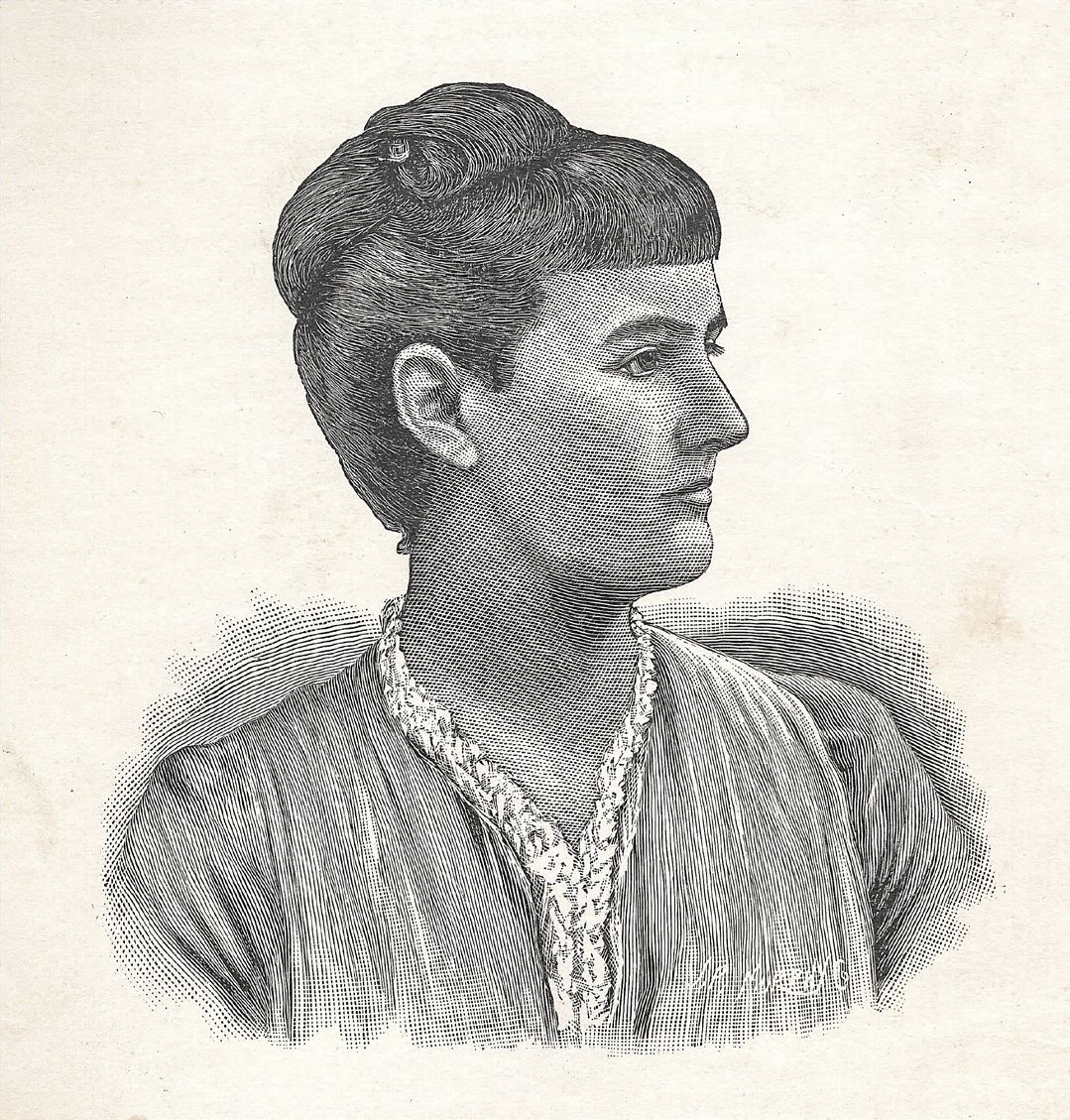
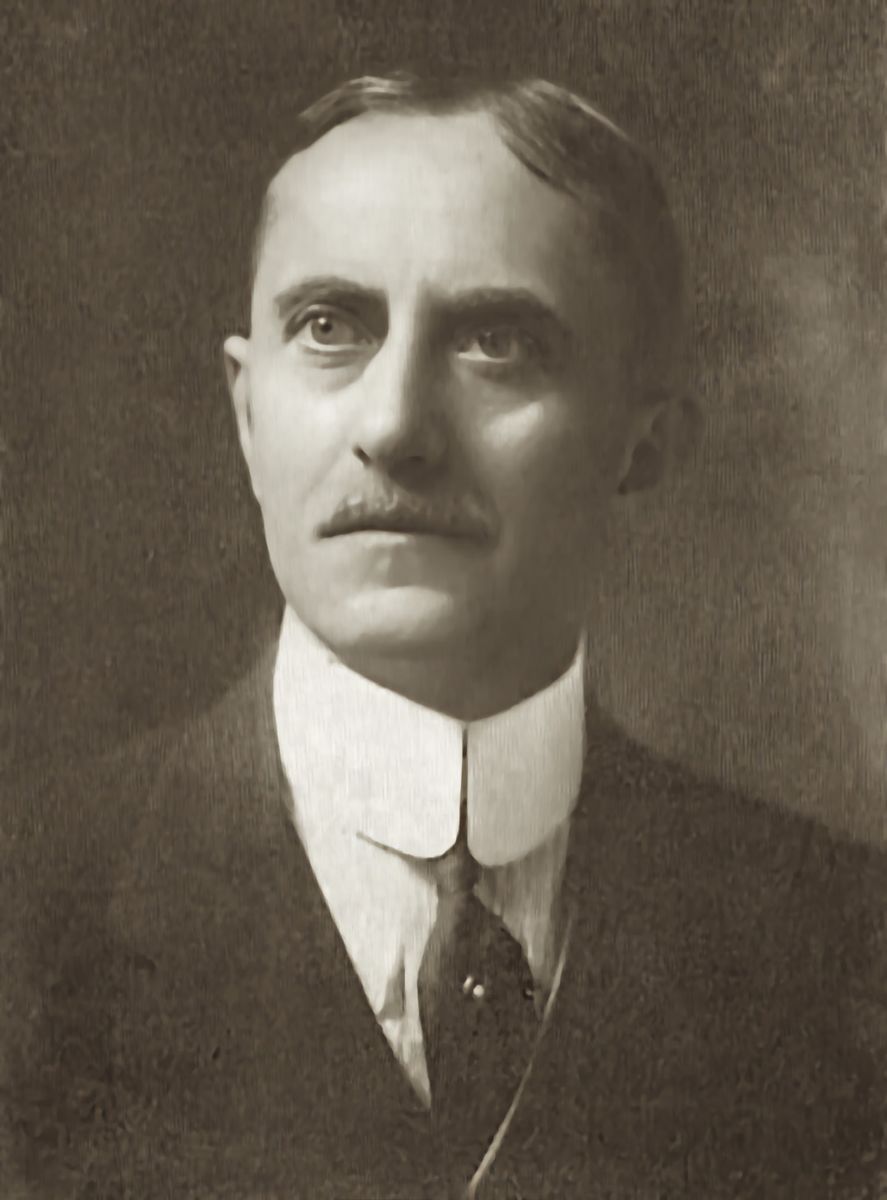
Anger consumed Irene Sheridan in mid-September 1888 as she read a newspaper article announcing the upcoming release of a biography of her recently deceased husband, The Life of Gen. P.H. Sheridan: Its Romance and Reality. Mrs. Sheridan fully expected that General Philip H. Sheridan, who at the time of his death on August 5, 1888, held the rank of General of the Army, would be the subject of numerous books. “I certainly have no objection to anyone writing of my husband,” Mrs. Sheridan wrote.1 By the time General Sheridan passed away, five biographies had already been written about him.2 What bothered Mrs. Sheridan was that the article stated one of the book’s authors, Frank A. Burr, who was a first sergeant in the Second Michigan Cavalry when Sheridan commanded the regiment in 1862, was described as General Sheridan’s “intimate friend.” It also mentioned that Sheridan “aided” Burr and co-author Richard J. Hinton, who was an officer in two United States Colored Troop regiments during the Civil War, “in the preparation” and revision of the “book.”3
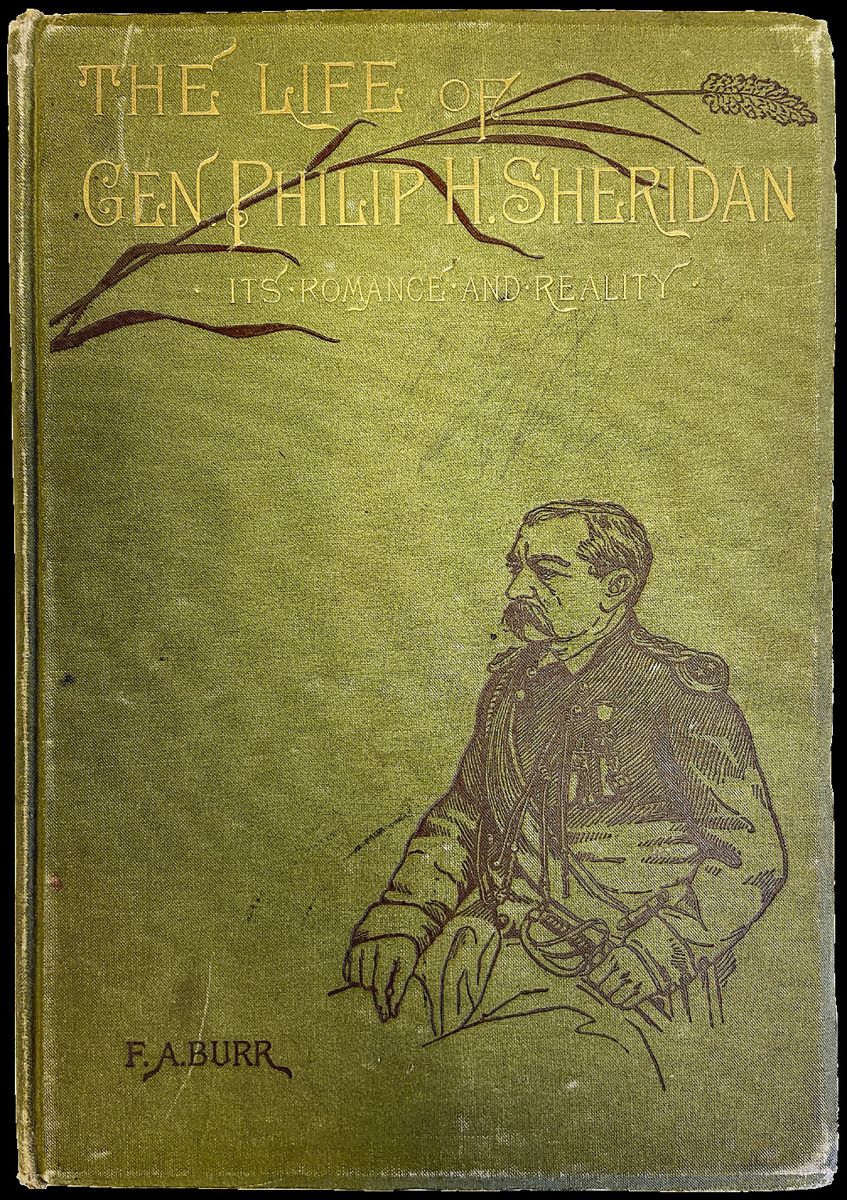
from the book. The only publication from which Sheridan’s widow would benefit financially was her husband’s twovolume Personal Memoirs of P.H. Sheridan, which its publisher, Charles L. Webster & Co., announced would be released on December 1, 1888. “I have no pecuniary interest in any publication about Gen. Sheridan except his own personal memoirs,” she explained.5 As newspapers across the United States published Mrs. Sheridan’s letter in late September, Sheridan’s supporters launched a smear campaign against Burr and Hinton without knowing how their book would portray Sheridan. Had Mrs. Sheridan or any of her allies taken a moment to read the excerpts in the sample that salespeople used to secure subscriptions for the book, they would have felt foolish criticizing it. Burr and Hinton admired Sheridan deeply and cast Sheridan as a military “genius” who came from “humble” beginnings and forged an unbreakable bond with his troops that translated into victory on the battlefield.6 However, armed with no knowledge of the book’s contents, Sheridan’s allies urged the public not to purchase the biography, claiming that the authors merely gathered “a number of well-known facts and a few illustrations… to make a little money.”7 As the criticism mounted, the publisher retracted the statements that enraged Mrs. Sheridan and asserted that neither they nor the authors “have… authorized any statements that Mrs. Sheridan was pecuniarily interested in the book nor that the General was responsible for its contents.”8
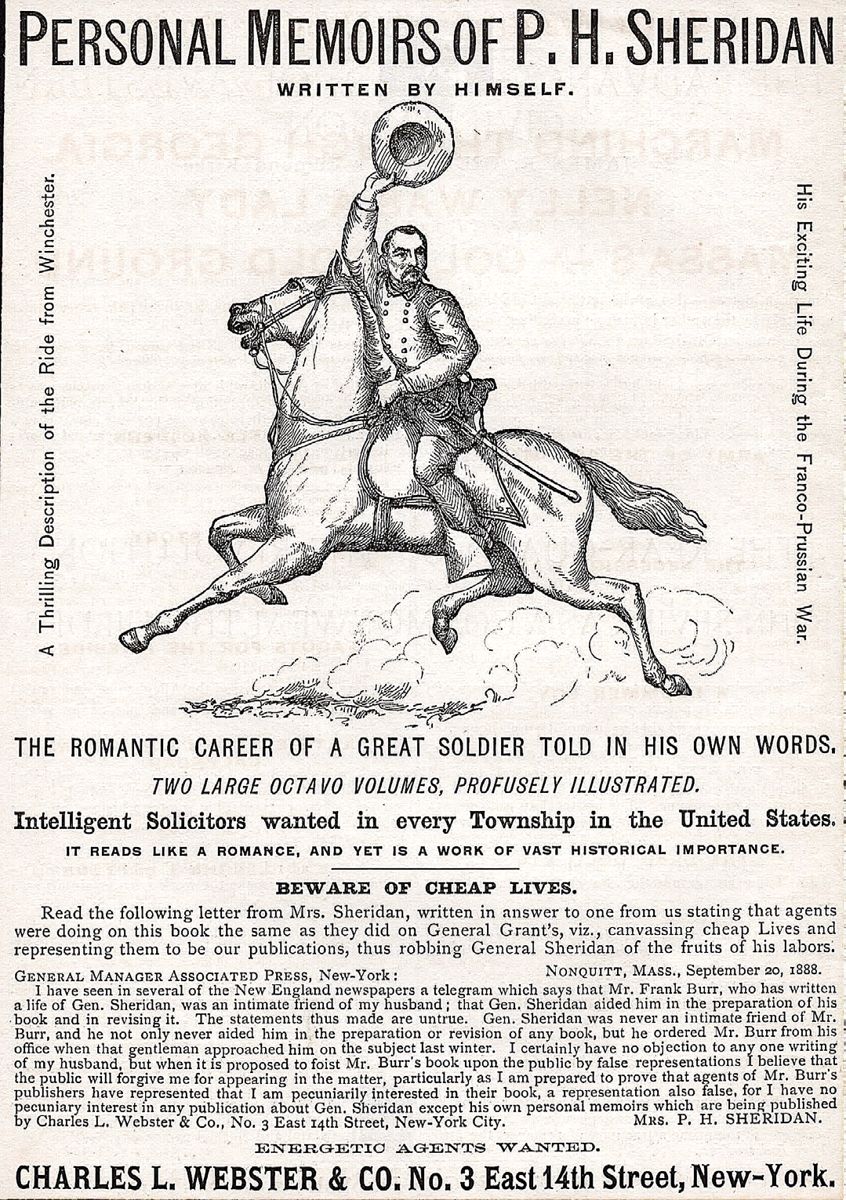
Unaware of how the book would portray her husband, Mrs. Sheridan realized that permitting the publisher’s claims to go unchecked would bring instant legitimacy to Burr’s and Hinton’s biography. Rather than reach out to the publisher, J.A. & R.A. Reid, Mrs. Sheridan shared her concerns with the Associated Press (AP), hoping newspapers nationwide would publish her grievances. “Gen. Sheridan was never an intimate of Mr. Burr, and he not only never aided him in the preparation or revision of any book, but he ordered Mr. Burr from his office when that gentleman approached him on the subject last winter,” Mrs. Sheridan explained to the AP on September 20, 1888.4 Additionally, Mrs. Sheridan protested the publisher’s claim that she would benefit financially
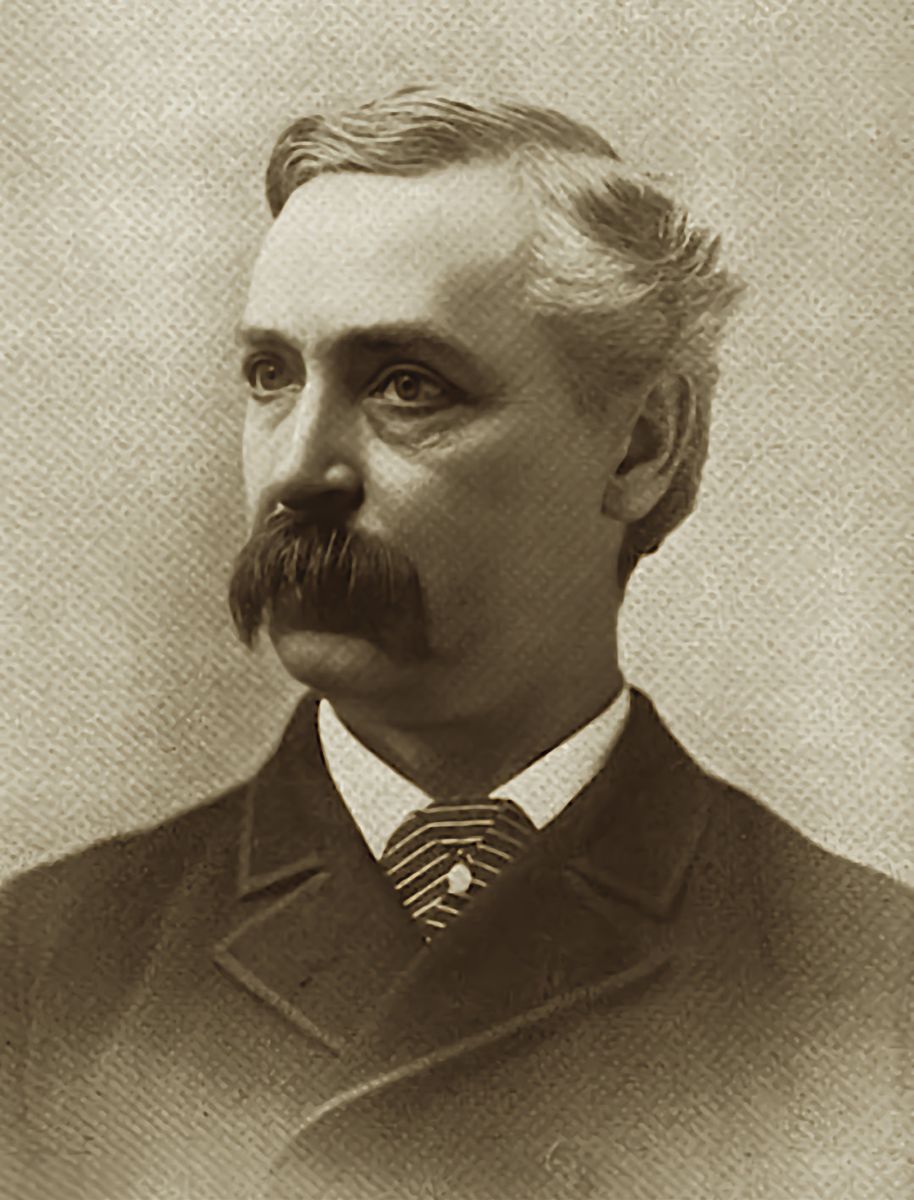
Frank A. Burr. (A General History of the Burr Family, 1891)
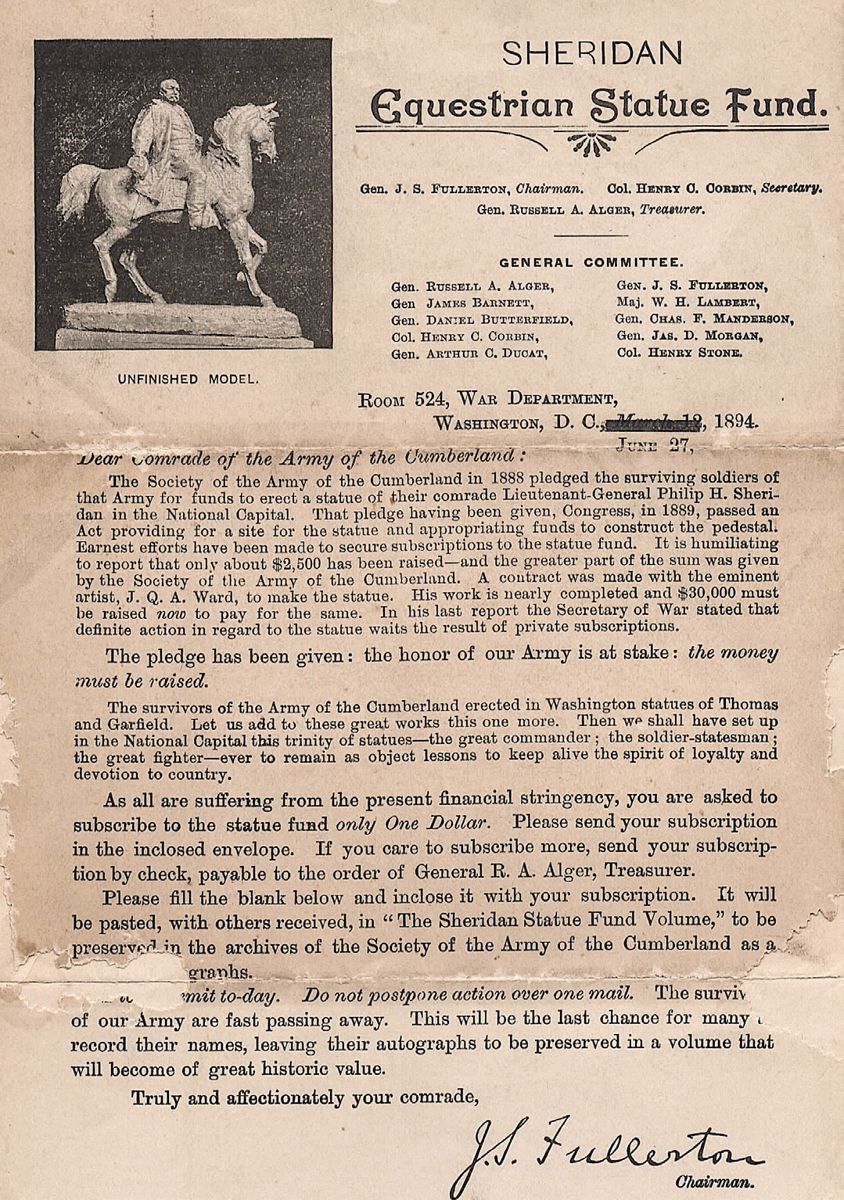
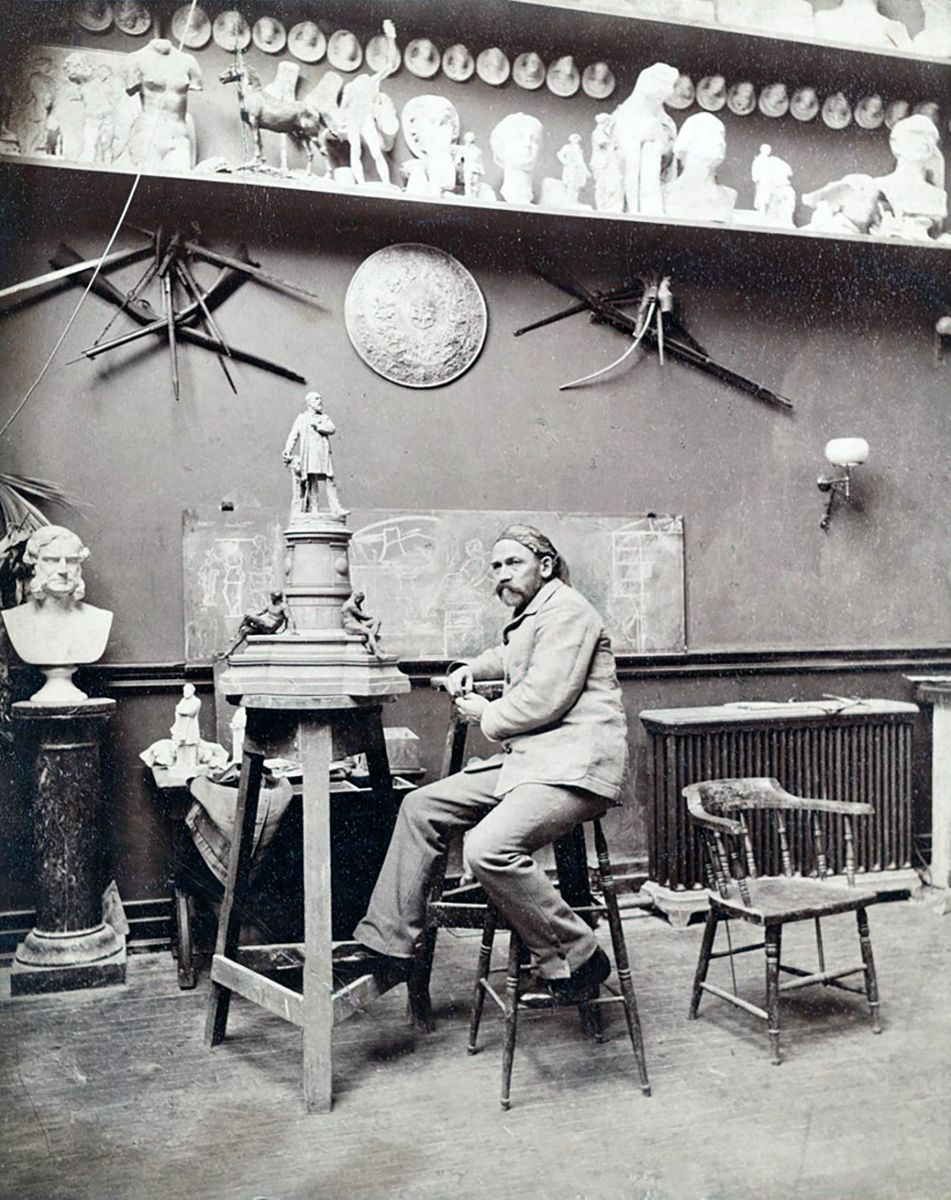
commissioned artist John Quincy Adams Ward. The veterans gave Ward six years to complete the project.12 Ward seemed a logical choice. Highly respected “for his lifelike statues of great men,” Ward knew Sheridan.13 In 1887, Ward, unaware that he would be selected to create a monument of Sheridan after the general’s death, interviewed Sheridan and crafted a study of Sheridan’s head.14 Initially, Ward had a clear vision for the monument. He wanted to depict Sheridan after the Civil War, a period of Sheridan’s life that Ward believed Sheridan was “especially proud.”15 Within two years after being commissioned, he produced a model. The model, a photograph of which appeared on a fundraising appeal to veterans of the Army of the Cumberland, was reportedly “satisfactory” to Mrs. Sheridan and “to the military authorities having jurisdiction in the matter.”16 However, it did not please Ward. “This design did not fulfill the ideal of the artist, and so he
Charles L. Webster & Co., a publishing company founded by Mark Twain, used Mrs. Sheridan’s letter to the Associated Press as part of its marketing campaign for The Personal Memoirs of Philip H. Sheridan. This ad warned buyers to “BEWARE OF CHEAP LIVES,” an attack against Burr’s and Hinton’s biography. (Author’s collection)
What Mrs. Sheridan thought of Burr’s and Hinton’s biography after its release in the autumn of 1888 is unknown, but the book received broad acclaim. A reviewer for The Philadelphia Times lauded it as “one of the most readable of all the many works relating to the heroes of the war.”9 One reader in Chicago believed that it served as the perfect “supplement” to Sheridan’s forthcoming Personal Memoirs.10 While Mrs. Sheridan and supporters launched their campaign against Burr’s and Hinton’s biography, veterans of the Society of the Army of the Cumberland inaugurated an effort to memorialize Sheridan in bronze in the nation’s capital. While Joseph Scott Fullerton, breveted brigadier general for his conduct at the Battles of Franklin and Nashville, led the effort to raise funds for the monument, a difficult task as the country grappled with economic recession at the time, and Congress worked to fund the monument’s pedestal, the Society of the Army of the Cumberland searched for a sculptor.11 In 1892, the Society
This sixty-four-page sales sample, used to obtain subscriptions for Burr’s and Hinton’s The Life of Gen. P.H. Sheridan, contained excerpts from six of the book’s thirty-one chapters. Curiously, the cover only listed Frank A. Burr on the cover. His co-author, Richard J. Hinton, is noted on the interior as having contributed to the book. Hinton’s name appeared on the cover of the full biography published in the autumn of 1888. (Author’s collection)
destroyed the cast,” a correspondent wrote.17 Ward, aiming for perfection despite his poor health, worked slowly to create a model he considered acceptable.18 Although exasperated by Ward’s slowness, the prospect of having her husband immortalized in the nation’s capital excited Mrs. Sheridan. In the autumn of 1903, she sold the home the Sheridans had lived in on Rhode Island Avenue, a gift from the “leading citizens” of Chicago, since 1883 when Sheridan succeeded Gen. William T. Sherman as commanding general of the army and purchased land to build a new house on Massachusetts Avenue, a glance away from where the future “splendid statue” of her husband would be erected.19 As Ward worked on the sculpture in the early 1900s, he invited Mrs. Sheridan to his New York studio and asked for her feedback, a decision he later regretted. When Mrs. Sheridan entered Ward’s studio on 52nd Street, she carried her own ideas about how Ward should depict her husband and how General Sheridan wished to be portrayed. In the closing years of General Sheridan’s life, during his tenure as commanding general of the army, he frequently walked Washington’s streets with his wife. On one occasion, they paused to view a statue of one of Sheridan’s comrades on horseback. Though the specific equestrian monument is unknown, General Sheridan considered it unsightly, remarking that the figure appeared “overweight,” and the horse seemed “too small.” Sheridan, aware that monuments would be erected to honor him after his death, did not object to being immortalized on horseback. However, he detested the idea of being memorialized on a monument that was disproportionate and looked stiff. “Whatever you do after I am gone, don’t put me on a horse like that,” Sheridan told his wife.20 Ward’s model did not meet Mrs. Sheridan’s expectations or her perception of how her husband wanted to be remembered.21 Ward depicted Sheridan as general of the army, astride a horse as if riding past troops in review. Mrs. Sheridan found Ward’s sculpture of her beloved husband’s face “not good, and…unnatural.”22 Mrs. Sheridan envisioned her husband represented as a lively young man riding his cherished horse Rienzi during his most famed moment: the ride from Winchester to Cedar Creek on October 19, 1864. She did not want her husband portrayed as Ward had done, as the stiff, robust, heart disease-plagued figure of his later years. Ward attempted to please Mrs. Sheridan but found it “impossible.”23 Mrs. Sheridan made things even more difficult for Ward when she denied his request to sketch pieces of Sheridan’s equipment.24 In the spring of 1905, after viewing Ward’s model with her son, Lieutenant Philip H. Sheridan Jr., Mrs. Sheridan
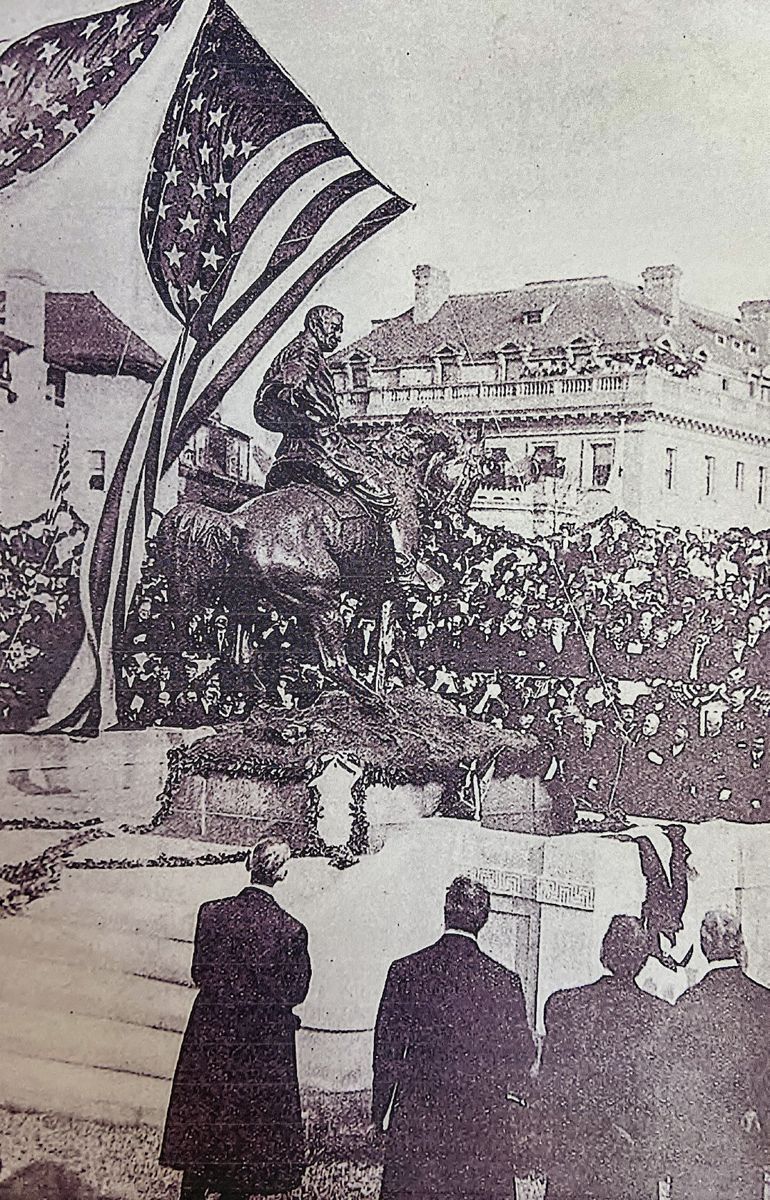
Top Right: Ward’s monument to Sheridan was dedicated in Albany, New York, on October 7, 1916. Despite Mrs. Sheridan’s disdain for it, she attended the dedication as a “guest of honor.” (Unveiling of the Equestrian Statue of General Philip H. Sheridan, Capitol Park, Albany, New York, 1916)
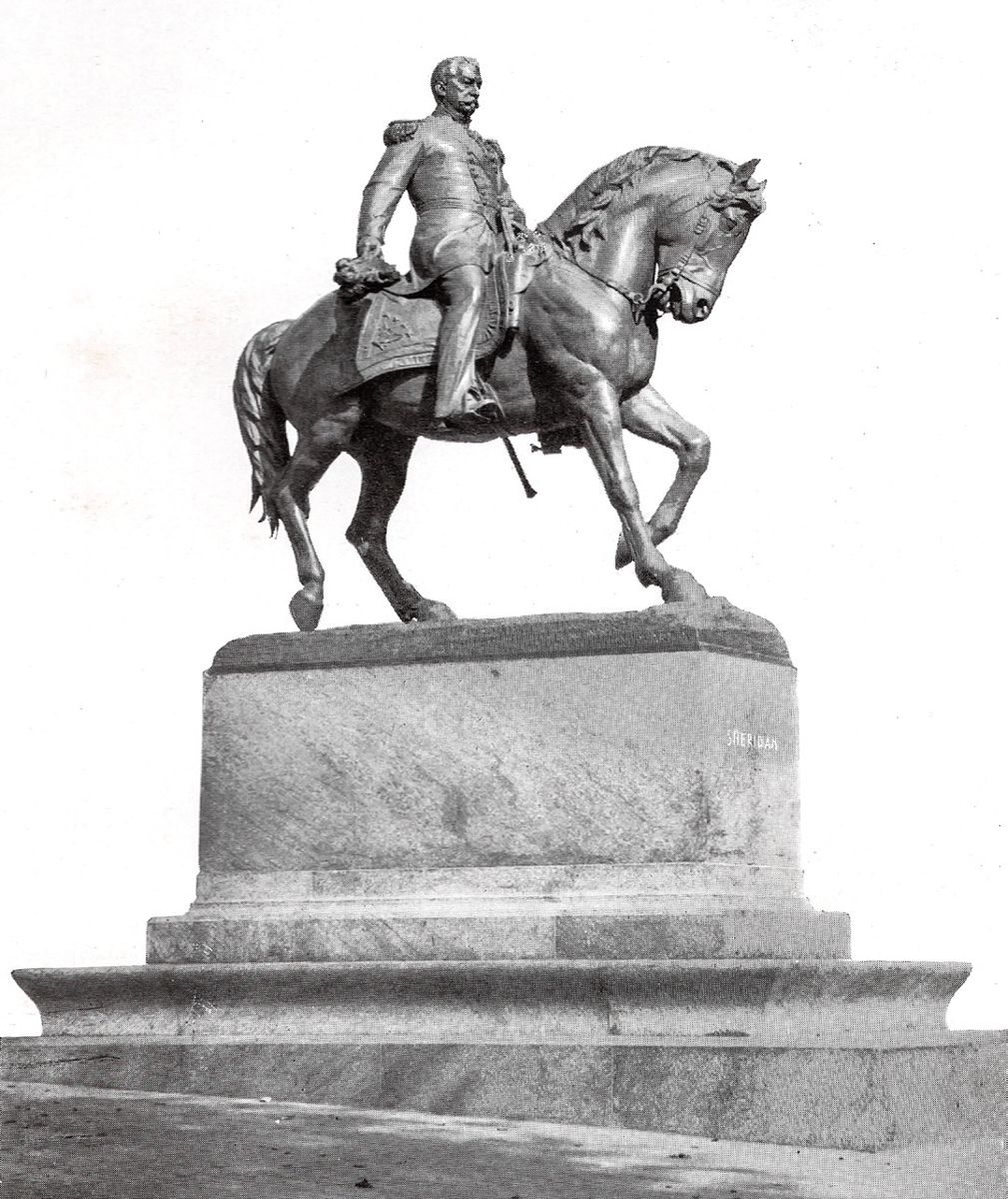
Right: East Capitol Park. A statute of Civil War general Phillip Sheridan, vstands between Eagle Street and the main steps of the state capitol building. Daniel Chester French lobbied to have it placed here after sculptor John Quincy Adams Ward’s death. (Kenneth C. Zirkel)
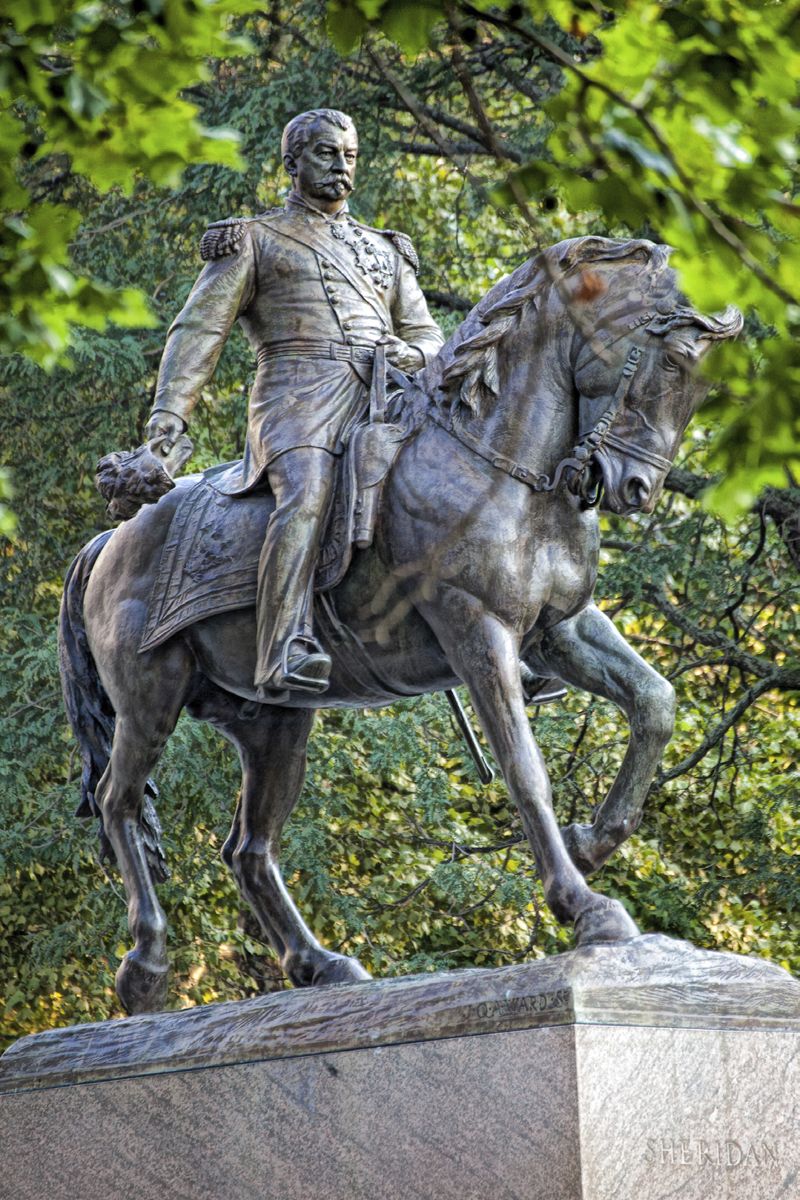
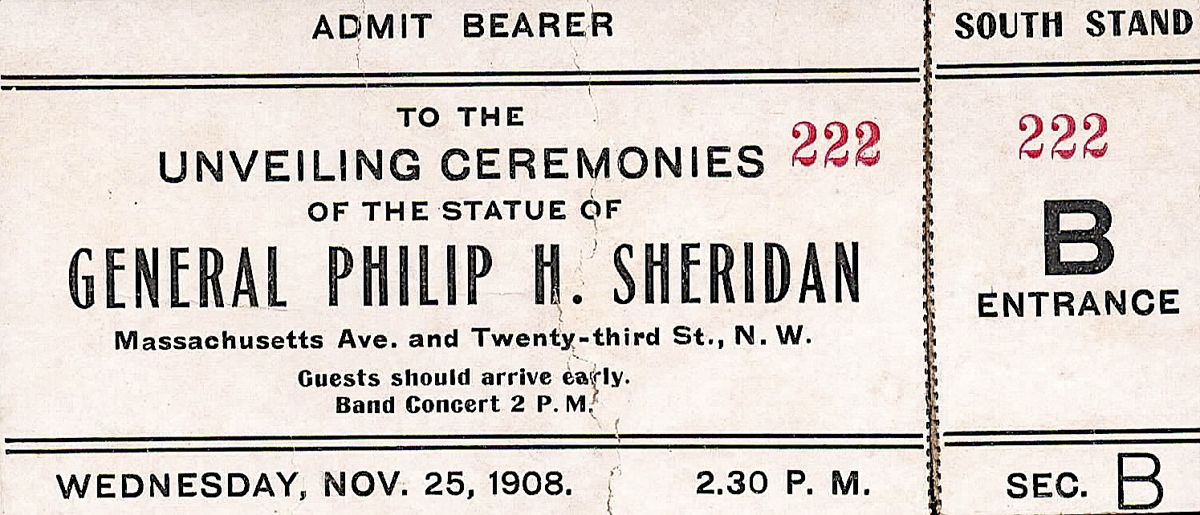
shared how much she “emphatically disapproved” of Ward’s sculpture with the monument committee and Secretary of War William Howard Taft. The committee directed Ward to start from scratch and prepare “new designs.”25 By the spring of 1906, Ward had completed his “new figure of Phil Sheridan.” Army officers sent by Secretary Taft to Ward’s studio reviewed it favorably, as did “friends of the general and…art critics.”26 However, Mrs. Sheridan and some members of the monument committee still disliked it.27 Among all the voices, Mrs. Sheridan’s carried the most weight. Secretary Taft regarded her opinion as most valuable, and in early 1907, Ward’s contract was terminated.28 Furious that he could not capture Mrs. Sheridan’s “impossible ideal of her illustrious husband,” Ward initiated a lawsuit against the Society of the Army of the Cumberland’s Sheridan Equestrian Statue Committee, seeking full recompense for sculpting six different models.29 While the legal battle, which Ward ultimately lost, ensued, the search for a new sculptor began.30 The committee quickly settled on Gutzon Borglum, a rival of Ward’s, who would embark on carving Mount Rushmore two decades later. Mrs. Sheridan approved of the choice. She admired Borglum’s talent and his admiration for General Sheridan. Mrs. Sheridan provided access to any military accoutrements Borglum wished to sketch.31 Secretary Taft approved Borglum’s model, with Mrs. Sheridan’s consent, on July 31, 1907. Borglum, according to one correspondent, breathed “a sigh of relief” as he keenly understood how “onerous” a task it had been for Ward.32 Fifteen months later, the monument was dedicated. Borglum’s monument met with widespread approval. One newspaper correspondent wrote that “the universal opinion of those who witnessed the unveiling” was that it was a “worthy memorial,” one in which Borglum adeptly “captured” Sheridan’s “life expression.”33
However, not everyone believed Borglum’s statue worthy of praise. Sculptor Daniel Chester French, best known for his depiction of a larger-than-life seated Lincoln in the president’s memorial in Washington, D.C., which he made twenty-five years later, and one of Borglum’s rivals, detested it. To French, it represented a great injustice to John Quincy Adams Ward, one of French’s mentors. French hoped that someone would appreciate Ward’s model, which was displayed in French’s studio in New York City after Ward died in 1910, and commission a full-sized bronze monument. Four years after Ward’s death, a group from Albany, New York, the city Sheridan claimed in his Personal Memoirs as his birthplace, expressed interest in erecting Ward’s statue.34 A letter of support signed by eight noted artists who expressed their “high appreciation” of Ward’s “statue as a work of art” built momentum.35 On April 4, 1914, the Albany monument committee “recommended… the erection” of Ward’s “equestrian statue” in front of the New York Capitol in Albany.36 When Mrs. Sheridan learned about this, she expressed her disgust to state officials. She renewed her complaint that Ward’s model did “not at all reproduce the Sheridan face and figure.” Her protest fell on deaf ears.37 Edward B. Cantine, the son of a Union veteran and a member of the monument committee, responded bluntly to Mrs. Sheridan “that the work will be continued and the protest disregarded” because the “model was selected by a committee of artists, and had been pronounced an excellent likeness.”38 At that moment, Mrs. Sheridan acquiesced, registered no additional complaints, and accepted the invitation to attend the unveiling on October 7, 1916, as a “guest of honor.”39
While Irene Sheridan might have finally lost the battle over Ward’s statue, her commitment to ensuring that the nation remembered her husband as a dashing, energetic officer who respected his soldiers and received their admiration in return demonstrated that she, as she repeatedly informed correspondents until her death fifty years after her husband’s, “would rather be Phil Sheridan’s widow than the wife of any living man.”40 Endnotes 1. 2.
New York Tribune, September 21, 1888. The following biographies of Sheridan, excluding Burr and Hinton, were published between 1864 and the end of 1888. Julian K. Larke, The Life of Gen. P.H. Sheridan: The Hero of the Shenandoah (New York: T.R. Dawley, 1864); Charles W. Denison, Illustrated Life, Campaigns and Public Service of Philip H. Sheridan (Philadelphia: T.B. Peterson & Brothers, 1865); P.C. Headley, Life and Military Career of Major-General Philip H. Sheridan (New York: William H. Appleton, 1865). Headley’s biography was reissued in 1883 as Fighting Phil: The Life and Military Career of Lieut. Gen. Philip H. Sheridan (Boston: Lee and Shepherd, 1883). James P. Boyd, The Gallant Trooper: General Philip H. Sheridan (Philadelphia: P.W. Ziegler, 1888); Joseph Faulkner, The Life of Philip Henry Sheridan: The Dashing, Brave and Successful Soldier (New York: Hurst & Co., 1888). 3. New York Tribune, September 21, 1888; Frank A. Burr, Second Michigan Cavalry, Compiled Service Record, National Archives and Records Administration, Washington, DC; Richard J. Hinton, Seventy-Ninth United States Colored Troops and Eighty-Third United States Colored Troops, Compiled Service Record, National Archives and Records Administration, Washington, DC; The Boston Globe, October 8, 1888. 4. New York Tribune, September 21, 1888. 5. Ibid. 6. The Life of Gen. Philip H. Sheridan: Its Romance and Reality, Sales Sample, Jonathan A. Noyalas private collection, Martinsburg, WV. 7. St. Louis Post Dispatch, October 7, 1888. 8. The Daily Item (Lynn, MA), September 21, 1888. 9. The Philadelphia Times, October 3, 1888. 10. Chicago Tribune, November 3, 1888. 11. Sheridan Equestrian Statue Fund, Jonathan A. Noyalas private
Ulysses S. Grant
collection, Martinsburg, WV; Evening Star (Washington, DC), March 13, 1907. Kathryn Allamong Jacob, Testament to Union: Civil War Monuments in Washinton, D.C. (Baltimore, MD: The Johns Hopkins University Press, 1998), 137. The Pittsburgh Press, August 12, 1907. Thomas J. Brown, Civil War Monuments and the Militarization of America (Chapel Hill: University of North Carolina Press, 2019), 168. Ibid. “Mrs. General Sheridan’s New Home,” The Index 9, no. 22 (1908): 8; Sheridan Equestrian Statue Fund, Jonathan A. Noyalas private collection, Martinsburg, WV. “Mrs. General Sheridan’s New Home,” 8. Brown, Civil War Monuments, 168. The Tennessean (Nashville, TN), October 28, 1883; Harper’s Weekly, July 9, 1887; “Mrs. General Sheridan’s New Home,” 8. Quoted in Jacob, Testament to Union, 134. Ibid., 137 The New York Times, March 14, 1907. New York Tribune, August 29, 1907. Jacob, Testament to Union, 137. The Buffalo Commercial, May 9, 1905. Brown, Civil War Monuments, 170. Evening Star (Washington, DC), March 13, 1907. The Buffalo Commercial, May 9, 1905; Evening Star (Washington, DC), December 22, 1905, March 13, 1907; Brown, Civil War Monuments, 170. The Times Recorder (Zanesville, OH), August 3, 1907; New York Tribune, January 13, 1909. Jacob, Testament to Union, 137. Ibid., 138. The Washington Post, August 1, 1907. Perth Amboy Evening News (Perth Amboy, NJ), November 25, 1908. Holzer, Monument Man, 253-254. Philip H. Sheridan Camp No. 200, Sons of Veterans, to J. Harris Loucks, March 12, 1914, quoted in Unveiling, 35-36. Resolution, April 4, 1914, quoted in ibid., 39. Harold Holzer, Monument Man: The Life & Art of Daniel Chester French (New York: Princeton Architectural Press, 2019), 254; Richwood Gazette (Richwood, OH), May 13, 1915. Brooklyn Eagle, April 17, 1915. The Times Union (Brooklyn, NY), October 7, 1916. Times Herald (Washington, DC), October 11, 1903.
Title page photograph: Civil War image of Major General Phil H. Sheridan in the field. (Library of Congress)
J onathan A. N oyalas is director of S henandoah University’s McCormick Civil War Institute and a history professor at Shenandoah. He is the author or editor of seventeen books including The Blood-Tinted Waters of the Shenandoah (Savas Beatie) and the forthcoming General Philip H. Sheridan: Life, War, and Memory (Routledge).
CivilWarNavy.com civilwarnavy.com