
Fiercest Fights One Of The
By Stephanie Hagiwara · Originally published September-October 2025 · pp. 6–9
In August 1864, control of the Shenandoah Valley, Va., pitted Union Gen. Philip Sheridan, Army of the Shenandoah, against. Confederate Gen. Jubal Early, Valley Cavalry. To the puzzlement of the men in the field, both generals seemed to prefer marching over fighting their foe.
Due to politics, Sheridan’s focus was on destroying food, livestock, and anything else that could militarily aid the Confederates. It was possible that Lincoln might not win the upcoming presidential election. The administration could not afford additional losses in the field. Sheridan had been cautioned not to fight a battle unless he could win. Future President William McKinley described the army’s movements as “a waltz up and down the valley, fighting and skirmishing, first at this point, and then at another, intrenching ourselves for a little while here and then over yonder.”
[THE BATTLE WAS] “A GRAND SPECTACLE! THE FLASHES FROM THE MUSKETRY AND ARTILLERY ILLUMINATING THE FIELD WITH THE BRILLIANCY OF A THOUSAND GAS JETS.” – CAPT. WILLIAM MCKINLEY, ARMY OF W.VA.
Gen. Jubal Early, C.S.A., colorization © 2025. (Public Domain)
Early believed that Sheridan “possessed an excessive caution which amounted to timidity.” Having fewer men, Early’s solution was to “use my forces so as to display them at different points with great rapidity, and thereby keep up the impression that they were much larger than they really were.” General Robert E. Lee, Army of Northern Virginia, sent Gen. Richard H. Anderson’s First Corps, 3,700 men as temporary reinforcement. Anderson outranked Early but graciously agreed to Early being in charge. On August 14, Anderson arrived at Front Royal, where the north and south forks of the Shenandoah River merged. By the end of August, Anderson considered the situation
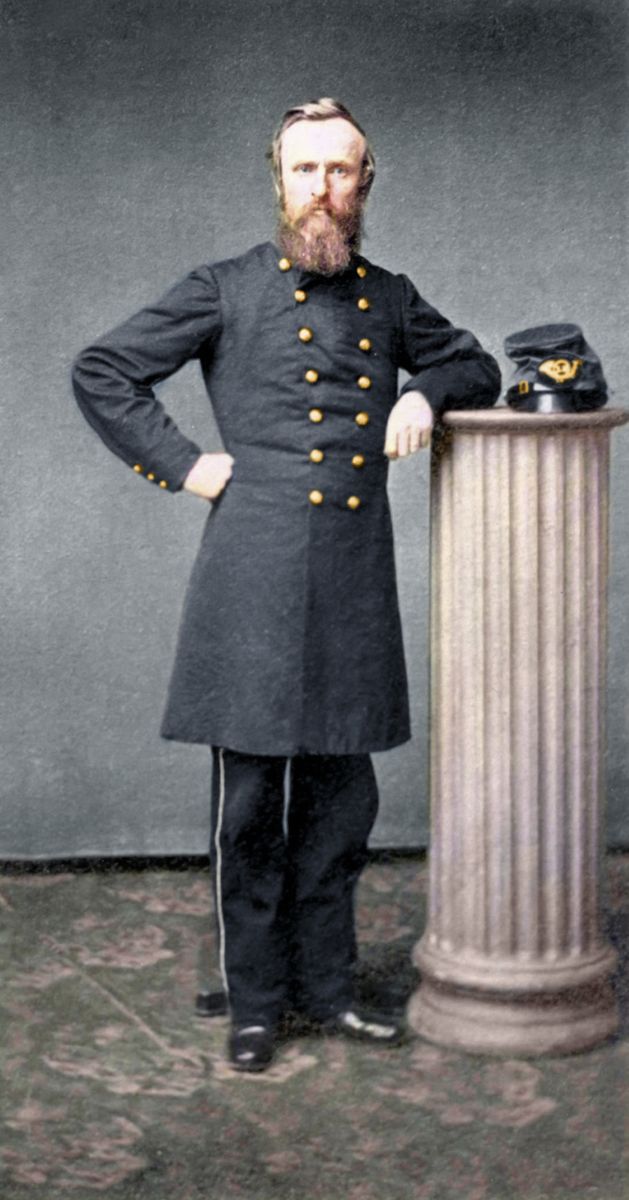
“useless when the enemy declined an engagement and we could not compel one.” He decided to march east, through the Blue Ridge at Snicker’s Gap and operate in the Loudoun Valley. On September 3, Sheridan decided to move his 40,000 men towards Opequon Creek. Gen. George Crook’s Army of West Virginia, consisting of about 7,000 men, camped at Berryville. Among them was Col. Rutherford B. Hayes, future U.S. president. Hayes’s men had been fighting daily since they arrived in August. “My brigade and the other brigade of Crook’s old division are in the front and do the most of it.” According to Hayes, “Half of his (Crook’s) force is capital infantry—the old Kanawha Division and two or three other regiments. The rest is poor enough—as poor as anything here.” (Public Domain)
The September 3 and 4 Battle of Berryville, Va., began about 4 p.m. C.S. Gen. Joseph B. Kershaw ordered Gen. Benjamin G. Humphreys’ Mississippians to deploy in the woods south of the Berryville Pike and Col. William D. Rutherford’s South Carolina brigade and Col. James P. Simms’s Georgia brigade down the Berryville Pike to attack Crook’s outnumbered picket line. Crook responded by rushing Col. Joseph Thoburn’s Division to the north end of the pike. He ordered Col. Isaac Hardin Duval’s Division to deploy to the left. Before Duval’s men arrived, C.S. Capt. Charles W. Fry’s Orange battery began firing. The yelling Mississippians rushed from the woods. The Federals made a running retreat that engulfed approaching troops. Thoburn’s entire division was routed. Hayes’s men had built campfires and were cooking supper when firing could be heard. The bugle sounded, sparking the 36th Ohio, 5th and 13th W.Va. into double quick crossing the road to form a line behind a stone wall. Captain Russell Hastings, 23rd Ohio, recalled, “It was a laughable sight to
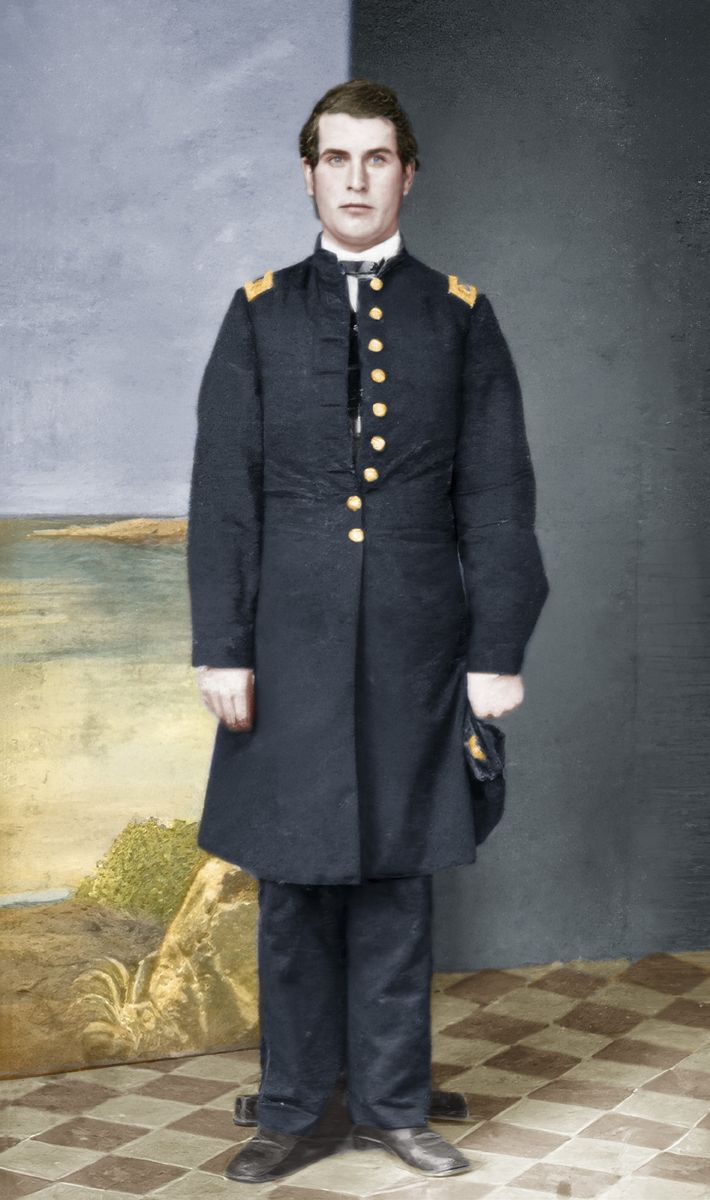
Maj. William McKinley, colorization © 2025. (Public Domain)
see the line formed with nearly every man holding a tin cup of coffee in hand, chewing and munching crackers and bacon.” Hayes’ men were soon reinforced by Duval’s 9th and 14th W.Va. Regiments. Duval’s men readied their guns and fixed bayonets. The men jeered as the panic-stricken Provisional Brigade ran past them to the rear. “Nothing could be more demoralizing to troops than to have such a stampede through their lines at such a vital moment. But our attention was quickly diverted from this fleeing mob by the onrush of the Confederate line. On the keen double-quick they came yelling like devils no doubt thinking the battle was won. I can assure you such a sight is not pleasing and such a rush is not easily stopped.”
“IT WAS A LAUGHABLE SIGHT TO SEE THE LINE FORMED WITH NEARLY EVERY MAN HOLDING A TIN CUP OF COFFEE IN HAND, CHEWING AND MUNCHING CRACKERS AND BACON.” – CAPTAIN RUSSELL HASTINGS, 23RD OHIO
The Federals fired “a murderous volley.” Hayes jumped on the wall and called out, “Go for them boys!” The men cheered. “The Confederates halted but an instant, then turned and ran, our boys after them.” Twilight came. For two hours, both sides deployed more men to fire at each other, emptying their cartridge boxes but unwilling to risk the danger of a night charge. The flashes of gunfire could be seen until after 10 p.m. “We had one of the fiercest fights yesterday I was ever in,” Hayes wrote. “Prisoners say it is the first time their division was ever flogged in fair fight.” Berryville was McKinley’s first battle in his role as an acting assistant adjutant general on Gen. George Crook’s staff. Part of the 21-year old’s job was serving as a highlevel messenger on a fast horse. According to Hayes, McKinley had two or three horses shot out from under him, including one at Berryville. McKinley enjoyed telling the Berryville tale of how he was to direct a regiment to a new position before the armies retired. It was night. He wasn’t familiar with the area, and the Confederates were nearby. McKinley’s heart “jumped into his throat” when he heard the words, “Halt! Who goes thar?” in a pronounced Southern accent. Taking advantage of the dark, McKinley turned his horse and hurried away. Soon he was again hearing the age-old challenge, “Halt! Who goes there?” but this time with a Yankee twang. Instantly, McKinley knew he was among friends. He gave the countersign and soon had the regiment moving. On September 4, Early had arrived at 9:30 a.m. to support Anderson. Kershaw’s men were already skirmishing. Early saluted Anderson and remarked, “Those Yankees came might near getting you yesterday.” Anderson replied, “Yes, General, and it is not your fault that they did not.”
During the night, Sheridan had moved Crook’s men closer to Gen. William Emory’s XIX Corps, and Gen. Alfred T.A. Torbert’s cavalry on Crook’s left flank. He planned a defensive posture. Early and Anderson planned an attack. The pair moved to an elevated position to view the ground. Looking through field glasses, Early realized Sheridan “was too strong to attack.” The generals decided it would be best to withdraw under the cover of darkness. Gen. Ulysses S. Grant, commander of all Union armies, had been sending troops to destroy the Shenandoah as a Confederate military asset. This was the first time that Early had seen Sheridan’s entire line since it had been reinforced. Sources:
Patchen, Scott Charles. The Last Battle of Winchester: Savas Beatie LLC, 2013 Hastings, Russell, The Civil War Memoir of Russell Hastings, Rutherford B. Hayes Presidential Center Hayes, Rutherford B. Rutherford B. Hayes Diary, Vol. II [1861- 1865], Rutherford B. Hayes Presidential Center Armstrong, Wiliam H. Major McKinley: William Mckinley & The Civil War: The Kent State University Press, 2000
Stephanie Hagiwara is the editor for CivilWarinColor.
com and CivilWarin3D.com. She also writes a column for
HistoryinFullColor.com that covers stories of photographs of historical interest from the 1850’s to the present. Her articles can be found on Facebook, Tumblr and Pinterest.
Subscribe Today!
Letters to the st!
e a Mu Provenanc
Editor
Email to: [email protected]