
Emerging Civil War
By Chris Mackowski, Ph.D. · Originally published September-October 2025 · pp. 42–44
Moment of Mercy —and Reflection
Sculpted by Terry Jones, Moment of Mercy was dedicated in 2001.
Sgt. Richard Kirkland died at the Battle of Chickamauga on September 20, 1863. (Photo courtesy Emerging Civil War)
Sergeant Richard Kirkland of the 2nd South Carolina Infantry leans with a canteen over a wounded soldier cradled in his arms. The wounded man is a member of the 127th Pennsylvania Infantry, although nothing on the nearby bronze tablet indicates that. You have to recognize the unit designation on the man’s kepi. Instead, the tablet recounts the story of Kirkland’s act of compassion, delivering water to wounded enemies in the wake of the December 1862 battle of Fredericksburg. “Soldiers in blue and soldiers in gray repeated this incident many times throughout the Civil War,” the plaque says. “This Moment of Mercy sculpture pays homage to them and the uniquely American spirit of aiding those in need.” My group and I are not in Fredericksburg, Va., though, but rather, we’re standing in front of the National Civil War Museum in Harrisburg, Penn. The choice of the 127th PA—a unit raised in Harrisburg—helps ground this scene in this place. The life-size figures help ground the story in common humanity. A similar monument, titled The Angel of Marye’s Heights, stands in front of Fredericksburg’s infamous stone wall in the very area where Kirkland ministered to the wounded. That statue stands atop a large granite base, raising the tableau above the visitor and accentuating the larger-thanlife scale of the figures. Moment of Mercy brings them to ground level and invites you to bear witness to the scene. I’m co-leading a bus tour from the American Battlefield Trust’s Teacher Institute on a half-day trip to the museum.
This is our last exhibit to look at before we hop back on the bus for the return trip to Gettysburg. Stories such as Kirkland’s capture our attention and imagination for many reasons. We like to be reminded of common decency, kindness, and our shared humanity. We admire people willing to put themselves in harm’s way to help others. We struggle to make sense of the chaos and carnage of war.
“The men in these armies spent the previous day trying to kill each other,” I tell the teachers. “And then, in a pause in the action, Kirkland goes out to help these wounded men and does what he can for them.” While such scenes can inspire us, we have to be careful not to romanticize or even fetishize them. For as touching as this moment of mercy was, let’s not forget that the men in these armies went right back to trying to kill each other— and they kept on trying to kill each other for another twoplus years. “Every monument has a story it wants you to remember,” I explain. “But remember: those stories aren’t histories. They are ways of remembering. The monument wants you to remember something a certain way.”
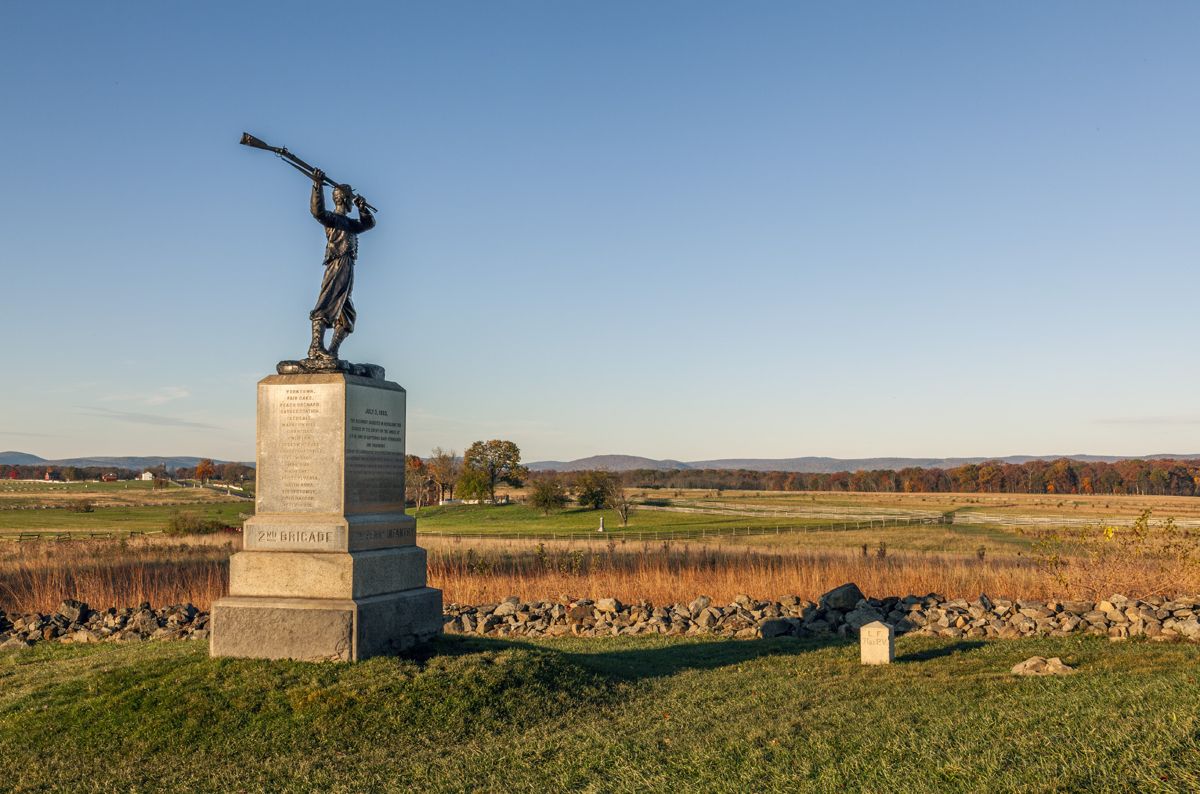
As dramatic as the 72nd Pennsylvania monument can be to photograph, it’s not nearly as dramatic as the legal fight over the statue’s placement. (Jack W. Melton Jr.)
I call to mind the Virginia Memorial the teachers have seen along West Confederate Avenue in Gettysburg. Atop it, Robert E. Lee stands majestic, heroic, gazing across the fields toward the Federal position along Cemetery Ridge. It is as idealized an image of Lee as has ever been created. But Lee also had a nasty temper: where is the monument of “angry Lee”? He had digestive problems at Gettysburg: where is the monument showing him doing the green-apple two-step? Lee owned slaves: where is the monument that shows Lee the slaveowner?
Just the mention of such portrayals ticks off a lot Lee admirers, but that also illustrates my point: people want to remember Lee in certain ways and sometimes only in certain ways. Monuments cast those specific memories into bronze or stone, further reinforcing them.
I call to mind, too, the monument to the 72nd Pennsylvania Infantry along Cemetery Ridge. A Zouave with rifle raised like a club poses dramatically against each evening’s sunset. Yet that regiment didn’t occupy that spot in the line as Confederates first broke through on July 3, 1863, and they initially refused to rush in as part of a counterattack. Only later did they go in. Years later, they placed their monument to suggest they took part in the heaviest of the fighting. They wanted to be remembered in a particular way, and they used the placement of their monument to reinforce that story, as inaccurate as it was.
“Use monuments as critical thinking opportunities,” I tell the teachers. “Each has a story to tell, but each has a story it doesn’t tell, too. And each one has its own backstory. Asking questions about those things can help us better appreciate a fuller story and a more complicated history.”
Chris Mackowski, Ph.D., is the editor in chief of Emerging Civil War (www.emergingcivilwar.com) and a writing professor at St. Bonaventure University’s Jandoli School of Communication.
WALLACE MARKERT
J&J Military Antiques