
Awards Announced For Excellence In U.S. Army History Writing
By Stephen A. Bourque. University of North Texas Press. · Originally published September-October 2025 · pp. 10–11
Awards Announced For Excellence In U.S. Army History Writing FORT BELVOIR, VA – The Army Historical Foundation is pleased to announce the winners of the 2024 Army Historical Foundation Distinguished Writing Awards. The 2024 awards honor books and articles published in 2024.
The Winners: Book Awards Biography Tubby: Raymond O. Barton and the US Army, 1889–1963. By Stephen A. Bourque. University of North Texas Press.
Operational-Battle History Cassino ’44: The Brutal Battle for Rome. By James Holland. Atlantic Monthly Press.
Journals, Memoirs, and Letters Patton’s Tactician: The War Diary of Lieutenant General Geoffrey Keyes. Edited by James W. Holsinger, Jr. University Press of Kentucky.
Unit History Ski, Climb, Fight: The 10th Mountain Division and the Rise of Mountain Warfare. By Lance R. Blyth. University of Oklahoma Press.
Reference US Battle Tanks, 1946-2025. By Steven J. Zaloga. Osprey Publishing.
Article Awards Academic Journals “A Bold Experiment: The U.S. Zone Constabulary in Occupied Germany.” By M. Ashley Vance. Army History, Fall 2024.
Post-Traumatic Stress Disorder in the Civil War t was painfully clear in the fall of 1865 that Daniel M. Stearns had been deeply changed by war. His friends and family watched as the veteran struggled to function as a civilian and concentrate on his various jobs. They described him as irritable, nervous, lethargic, and obsessed with his army service. The former lieutenant complained about feeling as if the earth was undulating under him as he walked and equated the pressure in his head to an iron band squeezing his brain. Neighbors noticed Stearns shunned the company of friends and former veterans, preferring to be alone with his dog Harvey, which had been the mascot of his regiment, 104th Ohio Infantry. In a moment of clarity, Steans confessed that, “Those damn cannonballs did this to me.” By 1888, his erratic behavior forced his family to admit him to the North Cleveland Asylum in Ohio, where he would spend his remaining years with other veterans’ suffering from their wartime experiences, that doctors were desperately trying to understand. Stearns was one of thousands of Civil War veterans who suffered debilitating psychological damage from their
Journals and Magazines “Robbed of Reason: Post Traumatic Stress Disorder in the Civil War.” By Ernest A. Dollar Jr. Civil War News, November-December 2024. The book award winners receive a plaque honoring the book and a $1,000 cash award; the winner in the Reprint category receives a plaque only. The article award winners also received a plaque and a $250 cash award. The Army Historical Foundation, a 501(c)(3) nonprofit, tax-exempt organization, is dedicated to preserving the history and heritage of the American soldier. Its goal is to promote greater public appreciation for the contributions that America’s Army—Regular, Reserve, and National Guard—has made to the nation in 250 years of service. The Foundation is the principal fundraiser for the National Museum of the United States Army at Fort Belvoir, VA, which opened to the public on 11 November 2020. In addition to fundraising for the National Museum of the United States Army, the Foundation’s projects and activities include refurbishment of historical Army buildings; acquisition and conservation of historical art, artifacts, and documents; support of Army history education programs; historical research; publication of historical materials on the American soldier; and providing counsel and support to private and governmental organizations committed to the same goals as the Foundation. The AHF Distinguished Writing Awards program was established in 1997 to recognize authors who make a significant contribution to the scholarship on U.S. Army history. Each year, nominations are submitted to the Awards Committee by publishers and journal/magazine editors. A small group of finalists is selected and a final judging is made. Thank you to all the book publishers and journals/ magazines who submitted nominees for this year’s awards. We look forward to your participation in next year’s program. For more information on the Foundation and its activities, please view the AHF website at www.armyhistory.org. For the AHF Distinguished Writing Awards, please contact: Mr. Matthew J. Seelinger Chief Historian Army Historical Foundation Fort Belvoir, VA 22060 (703) 562-4166; [email protected]
Congratulations to Ernest A. Dollar Jr. We are proud to extend our warmest congratulations to Civil War News author Ernest A. Dollar Jr. for receiving the 2024 Army Historical Foundation Distinguished Writing Award in the Journals and Magazines category. His compelling and insightful article, “Robbed of Reason: Post Traumatic Stress Disorder in the Civil War,” published in the November–December 2024 issue of Civil War News, was recognized for its exceptional scholarship, originality, and contribution to the field of military history. Dollar’s work sheds light on the long-overlooked emotional and psychological toll of the American Civil War, examining the historical roots of what we now understand as Post-Traumatic Stress Disorder (PTSD). Through careful research and evocative storytelling, he gives voice to the silent suffering of countless soldiers whose experiences were often dismissed or misunderstood in their own time. This national recognition by the Army Historical Foundation underscores the importance of continuing to explore the human cost of war. It highlights the value of historical journalism in deepening our understanding of the American experience. On behalf of the entire Civil War News editorial team and our readership, congratulations, Ernest, on this welldeserved honor!
service. Across the United States, troubled veterans were recognized for their erratic and violent behavior, substance abuse, and suicidal tendencies. Newspapers bore witness to the wave of institutionalized veterans and the struggle to find them solace. Identifying former soldiers who suffered from mental wounds from their service in Union and Confederate armies is a relatively recent, and difficult to quantify, process, but evidence of wartime trauma does exist in the historic record. Recent scientific advances have deepened our understanding of the mechanics of the human brain and body. This knowledge provides a new analysis of the veterans’ lives providing historians ith clearer understanding of men who suffered long after the guns fell silent. Examining Lt. Stearns’ war record suggests the root of his problems. The 25-year-old enlisted in the 8th Regiment, Pennsylvania Reserve Infantry in 1861 and quit after seeing little service. He reenlisted a year later in the 104th Ohio Infantry and experienced his first major combat in Maj. Gen. William T. Sherman’s 1864 Atlanta Campaign. Stearns and his new regiment found themselves in the brutal fighting outside Atlanta. After two days straight in the saddle leading his men, Stearns fell victim to a fever doctors diagnosed as sunstroke. After a day of rest, he was thrown back into the fighting at the Battle of Utoy Creek on August 6, 1864, where the regiment lost 26 men. Three months later, Stearns and his Ohioians found themselves again in the thick of a battle, receiving the full fury of Maj. Gen. Patrick Cleburne’s attack at the Battle of Franklin where the regiment lost another 60 killed and wounded.
Dr. Jacob Da Costa, ca. 1880. (Courtesy of the Center for the History of Medicine.)
Stearns’ battlefield experiences took their toll on his mind. Military doctors saw signs of stress but misdiagnosed his problem as “sunstroke,” a diagnosis commonly used by Civil War doctors who struggled to find a cause for the strange behavior they didn’t understand. Other terms for unknown behaviors such as nostalgia, neuralgia, melancholy, and homesickness. Doctors witnessed the psychological problems in the men they saw but lacked understanding to treat them and the language to articulate their conditions. There were physicians who worked to identify the causes of the troubled men who wandered into their hospitals and gave their condition a name. Doctors Jacob Da Costa and Isaac Stearns (no relation to Daniel M.) cared for thousands of men including those with physical conditions they could not explain. Da Costa examined soldiers who exhibited abnormal cardiovascular issues in his Philadelphia hospital. Their hearts raced while at rest and they seemed unable to concentrate. He speculated that this condition might be related to diet, field equipment, or, perhaps, their wartime experience. As early as 1862, Da Costa
Winslow Homer’s painting, “Playing Old Soldier,” captures one man’s attempt to avoid work by feigning illness. Many army surgeons mistakenly believed men invented their ailments when in reality their symptoms were the physical manifestation of undiagnosed combat stress. (Wikipedia Commons)
Valley Campaign. Immediately after the war, his family noticed a distinct change in Thomas. Problems came to a head in 1867 after he forced his wife to play their family piano while holding an axe over her head. Thomas was admitted to the North Carolina Insane Asylum in Raleigh where he drifted in and out of lucidity the rest of his life. In 1874, a visitor noted “the mildest description that can be given of the state of Col. Thomas’ mind was that he was a raving, furious maniac.” He was eventually transferred to the state’s second asylum in Morganton, built to handle an increasing number of psychological casualties, where he eventually died in 1893. Understanding the behavior of these Civil War veterans can be unlocked by modern science which provides powerful tools that confirm the link between trauma and symptoms. Modern brain mapping and neurofeedback equipment give doctors the ability to see the physical brain damage caused by trauma and correlate it with symptoms of veterans. Linking trauma’s changes in the brain to the symptoms, gives researchers a new approach to reexamine the historic record to uncover a generation deeply impacted by war. Trying to determine the exact numbers of veterans psychologically scared by the war is impossible. The spectrum of experiences includes those who were able to cope with the trauma they experienced and live fruitful lives while others were debilitated to the point of suicide. New research seeks to refine these numbers and provide insights into the role trauma played in the lives of Union veterans. The Early Indicators of Later Work Levels, Disease, and Death project launched by the National Bureau of Economic Research is a massive data analysis study that examines the lives of Union veterans to determine the impact of war service and its impact on their children. William Holland Thomas. (Public Domain) Researchers extracted data from almost 40,000 pension records of white Union army soldiers and 21,000 black soldiers to understand the war’s impact on survivors. The study looked at 1,325 unique variables in the lives of former soldiers such as wartime service, evidence of chronic disease, mortality, socioeconomic status, and overall health to discover trends and correlations between veterans. Also included in this massive data analysis are the lives of 54,000 children of veterans to discover how the war impacted them. This analysis is part of a burgeoning field of study called epigenetics, which explores how the changes trauma causes in the Illustration of the North Carolina Insane Asylum in Raleigh, N.C., as it body can be passed through appeared ca. 1860. heredity. The data analysis first took note of soldiers with these conditions who experienced fighting during the Peninsula Campaign. Over the next two years, the same symptoms continued to appear in his patients, leading Da Costa to share his findings with the medical profession. He penned an article in 1864 in which he described soldiers who showed signs of erratic heartbeats and other conditions such as headaches, tunnel vision, nightmares, insomnia, or fatigue. Well after the war in 1871, Da Costa formalized his wartime research profile of the 300 soldiers in another article, “On irritable heart: A clinical study of a form of functional cardiac disorder and its consequences.” Dr. Isaac Stearns, 22nd Massachusetts Infantry surgeon, saw patients with the same issues Da Costa wrote about and also struggled to find a cause. Both men looked to theories promoted by British doctors who had examined veterans from the 1853–1856 Crimean War. Stearns was drawn to the work of Dr. Dennis de Berdt Hovell who had studied the impact of events on the nervous system and the various physical results produced. Particularly interesting was Hovell’s term “moral shock” which associated these physical conditions with horrible events that eroded morals.
Artist George Lambdin painted “At the Front” featuring his younger brother, Capt. James Harrison Lambdin of the 121st Pennsylvania, in a pensive moment in camp. Captain Lambdin escaped wounding but the stress of war on his body caused a rapid deterioration which led to his release from the army in 1864 and early death six years later. (Detroit Institute of Arts, Founders Society Purchase, Director’s Discretionary Fund, 59.314.)
has revealed intriguing results. One discovery revealed that children of Union Army soldiers who suffered starvation as prisoners of war tended to be more obese and have shorter lifespans after the age of 45. In 2006, researchers using this data drew the startling conclusion that suggested soldiers who served in units with high casualty rates or served while young showed increased signs of cardiac and gastrointestinal issues as well as susceptibility to nervous diseases and other ailments. In all, researchers suggest 44% of Union veterans studied suffered some type of mental illness. These physical problems are linked to the dramatic changes caused when fear triggers the fight, flight, or freeze response in the brain. It left not only the minds of Union and Confederate soldiers troubled but stress also left their bodies “used up” and “played out.” British Revolutionary and Napoleonic War pensioners were described as “worn out in the service,” a similar phrase. Daniel Stearns understood his time at war caused his problems even if doctors did not. He looked around the Cleveland Asylum and saw fellow soldiers whose minds were eeply troubled by their experiences on almost every Civil War battlefield. For the next 50 years, governments, hospitals, jails, and families, both North and South, were overwhelmed by the needs of returning traumatized men whose minds and bodies were shattered by war. They struggled to understand their problems and provide the comfort they needed. It would take a century and a half before the impact of war on veterans became clear and how their experience resonated with generations afterward.
An Illustration of the National Home for Disabled Volunteer Soldiers, from the 1885 edition of the Wisconsin Blue Book. The National Home for Disabled Volunteer Soldiers was a network of residential communities that provided care for Union veterans after the American Civil War.
The tired soldier – a sketch from life at Petersburg during the siege June 19th 1864. By Edwin Forbes. (Library of Congress)
I Robbed of Reason:
By Ernest A. Dollar Jr. Lt. Daniel Merrill Stearns. (Courtesy Sue Scullion)
Dr. Isaac Holden Stearns. (The Medford Historical Society Civil War Photograph Collection)
ErnEst A. DollAr Jr., A nAtivE of DurhAm, north CArolinA, hAs workED in historiC sitEs in both north AnD south CArolinA sinCE 1993. hE CurrEntly sErvEs As thE DirECtor of musEums for thE City of rAlEigh. hE is thE Author of thE 2022 book Hearts torn asunder: trauma in tHe Civil War’s Final Campaign in nortH Carolina.
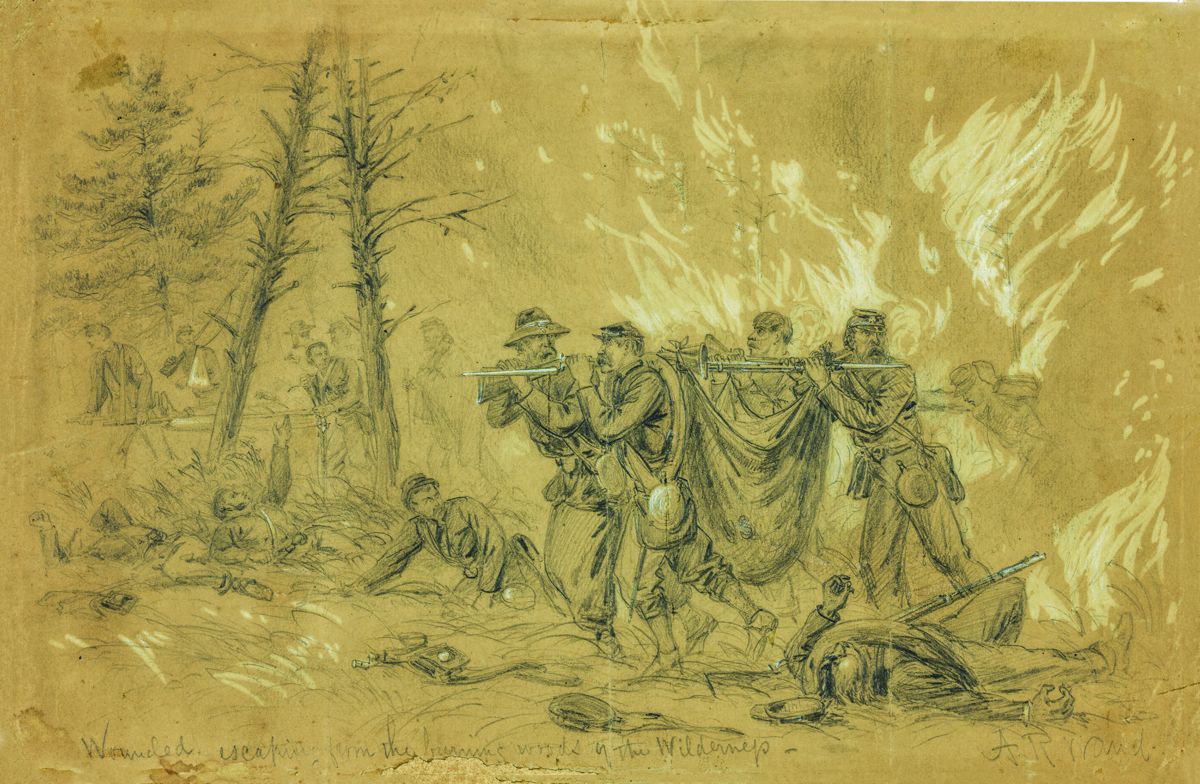
“Wounded escaping from the burning woods of the Wilderness” by Alfred Waud. (Library of Congress)