
Fighting for the Forts The War Before The War
By Leon Reed · Originally published May-June 2025 · pp. 60–65
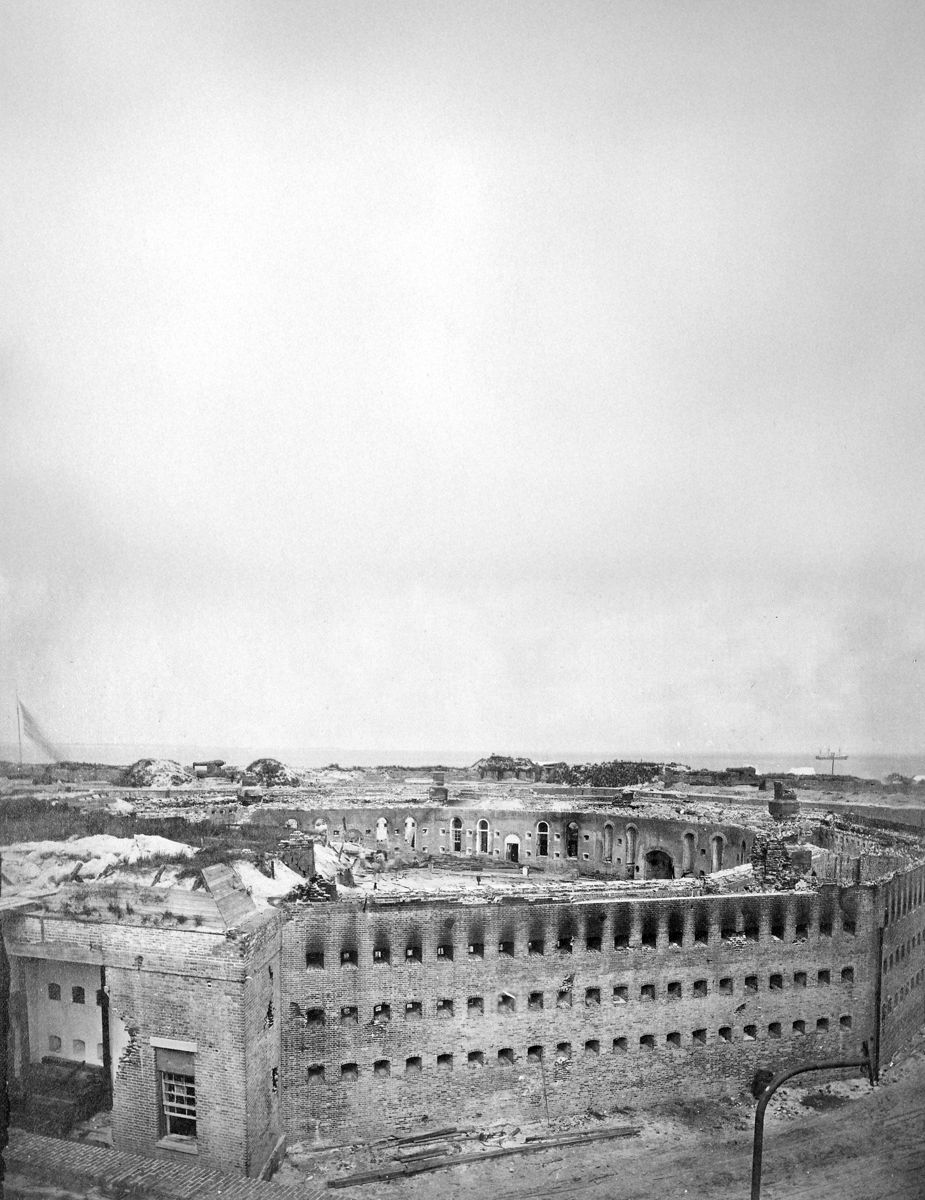
Fort Pulaski showing the effect of Union artillery. (Jack W. Melton Jr.)
Fort Sumter is frequently viewed as the “beginning of the Civil War.” But in reality, a small war had been underway for four months before the first shots were fired in Charleston Harbor. It involved possessing several dozen federal properties in seceding states, including forts; customs houses, mints, barracks, and navy yards; and arsenals where weapons and ammunition were manufactured or stored. A few weeks before Lincoln’s election, U.S. Army General in Chief Brevet Lt. Gen. Winfield Scott urged the Buchanan administration to guard against the risk that southern states might seize any of the nine forts in southern states. Most were ungarrisoned; none had enough men to hold out against any force trying to take it.1 The army wasn’t in a position to respond, even if it had been of a mind to do so. First, as long as John Floyd, former governor of Virginia, remained as secretary of war, nothing was going to happen. Even after Floyd’s December 29, 1860 departure, Scott had few resources; the prewar army consisted of 197 companies (99 infantry, 50 cavalry, and 48 artillery), only 18 of which, all artillery, were stationed east of the Mississippi River.2 Secessionist leaders urged the Southern states to seize forts and arsenals immediately, to prevent garrisoning by the “General Government.” South Carolina went first, seizing everything in Charleston Harbor but Fort Sumter in December. Alabama seized the arsenal at Mount Vernon and two Mobile forts, Fort Gaines and Fort Morgan, on January 3, 1861, eight days before its secession convention signed an ordinance of secession. On January 1, Georgia Senator Robert Toombs wrote Georgia Governor Joseph Brown, stating, “Mr. Holt of Kentucky, our bitter foe, has been made secretary of war. Fort Pulaski is in danger.”3 Two days later, Georgia militia seized Fort Pulaski, a full eighteen days before Georgia’s secession. Florida forces seized the Apalachicola Arsenal on January 6, and Fort Marion the next day. The state seceded January 10 and seized Fort McRae January 12.
Fort Morgan, Mobile Point, Ala., 1864, showing damage to the south side of the fort. (NARA)
On orders of the governor, Louisiana militia surrounded the Baton Rouge Arsenal and demanded its surrender, a full two weeks before secession. The commander, Capt. Joseph H. Haskin, threatened with “a rash sacrifice of life,” complied. Arkansas militia seized the Little Rock Arsenal in February, months before the public in that state supported secession. Though he favored secession, North Carolina’s Governor John Ellis objected when local militias seized several federal forts and arsenals in early January. Ellis saw this as provoking resistance from Unionists and ordered the forts returned.4 “As such a move … is without orders from this Department and without the warrant of law, you will at once require the troops … to be withdrawn from that fort, and the same placed in charge of the United States who may have been dispossessed.”5 Governor Ellis wrote President Buchanan explaining his quick order for the return of the facilities, but his questions showed a deep suspicion of federal intentions. He stated the takeover had been triggered by a rumor that the National Government was about to garrison the forts “and begin the work of our subjugation… I now most earnestly appeal to your Excellency to strengthen my hands in my efforts to preserve the public order here by placing it in my power to give public assurances that no measures of force are contemplated towards us. … Should I receive assurances that no troops will be sent to this State prior to 4th March next, then all will be peace and quiet here, and the property of the United States will be protected as heretofore. If, however, I am unable to get such assurances, I will not undertake to answer for the consequences.” But the pro-southern Floyd was gone and new Secretary of War Joseph Holt answered. His January 15 reply was undoubtedly less assuring than Ellis had hoped for. After passing on the President’s thanks for the prompt “expulsion of the lawless men,” Holt answered cautiously:
“In answer to your inquiry, … I am directed to say that they, in common with the other forts, arsenals, and public property of the United States, are in the charge of the President, and that, if assailed, no matter from what quarter or under what pretext, it is his duty to protect them by all means which the law has placed at his disposal.” With that message, Holt signaled that things were not going to continue as they had for the previous few months when the Buchanan War Department had yielded to any surrender demand. Holt went on and dropped a threat of his own:
“Should they, however, be attacked or menaced … he could not escape from his constitutional obligations to defend and preserve them.”6 Even when state forces demanded the surrender of a small garrison, a considerable degree of military courtesy still prevailed. Lincoln’s secretary, John Nicolay, described a typical hand-over, “a demand for surrender in the name of the State and the compliance under protest by the officer in charge – salutes to the flag, peaceable evacuation, and unmolested transit home being graciously permitted as a military courtesy.”7 The hapless Federal attitude was changing. The new Lincoln cabinet’s tougher attitude following the departures of Floyd and Georgian Howell Cobb gave Scott more freedom to act. On January 2, he appointed Charles Stone to improve the defenses of Washington, D.C., and weed out secessionists in the local militia. On January 3, the day after receiving a letter from the commandant that the Harper’s Ferry arsenal was under threat, Holt directed the transfer of a 60-man company under Lt. Roger Jones, from Carlisle Barracks to Harper’s Ferry.8
An aerial photo of Fort Zachary Taylor State Park, Key West, Fla. (Photo by Andy Newman/Florida Keys News Bureau)
General Scott showed a strong strategic sense in prioritizing areas he was prepared to defend with his limited resources. Some forts were especially important. Fort Monroe controlled access to Chesapeake Bay and would be a vital base for blockaders or land forces operating in the Peninsula area. Fort Washington was a brick fort on the Potomac River, at the time the only defensive rampart guarding the river approaches to Washington, D.C. It was considered in some danger from both an armed attack from Virginia and from pro-secession groups in Maryland. An initial garrison of 40 Marines was assigned to the fortification; on January 16, Captain A.S. Taylor, commanding at Fort Washington, wrote the Commandant of the Marine Corps, stating the fort was being made ready “to mount howitzers in, but when mounted I have not men sufficient to work them and at the same time protect other assailable positions of the fort.”9 On January 31, the Marines were replaced by a garrison of Army recruits. Based on a letter from St. Louis congressman Frank Blair, a small garrison of Regular Army soldiers under Capt. Nathanael Lyon was dispatched to protect the St. Louis Arsenal, which held the largest supply of weapons in any slave state, in late January.10 After Fort Monroe, Key West (Fort Taylor) and Dry Tortugas (Fort Jefferson) may have been the most important Federal forts. Both would be important bases for blockading fleets and both were vital to controlling access to the Gulf of Mexico. One article related that “Tortugas is to the Gulf of Mexico … and Caribbean what Malta is to the Mediterranean and Adriatic.” The same article deemed Key West a more commanding entrance (to the Gulf) than Gibraltar provided the Mediterranean.11 Fort Jefferson was miles offshore and not difficult to defend, once it was garrisoned and equipped. As General Scott observed, undefended it was vulnerable to takeover by “a handful of filibusters or a rowboat of pirates.” On January 4, 1861, less than a week after Floyd’s departure,
Scott wrote Major Lewis G. Arnold, commanding the 2nd U.S. Artillery, at Fort Independence in Boston Harbor. Scott ordered Arnold to prepare for deployment to the south and to “provisionally engage transportation.”12 The party of four officers and 62 enlisted men arrived at Fort Jefferson on January 18.13 With the addition of armaments from the “abundance of guns and munitions” at Fort Taylor, Fort Jefferson was secure.14 On January 21, 1861, Scott wrote Secretary Holt that work was continuing to strengthen Fort Taylor. Half the garrison of Jefferson Barracks (22 men) had redeployed to the fort and Scott instructed Captain John Brannan of the 1st Artillery to send the remainder. Other than Charleston, perhaps the sharpest confrontations over possession of a fort happened in Pensacola. In early January 1861, the small garrison, Co. G, 1st U.S. Artillery, under Lieutenant Adam Slemmer was stationed at Barrancas Barracks.15 On the evening of January 8, while the garrison was moving the powder supply to a more secure location, a party of men approached the fort and was fired on by the guard; some consider these the first shots fired in the Civil War.16 The next day, Scott ordered Slemmer to do everything possible to keep a presence in the harbor. Slemmer moved his command of 47 soldiers and thirty loyal sailors from the naval yard to the more easily defensible Fort Pickens on January 10, the day Florida seceded.17 A delegation of “citizens from Florida and Alabama” soon visited the fort, demanding its surrender. Slemmer replied that his commission extended through the national government and that the governors of Florida and Alabama “are nothing to me.” Yet another armed party approached the fort on the night of the January 13, the third group within less than a week. On January 28, Slemmer and local forces agreed to a ceasefire; the local forces wouldn’t attack as long as the garrison wasn’t reinforced. However, both sides continued to build up forces in the area. Most dramatically, on January 21, Capt. Israel Vogdes of the 1st U.S. Artillery, stationed at Fort Monroe, was instructed to send a company to Fort Pickens.18 They arrived on February 6, after the ceasefire, and remained on ships, ready to move when needed, until the Fort Sumter situation started to unravel in mid-April. On April 6, Brig. Gen. Braxton Bragg wrote to LeRoy Pope Walker, the Secretary of War, asserting that the Union forces at Fort Pickens were acting in violation of the “no reinforcement” agreement and that “we are entirely absolved from all obligations under the agreement of 29th January.” He also claimed that he couldn’t do much. “I am not prepared with my batteries for anything more than a feeble defense.” Bragg commanded 5,000 troops, though more were arriving.19 A Southern newspaper recognized the reality of the situation on April 23: “We cannot starve them out without a naval force superior to that at their command. So we shall have to keep a strong force on hand to watch this nest of impudent fellows right under our noses.”20 In late November 1860, Captain James Totten and 65 men from the 2nd U.S. Artillery were reassigned from Fort Leavenworth, Kan., to garrison the previously empty Little Rock Arsenal. Totten’s move was intended as a show of force, but it backfired. It undoubtedly hastened the seizure of the arsenal and brought the nation to the brink of war, more than two months before hostilities eventually commenced. Some citizens of Arkansas came to see the presence of troops as an assault on the state’s sovereignty.21 Governor Rector demanded assurances from the fort’s commander that no efforts would be made to augment the defenses or remove or destroy any of the inventory.22 The commander wrote back stating that he was subject to the orders of the adjutant general, which didn’t satisfy the secessionists. Totten immediately wrote to Col. Samuel Cooper, adjutant general of the U.S. Army, requesting instructions. Perhaps
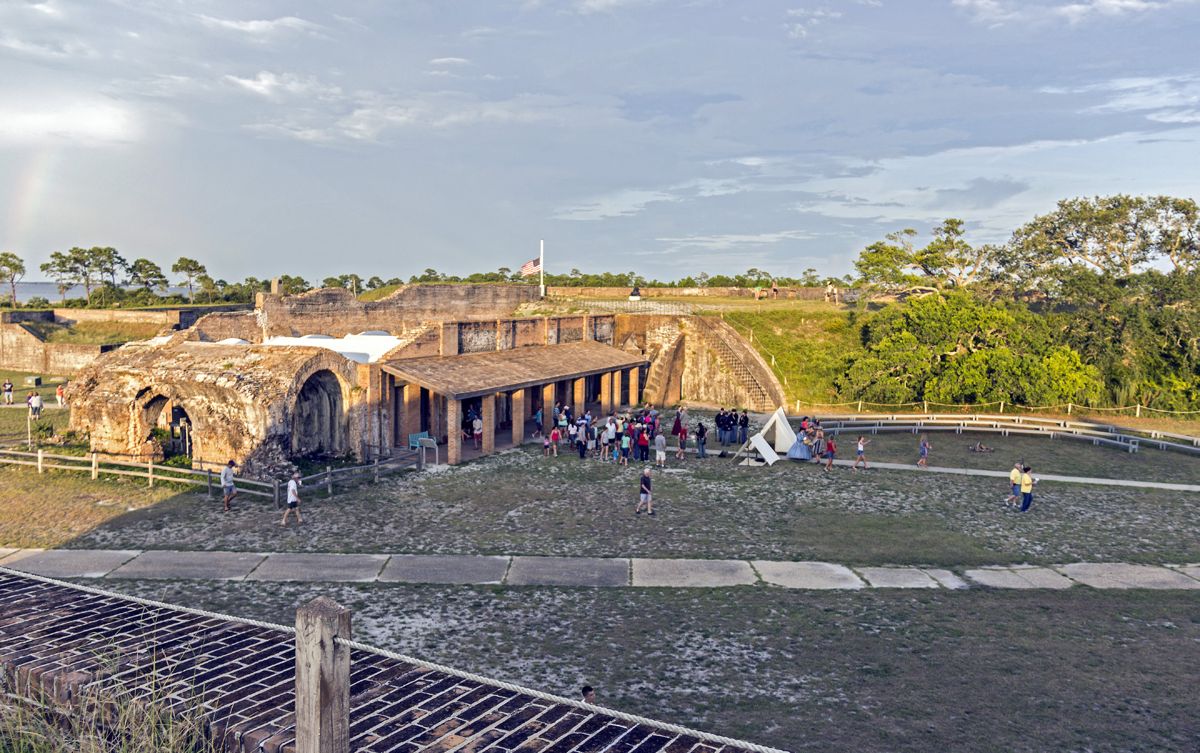
Interior view of Fort Pickens.
inevitably, Cooper, who would later resign and hold the same position for the Confederacy, never replied.23 Rumors continued to fly about reinforcements.24 Prosecession mobs began gathering around the arsenal, much to the consternation of Little Rock town fathers and residents.25 As the pressure ratcheted up and orders from the War Department were not forthcoming, Captain Totten engaged in painstaking negotiations about surrender terms and, his concerns being satisfied, he agreed to surrender on February 8. As was common with other transactions occurring at this early date, a certain courtesy still prevailed in this handover. Governor Rector promised “to the United States forces now in charge thereof the right of marching away from said place with all the honor due them as federal officers and soldiers, who do not surrender their trust, but simply evacuate a post for want of instructions from their superiors, and in doubt as to the propriety of bringing on civil war among their fellow countrymen.”26 The women of Little Rock presented a sword to Captain Totten, writing,
“The ladies of Little Rock present this sword as a testimonial of gratitude for your gallant and humane conduct for saving our city from destruction and our relatives in becoming participants in an incipient civil war, the end of which, Heaven could only know.”27
The smoldering conflict burst into flames once the South fired on Fort Sumter and Lincoln called for troops. With fewer limits on his actions and more troops becoming available, Scott had more ability to respond, but he still couldn’t defend everything. With the Florida forts secure or with reinforcements at hand, the highest immediate priorities remained the national capital and Fort Monroe. Of the six regiments responding in the first week after Lincoln’s call for 75,000 volunteers, two (2nd and 4th Massachusetts) were sent to Fort Monroe; three (the Pennsylvania “First Defenders,” 6th Massachusetts, and 7th New York) went to Washington, D.C., while the 8th Massachusetts stayed in Baltimore. A company of U.S. Regulars marched with the Pennsylvania troops on their way to reinforce Fort McHenry and on April 15, 1861, the entire 1st U.S. Artillery was dispatched to make Fort Washington secure. The Norfolk Naval Yard and the Federal arsenal at Harper’s Ferry remained vulnerable and threats began to emerge as early as April 18. Providing troops was a priority after the capital and Fort Monroe were secure, but Virginia militias moved first and the two sites were taken, with their stores of arms, ships, and production equipment. Louis.
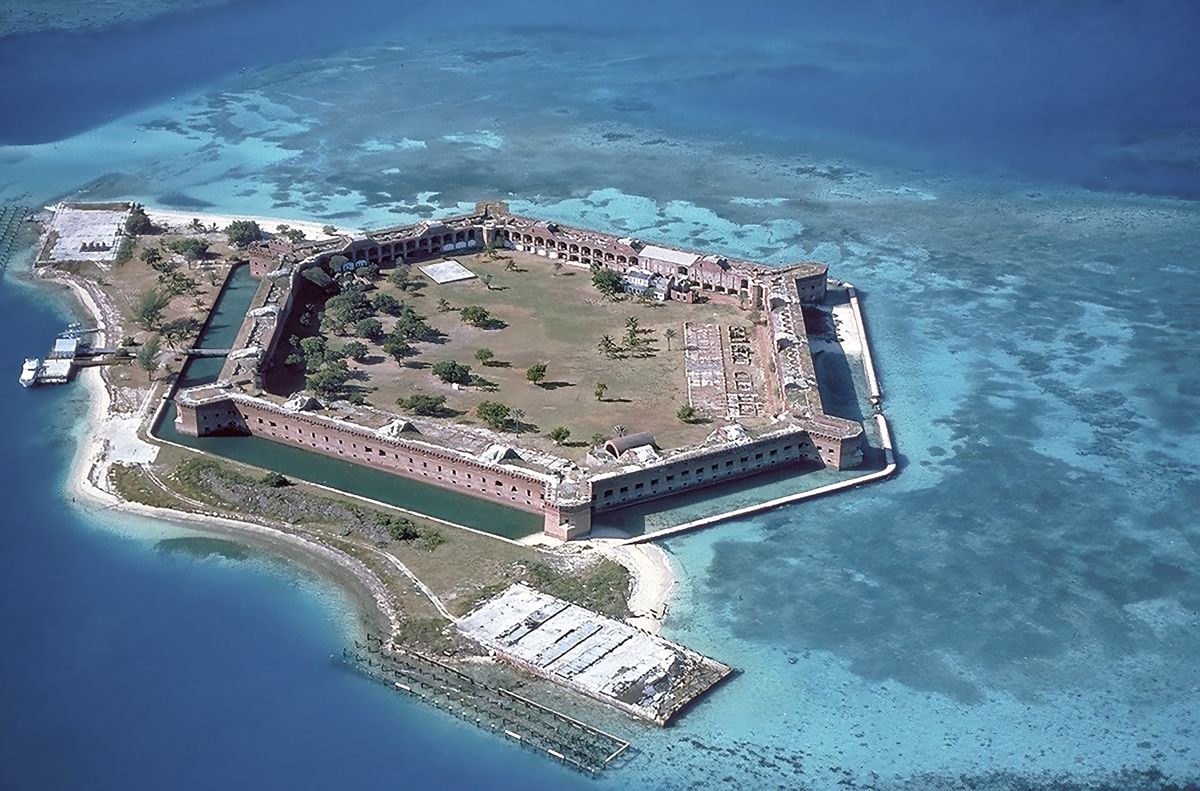
Aerial view of Fort Jefferson at the Dry Tortugas. (NPS)
Finally in Florida, the original garrison had secured Fort Jefferson and landing the troops who had remained offshore strengthened Pickens. The forces occupying Fort Taylor were still vulnerable. The U.S. declared martial law in Key West on May 10 and the commander, Major William French, threatened to turn his cannon on the town if they did not “behave themselves.” French ordered all Confederate sympathizers removed, banned flying the Confederate flag, disbanded the pro-Confederate militia, and required all adult men still in town to sign a loyalty oath. Backed by the fort’s guns and the apparent willingness of the Union garrison to use them, the threats were believable and many Confederate sympathizers left. In four months’ time, the seceding states had seized most federal property within their borders but the big prizes eluded them. The nation’s capital, the supply of arms in St. Louis, and the key bases at Fort Monroe, Fort Jefferson, and Fort Taylor remained in Federal hands, ready to support blockading operations and the invasions of North Carolina, the James Peninsula, and New Orleans. Winfield Scott had made the most of the limited forces and time at his disposal. Endnotes 1 Quoted in Frank Moore, The Rebellion Record: A Diary of American Events, Vol. 1, New York, G. P. Putnam, 1862, p. Doc. 123; Winfield Scott, Memoirs of General Winfield Scott, New York, Sheldon and Co., 1864. 2 Clayton R. Newell, The Regular Army Before the Civil War, 1845–1860, Washington, Center of Military History. 3 Shearer Davis Bowman, At the Precipice: Americans North and South During the Secession Crisis, Chapel Hill, University of North Carolina Press, 2010. 4 “The National Troubles – Government Fortifications and Arms Seized in North Carolina,” New York Times, January 3, 1861; OR I:1, pp. 474476. 5 Ellis papers, Vol. 2. p. 553. 6 OR I:1, pp. 484-485.; Ellis Papers, Vol. 2, pp. 554-555. 7 John Nicolay, Campaigns of the Civil War, Volume 1: The Outbreak of Rebellion, 1881. 8 OR, 1:51, part 1, pp. 308-309. 9 OR I:51 p. 313.
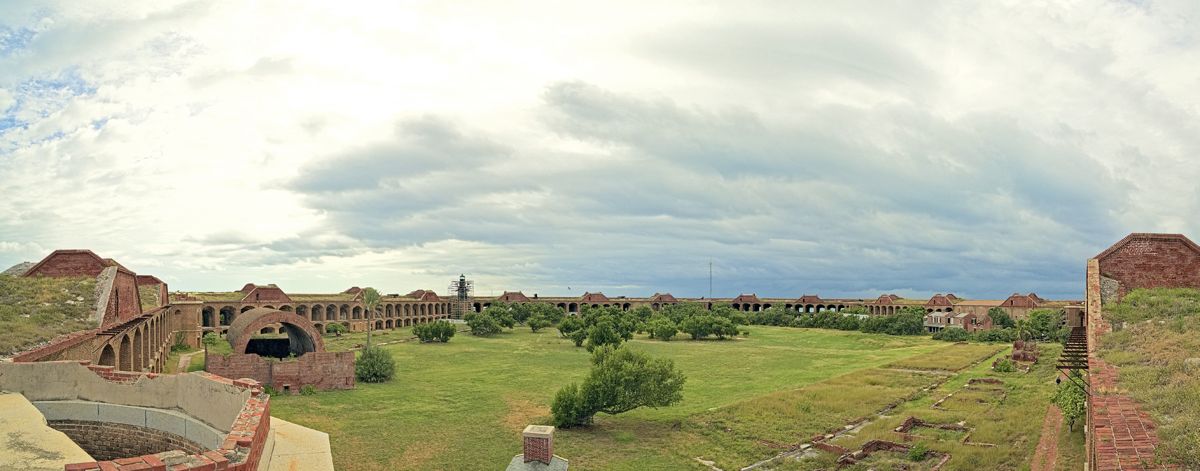
The parade ground of Fort Jefferson on Garden Key in Dry Tortugas National Park, Florida.
10 John McElroy, The Struggle for Missouri, Washington, DC, National Tribune Co., 1909, pp. 39-40. 11 “Speech of George W. Westin,” National Republican 12 Josiah Shinn, “Fort Jefferson and Its Commander in 1861,” Journal Military Service Institution, 1910, pp. 487-97. 13 OR, I:1, p. 345. 14 Ibid., p. 346. 15 Brig. Gen. Loomis L. Langdon, “The Relief of Fort Pickens, Florida, Part 1: The First Expedition,” Journal Military Service Institute, SeptOct. 1909, p. 267. 16 J. S. Gilman, “With Slemmer in Pensacola Harbor,” From Sumter to Shiloh, Battles and Leaders of the Civil War, Volume 1, South Brunswick, Thomas Yoselof, 1956 (reprint), p. 27. 17 Langdon, “First Relief Expedition,” p. 269. 18 OR I:1, p. 352. 19 Ibid., p. 457. 20 Mobile Advertiser, April 23, 1861, quoted in Moore, Rebellion Record, Vol. 1, p. 60. 21 Sesser, Arsenal Crisis, p. 35. 22 OR I:1, 638-639. 23 Cooper resigned his commission on March 7, 1861, and made his way to the then-capital, Montgomery, Ala., where he was appointed to the same position with the Confederacy that he had held with the United States. His last act as Confederate adjutant general earned him universal praise from archivists and historians: he preserved the official records of the CSA War Department and turned them over to the United States government, where they constitute the CSA portion of the OR. 24 Sesser, Arsenal Crisis, p. 44. 25 Ibid., p. 63. 26 Weekly Arkansas Gazette, February 16, 1861. 27 OR, I:1, pp. 638-645; “Presentation of a Sword to Capt. Totten,” Weekly Arkansas Gazette, February 16, 1861.
Leon Reed is a retired U.S. Senate aide and defense He lives in Gettysburg. This article is adapted from his forthcoming book, Fort Sumter’s Long Shadow: Lincoln Calls for Troops, the North Creates an Army, and the Upper South Reconsiders Secession. consultant.