
Vision and Valor: The War Through Women’s eyes
By Juanita Leisch Jensen · Originally published March-April 2025 · pp. 18–21
When considering the roles of women in the Civil War that met important needs of soldiers, one image that should spring to mind is that of an army marching into battle armed with needles, for these are the weapons tens of thousands of seamstresses wielded in manufacturing uniforms, underclothing, outerwear, tentage, flags, guidons, handkerchiefs, haversacks, housewives, caps, hats, and untold other sewn goods. Some items (like tentage), were most often manufactured using sewing machines in factories and workshops, while others (like handkerchiefs and tobacco bags) were most often crafted in smaller quantities. This article will focus on the work of seamstresses making uniforms for depots and contractors. Women of all ages, from richest to poorest, were expected to learn plain sewing in childhood. They advanced in their sewing skills, becoming proficient enough to produce both clothing for their families and soft goods for their household. If they were so well situated that others did this necessary sewing for them, then they were expected to advance into decorative needlework. Sewing skills were not only important skills for daily life, but also for basic financial security, as it was well understood that women facing financial disasters could resort to sewing. While some women who were not professional seamstresses sewed uniforms for family members and soldiers in units of particular interest to them (often volunteering for soldiers’ aid and other benevolent societies), the vast majority of Civil War uniforms were sewn by anonymous paid seamstresses laboring under a piece-work system that achieved impressive results, but at an untold human cost. Throughout the war and on both sides, officers were expected to provide their own uniforms and generally did so by ordering them from tailors who kept abreast of current regulations, requirements, and styles. Tailors procured materials, produced patterns, and cut garments to measure, altering them as necessary after making them.
“Armed with Needles” By Juanita Leisch Jensen
By contrast, uniforms were provided for enlisted soldiers. The U.S. Army Quartermaster Department established a permanent depot on the Schuylkill River near Philadelphia, which operated from the War of 1812 until modern times. Smaller Federal Quartermaster operations were established in a handful of other locations, including Boston, Cincinnati, New York, St. Louis, and Jeffersonville (Indiana), to meet heightened needs during wartime. Initially, the Confederate government tried to operate on a ‘commutation’ system whereby states were to be reimbursed for the uniforms they provided to the troops they volunteered for service. When this system proved unworkable, the Confederate government established regional and (in some cases) state quartermaster depots in Augusta (Georgia), Charleston (South Carolina), Houston, Montgomery (Alabama), Nashville (later Atlanta), Staunton, and Tuscaloosa. Both the Federal and Confederate depots operated with (nearly identical) processes, which strongly prioritized accountability over ease: - Depot employees maintained a book of women desiring to take in work, generally differentiating women who sewed cotton garments (drawers and shirts) from those who made wool garments (coats and trousers). - The depot employees procured materials and measured and cut materials which they assembled into ‘kits.’ - They issued them to the women along with corresponding tickets taken like a blank check out of a book made for the purpose, noting to whom the kits were issued. - Women traveled (sometimes walking miles) to the depot, picked up their kits and tickets, and carried the kits back to their homes, where they and their family members completed the garments. - The seamstresses then returned the finished garments to the depot and presented the clothing and tickets to an inspector. If the garments passed inspection, the inspector signed the ticket. - The seamstress then took the garments and signed ticket to the superintendent who also signed the ticket, adding the amount to be paid. - The seamstress then signed the ticket and presented it for payment.1 With dozens or hundreds of women arriving at the depot each day, the process of walking to the depot, waiting in multiple lines, turning in finished work, and getting new kits could easily take all day. Even before the Civil War, the plight of women who relied on income from sewing was tenuous, and it became worse as women whose husbands were away at war flooded the workforce. Even as inflation caused prices to skyrocket, public and private employers lowered wages and still found workers. The resulting destitution was an issue acknowledged in newspapers:
It is stated that a large number of poor women in Boston and vicinity are hired to make woolen shirts for soldiers at the pitiable pittance of five cents apiece. They are hired by contractors who get good prices out of the government, and are growing rich out of the business.2 As early as 1861, the Philadelphia Inquirer reported on a “Public Meeting of Working Women,” who met and publicly objected to the lower prices paid by contractors, urging the government to employ women directly rather than through contractors.
We are not willing that the Government should be used by base-hearted contractors for selfish purposes. We are unwilling that a few men should get rich, very rich, at the expense of our honest labor. We will not submit to the starvation prices offered by these shylocks when they make the Government pay them full price, which we are deprived of.3 A six-chapter memoir published in consecutive issues of the 1865 Atlantic Monthly included statistics showing that, from 1861–1864, government depots lowered the price they paid seamstresses11-12% on lined blouses, cavalry jackets and shirts, and 20% on overalls and 36% on infantry pantaloons. A seamstress in the unfortunate position of sewing for a contractor would receive only 35-50% of the government prices.4 The memoir also includes grievances she heard discussed at a public meeting of working women in the same city as the meeting mentioned above, though she does not reveal the date of the meeting:
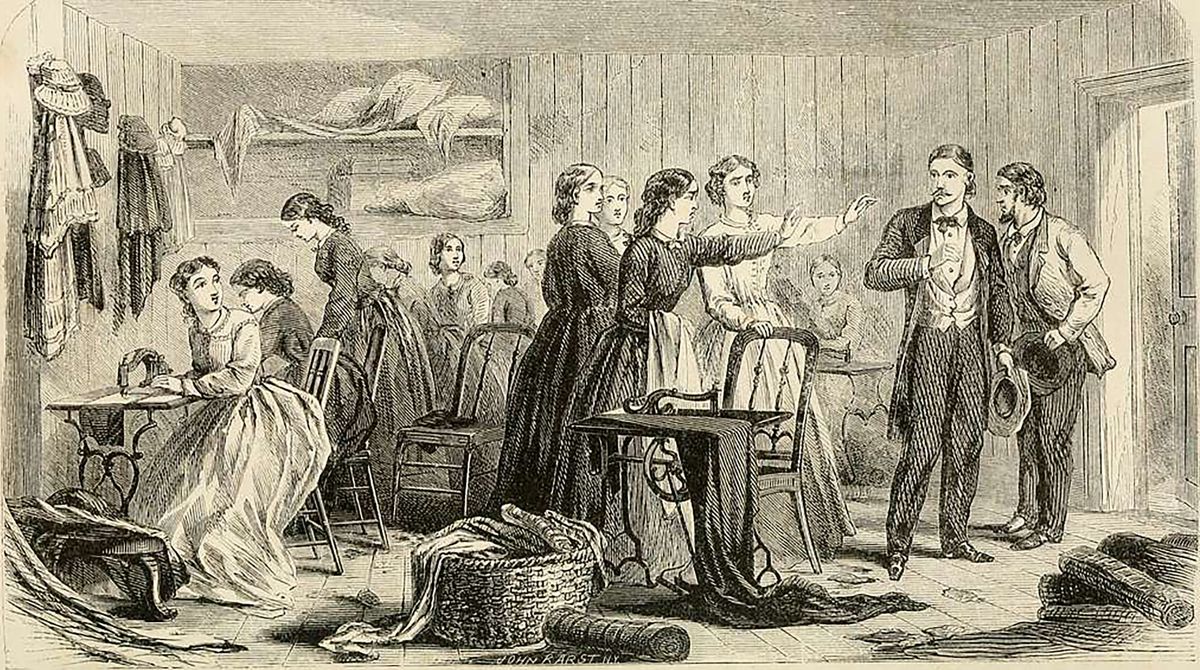
At last they met together in public, common sufferers under a common calamity, interchanged their experiences, and mingled their tears … . in this assembly the domestic experience of each individual was in mournful harmony with that of all. The great majority were wives of soldiers who had gone forth to uphold the flag of our country. Hundreds of them were clad in mourning, their husbands had died in battle, - their remittances of pay had ceased, their dependence had been suddenly cut off, – and they were thus thrown back upon the needle, … They came together on the occasion referred to to compare grievances, and devise whatever poor remedy might be found to be in the power of a body of friendless needle-women. The straits to which many of these deserving widows had been reduced were awful. One widow, taking out shirts at the arsenal, earned two dollars and forty cents in two weeks, but was denied permission to take them in when done, though urgently needing her pay, being told that she would be making too much money. One … whose husband was then in the army, found the price of infantry-pantaloons reduced from forty-two to twenty-seven cents, – reduced by the Government itself, – but she made eight pair a week, took care of five children, and was always on the verge of starvation. She declared, that, if it were not for her children, she would gladly lie down and die! The widow of a brave man who gave up his life at Fredericksburg worked for the Government, and made eight pair of pantaloons a week, receiving two dollars and sixteen cents for the uninterrupted labor of six days of eighteen hours each. The wife of another soldier, still fighting to uphold the flag, worked on great-coats for the contractors at thirty cents each, and earned eighty cents a week, keeping herself and three children on that! An aged woman worked on tents, making in each tent forty-six buttonholes, sewing on forty-six buttons, then buttoning them together, then making twenty eyelet-holes, – all for sixteen cents. After working a whole day without tasting food, she took in her work just five minutes after the hour for receiving and paying for the week’s labor. She was told there was no more work for her. Then she asked them to pay her for what she had just delivered, but was refused. She told them she was without a cent, and that, if forced to wait till another pay-day, she must starve. The reply was, “ Starve and bed-d! That is none of my business. We have our rules, and shall not break them for any.” A tailor gave to another sewing-woman a lot of pantaloons to make up. The cloth being rotten, the stitches of one pair tore out, but by exercising great care she succeeded in getting the others made up. When she took them in, he accused her of having ruined them, and refused to pay her anything. She threatened suit, whereupon he told her to “sue and be d-d,” and finally offered a shilling a pair, which her necessities forced her to accept.
A review of the pay records of women working in uniform depots determined that in at least one southern depot, more than half the women signed for their money with an “X,” a reliable indicator of the illiteracy rate among seamstresses.5 So far as we know, not one of the women employed by a contractor or depot to make Civil War uniforms took time to leave us with an account of her experiences. Fortunately, one sympathetic observer living in Atlanta, Ga., did, describing seamstresses who passed her house going to and from the depot:
… [a] daughter about sixteen, has a bad cough – but walks two miles to town to obtain Making clothes for the boys in the army, by Adalbert John Volck, Government sewing – 1864. (Library of Congress) pants, coats etc. She stops here frequently to rest, and women armed with needles were key contributors to for the material is of the heaviest kind. She gets keeping soldiers clothed in the Civil War. one dollar for pants, a dollar and a half for coats, and fifty cents for shirts. She has been sewing for Endnotes 1. Credit is due to Fred Gaede for allowing me to preview the muchmonths to get pair of shoes and came yesterday anticipated Quartermaster Manual, Volume II. It is from the to show them to me – she was so delighted. She Introduction and Appendices that I learned much of this information. is now saving her tickets, and not drawing the 2. Springfield Daily Republican, Nov. 15, 1862. 3. Philadelphia Inquirer, Sept. 4, 1861, p. 8. money for her sewing, fearing she would have to 4. Atlantic Monthly: A Magazine of Literature, Art, and Politics. spend it … This girl is intelligent and refined in Boston: Ticknor and Fields, Volume V. 1865, pp. 673-679. her feelings and she often cries when she tells me 5. I am indebted to Les Jensen, who shared the results of his research on uniform depot pay records. of the insults she receives from the men who deal 6. “Miss Abby’s Diary,” January 20, 1864, excerpted in Secret out the work. Yankees: The Union Circle in Confederate Atlanta by Thomas G. Many a woman walks eight or ten miles to town Dyer. Baltimore: The Johns Hopkins University Press, 1999, pp. 286-287. to get sewing; they often have no shoes, or only those made of cloth “pitched within and without” – and rarely ever wear stockings – for the simple reason they have none.6 Despite the low prices paid, high inflation, and nearly inhuman conditions seamstresses endured, they persevered through the war producing uniforms for both government depots and contractors. For the U.S. government, the vast stores of goods surplus to need that remained at the end of the war attest that the Union army seldom suffered uniform shortages. Even the shortages that existed in the Confederate army were generally more localized and of shorter duration than is generally believed. However great the human cost to the seamstresses, the systems worked,
J uanita L eisch J ensen is speaker , writer , researcher a nationally known
( and avid collector ) of subjects related to civilians and the C ivil W ar . S he authored two books : W ho W ore W hat : W omen ’ s C lothing , 1861-65, and an I ntroduction to C ivil W ar C ivilians . S he is a member , fellow , and former G overnor of the C ompany of M ilitary H istorians . J uanita and her husband , military historian L es J ensen split their time between homes in O range C ounty , N.Y., and S henandoah C ounty , V a .