
The Unfinished Fight
By Craig L. Barry · Originally published March-April 2025 · pp. 8–10
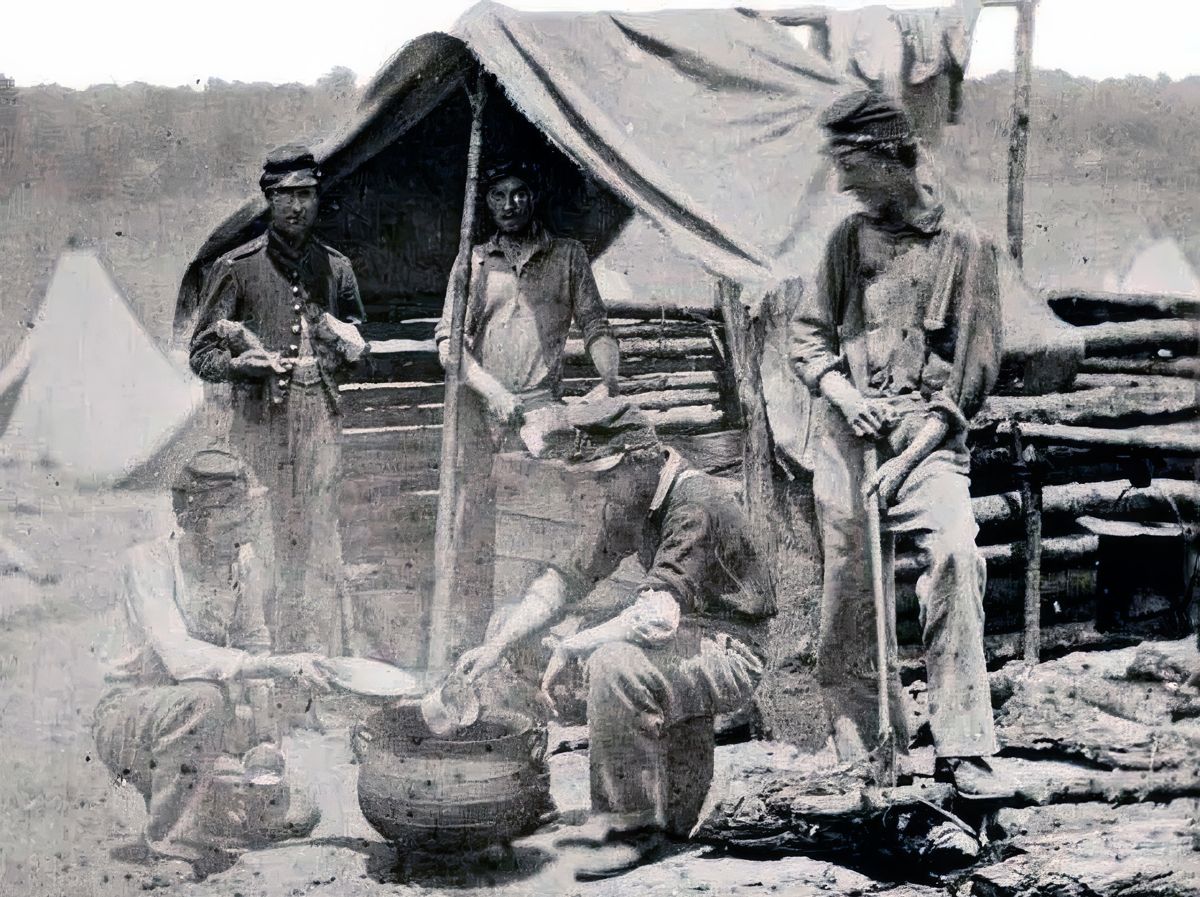
Civil War soldiers ate more beans than any other vegetable. When meat was scarce, the most common protein alternative widely available was beans. It is important to note that the beans issued during the Civil War as part of the normal rations were not the canned “pork and beans” known today. There were canned foods during the Civil War but the product known as “pork and beans” in tomato sauce only gained popularity in America after the War. Josh Billings noted, “Here is just what a single ration comprised, that is, what a soldier was entitled to have in one day. He should have had twelve ounces of pork or bacon, or one pound four ounces of salt or fresh beef; one pound six ounces of soft bread or flour, or one pound of hard bread, or one pound four ounces of corn meal…But the ration thus indicated was a camp ration. Here is the marching ration: one pound of hard bread; 3/4 of a pound of salt pork, or one and 1/4 pounds of fresh meat; sugar, coffee, and salt. The beans, etc., were not issued to the soldier when on the march, as he could not carry them.” The problem noted with beans as a marching ration was not that they could not be physically carried with the other rations per se; it was that there had to be a viable method of preparation while on campaign. As previously stated, the beans were issued dry and had to be soaked all day prior to cooking. The use of baking soda, known as saleratus, would have sped the process of softening the beans while on the march if it were available, but then there was still the matter of carrying an iron pot or Dutch oven with a cover large enough and the time required to cook them, which was usually overnight. If one should happen to eat undercooked army beans out of expediency, a nasty stomach ache was the result. Hence, while popular among the men, beans remained an item of camp rations, or at least an item of issuance when camping conditions permitted the necessary time for overnight preparation. This was usually not the case while on campaign.
Civil War soldiers had a universal propensity to complain about their rations, whether in camp or on the march. So when soldiers were issued the regular camp ration of dry beans, what did they think of them? Well, it appears they were favorably regarded given the alternatives and consumed with enthusiasm. Beans were cheap and therefore issued with frequency. A camp song to the tune of the hymn ‘The Sweet By-and-By’ was composed to express their fondness for them:
There’s a spot that the soldiers all love, The cook tents the place that we mean, And the dish we love best to find there, Is the old fashioned white army bean. Chorus: ‘Tis the bean that we mean And we’ll eat as we ne’er ate before; The army bean, nice and clean We’ll stick to our beans evermore. The history of the popular ditty known as “Goober Peas” is a subject for another day. It is best regarded as a folksong of unknown origin, though often credited to the Georgia Militia. It was widely sung outside Georgia, though. One of the earliest known versions dates to July 1863 at the Union prison on Johnson’s Island. Soldiers were so fond of beans they would occasionally trade part of their salted meat ration to get more. The following passage from Daniel Fletcher (Reminiscences of California and the Civil War) lends considerable insight into both the fondness for beans as an item of rations as well as how they were prepared: “We had baked beans quite often…The cook used to exchange some of our salt beef with some other company for beans. I think I never ate better beans than we had at Modified for smaller quantities, this is a good recipe to Camp Sacket in the winter of 1861-62. The cook used to follow for preparing beans in camp. It is probably easier put in a hole dug in the ground a copper kettle large enough to make something palatable out of the army bean than to hold a bushel or more. A fire was made in the hole, so any other item of rations. Soldiers on both sides ate beans that it was very hot. He put fifteen pounds of pork on top of whenever the opportunity arose. Confederate rations were the beans in the kettle, put the kettle in the hole and packed similar to the Union including beans. The difference in the around it a lot of small, hot rocks. The beans were then C.S. rations was that cornmeal was often substituted for covered up with an iron cover, and a fire was built on top. wheat flour and the “beans” were not the white “Army” This was done at sundown. There was a guard at the cook bean but usually a variety known as Southern cow peas, tent, day and night, meaning crowder or field and he was requested peas. The Confederate to keep a fire on top Quartermaster reported of the beans all night. stores of “rations of “AT NOON WE DRAW A RATION The next morning pease, meat and mixed OF CORN BREAD, PORK AND Company H had vegetables” were on hand BEANS … TOOK BREAKFAST AT baked beans good but they were apparently enough for a king. not getting to the soldiers 7 OCL [O’CLOCK] OF COLD BEANS The colonel was up in the field at least not on AND CORN BREAD.” late at night, as he a regular basis. By late – LEONARD G. FERGUSON, 57TH frequently was, to 1862 the Confederate PENNSYLVANIA INFANTRY, MONDAY, see what was going Quartermaster struggled JUNE, 27, 1864 on in the regiment, to regularly supply and saw the fire anything but basics. One at our cook-tent. Alabama soldier noted: He inquired of the “Our rations are guard, “What is that fire down at Company H’s cook-tent?” outrageously short now. Yesterday morn(ing) had last of The guard said they were cooking beans. “Company H is beef for breakfast and that evening (we eat only 2 meals always cooking beans,” he replied. He then went to bed. We a day now) dry bisc(uits) without grease & no meat. This sent him over a plateful the next morning.” morning – dry biscuits again but not enough & had to make breakfast on parched corn. This evening we have had no dinner at all until we draw rations.” The Alabamans ended up foraging a few vegetables, bartered for some flour and a beef shank from somebody more fortunate and made a kettle of “the riches (sic) soup I ever saw.” It held them over until rations were available. Depending on how long men had to make do with dry biscuits and water supplemented by whatever could be foraged, getting beans for breakfast, lunch, and dinner may not have been too bad. Since beans were filling, it well could have provided a reason to celebrate. Beans could be boiled, broiled, or baked, and period accounts mention a variety of ways to prepare them. A distinction should probably be made between beans and the late war Confederate emergency ration, peanuts. While technically a legume or “bean,” the peanut, also known as the pindar, groundnut, or “goober pea” as a ration did not appear to be prepared in the same manner as pease (peas) or beans. This means soaked in water and boiled. Instead, period accounts primarily mention roasting peanuts or eating them raw, hence “…wearing out your grinders eating goober peas.” The mid-19th century French military saying for “the end is near” which given their lack of military success they no doubt used quite often, was “lafin des haricots” or literally, the beans are gone.
THE UNFINISHED FIGHT: ARMY BEANS By Craig L. Barry
Another way to use the Civil War bean ration for variety and still feed an entire company was to cook up a kettle of “hearty bean soup.” The following receipt (recipe) or variations on it seems to be common: “A cup of dried white beans or pease (peas) to five cups of water, soaked overnight. Add salt pork with chopped carrot/onion/potato (any fresh or dried vegetables available went into the soup) and cook 45 minutes or until vegetables are tender.” No matter how they were prepared, beans were a staple of campfire cuisine. A Union cavalry trooper named Vidal Thorn wrote in a letter to his family back in New Hampshire; “I suppose you would like to know what I had for Thanksgiving breakfast…well I had a very good one. There were baked beans, bread and coffee with milk in it, which makes a good army meal.” The date was November 26, 1863, and this was the first year of the National Holiday of Thanksgiving. He mentioned being thankful for his life being spared thus far and guessed that back home they were enjoying chicken pie, cider, plum pudding and “C & C” whatever that is. Vidal Thorn was killed July 1864 near Cox’s Mills, Virginia, while on picket duty. Sources: • • • • • •
Wm. A. Hunter (ed), Civil War Diary of Leonard G. Ferguson, 57th Pennsylvania Infantry, Pennsylvania Historical Society, 1908, p. 212. See Entry for Monday, June 27, 1864. Ferguson John Adams Lee, Canned Foods, Chicago: J. Lee Publisher John Billings, Hardtack and Coffee: The Unwritten Story of Army Life, New York: George Smith Publishing Paul Glass and Louis C. Singer, Singing Soldiers: A History of the Civil War in Song, New York: Da Capo Press, Inc. Daniel C Fletcher, Reminiscences of California and the Civil War, Ayer, Mass: Huntley Turner Press Samuel Pickens, Civil War Diary of Samuel Pickens, 5th Alabama, Tuscaloosa, AL Ken Abala, Beans: A History, New York: Bloomsbury Publishing Susan Dosier, Civil War Cooking: The Union, Mankato, Minn.: Capstone Books Letter from 1st New Hampshire Cavalry trooper Vidal Letaine Thorn to his brother dated Thursday November 26, 1863 from a camp near Bealton Station, Va.
Craig L. Barry was born in Charlottesville, Va. H e holds his BA and M asters degrees from UNC (Charlotte). Craig served The Watchdog Civil War Quarterly as Associate Editor and Editor from 2003– 2017. The Watchdog published books and columns on 19th-century material. He is the author of several books including The Civil War Musket: A Handbook for Historical Accuracy (2006, 2011), The Unfinished Fight: Essays on Confederate Material Culture Vol. I and II (2012, 2013). He has also published four books in the Suppliers to the Confederacy series on English Arms & Accoutrements, Quartermaster stores and other European imports.