
Vision and Valor The War Through Women’s Eyes
By Juanita Leisch Jensen · Originally published July-August 2025 · pp. 22–25
No Idle Hands – Knitting Socks for Soldiers
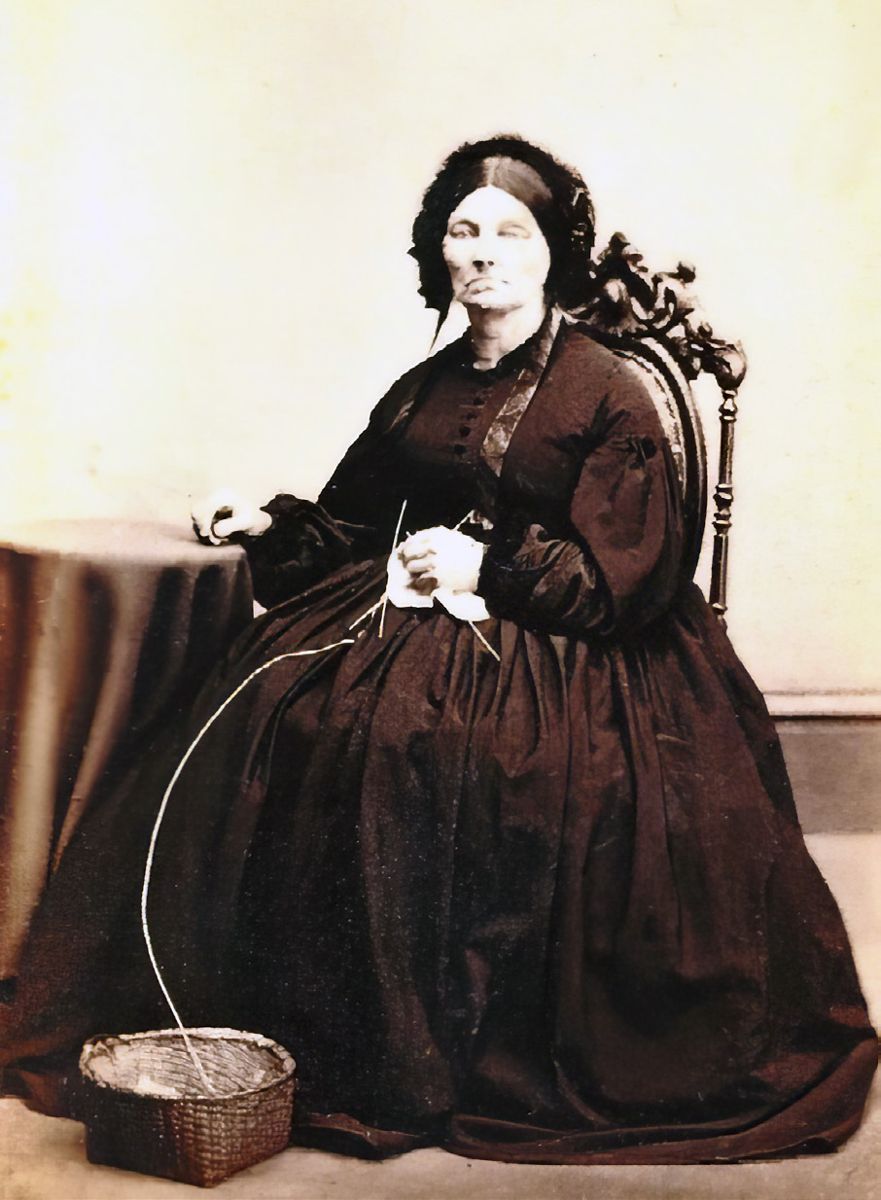
Think for a moment about all the keystrokes made on all the cell phones so constantly present in the hands of boys and girls (and adults of all ages) these days. Admittedly, the near-constant digital manipulation and pervasive electronic communication are amusing, entertaining, and, yes, addictive. In the Civil War, there was an equally popular, similarly pervasive, nearconstant form of digital manipulation, albeit with different handheld devices. By contrast to the electronic messages of cell phones, these handheld devices, knitting needles and yarn, produced much-wanted and needed material goods, including socks and stockings for soldiers. Both commercial and domestic knitting machines indeed existed at the time of the Civil War, but this article concentrates on hand knitting. Knit products made for soldiers included nightcaps, shawls, gloves, mittens, and other items, but this article will focuses primarily on socks and stockings. Producing socks was a standard household task, mentioned in the diaries of plantation mistresses. Other items of clothing might be purchased, but socks and stockings were knit at home, as noted in the 1814 household diary of Martha Ogle Forman.
“Busy Fingers.” The center pair of hands hold three knitting needles, a configuration used to knit a tube, as when knitting socks. (This illustration of “Busy Fingers” appeared in The Tribute Book, A Record Of The Munificence, SelfSacrifice and Patriotism of The American People During The War For The Union by Frank B. Goodrich. New York: Derby & Miller, 1865.)
December 4, 1814 We have finished knitting 31 pairs of stockings for our black family. General Forman went with me to Savinton and I purchased 4 shirts and 4 cravats for William Forman and 3 shirts for Adolphus Valyoe.1 Many accounts indicate that children, both boys and girls, were taught to knit, and this is confirmed in an account of “Child Life in Colonial Days” first published in 1899.
Knitting was taught to little girls as soon as they could hold the needles. Girls four years of age could knit stockings and mittens. …2
“Six and Eighty-Six Knitting for Soldiers.” The older woman in this illustration holds three knitting needles and appears to be knitting the upper portion of a sock. The young girl appears to be concentrating on using two needles. (The Tribute Book, A Record Of The Munificence… During The War For The Union by Frank B. Goodrich. New York: Derby & Miller, 1865.)
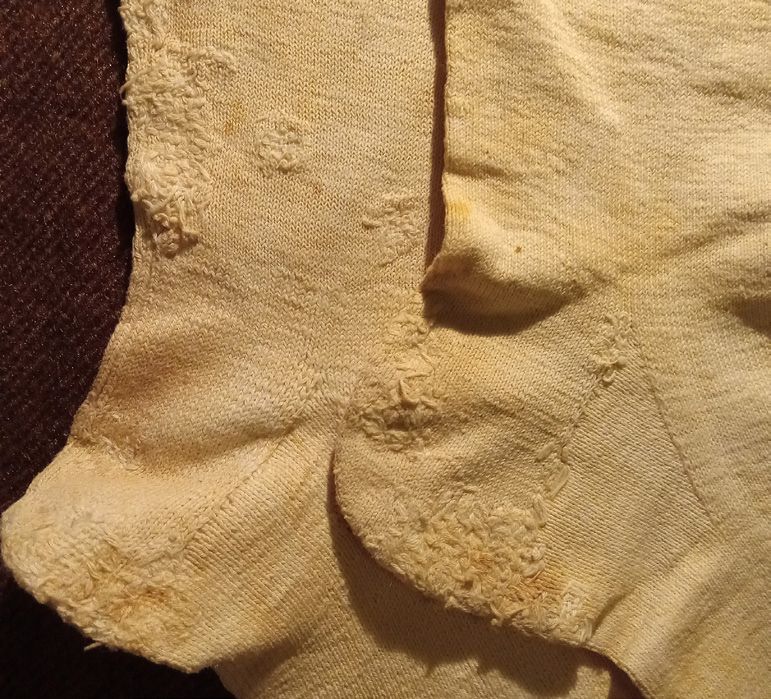
This pair of socks has the date “1837” worked into the tops. They were repeatedly repaired. (Author’s Collection)
Much like the ammunition, tentage, and uniforms discussed in prior Vision and Valor articles, the need for socks and stockings boomed during the Civil War.
An Army might march, figuratively, on its stomach, but it literally marches on its feet, and during the Civil War those feet were too often sore, cold, wet, and blistered. By far the most important knitted product of the war was the humble sock, which both Union and Confederate quartermasters purchased in enormous quantities…3 Both Federal and Confederate uniform regulations prescribed that soldiers receive four pairs of stockings per year.4 Even assuming soldiers received the full allotment, these quantities were woefully inadequate. Contemporary estimates indicated that soldiers wore through one pair of stockings every week.5 In civilian life, socks were frequently washed and darned, extending their useful life. Soldiers found little time to wash or darn socks, which may help to explain the discrepancy between governments’ seemingly unreasonable expectation that socks would last three months.
Neither government could keep up with the armies’ demand for stockings. Stories of soldiers going barefoot or suffering … because they had to wear boots without stockings spurred females young and old to take up their knitting needles.6
Some skilled knitters took to the task with such enthusiasm and skill that they used colored yarns to add visual interest to the socks they knit.
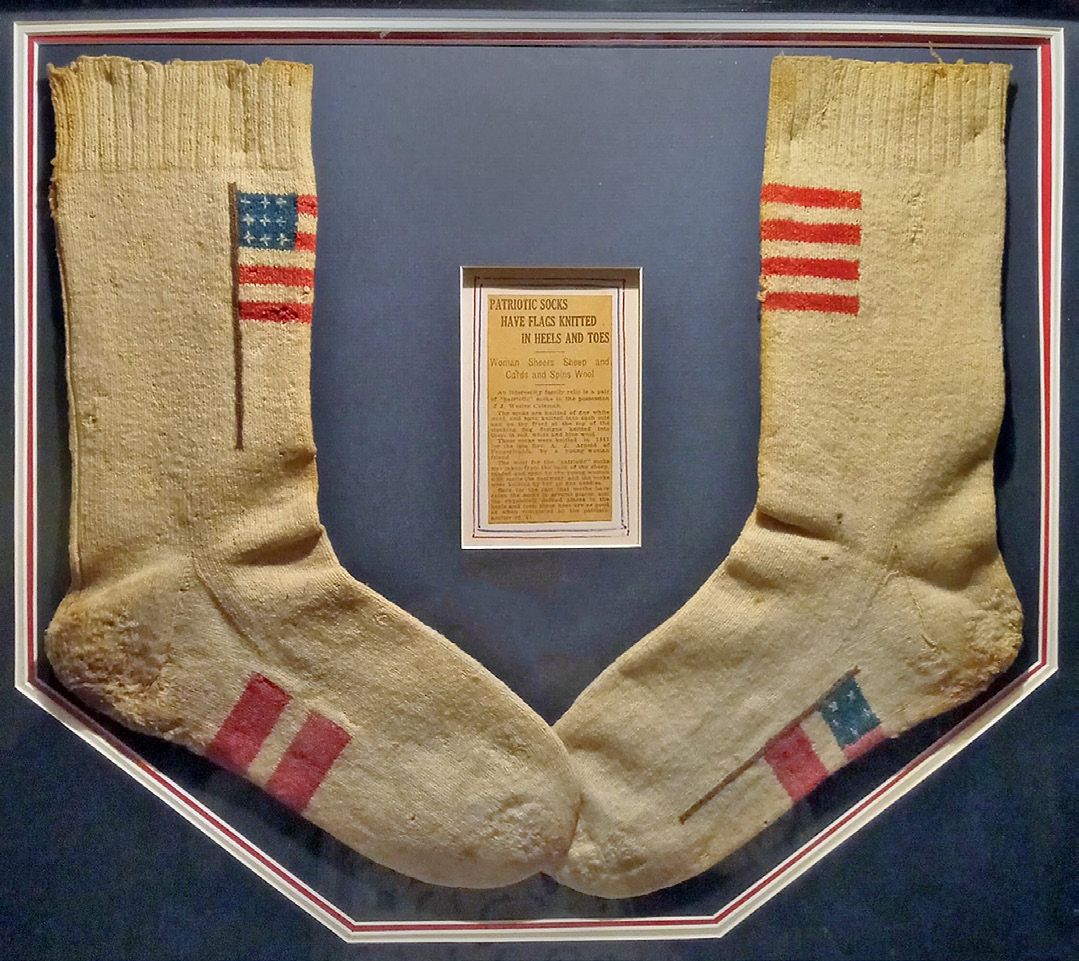
Flags and objects decorated with flags were highly valued by soldiers and civilians alike, whether they were made by anonymous workers in factories or were handmade gifts from loved ones. One pair of socks with U.S. flags knit in the calf, and Confederate First National flags knit into their soles.
This pair of socks framed with a newspaper article describing their history and production. The text of the newspaper clipping follows: PATRIOTIC SOCKS HAVE FLAGS KNITTED IN HEELS AND TOES Woman Sheers Sheep and Cards and Spins Wool An interesting family relic is a pair of “patriotic” socks in the possession of J. Wesley Coleman. The socks are knitted of fine white wool and have knitted into each sole and on the top at the front of the stocking, flag designs knitted into them in red, white and blue wool. These socks were knitted in 1861 for the Rev. A. J. Arnold of Pennsylvania by a young woman friend. The wool for the “patriotic” socks was taken from the back of the sheep, carded and spun by the young woman who made the footwear and the socks were knitted by her on fine needles. Save for the fact that moths have eaten the socks in several places, and the exquisitely darned places in the heels and toes, these hose are as good as when completed by the patriotic knitter of ’61. (Author’s Collection)
The enthusiasm and skill of the young woman mentioned in this newspaper article was not, of course, universal, as illustrated in an 1861 article from one woman to her sister:
September 17, 1861 Dear Sister … I am almost ashamed to say that I haven’t knit a single pair of socks, but I’ve had so much other work, what with Jimmy’s being sick & my houskeeping to attend to, & now I’ve been knitting for John, too, he was plum out of socks, but I intend comensing soon & knit all I can. Sis M & Sallie are both ahead of me, both of them have 3 pair apiece & still knitting. The sewing society in Cam have between 2 & 3 hundred garments made to send on, & still making, they are just as buy as bees over there.7 We might contrast this with Mrs. Robert E. Lee, whose efforts were described in her biography, which was originally published in 1939.
It would have been a relief to Mrs. Lee at this time if it had been possible for her to take part in the work of the women of the Confederacy … though confined to a wheel chair, her hands were never idle. They seemed dedicated to the cause of the
Confederate soldier. She was constantly occupied with knitting socks for the army. During the months of March, April and May [1864] she sent over two hundred pairs of socks for distribution to the Stonewall Brigade.8 While some women contributed as individuals, many others worked through groups like soldiers’ aid societies, contributing to soldiers from their communities, or through coordinating organizations like the U.S. Sanitary Commission and U.S. Christian Commission. Regardless of the group and coordination, gifts to soldiers were much appreciated, as illustrated in a letter from a member of Ringgold Light Artillery while stationed at Camp Dupont, Va.
If the Ladies had heard the cheering when the men received them (the stockings) they would, I think, be satisfied. Some of the men were nearly run out of stockings as those we received from the government were very poor. Some of the socks had slips of paper in the toes, with the young lady’s names on them and the men were wearing them as breastpins. There was quite a premium on all the slips with Miss ______ on them. I heard one fellow offering a married man his supper, coffee and all for the slip with Miss Bette somebody’s name on it.9 As noted in a Confederate Veteran magazine article,
Every community had its soldiers aid and knitting societies, and each mother, wife, sweetheart, and sister looked after her own dear ones on the field, and constantly sent comfortable clothing and boxes of food to them from their own depleted larders. … This unique letter is an expression of appreciation from the “boys in gray”
Camp Near Petersburg February 16, 1864 “The members of the third company battalion, Washington Artillery of New Orleans, embrace this opportunity of tendering to the ‘Young Ladies Knitting Society’ of Fayetteville, N.C., their thanks for the recent present of sixty-five pairs of socks.” “Exiled from home as we are, and de barred by the exigencies of war from the attention and care of the loved ones at home, such attentions are
Endnotes distracted country, we shall tell our mothers and sisters of their goodness and they will unite us in thanking them.” “For all the socks the maids have made, Our thanks for all the brave, And honored be your pious trade, The soldier’s sole to save.”10
Could the soldiers who marched through, between, and across counties and entire states have made the journeys and even arrived at the theater of war without socks knit and contributed by civilians? Knitting socks for soldiers certainly impacted military operations. It is a vastly underrated role of civilians in the Civil War.
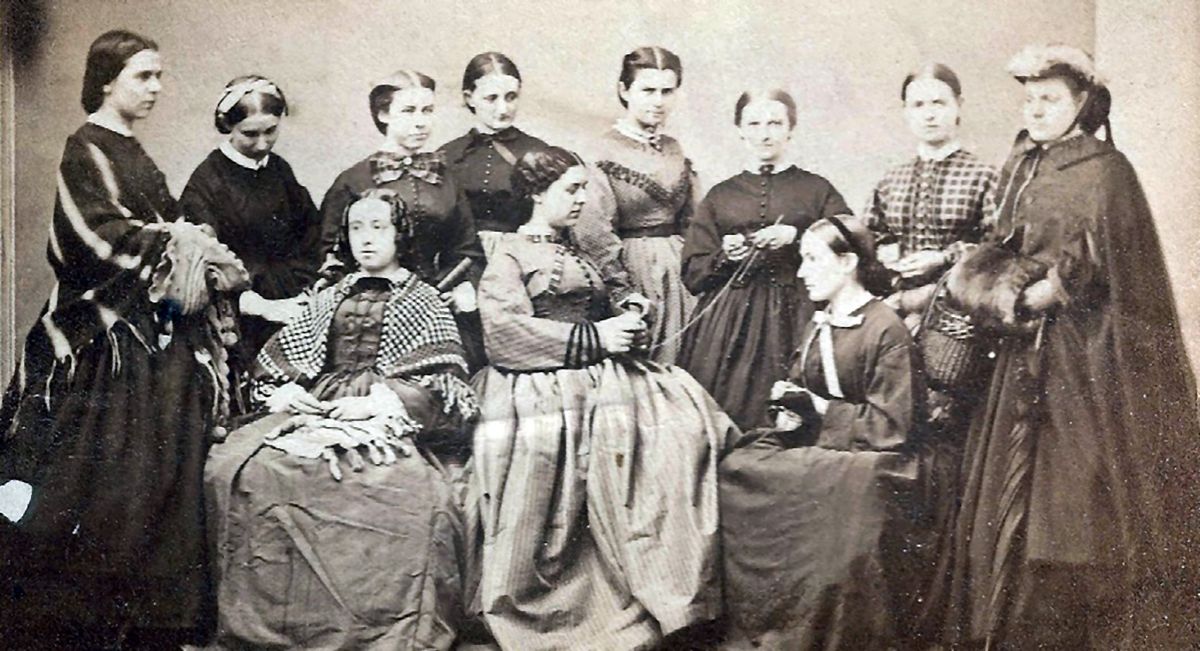
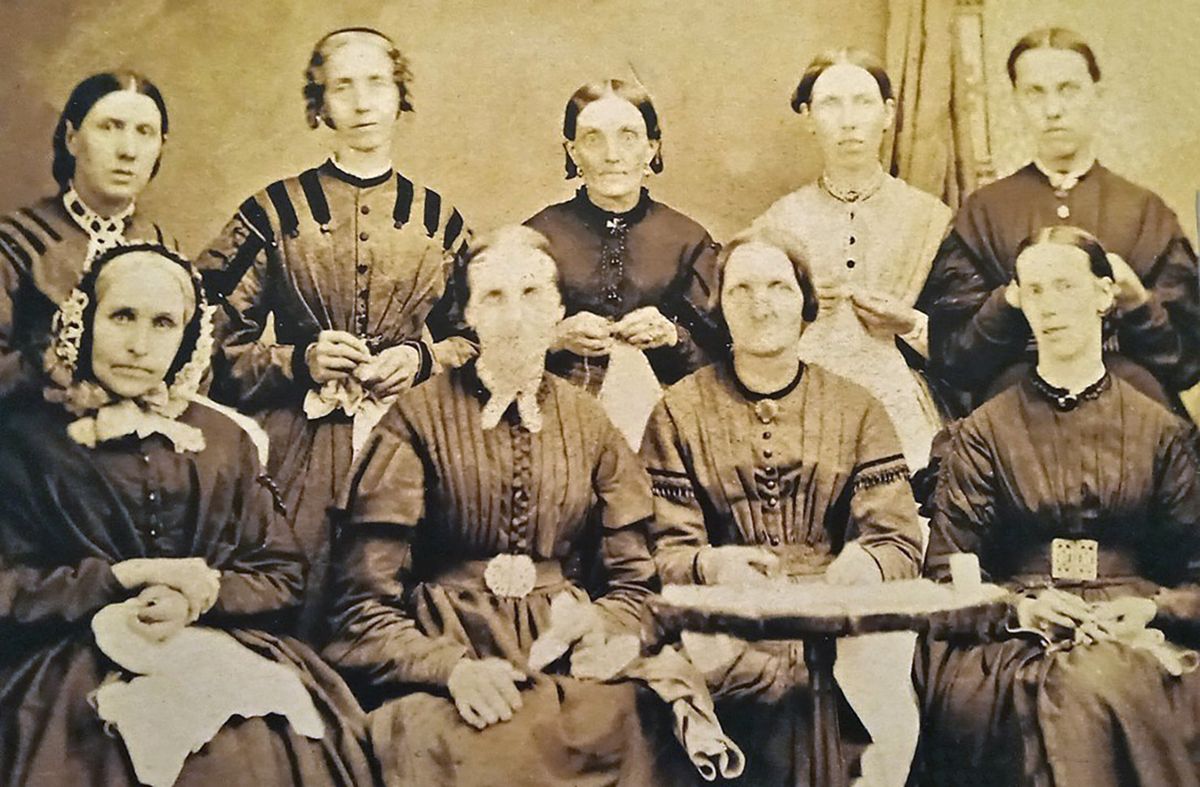
Anne L. Macdonald. No Idle Hands: The Social History of American Knitting. New York: Ballantine Books, 1988. 2. Madelyn Shaw and Lynne Zacek Bassett. Homefront & Battlefield: Quilts & Context in the Civil War. Lowell, MA: The American Textile History Museum 2014. 3. W. Emerson Wilson, editor. Plantation Life at Rose Hill: The Diaries of Martha Ogle Forman 1814–1845. Wilmington, DE: The Historical Society of Delaware, 1976, p. 6. 4. Alice Morse Earle. Child Life in Colonial Days. Stockbridge MA: Berkshire House Publishers, 1993, (originally published MacMillan in 1899) p. 339. 5. Madelyn Shaw and Lynne Zacek Bassett. Homefront & Battlefield: Quilts & Context in the Civil War. Lowell, MA: Women sometimes posed for group photographs. In each of these The American Textile History Museum, cdvs, many of the women are holding needlework projects. 2014, p. 135. 6. Regulations for the Army of the Confederate States, Published by direction of the President, Richmond VA: J.W. Randolph, 1863, and Revised United States Army Regulations of 1861. Philadelphia: George W. Childs, 1863. 7. Quoted in Homefront & Battlefield, p. 85. Original source: Abby H. Woolsey to My Dear Girls Dec. 6, 1861, Box 185, Letter 188. 8. Homefront & Battlefield, p. 83. 9. Sarah M. Fountain, editor. Sisters, Seeds & Cedars: Rediscovering NineteenthCentury Life Through Correspondence from Rural Arkansas and Alabama. Conway, AR: UCA Press, 1995, p. 118119. 10. Rose Mortimer Ellzey MacDonald. Mrs. Robert E. Lee. Arlington, VA: Robert B. Poisal, 1973, p. 177. particularly gratifying, and when grim-visaged 11. Arthur D. Graeff, Compiler. Four Firsts in Berks – 1861. Historical Society of Berks County, 1961, p. 34. war shall hide his wrinkled front and halcyon 12. Confederate Veteran. Wendell, NC: Broadfoot’s Bookmark. days of peace shall have returned to bless our Reprint of 1930 volume XXXVIII, p. 375. 1.
J uanita L eisch J ensen is a nationally known speaker , writer , researcher ( and avid collector ) of subjects related to civilians and the C ivil W ar . S he can be reached at lesandjuanita 1@ hushmail . com to schedule talks and presentations . S he is a member , fellow , and former G overnor of the C ompany of M ilitary H istorians . S he is also a member and former P resident of the S ociety for W omen and the C ivil W ar . S he authored two books : W ho W ore W hat : W omen ’ s C lothing , 1861-65, and an I ntroduction to C ivil W ar C ivilians . J uanita and her husband , military historian L es J ensen split their time between homes in O range C ounty , N ew Y ork , and S henandoah C ounty , V irginia .