
Burnside’s Invasion of East Tennessee
By Alexander B. Rossino · Originally published January-February 2025 · pp. 46–50
Harper’s Ferry, West Virginia. View of Maryland Heights. (Library of Congress)
John S. Clark’s
Estimate of Confederate Strength in September 1862 By Alexander B. Rossino
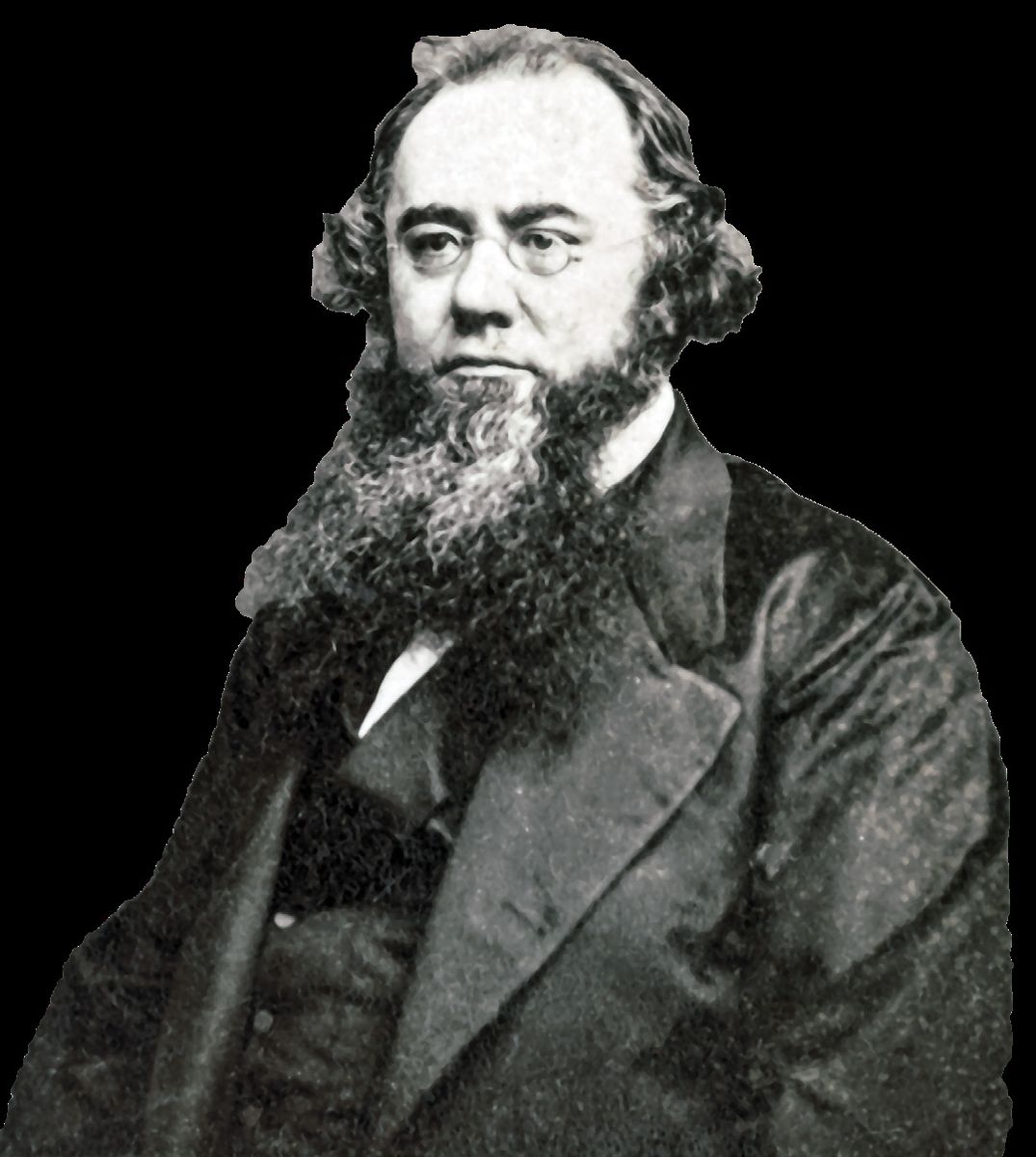
On September 23, 1862, three days after the Maryland Campaign came to its bloody conclusion near Shepherdstown (West) Virginia, the U.S. Secretary of War, Edwin M. Stanton, called together a commission of military officers in Washington, D.C., to investigate “the circumstances attending the late evacuation of Maryland Heights, under the command of Colonel Ford, and the subsequent surrender of Harper’s Ferry by Colonel [Dixon S.] Miles” to Confederate forces led by Major General Thomas J. “Stonewall” Jackson.
Secretary of War Edwin Stanton. (Library of Congress)
Composed of six officers, and presided over by Maj. Gen. David Hunter, the Harpers Ferry Military Commission spent the next month hearing testimony and collecting documents on Miles’s surrender. It then issued a final report in early November that concluded,
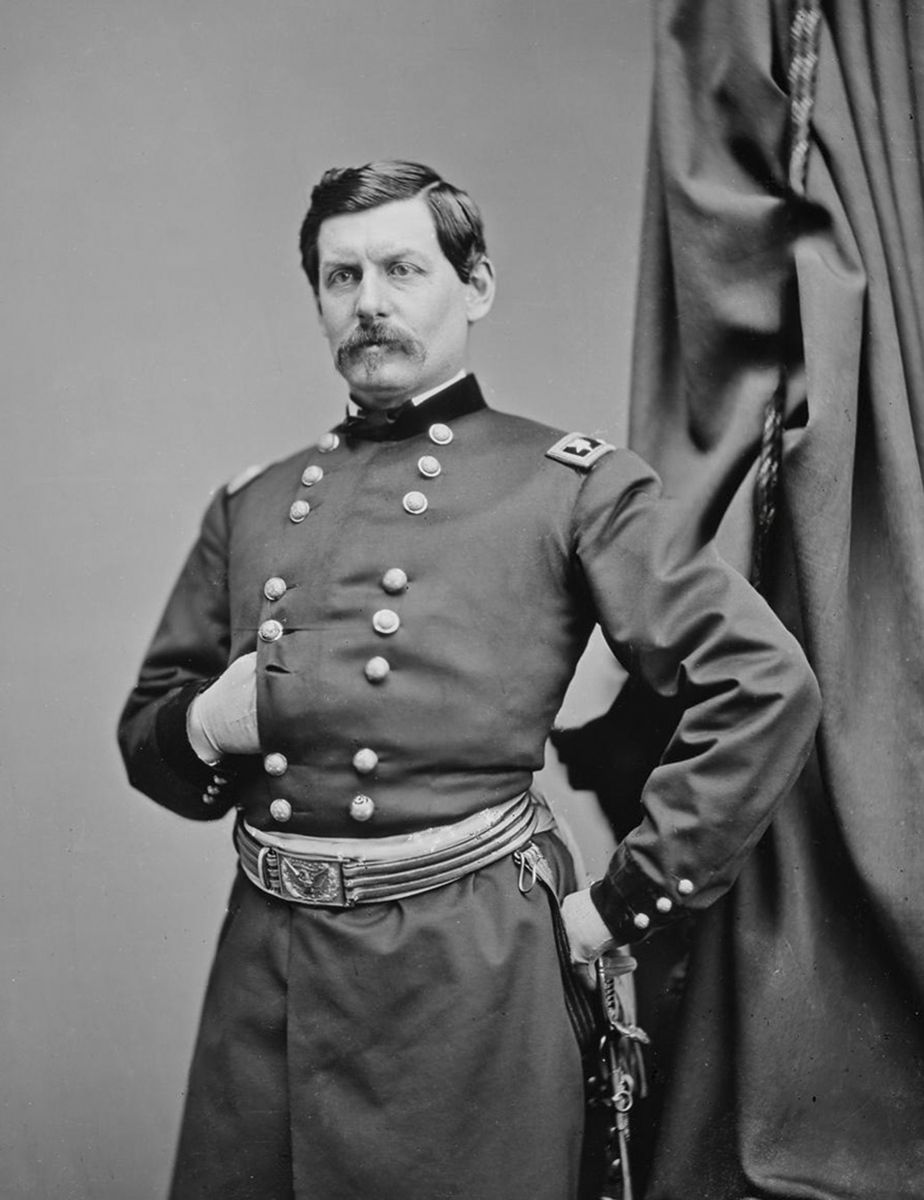
The garrison should have been satisfied that relief, however long delayed, would come at last, and that 1,000 men killed in Harper’s Ferry would have made a small loss had the post been secured, and probably save 2,000 at Antietam. How important was this defense we can now appreciate. Of the 97,000, composing at that time the whole of Lee’s army, more than one-third were attacking Harper’s Ferry, and of this the main body was in Virginia.1 The last line of this quote, placing the number of Lee’s troops at 97,000, is intriguing. After all, estimates of
Col. Dixon Stansbury Miles. (Library of Congress)
Confederate combat strength mentioned in dispatches from Maj. Gen. George B. McClellan’s headquarters typically put the enemy’s number at between 100,000 and 120,000 men. This total rose even further in the days following Antietam when Allen Pinkerton, McClellan’s civilian head of intelligence, estimated “the Rebel Force to be 140,000 and yours [McClellan’s] about 90,000” in a conversation with President Lincoln on September 22. Curiously, according to Pinkerton, Lincoln “admitted that he believed the rebels had the number I said.”2 The number 97,000 is rather precise. It also appears to have come from sources not linked to the Army of the Potomac. Where then did it originate? It turns out that the estimate came from a report compiled by Col. John Swartout Smith Clark, an aide of Maj. Gen. Nathaniel Banks, in September 1862. Clark had served as Banks’s head of military intelligence during the campaign in Virginia just prior to Lee’s operation in Maryland, and while in that capacity, he began collecting information on the strength of the Confederate army in the run-up to the Battle of Second Manassas. Banks described this process in a letter to Lincoln in December 1862.
[Clark] was the first to discover and report, by patient observation with officers of the Signal corps of my command, the movements of
General Lee, and the army under his command, towards Buck Mountain, White Plains, and Manassas, when the army of Virginia occupied the Rappahannock Valley, and gave in person to General Pope, then at Warrenton Junction, notice of the movement and plans of Lee’s army. His report was afterwards fully verified by the facts. … Subsequently he prepared a full statement of the organization of Lee’s army, then in Maryland, with a statement of the forces and officers of all its Divisions, Brigades, and Regiments of Infantry, Artillery, and Cavalry, and the States they represented. This Report I had the honor to present to you in person, and copies also, were sent to the Secretary of War, and the Commanderin Chief, in September.3
Col. John Swartout Smith Clark. (FindaGrave)
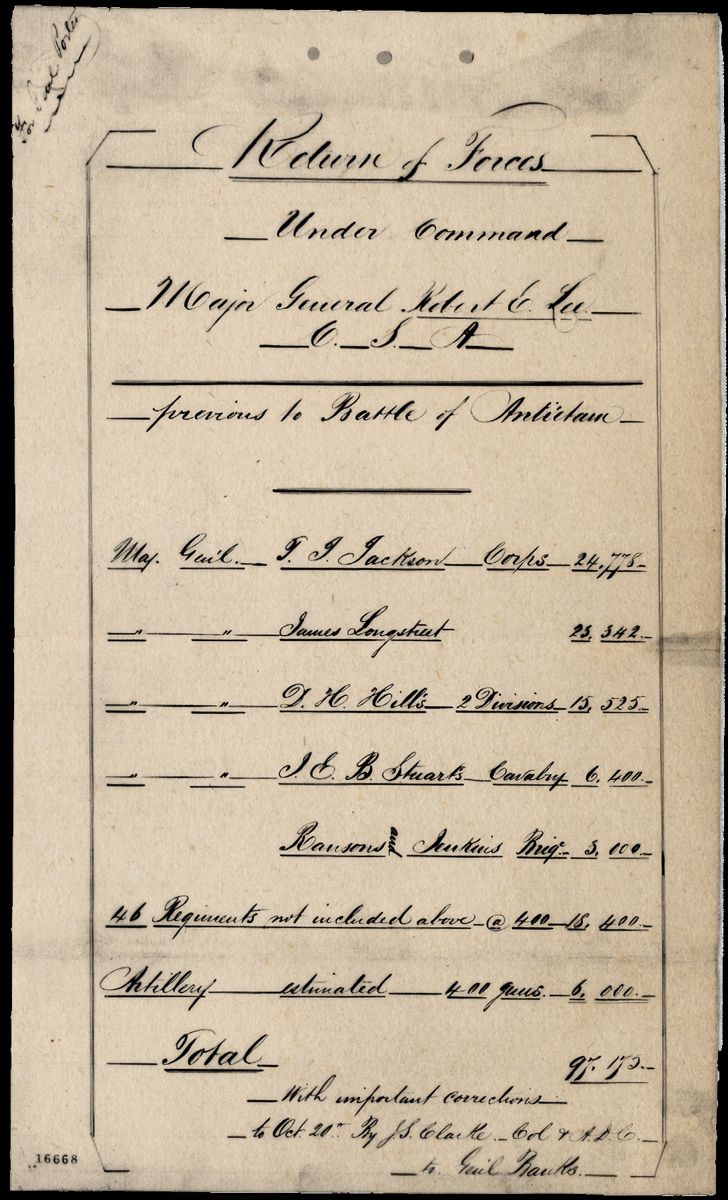
Clark’s report concluded that Confederate strength at the start of the Maryland Campaign totaled 97,175 men. The Harpers Ferry Military Commission then relied on this estimate for its rounded-off 97,000-man figure. President Lincoln apparently had these numbers in hand when he spoke with Allen Pinkerton on September 22, a fact that renders suspect Pinkerton’s claim about Lincoln agreeing with his 140,000-man estimate. Colonel Clark’s numbers clearly contradicted the significantly higher total that Pinkerton had reported on McClellan’s behalf.4 Equally curious about these events is the fact that Edwin Stanton called the Harpers Ferry Military Commission into being on September 23, one day after Pinkerton’s talk with Lincoln. Stanton also possessed a copy of Clark’s report because Banks sent it to him while Lee’s army was still in Maryland. This means it must have been delivered before September 19. Did Stanton, a bitter enemy of McClellan’s, decide to investigate the subject via the Harpers Ferry Military Commission? It is a question worth asking because the commission found fault with McClellan for not relieving the garrison before September 15, while at the same time it excoriated Miles for being the man primarily responsible for the post’s surrender. Returning to Clark’s report, the copy found in McClellan’s papers is dated October 20, 1862, although a note written on one of the pages indicates that Clark had updated the numbers for Jackson’s command on October 2. In his history of Union military intelligence gathering during the war, Edwin Fishel relates that Clark “interrogated 250 Confederates, from 228 regiments, in the Washington prisons after the Second Bull Run and Antietam battles.” It is impossible to know if all the men Clark questioned had actually served in the Army of Northern Virginia, but one suspects some may not have because of the excessively high number of regiments cited in his report. As Fishel notes, Lee did not have more than 181 regiments in the ranks up to September 1862.5
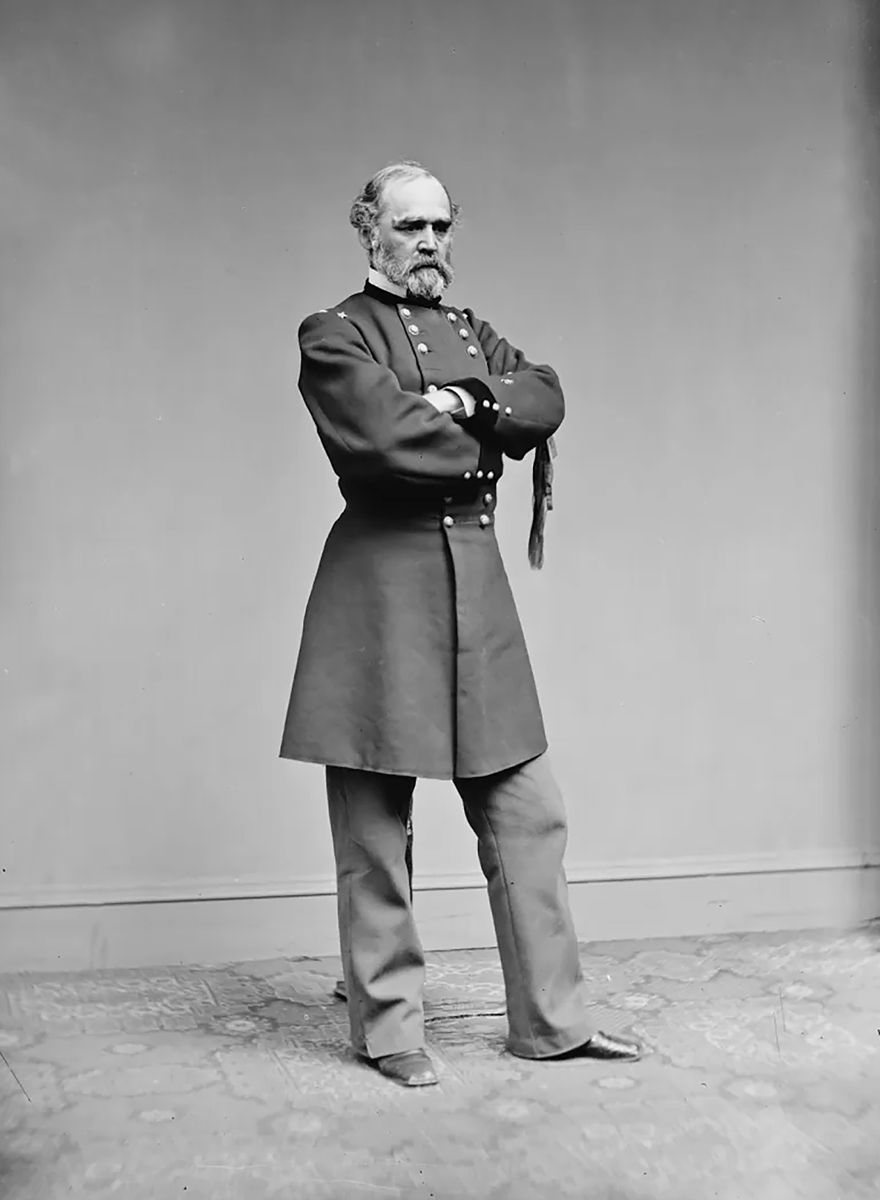
Clark’s study yielded fascinating results despite his overcounting of Confederate regiments. It would also prove to be one of only two hard-evidence studies of Southern strength in the Eastern Theater until Joe Hooker created the Bureau of Military Information (BMI) in January 1863. U.S. Army Quartermaster Montgomery C. Meigs conducted the first study on the James River peninsula in July 1862, arriving at the conclusion that Lee had 105,000 men under arms. Clark carried out his audit one month later. Both men receive little credit for this work even though their intelligence efforts preceded Hooker’s innovation by five to six months.6 As for the content of Clark’s October 1862 report, there are serious problems with its methodology. For example, Clark wrote on the first page that Lee commanded 97,175 men in Maryland. He claimed to have come to this figure by compiling the strength of regiments and brigades identified and confirmed by the prisoners of war he questioned, yet a quick tally of the high-level numbers presented by Clark yields a total of 97,445 men, not 97,175.7
Montgomery C. Meigs.
The difference of 270 men is not significant, but it is enough to send up a red flag about Clark’s rigor when it came to adding his figures. The need for skepticism is validated by a more detailed examination of Clark’s report. One finds sloppy additions throughout its 22 pages. Tallying the ranks of all the regiments listed by Clark in a spreadsheet yields a total of 76,189 men. Adding the totals that Clark provided for Ransom’s/Jenkins’s Brigade (3,000), 46 additional regiments not included in formal ANV commands (18,400), and 6,000 men with the artillery raises the ANV’s strength to 103,589. Clark also doublecounted 19 regiments and even listed two regiments three times. This is a serious error that requires us to delete these regiments from Clark’s total. Doing so yields a final tally of 65,089 Confederate troops under arms. Now, we are getting somewhere. Sixty-five thousand men is a far more believable number than 97,175. It also compares favorably with the conclusions of modern scholars. In his detailed study of the Army of Northern Virginia’s rolls in the early 1990s, John Owen Allen found that 75,528 men made up Lee’s army as of September 2, 1862. Scott Hartwig concluded similarly that Lee probably started the campaign with 75,305 men, while Gene M. Thorp estimated in 2012 that Lee led 63,800 men across the Potomac.8 Despite the flaws in John Clark’s report, it appears to contain a kernel of truth when it comes to estimating Confederate strength during the Maryland Campaign.
Clark’s estimate was the best available at the time, and as such, it convinced political and military leaders that Little Mac had indeed faced an enemy force larger than his own 87,164-man army at Sharpsburg. Attesting to the report’s general acceptance, George McClellan cited Clark’s figure in his final Report on the Organization and Campaigns of the Army of the Potomac. Writing that the number was “an estimate of the forces under confederate General Lee, made up by direction of General Banks from information obtained by the examination of prisoners, deserters, spies, etc. previous to the battle of Antietam,” McClellan used it to argue he had prevailed against a superior enemy. Doing so was not disingenuous on his part because both Maj. Gen. Nathaniel P. Banks and the Harpers Ferry Military Commission accepted Clark’s 97,000-man estimate as sound. We know it was not, but no one understood this at the time and wars are not won in hindsight.9
Maj. Gen. Nathaniel P. Banks. (Library of Congress)
So, just how strong was Lee’s army at the outset of the Maryland Campaign? No one knows for certain. It is likely that even General Lee did not have a good grasp on his own troop numbers. Clark’s corrected figure of 65,089 men seems to be a reasonable number to start with, however, if one takes Lee at his word that by September 12, he believed straggling had cost him between one-third to one-half of his effective strength. Losing that many men would have reduced the Army of Northern Virginia to between 32,500 and 45,500 troops. This range is reasonable compared to the numbers cited by former Confederate officers and Antietam historian Ezra A. Carman after the war. Therefore, despite his study’s many flaws, John S. Clark seems to have compiled a more accurate estimate of Confederate strength before the Battle of Antietam than even he understood.10
Endnotes U.S. War Department, The War of the Rebellion: A Compilation of the Official Records of the Union and Confederate Armies, 128 vols. (Washington, DC, 1880-1901), Series 1, Vol. 19, Part 1, 800. Cited hereafter as OR. 2. James D. Horan, The Pinkertons: The Detective Dynasty That Made History (New York, NY, 1968), 132. 3. Nathan P. Banks to Abraham Lincoln, Dec. 19, 1862. Lincoln Financial Foundation Collection, Call #71200908408685. Available online at https://archive.org/details/coloneljohnsclar00bank/page/n1/mode/2up. 4. John S. Clark, “Return of Forces under Virginia General Robert E. Lee,” in George Brinton McClellan Papers: Letterbooks and Telegram Books, Sept. 2-Oct. 31, 1862. Available online at https://www.loc.gov/item/mss318980181/. This version of Clark’s report is dated Oct. 20, 1862, but was corrected for information received during the Maryland Campaign on Oct. 2. A note on the first page reads, “For Fitz John Porter.” 5. Edwin C. Fishel, The Secret War for the Union: The Untold Story of Military Intelligence in the Civil War (Boston, MA, 1996), 237. 6. Ibid., 583. 7. Clark, “Return of Forces,” 1. 8. John Owen Allen, “The Strength of the Union and Confederate Forces at Second Manassas.” Thesis Submitted for Master of Arts Degree (1993). George Mason University. Fairfax, VA, 41. D. Scott Hartwig, To Antietam Creek: The Maryland Campaign of September 1862 (Baltimore, MD, 2012), 679f. Gene Thorp, “In Defense of McClellan at Antietam: A Contrarian View,” in The Washington Post (September 2012). 9. George B. McClellan, Report on the Organization and Campaigns of the Army of the Potomac (New York, NY, 1864), 398. 10. OR 19:2, 606. General Lee estimated that he fought at Sharpsburg with “less than 40,000 men.” OR 19:1, 151. Also see Ezra A. Carman, The Maryland Campaign of September 1862, 3 vols. Thomas G. Clemens, Ed. (El Dorado, CA, 2012), 2:599, in which Carman concluded that Lee fought at Antietam with 37,351 men. 1.
A resident of Boonsboro, Md,. Dr. Alex Rossino earned his Ph.D. in History at Syracuse University. He is the author of several books and articles, including Their
Maryland: The Army of Northern Virginia from the Potomac Crossing to Sharpsburg in September 1862 and The Tale Untwisted: General George B. McClellan, the Maryland Campaign, and the Discovery of Lee’s Lost Orders, which he co-wrote with Gene Thorp. His latest book, Calamity at Frederick: Robert E. Lee, Special Orders No. 191, and Confederate Misfortune on the Road to Antietam, came out with Savas Beatie in October 2023. Dr. Rossino is also a novelist. His book, Six Days in September: A Novel of Lee’s Army in Maryland, has been praised for its historical accuracy by Civil War enthusiasts. Its companion, The Guns of September: A Novel of McClellan’s Army in Maryland, came out in September 2024.