Stephen Lang, Jeff Shaara
By Harold Holzer · Originally published September-October 2024 · pp. 5–7
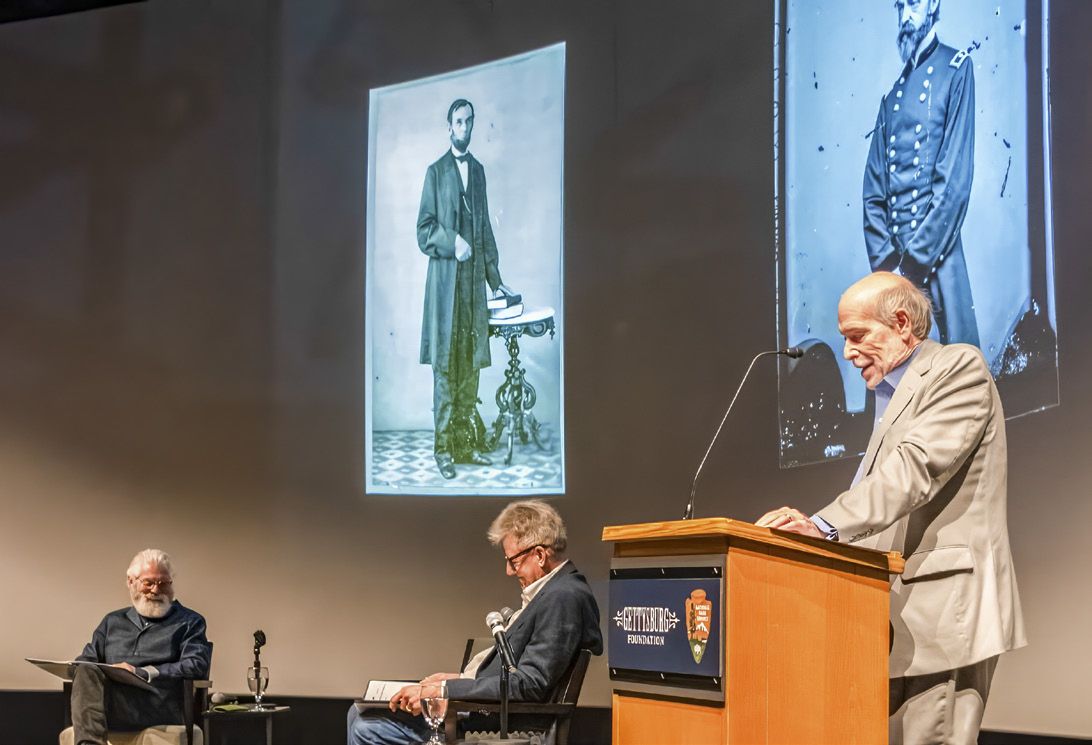
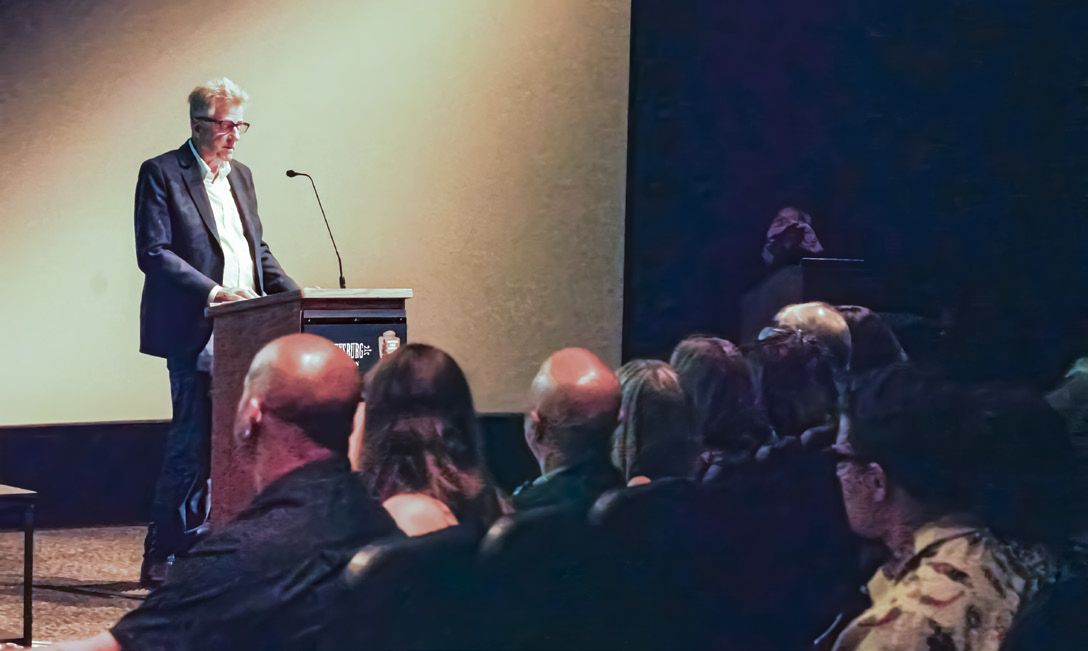
Stephen Lang, Jeff Shaara Star in a Holiday Weekend Ensemble Performance at Gettysburg By Harold Holzer GETTYSBURG, PA—For award-winning actor Stephen Lang, star of the films Gettysburg and Gods and Generals, not to mention the futuristic global blockbuster Avatar, it was a return to the past and the Civil War town he loves most. Lang regards Gettysburg “not only as hallowed ground of memory, but as a place of purpose for the future, where conflicting ideas can be discussed without rancor.” This year, on July 5, he brought an ensemble: novelist Jeff Shaara, musician Tim Cobb, and this reporter. The result was both magical and memorable: Battle Hymns: Gettysburg in Myth, Music & Memory, a 90-minute tourde-force performance of historical and fictional prose and poetry for a sold-out audience at the Kinsley Theater in the Gettysburg Visitor Center. Lang is a true Gettysburg veteran: he has been visiting and performing here for years, delivering his one-man play Beyond Glory (particularly its long soliloquy on James Jackson Purman, a Battle of Gettysburg Medal of Honor recipient). His young reader’s book on Purman, The Wheatfield and the animated film it inspired debuted here. Lang received the inaugural Kinsley Award from the Gettysburg Foundation for exemplifying Abraham Lincoln’s vision for a civil and inclusive society in 2019. He has also recited the Gettysburg Address at both the annual Lincoln Forum and at the Soldiers’ National Cemetery at Dedication Day. Lang’s voice can now be heard performing the iconic speech in the introductory film at the newly restored and repurposed Gettysburg Lincoln Railroad Station. “Gettysburg has meaning to me on several levels,” Lang said in a post-performance interview for this article. “First of all, it represents a victory of union over disunion, and the preservation of our democracy, and then there is the beauty of the place: the fields and orchards and the rocky hills and meandering creeks. This landscape is imbued with the spirit of those who struggled here. It is palpable and can be felt on a soft breeze or a warm rock. It is a place for reflection and renewal.” On July 5, the night after a dazzling Independence Day fireworks display lit up the hazy sky above the battlefield, Lang provided dramatic fireworks of his own by leading the group performance at the Gettysburg National Military Park Visitor Center. As noted, Lang generously shared the spotlight with friends from both Gettysburg and his native New York City. “Can there be any greater gift than the opportunity to work with such deeply talented men?” asked Lang. “Each is a master at his chosen art: Harold Holzer as a historian; Jeff Shaara as a writer of historical fiction; and Tim Cobb as a remarkable musician. These three gentlemen all share a deeply committed, and what I would characterize as a scholarly, approach to their work. This is immensely appealing to me. They are the kind of people I like to be around.” For Shaara, the occasion coincided with the 50th anniversary of his father Michael’s landmark Pulitzer Prizewinning book, The Killer Angels, which inspired the Ron Maxwell Gettysburg film in which Lang played General George Pickett. Shaara read both the opening and closing passages of Killer Angels for “Battle Hymns,” bracketing the deeply moving recitations with a passage from his own sequel, Gods and Generals, and another from his historical novel Last Full Measure. Shaara’s latest book, Shadow of War: A Novel of the Cuban Missile Crisis, has already earned acclaim and popularity, as well as a long book-signing line at the Visitor Center following the July 5 show.
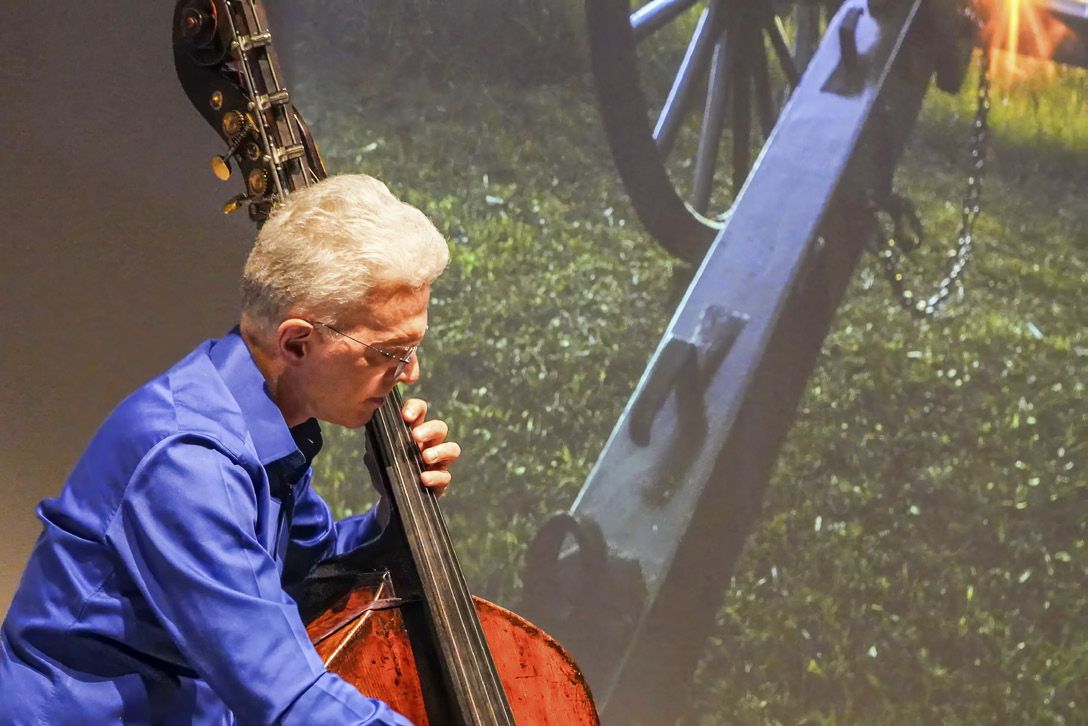
“It was a unique and amazing privilege sharing the stage with Stephen Lang, Harold Holzer, and Tim Cobb, three extremely talented artists,” said Shaara. “To be included, I accept that as a serious compliment. It was an extraordinary evening, for the four of us and, I think, for the audience as well. I hope we can do it again.” Cobb is principal bassist for the New York Philharmonic and head of the bass department at the Juilliard School. He brought along his prized ca. 1820 Italian bass instrument and used it to perform extraordinary musical interludes dotted with strains from “Dixie,” “Battle Cry of Freedom,” “Battle Hymn of the Republic,” and other Civil War music. Cobb concluded the program, after Lang’s extraordinary performance of the Gettysburg Address, with a deep-toned version of “Taps.” This was Cobb’s second collaboration with Lang, and second journey to Gettysburg. He recorded the solo bass soundtrack for Lang’s animated film short, The Wheatfield, and appeared onstage with Lang and me here in 2013 to mark the 150th anniversary of the battle. Stephen Lang remembered that 2013 appearance as “an event that combined theater, history, animation, and music. It was a grand success, but just as important, a lot of fun. Ever since then, I have wanted to do something similar, and this seemed like as good a time as any.”
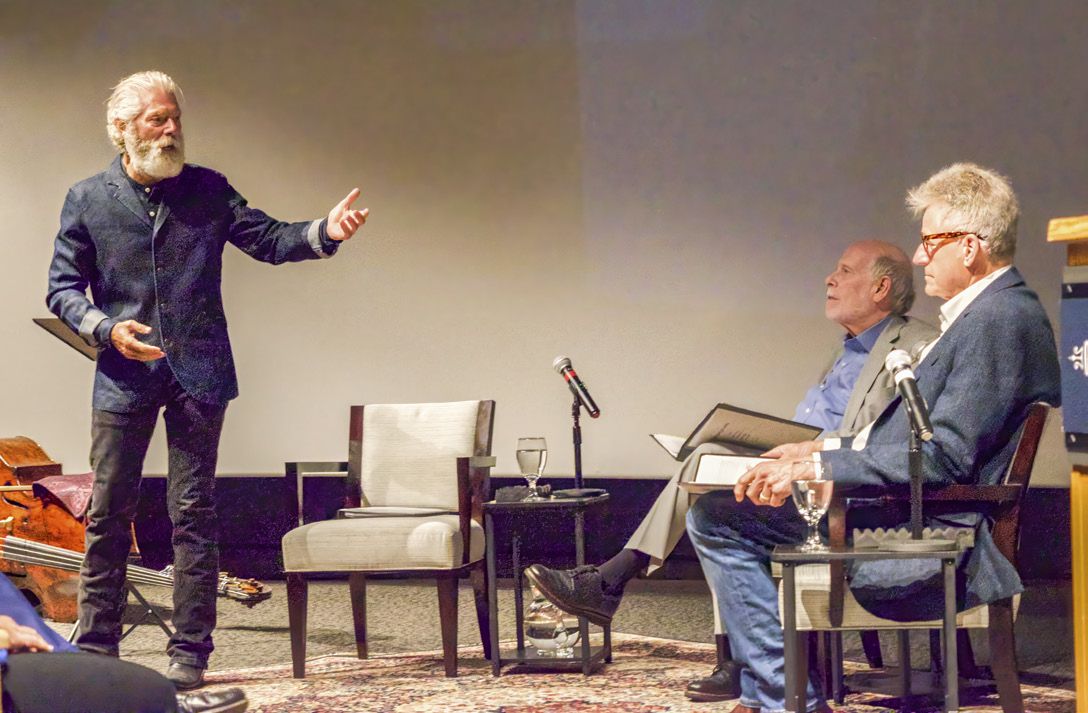
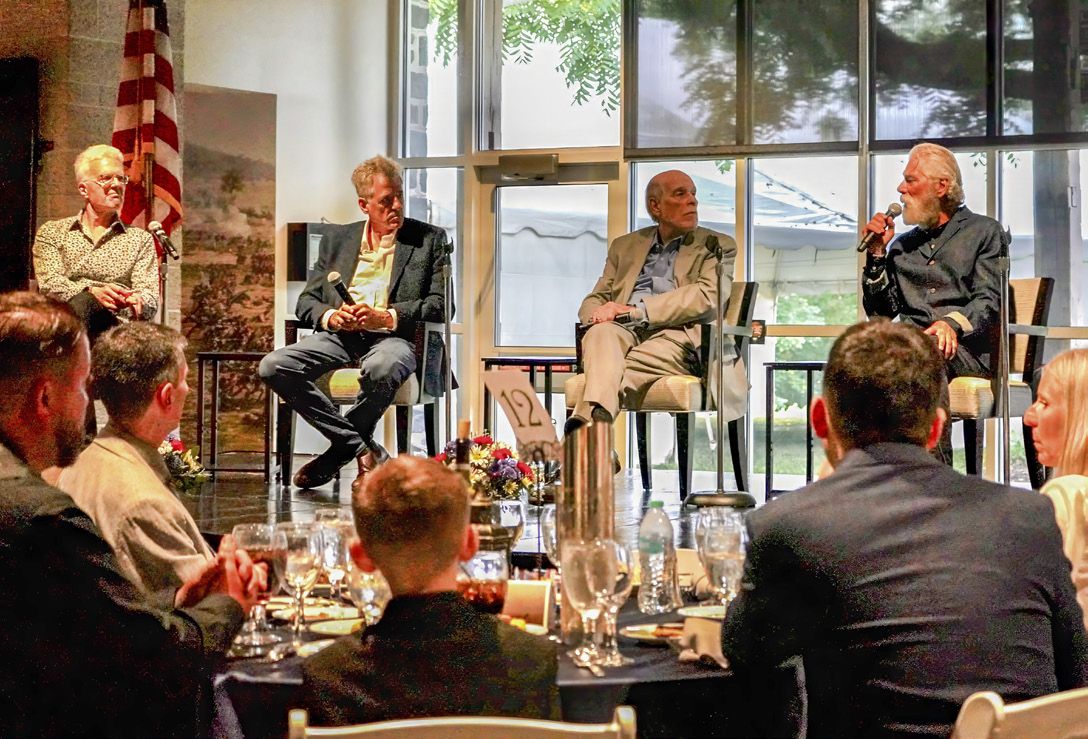
Full disclosure: the fourth member of the troupe, namely this reporter, leapt at the invitation from his friend Stephen Lang. My role was to contribute readings from the letters and speeches of Abraham Lincoln. Civil War News publisher Jack Melton, in turn, invited me to write this summary of the proceedings. Among the passages I got to recite was the now-famous criticism Lincoln penned to General George G. Meade following Meade’s failure to pursue Robert E. Lee after Gettysburg. “He was within your easy grasp, and to have closed upon him would…have ended the war.” The President “never sent, or signed” the censorious missive, according to a notation at the bottom in Lincoln’s own hand. As the commander-in-chief later explained to a newspaperman: had his letter provoked Meade’s resignation, “I will have a hole for which I have no peg!” As a prelude to Lang’s riveting delivery of Lincoln’s most revered oration, I concluded my readings with the letter of praise that principal Gettysburg orator Edward Everett generously sent Lincoln following their appearance at the dedication of the national cemetery on November 19, 1863. Writing the day after both men had delivered speeches there, Everett lauded the President for his “eloquent simplicity,” and conceded: “I should be glad if I could flatter myself that I came as near to the central idea of the occasion, in two hours as you did in two minutes.” Except for his rendering of the Gettysburg Address, Lang focused exclusively on recitations of his own remarkable, original Civil War poetry, which the actor modestly describes as “doggerel,” taking the rapt audience through the entire first day of the Gettysburg battle in dramatic rhyme, through the voices of Lee, Lincoln, John Buford, John Reynolds, Winfield Scott Hancock, and a multitude of others. To produce and perform Battle Hymns, it might be noted, Lang traveled to Gettysburg from Greece, where he is filming a movie for Amazon, The House of David, portraying the prophet Joseph adorned with a much-longer beard than his fans are accustomed to seeing on the versatile actor. Somehow, the whiskers seemed “altogether fitting and proper” for Gettysburg, too. Lang and his family also enjoyed tours of the newly reopened Little Round Top, and later of the entire battlefield, braving scorching heat and humidity that perhaps only the original Joseph could long endure. He then flew back to his European location to continue filming House of David, but not before confiding his hopes of taking the four-man Battle Hymn production to other venues. Its July 5 Gettysburg premiere was followed by a seated dinner at the Visitor Center, then a public conversation with the four performers, expertly moderated by Janet Riggs, immediate past president of Gettysburg College. During the chat, Lang revealed that he and Shaara have also collaborated on Grand Reunion, the screenplay for a film about the surviving veterans’ 1913 mass gathering on the 50th anniversary of the Gettysburg battle. “I’ve never really collaborated on any writing project before,” Shaara said of the new project. “Creating the screenplay was eye-opening, especially sharing the creative process with someone like Stephen Lang, who brings different experiences, different talents, and total professionalism. And even better, he’s great to work with.” The Battle Hymns premiere was coordinated and hosted by Brian Klinzing, director of development for the Gettysburg Foundation, with generous support from leadership and staff of the organization. J. Gordon Beitenmiller, member of the Gettysburg Foundation Board of Directors, introduced the dinner panel. Production guru Ron Rogell provided stage management and lighting, and Gettysburg’s own Jake Boritt, who recently co-produced the first Gettysburg Film Festival, created and screened a panorama of modern and period images that served as an evocative backdrop for the readings.
– MAKER –