
Importance of Reputation
Originally published September-October 2024 · pp. 42–51
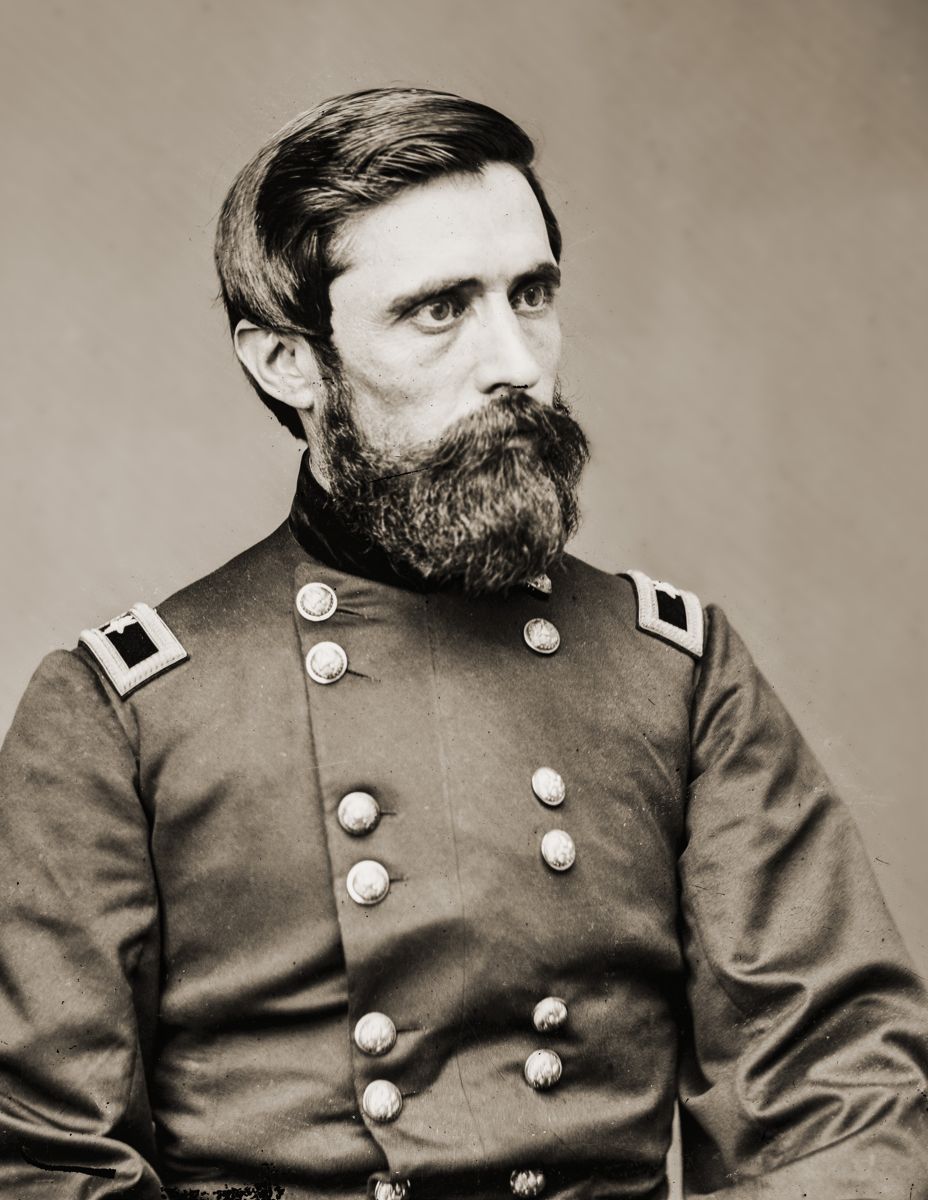
General John A. Rawlins. (Library of Congress)
In November 2022, the first author received an unexpected phone call. The caller, Mr. William Spann, explained that after reading Ottens’s biography, General John A. Rawlins: No Ordinary Man, he was impelled to revisit the contents inside a long-neglected box given him sixty years ago by a neighbor in Newburgh, New York. That neighbor was William Bull, a great grandson of General John Aaron Rawlins. Bull’s maternal grandmother was Emily Rawlins Wait, the younger daughter of the general. Mr. Spann revealed that the box contained dozens of items pertaining to Rawlins and his family members. Over the next twelve months the astounding contents of the box would finally be revealed. Prior to the Civil War, Rawlins was retained as the attorney for Grant’s leather store in Galena, Ill., owned by Jesse Grant, the father of Ulysses S. Grant. Hard on his luck in 1860, Ulysses Grant moved to Galena with his wife Julia to work for his father in the store, a job he detested. It was Rawlins’s rousing April 15, 1861, speech to Galena residents that spurred Grant’s re-enlistment in the U.S. Army, seven years after his resignation from it. “I have been a Democrat all my life, but this is no longer a question of politics. It is simply union or disunion, country or no country,” Rawlins opined in his speech to Galena residents following Lincoln’s Call for Volunteers. “I have honored every favorable compromise, but the day Lost and Found: A Trove of General Rawlins Material Comes to Light By Allen J. Ottens, Melissa A. Winn, and Ryan P. Semmes
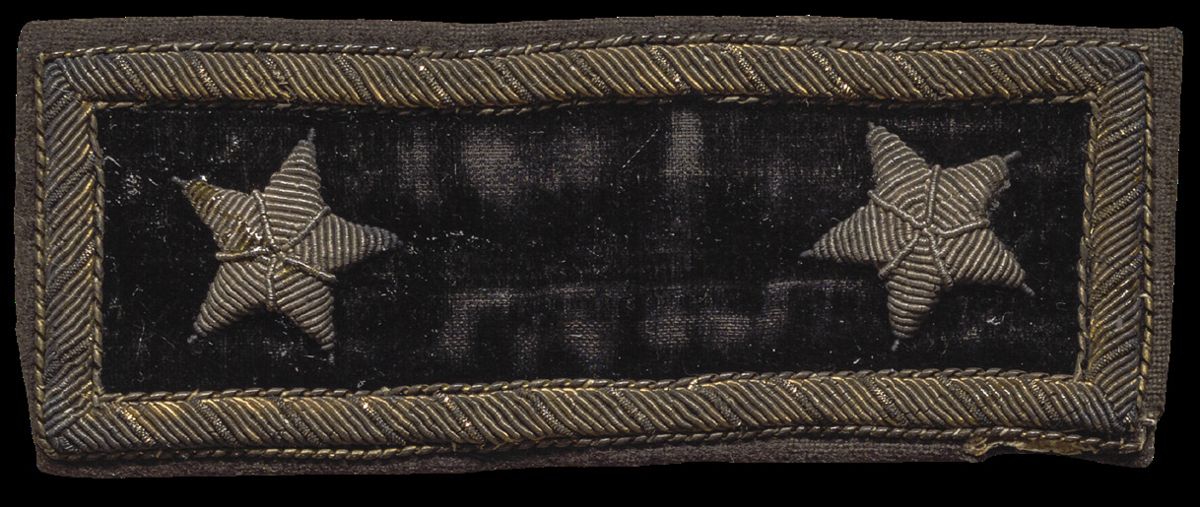
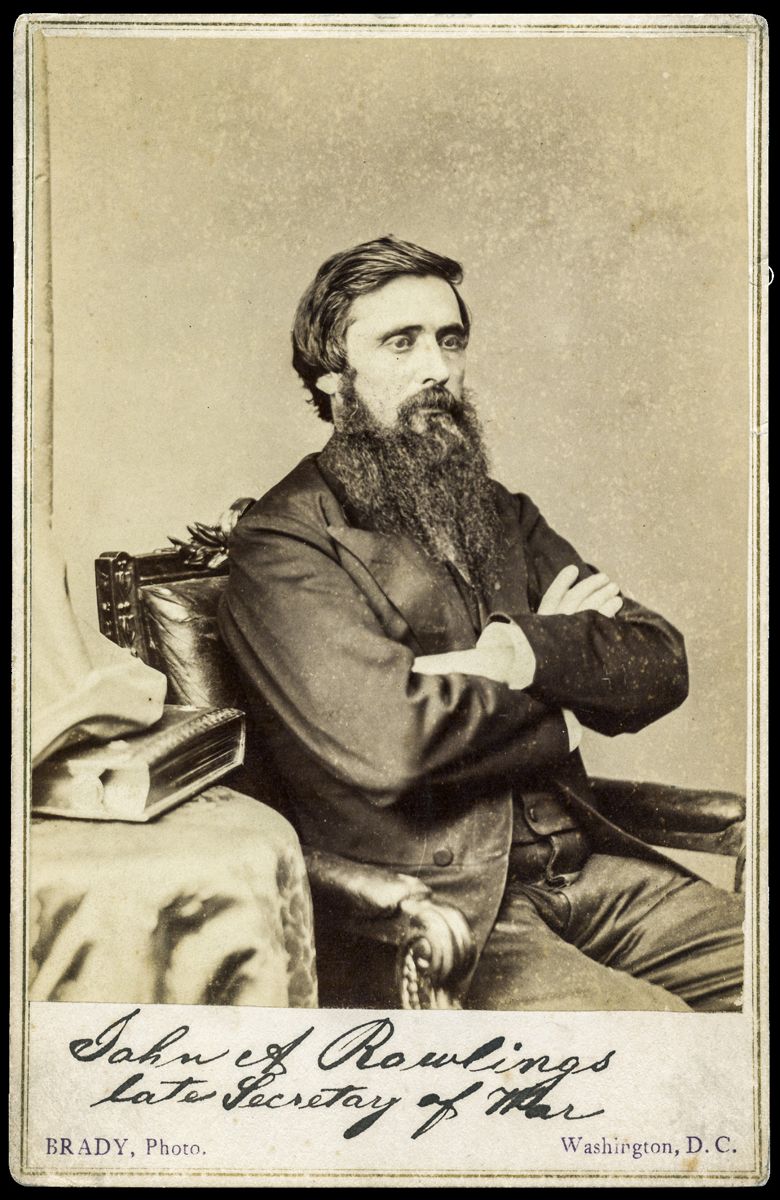
At City Point, Generals John Impressed with Rawlins’s devotion to the country, work ethic, and moral character, when Grant became a general in August 1861, he invited the recently widowed attorney to join his staff as assistant adjutant general. Eventually, Rawlins would become Grant’s chief of staff, chief of staff of the armies, and during Grant’s presidency, Rawlins would serve as his first secretary of war. From a personal perspective Rawlins served as the assertive protector of Grant’s reputation, close friend and confidant, trusted adviser, and the scold who shielded Grant from liquor. In his professional capacity, Rawlins displayed proficiency at issuing orders and writing reports, acting as Grant’s emissary on select delicate missions, and providing input on critical decisions regarding political and even foreign affairs matters. Grant’s military secretary, Colonel Ely Parker, who knew both in pre-war Galena, regarded Rawlins as “absolutely indispensable to General Grant.” Nineteen letters written by Rawlins from his Galena home are the highlight of the collection. Eighteen were to his tuberculosisstricken first wife, Emily, while she was convalescing at her parents’ home in Goshen, N.Y., for several months in 1859 and again in 1861. One letter, written on Christmas Day 1856 to his sister-in-law, Ann Smith, in Goshen, is probably the earliest Rawlins letter extant. The box contained numerous letters written by Rawlins’s family members including Rawlins’s mother, Lovisa, and his second wife, Emma, to his three surviving children. There were personal letters written to Rawlins while he was secretary of war, some which yielded surprises. The collection includes numerous examples of paper ephemera such as family photographs, invitations sent to Rawlins to attend various events, copies of resolutions, and condolences following his September 1869 death, and even the program from the first commencement exercise at Cornell University. Most unexpectedly, the box also contained several of Rawlins’s officer shoulder straps and cap insignia. The discovery of these materials belonging to Rawlins is remarkable for many reasons, not the least of which is a bit of mystery surrounding his belongings that surfaced after his death in 1869, at the young age of 38, while serving as secretary of war in Ulysses Grant’s cabinet. His papers, perhaps two army chests full, at that time, went missing. It is not known who came into their possession or if they were destroyed. About this mystery, Grant scholar John Y. Simon once lamented, “The disposition of the Rawlins papers upon the death of John A. Rawlins and their whereabouts constitutes one of the most perplexing problems for anybody in the Grant field.” Archivists at the Library of Congress in the 1930s and again in the 1960s conducted extensive, but futile, searches to find the trove of Rawlins A cabinet card of Secretary of War John A. Rawlins. His name papers. is often misspelled, as evidenced by the notation of this card. The eighteen letters to wife Emily are He served in Grant’s Administration from March 1869 until his replete, as one would expect, with family untimely death in September 1869. (Courtesy of Melissa A. Winn and local news updates and Rawlins’s Collection)
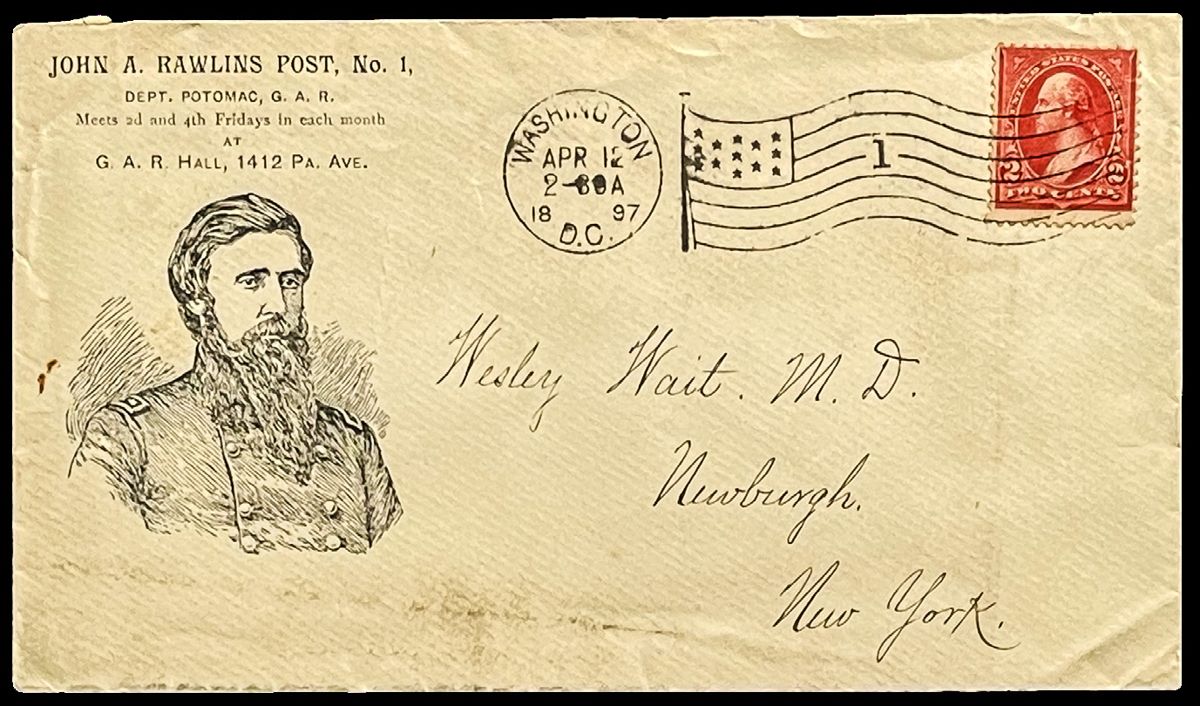
The collection also includes personal correspondence to General Rawlins’s descendants and their families, including this envelope for a letter to a family member from The John A. Rawlins G.A.R. Post No. 1 in Washington, D.C. (Courtesy of the Ulysses S. Grant Presidential Library at Mississippi State University)
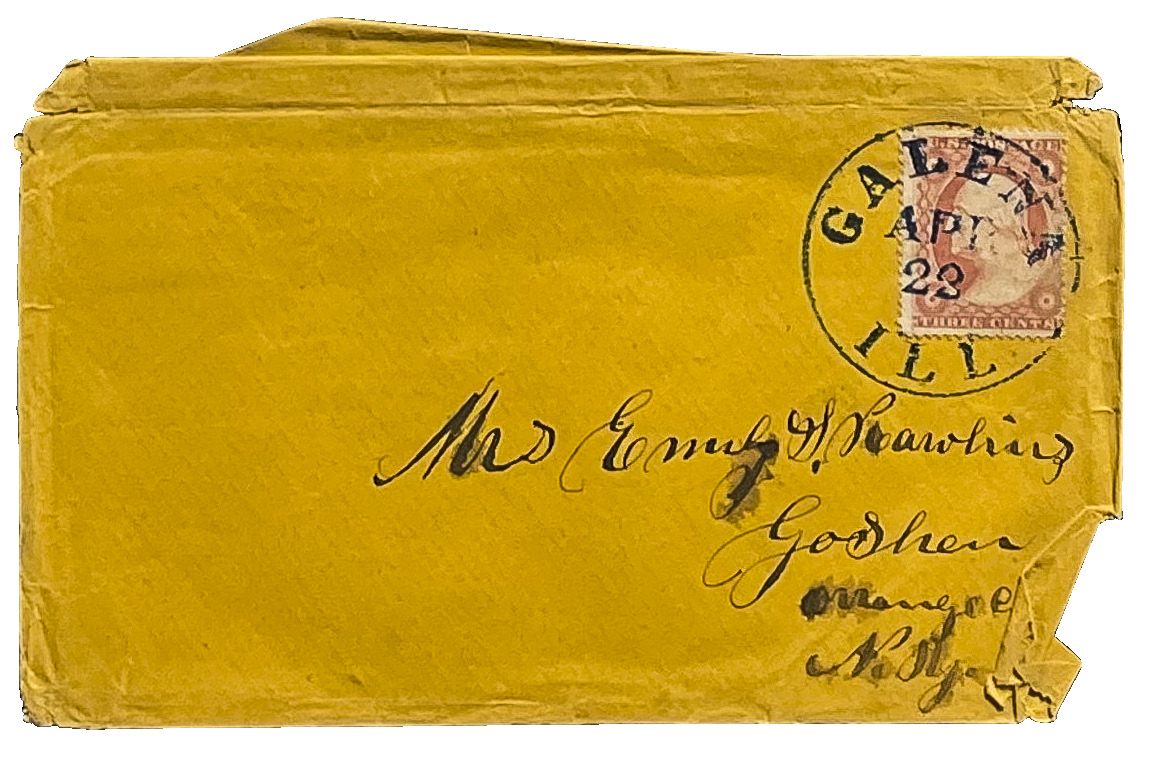
The new collection contains some of Rawlins’s personal correspondence, including letters like this one to his first wife, Emily. (Courtesy of the Ulysses S. Grant Presidential Library at Mississippi State University)
A commemorative ribbon for the John A. Rawlins G.A.R. Post No. 1 in Washington, D.C. A very active membership was instrumental in moving Rawlins’s remains from Congressional Cemetery and having him reinterred near other Civil War dignitaries in Arlington National Cemetery. (Courtesy of Melissa A. Winn Collection)
ardent hopes for her improved health. There are three references to the issue of Emily’s weight, including one in the letter of July 9, 1861, just weeks before her death, in which he asks her to “tell me in your next [letter] how much you weigh & just what the Dr. says.” Thus, Rawlins certainly knew tuberculosis (known as consumption at that time) was draining her physical resources. The letters to Emily do not, unfortunately, contain any references to his relationship with U.S. Grant or to the dramatic speech Rawlins made at the Galena courthouse urging military retaliation after the bombardment of Fort Sumter. However, they do provide some insights into Rawlins’s feelings about the prevailing political and military climates. For example, in his June 6, 1861, letter, Rawlins, a fervent supporter of Stephen Douglas, refers to the latter’s recent death as a “terrible calamity for the country” and equates Douglas with Thomas Jefferson. We learn in another letter that in mid-June 1861, Rawlins made a trip to Shullsburg, Wis., to “drum up recruits for the ‘Grand Army’ of the republic.” A patriotic Galena speech that he does refer to is one he made in May 1861 upon the death of Colonel Elmer Ellsworth. He tells Emily his touching salute to the gallant Zouave moved audience members to bury their faces in handkerchiefs and almost brought him to tears.
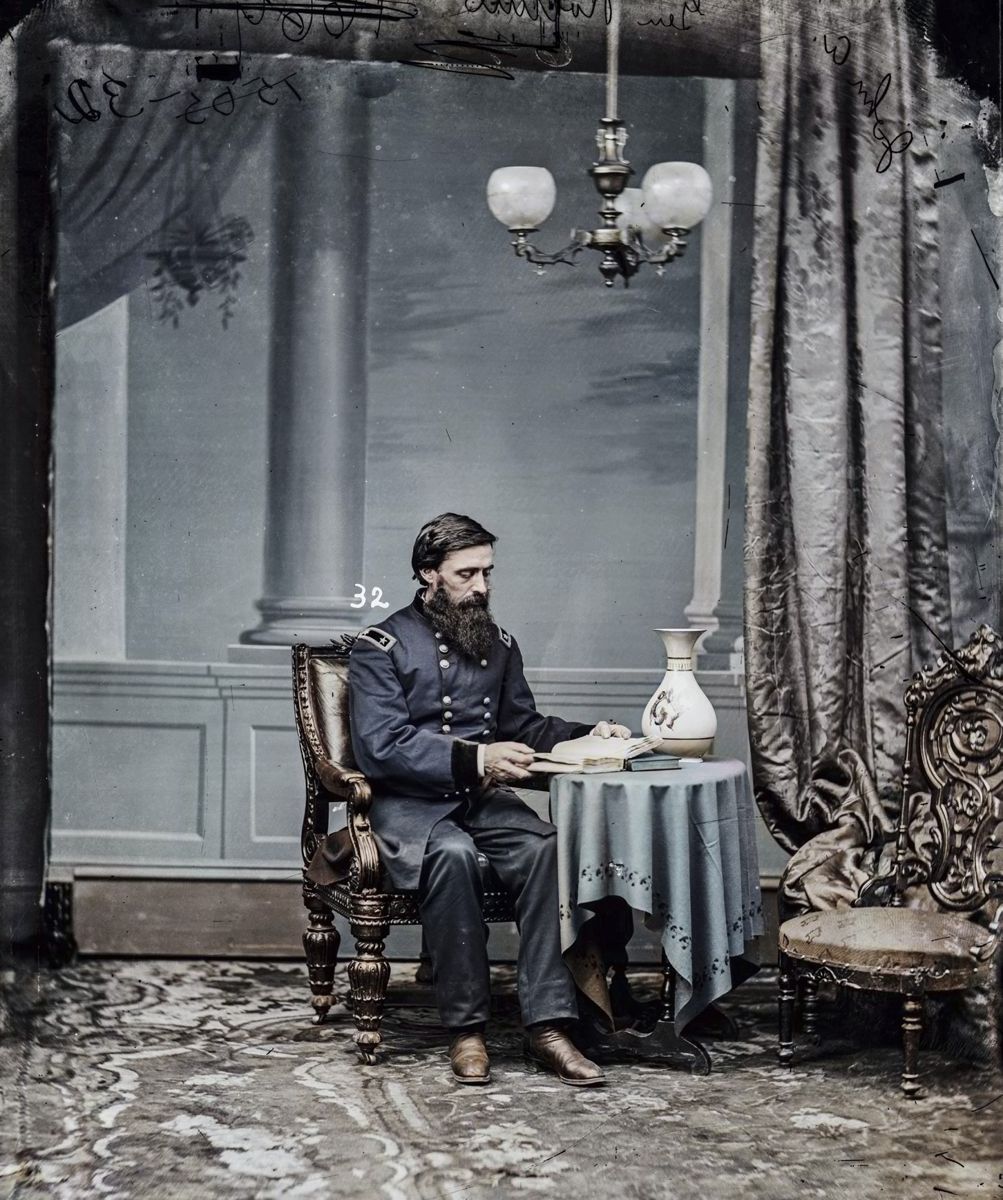
Major General John A. Rawlins. (Library of Congress)
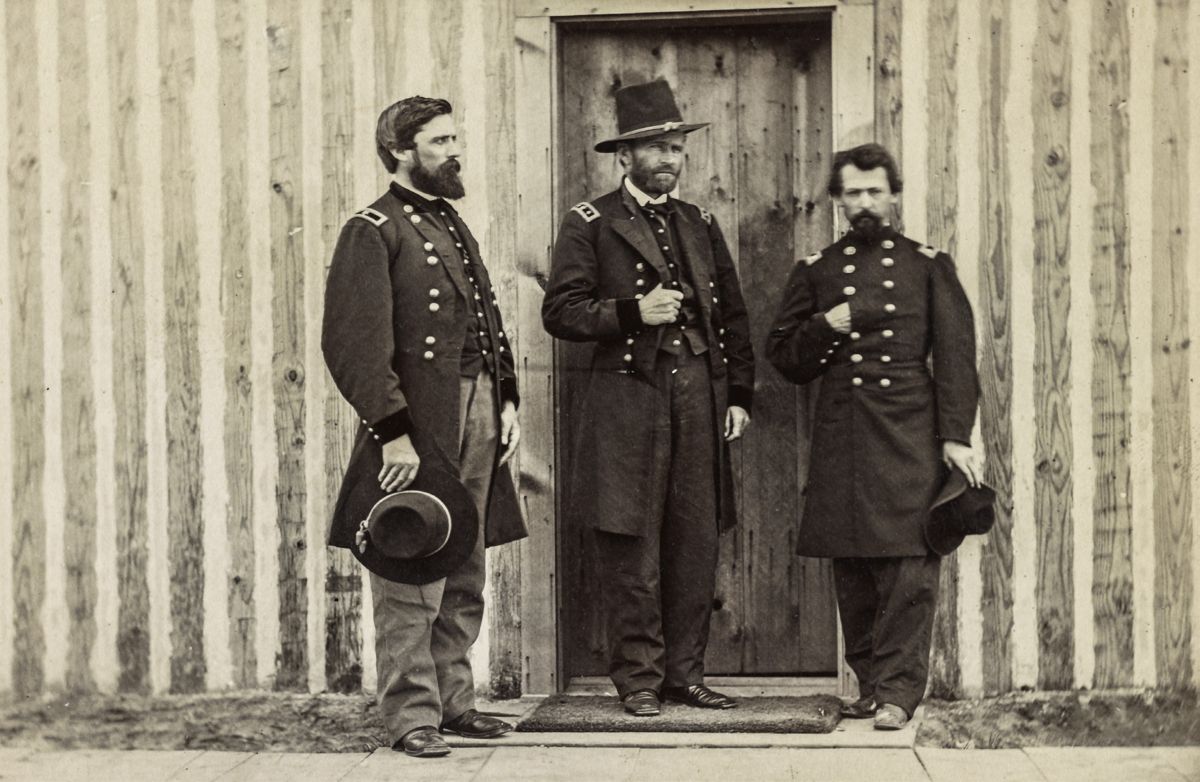
Brig. Gen. John A. Rawlins met his second wife, Emma, in Vicksburg, Miss., in July 1863. They married later that same year. (Library of Congress)
The letters provide some rare insights into Rawlins’s Their sparring over travel arrangements continued into relationship with Emily. They appear to reveal that during September, when on the 6th, Rawlins wrote that his coming the spring of 1861, Rawlins was feeling torn by divided to Goshen was still “out of the question” due to his “limited loyalties: to his desperately ill wife who passed away on means.” Three days later, he seems to soften his hardline, August 30, 1861, or to his country. On May 30, 1861, he telling her that when she does get back home, “I shall be told her that, “Times look gloomy. I may yet have to go doubly happy in making amends for previous derelictions in & fight for my country.” Less than three weeks later he duty by spending my evening with you rather than at my office, reassured her, “But don[’]t be or other places of amusement.” afraid of my going. I shall not Yet, in the next sentence, he unless I am obliged to by the cautions that his change of heart demand of the government.” In might only go so far: “But don’t “TIMES here are HARDER July, he reversed course, telling construe this with any promise than they have been since we her, “I would like to go with the for of the future we are entirely were MARRIED; and while Army, [so] that the children . . ignorant.” We are left to guess our BUSINESS is as good . might feel a glow of pride to what Rawlins’s “other places of know their father had, when his amusement” were. Emily and as any in the COUNTRY still country called for its true sons in Jimmy returned to Galena later we have taken in SCARCELY the hour of peril, gone forth & that month, apparently because any MONEY.” done his duty … .” of a compromise agreement, Interspersed among Rawlins’s in the company of some of her rhapsodic expressions of his relatives. love for Emily and extolling her beauty, there are flashes of friction between the two. For example, he strenuously argues against her wish that he should travel to Goshen to accompany her and their twoyear-old son, Jimmy, on their return to Galena following her 1859 convalescence. In a June 12 letter, he explains why he can’t: “Times here are harder than they have been since we were married; and while our business is as good as any in the county still we have taken in scarcely any money.” On June 28, he took a firmer stand: “Emily I do hope when I inform you as I now do, that I cannot consistent [sic] with your & my interest come after you. You will not think hard of me for so doing. I tell you Emily I cannot possibly get the money to defray my expenses without borrowing it, and it would take at the very least one hundred dollars, besides I have some debts that must be paid.” However, in Rawlins’s letter just the next day, we learn that Emily has taken a surprisingly assertive stance for a mid-nineteenth century wife; she refused to return with their son unless he accompanies them. In that June 29 letter, Rawlins writes,
“But if you absolutely bring it down to the simple determination, ‘that unless I come after you, you will not again return to our home’ I shall have to comply with your request, although it will be taking a step these hard times that I will feel the effects for some time in the future.” Moreover, it appears that she startled him into a confession and semi-apology, as he goes on in the same letter to say,
“In many, very many things Emily I may have come short of my real duty towards you in not spending my evenings at home so much as I should but these things I regret as much as you possibly saw.”
An 1869 invitation to dine with William Evarts and his wife, sent to Rawlins as Secretary of War. (Courtesy of the Ulysses S. Grant Presidential Library at Mississippi State University)
Of the personal letters written to Rawlins, one of the most interesting, an 1869 invitation to dine with William Evarts and his wife, was sent to him during his brief tenure as secretary of war. Evarts had just finished serving as attorney general during Andrew Johnson’s administration. The invitation comes with an added purpose, “To meet Genl. Sherman.” The invitation also bears in a secretarial hand the note, “accepted Ap. 6th.” This was arranged just over a month after Rawlins strenuously advised President Grant to revoke his order giving William T. Sherman command of the Army’s various departments and bureaus. Rawlins was legally correct in maintaining that these departments should continue under his own civilian oversight, rather than the military’s. Sherman was incensed over Grant’s siding with Rawlins, and their relationship became strained. Sherman never let the issue drop; and he ranted about that decision years later in his memoirs. Rawlins should be given credit for not ducking this face-off with Sherman, but we wonder how strained the conversation around the Evarts dinner table was. Perhaps the most intriguing item found in the collection is a copy of the notable June 6, 1863, letter Rawlins wrote to Grant during the Vicksburg siege, admonishing him for displaying signs of intemperance. Rawlins’s purpose was to sound an alarm and appeal to Grant’s sense of honor and desire to achieve military success. Rawlins warned Grant that any drinking could bring down disgrace on him, usher in defeat, and imperil the lives of those under his command. In this, one of the most remarkable personal communications of the war, Rawlins expressed his ardent support for Grant but warned that should he imbibe, Rawlins would ask to be relieved from duty. The copy in the collection is obviously not in Rawlins’s hand, but it was written on military stationery of the time and closely resembles period letter book copies. A note on the back page of the letter states “This is an exact copy of a letter given to the person to whom it is addressed [Grant] at its date about four miles from our head quarters in the rear of Vickskburgh [sic]. Its admonitions were headed [sic] and all went well.” The note is signed “John A. Rawlins,” in the style of an aide’s copy. Perhaps an aide of Rawlins copied it for Rawlins. Clearly, the letter was saved by the Rawlins family for a reason. The Grant administration grappled with several foreign relations issues, notably negotiations with England about reparation claims for merchant ships captured or damaged by Confederate privateer vessels such as the CSS Alabama and debate regarding recognition of the Cuban insurgents rebelling against their Spanish overlords. There was also serious debate about the possible annexation of the Dominican Republic (known then as Santo Domingo), a move that Grant would come to espouse. The drumbeat for annexation was driven by interest in the nation’s considerable natural resources and its strategically situated Samaná Bay, which had for some time been regarded as a desirable location for a naval base and coaling station. Fragments of this intrigue over Santo Domingo are revealed in correspondence to Rawlins from the fabulously wealthy shipping magnate, Paul S. Spofford and his New York-based firm, Spofford, Tileston & Company. In two letters, Paul Spofford, on May 22, 1869, and on July 19, magnanimously invited the Rawlinses to vacation with him and his wife at Newburyport and the Isle of Shoals. Spofford’s motive for lavishly entertaining Rawlins is not hard to fathom. With serious talk underway about annexing Santo Domingo and even granting it statehood, Spofford, Tileston & Company was starting a steamship line from New York to Santo Domingo. Paul Spofford at the time was working hand-in-hand with one Joseph W. Fabens, an agent for the Dominicans who was pushing on their behalf for annexation. Fabens, a shady character, would stand to make a fortune if he could swing that deal. Likewise, Spofford’s steamship line would profit handsomely from the increased trade with Santo Domingo. Fabens and Spofford had even met with Grant at the White House in early April 1869, making a case for annexation. Of course, Spofford knew that Secretary Rawlins had Grant’s ear, and it could only help his chances if there was an influential voice in the cabinet positively disposed toward him. The collection contains an interesting letter from Spofford, Tileston & Company’s office to Secretary Rawlins dated May 22, 1869. This is an invitation for Rawlins to sail June 2 on the firm’s first vessel, the Tybee, bound for St. Thomas, Santo Domingo, Samaná Bay, and Puerta de la Plata, a journey to last twenty to twenty-five days. Rawlins was informed that Fabens and “several of his gentlemen of note” would also be on board. The trip was intended for officials to see first-hand the potential for profitable commerce and to gather information about the government and populace. No doubt, Spofford was confident that Rawlins would bring back favorable information to share with Grant and the cabinet. A notation on this letter indicates that Rawlins accepted the invitation, subject to the approval of his physician. Rawlins was in the final stages of his struggle with tuberculosis and had less than four months to live. A May 31 letter from the Spofford, Tileston office to Rawlins reveals that Rawlins must have had a recent personal meeting with Fabens, because Fabens told the office that Rawlins would be pleased to make the voyage, but that he did not want to be so long without his physician. This letter assures Rawlins that his physician is welcome to join him. Rawlins, it turns out, did not go on this voyage. At the time he was personally concerned about his second wife’s difficult pregnancy; and he was involved professionally with studying the plans for the Brooklyn Bridge. Construction on the bridge could not go forward without his approval. Medically speaking, he was also about to experience dangerous hemorrhaging in his lungs. President Grant, though, wanted to know more about the Dominican Republic’s desire for annexation to the United States, therefore he sent his personal Secretary, Orville E. Babcock onboard the Spofford, Tileston, & Company’s Tybee. Babcock’s journey led him to befriend Fabens and his cohort William Cazneau, and several other interested parties both American and Dominican. Babcock returned with a memorandum of understanding that President Grant hoped to turn into a treaty of annexation. Public apathy towards annexation and opposition to expansion within the Republican Party, though, prevented the Dominican Republic from joining the United States. As a cabinet secretary, Rawlins would be sought after as an honored guest or friend at various social events. The collection contains numerous examples of invitations. For example, his presence was requested by General Oliver O. Howard at the closing exercise on June 25, 1869, at Howard University. There is an invitation to attend the National Music Festival, which Rawlins declined on June 6, 1869, because “my health and duties are such as to prevent me from doing so.” There is a touching note from Moses Hallet, one of Rawlins’s school mates from Galena, at that time serving as a judge in the Colorado Territory, inviting him to visit “why not for a month?” The fact that letters of condolence and copies of resolutions honoring Rawlins’s passing are contained in the collection is hardly surprising. On September 9, 1869, the long funeral procession escorting Rawlins’s remains down Pennsylvania Avenue included sixteen pall bearers, over two hundred vehicles, and a full Marine band. The next day’s Daily Morning Chronicle reported that not since Lincoln’s body had passed down the streets of the capital had Washington witnessed “such a universal and touching tribute to any of the great men who have since passed away.” The Union League Club’s three-page resolution praises Rawlins for the “… unfailing brilliancy of his military record, and his uniform fidelity to the National Cause, not less than his fraternal relations with the illustrious General whose triumphs and counsel he shared …” The members of the Swiss Legation at Washington, D.C. expressed “… the hope that the life of the distinguished sufferer may be spread to his many friends, but more especially to his country.” Probably the words most precious to Rawlins were conveyed in a September 20 resolution from his beloved Army of the Tennessee to his widow, Emma:
John A. Rawlins: No Ordinary Man was published by Indiana State University Press in 2021. Melissa A. Winn is a writer, editor, and photographer, and the Marketing Manager at the American Battlefield
Trust. Previously, she served as Director of Photography for Historynet, publisher of nine history-related publications, including Civil War Times and America’s Civil War. Melissa collects Civil War photographs and ephemera with an emphasis on Maj. Gen. John A. Rawlins. Praising Rawlins’s close and important working and personal relationship with Grant, fellow staff officer James Wilson said, “There can be no doubt as to the position he filled or the good influence he exerted.” (Library of Congress)
Dr. Ryan P. Semmes is Professor and Director of Research at the Ulysses S. Grant Presidential Library at Mississippi State
University. He has been the archivist for the Ulysses S. Grant Presidential Library since 2009. Ryan’s research focuses on the connections between foreign and domestic policy and the nature of citizenship during the Reconstruction era.
James Country
MERCANTILE
“Resolved. That the pure personal character, strict individual and political integrity, valor and military service of General John A. Rawlins, most justly won for him universal respect when he was living and entitle his memory to be cherished in the hearts of all good and patriotic citizens now that he is dead.” With such examples of personal and political correspondence, Mr. Spann believed that his collection should remain intact. Through an intermediary, he came into contact with the Ulysses S. Grant Presidential Library (USGPL) at Mississippi State University. Thanks to a generous donor, USGPL had the funds to purchase the entire collection. It has been safely residing at the USGPL since September 2023. Archivists at the USGPL have arranged and described the collection to professional standards, placed it in acid-free folders and containers, and created a finding aid which is available online at the Mississippi State University Libraries website. The first author spoke recently with Dr. Anne Marshall, Executive Director of USGPL. “Thrilled to have it,” she said about the collection and then added, “We welcome any Rawlins researcher to come and use the collection.” Since its arrival, graduate students from Mississippi State University’s Department of History have already begun creating a temporary exhibit of the collection, using the materials in it to tell the story of Rawlins and Grant’s relationship. This exhibit will open in Fall 2024. That this collection of Rawlins’s letters, family documents, and ephemera has come to light might give renewed impetus to search efforts focusing on descendants of Rawlins. Perhaps family members of Rawlins’s older daughter, Jennie Holman, or his second wife, Emma Hurlburt Rawlins, came into possession of papers that remain unaccounted for. The discovery also reminds us that the study of the Civil War is ongoing, with new discoveries and surprises abounding and informing us at every turn. Allen J. Ottens is a professor emeritus of counselor education and supervision at Northern Illinois University. He is also a past-president of The Manuscript Society. His book General
1,000’s of Civil War Treasures! Plus! Revolutionary War • Spanish-American War Indian Wars • Mountain Men • Bowie Knife Collector Arms • Fur Traders • World Wars I & II
Eliza Frances Andrews (1840–1931) received a strong education and was a successful writer and educator. Her War-Time Journal of a Georgia Girl surely ranks among the most observant and intelligent wartime memoirs by a Southern woman.
“I Thank the Lord I Am Not a Yankee…”
Edited with commentary by Stephen Davis, I Thank the Lord I Am Not a Yankee includes selections of her wartime and postwar journals which are most expressive of her Confederate patriotism and Southern pride. February 2023 • $35.00, hardback
Stephen Davis is author of ten books on the Civil War, most of which treat the Atlanta Campaign. His two recent volumes on Confederate General John Bell Hood have won several prizes, including the Fletcher Pratt Award of the New York CWRT.
The home of