
Civil War Conscription
By Joan Wenner · Originally published September-October 2024 · pp. 29–33
Just as in modern times, armed opposition fuels volunteerism but is typically followed by conscription when increased mobilization is needed to bolster the ranks, particularly front-line troops, if volunteer recruitment provides insufficient replacements due to sickness, death, injury, and desertion. On March 4, 1861, President, Abraham Lincoln, rode up Pennsylvania Avenue to deliver his inaugural address. By May 3rd, he would be calling for 75,000 three-months, volunteers, another 42,000 three-year volunteers, plus 18,000 sailors to blockade southern ports, even though the Navy had fewer than 60 ships at that time and any increase would require many more sailors to man them. While not all young males were interested due to factors such as fear and disillusionment, many eager men came to recruiting offices from farms, villages, and cities across the North and South. Excitement, as well as alarm, seemed to permeate every home, it was reported. A journalist traveling in the South witnessed “crowds of armed men singing and promenading in the streets… though of course unfamiliar with the horrors of the battlefield…” The same sequence of enthusiasm and conscription concern USCT regiments, in which a number of ‘recruits’ were said to be fighting for their freedom as Union soldiers. According to The Civil War Chronicle, which provides an extensive timeline of the war and beyond, Fort Sumter was a flashpoint for the disputing sides from late December 1860. Confederate forces began seizing Federal property throughout the South. Following the secession of South Carolina on December 20th, the Federal garrison at Fort Moultrie relocated to “the haven of Fort Sumter in the middle of Charleston Harbor.” What are sometimes considered the first shots of the war were from secessionist artillery targeting the Federal supply ship Star of the West, which was also carrying reinforcements for the garrison. Further south, the governors of Florida and Alabama demanded Federal troops at Fort Pickens surrender, though it remained in Union hands. Lincoln had vowed not to fire the first shot at Sumter, but when Confederate batteries opened fire on April 12, 1861, the Union garrison returned fire but suffered defeat two days later and filed out of the battered fort. The next day, Lincoln issued a call for 75,000 three-month volunteers to quell the insurrection.
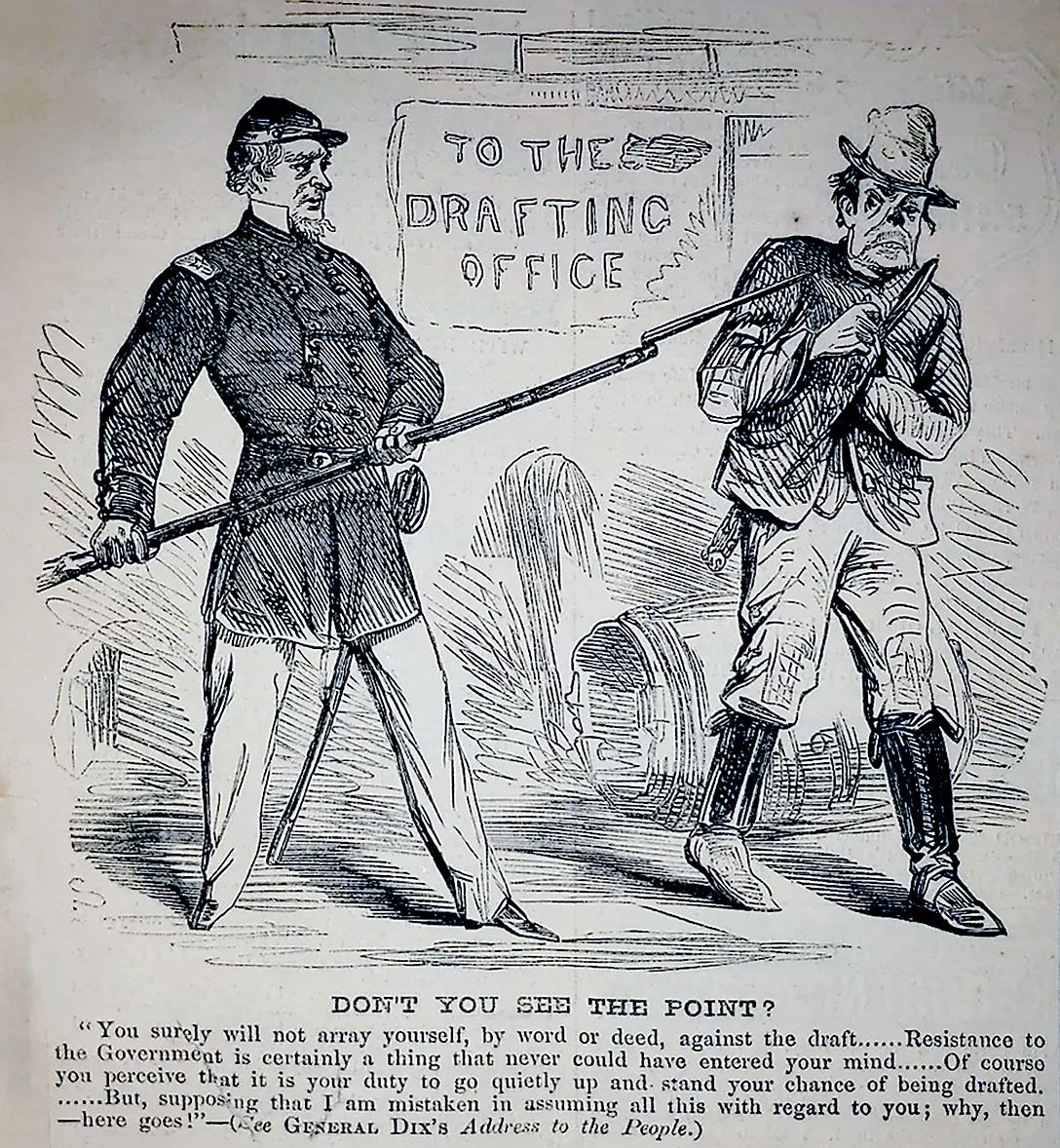
This political cartoon, entitled “Don’t you see the point?” Published in Harper’s Weekly on August 29, 1863.
Most, it’s said, believed the war would be of short duration, but when the reality of a prolonged conflict set in, volunteering dried up in contrast to the patriotic fervor shown in the beginning, With a definite lack of enthusiasm for the draft, some other solution for obtaining military manpower had to be devised. In mid-April 1862, Confederate President Jefferson Davis “approved an act calling for the conscription of every white male between the ages of 18 and 35 for three years of military service—the first national military draft to be instituted in the United States.” Historians oddly overlooked the point that the Confederacy was not in the United States at the time, and forgot all about the statewide drafts employed during the Revolutionary War. On March 3, 1863, the Union Congress passed the Military Act, also called the Enrollment Act, which was a replacement for the “ineffectual Militia Act of July 17, 1862.” The Federal government was now solely responsible for conscripting troops for the Union army, writes author David McCormick. It designated the position of provost marshal and added enrollment officers within each congressional district. In May 1864, Pennsylvania advertised a draft event to take place in Chambersburg, calling for 700,000 men. The legislation, especially the opportunity of paying of a fee to have someone else serve for an individual able but unwilling to serve, did not sit well with Democrats. They were reluctant, to say the least, to put “whole control” of males aged 20 to 45 solely with the president, with one newspaper calling the 1863 Military Act “a dangerous precedent of overreaching federal authority…” and an infringement of powers rightly resting with the states. “Unconstitutional” was the byword.
Also angering them was Congress passing an 1864 amendment that limited to one year how long the commutation fee would prevent someone from being drafted. Another imposed loss of citizenship as a penalty for draft evasion or desertion. Again, historians have forgotten the same buy out option was present during the Revolutionary War where groups of men subjected to the draft could pool their resources to hire some to represent the group in the military.
Things would become increasingly “downright ugly” as draft activities progressed as the war dragged on. Provost marshals and enrollers were demonized, including being labeled as spies and embezzlers, with their lives threatened. Gangs threw stones, women beat the enrollers about the head with brooms, and threw hot water; some enrollers were confirmed murdered for doing their appointed jobs. Those whose duties included tracking down deserters, the draft agents, fared no better.
Others were effectively told to stop their work or else. Vigilantes roamed the territories while Democratic legislators in various states took matters into the courts to adjudicate the constitutionality issue to no avail. Also, like today, misinformation reigned. Conscription in the War Between the States would ultimately be only partially successful.
Joan Wenner is a longtime contributor to Civil War News with a law degree, and a special interest in maritime topics and ‘snapshots’ of historical figures. A native New Yorker, she now resides in eastern coastal North Carolina. For comments email [email protected].