
Mathematically Impossible
By Stephanie Hagiwara · Originally published November-December 2024 · pp. 47–49
Mathematically Impossible
The October 8, 1862, Battle of Perryville, Ky., pitted U.S. Gen. Don Carlos Buell’s Army of the Ohio against C.S. Gen. Braxton Bragg’s Army of Mississippi. At stake was control of Kentucky.
“I believed that a charge would end in my death and the defeat and ruin of my regiment.” – C.S. Col. John H. Savage, 16th Tenn.
The battle opened about 3 a.m. over possession of Peters Hill and the remaining pools of water in Doctor’s Creek.
Summer and fall had been oppressively hot, and water was scarce. The Federal’s swift, bloody victory convinced Confederate generals William Hardee, the left wing commander and Benjamin Cheatham, 2nd Division commander, that they were outnumbered. Instead of following Bragg’s battle plan, they would “be guided by events as they developed.”
Newly minted U.S. Brig. Gen. Alexander McCook, I Corps, was alerted to the battle in the pre-dawn hours. He ordered his men to march the ten miles from Markville to Perryville. To speed the journey, McCook’s train, excluding his ambulances, were left behind.
As he approached, McCook could hear the fight on the right and could see Confederate scouts roaming the woods to the east. He positioned the men as they arrived. Gen. Lovell Rousseau, 3rd Division, on the high ground near the crossroads. Next came Gen. James S. Jackson’s 10th Division.
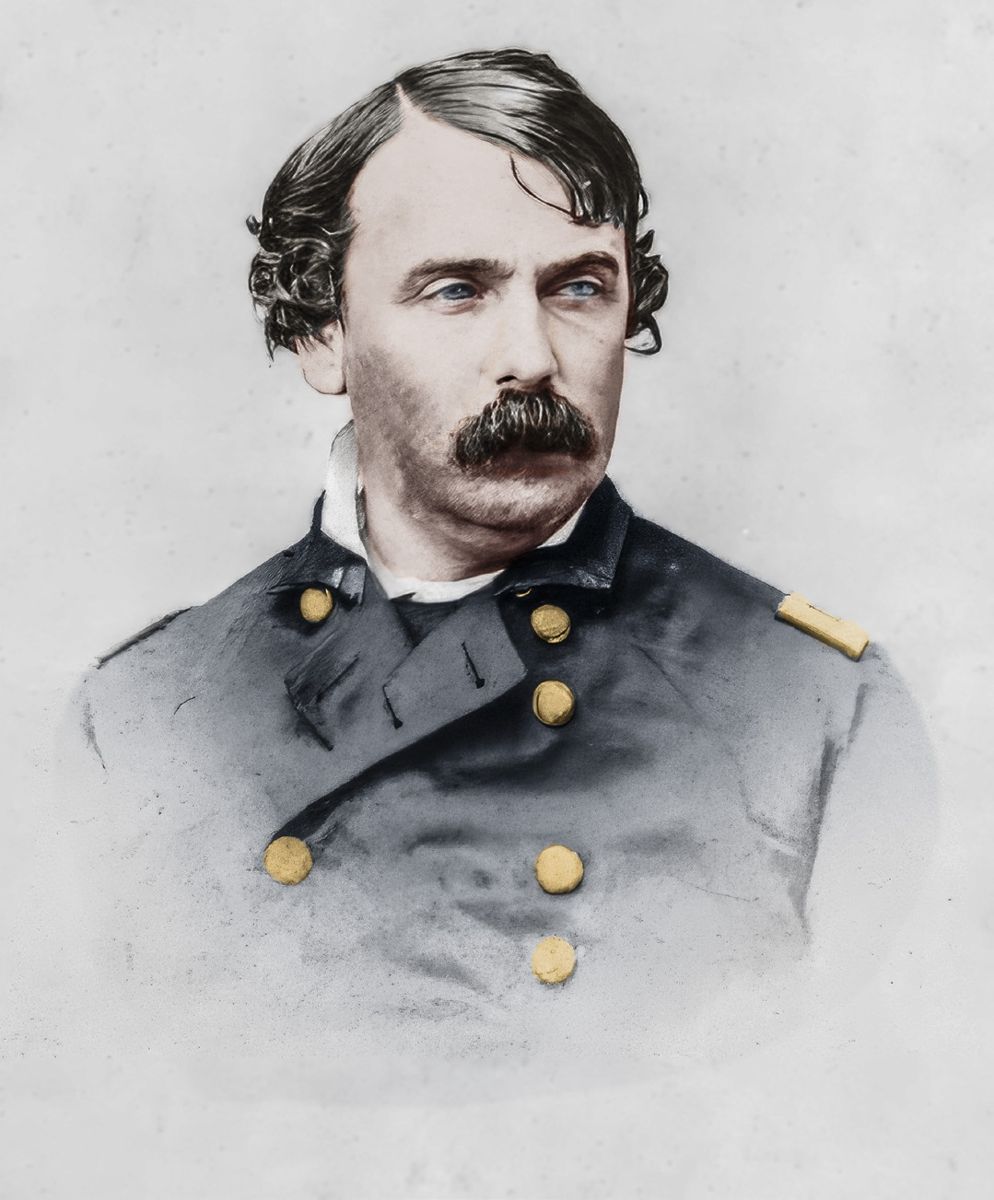
Hot tempered, Jackson had served in the Mexican– American War and as a U.S. Congressman representing his native Kentucky. In his eagerness for battle, Jackson had march his green troops before breakfast or filling their canteens. They were all tired, hungry, and thirsty.
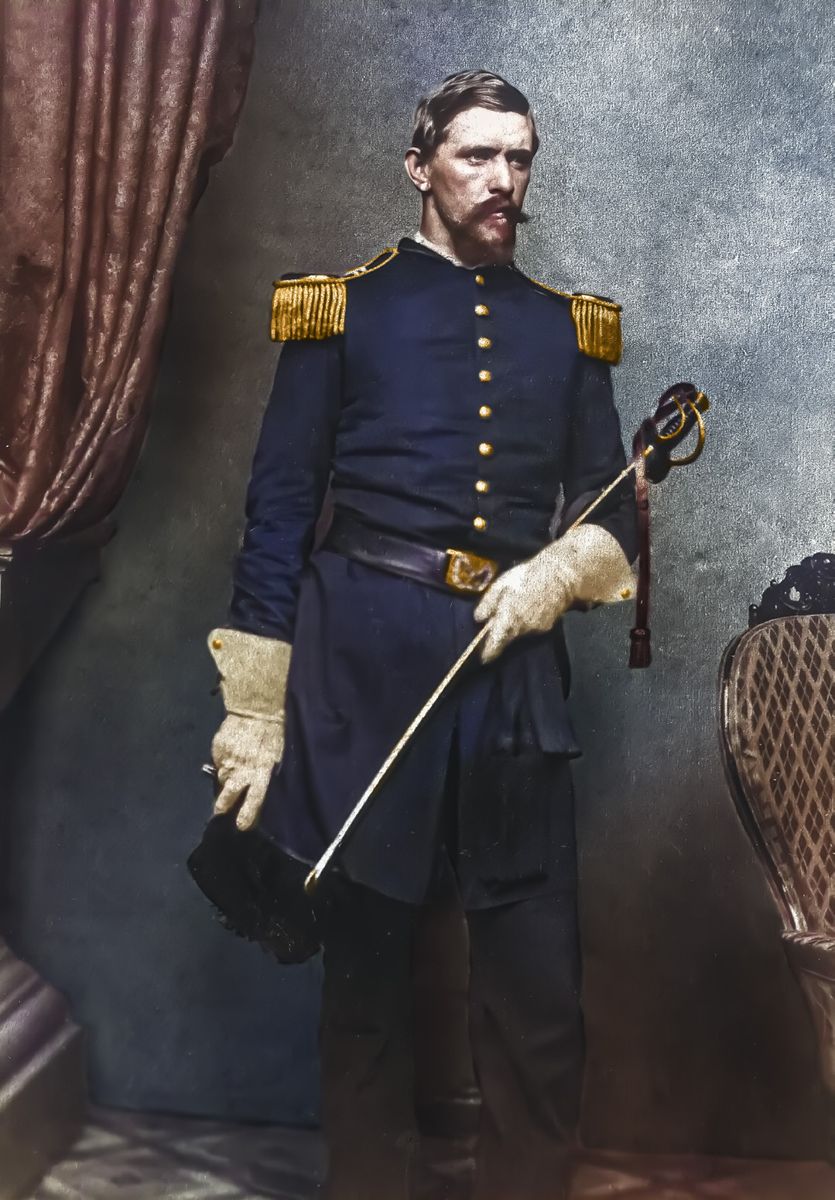
U.S. Gen. William Rufus Terrill’s 33rd Brigade, was ordered to Open Knob, a ridge overlooking the Chaplin River and its pools of water. He was to position his cannon on top and secure the river below with skirmishers. “I’ll do it, and that’s my water,” responded Terrill. McCook had situated his army’s least experienced rookies forward of his line.
Terrell, a West Point mathematics instructor, had stayed loyal to the Union, unlike his brother, James, and cousin J.E.B. Stuart. The Virginian had served as an artillery battery commander with distinction at the Battle of Shiloh, Tenn. His pet project was Lt. Charles Parson’s recently formed battery, consisting of five smoothbore Napoleons, two 12-pdr. howitzers and one Parrott rifle.
Bragg ordered Cheatham’s 6,000 men to double-quick to Walker’s Bend for an echelon attack. Gen. Daniel Donelson brigade would start the assault followed by Alexander P. Stewart’s and George E. Maney’s brigades. To get into position, Cheatham’s Division had to navigate a tangled, wooded riverbank before climbing a vertical 20 to 50 feet high bluff. Worse, Bragg’s scouts had returned before Terrell’s Brigade reached Open Knob. Instead of attacking the Federal flank, the Rebels would be making a frontal assault. Protesting the order to attack, C.S. Col. John H. Savage, 16th Tenn. concluded both Donelson and Cheatham hated him enough to kill him and his men.
Six roads led into Perryville. The rolling terrain dipped and rose amid cornfields, fences and woods. Savage considered the lone Federal battery a decoy to lure the Confederates into a trap. Savage insisted that 61-year-old West Pointer Donelson, former U.S. Pres. Andrew Jackson’s nephew, issue the order himself. At 2 p.m. Donelson, yelled “Charge.”
The Confederates marched forward silently, “as if on dress parade.” The 16th Tenn. led the way towards U.S. Col. George Webster’s, 98th Ohio Volunteer Infantry, placed as a reserve near the crossroads behind a rail fence above a large cornfield. As the Rebels emerged out of a hollow, Webster’s 3,000 rookies and six cannon released a murderous fire, mowing down the attackers. Still the brigade moved forward, tenaciously getting within 150 yards of Webster’s position before falling back.
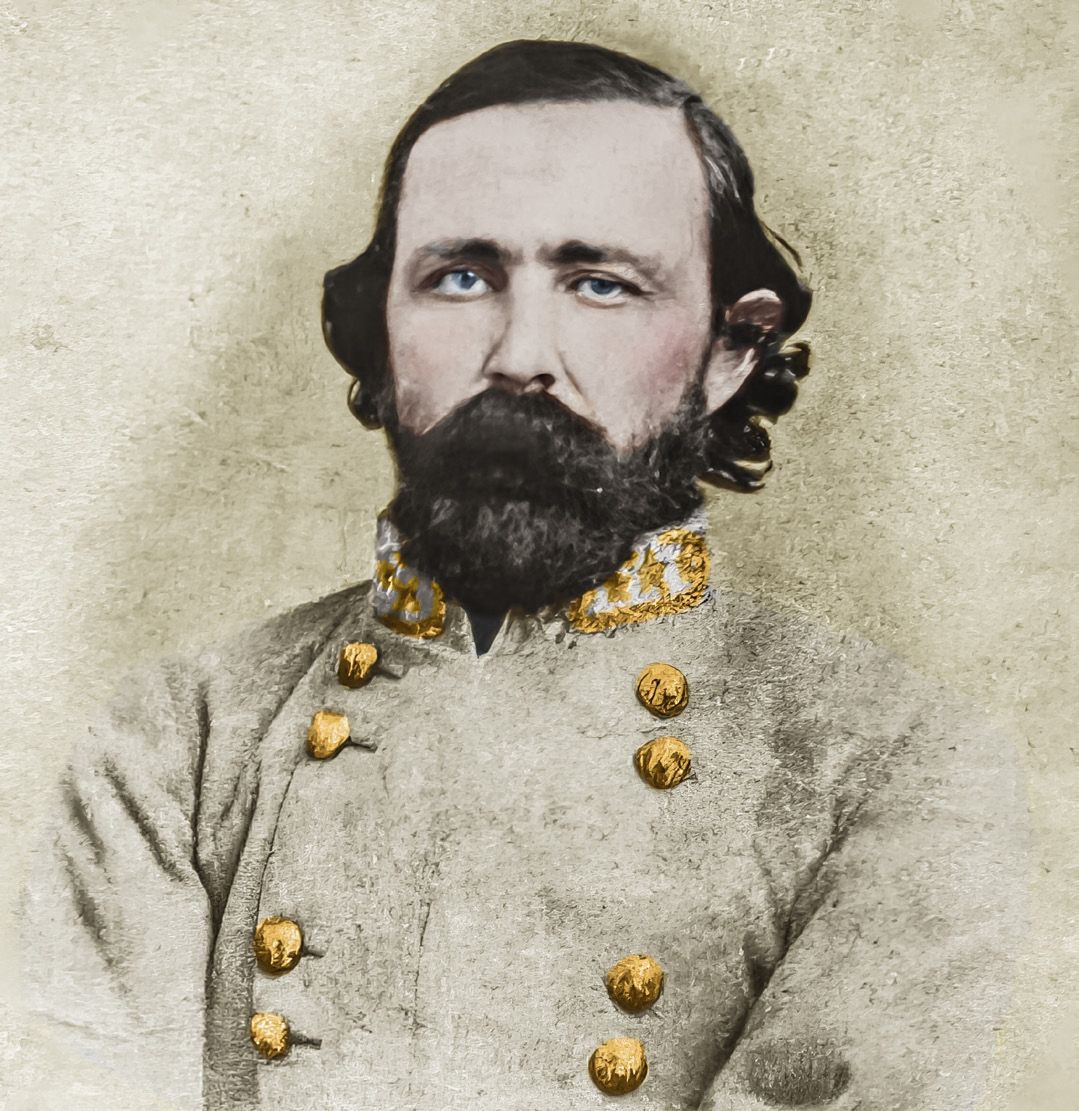
Maney was assigned Open Knob as his target. His infantry filed out of the woods, advancing with artillery support. At 90 yards, Parson turned his cannon upon them. The Rebels crossed the 300 yards of rolling ground, reaching the rail fence at the base of the ridge. From above poured “grape, canister and shell, together with the small arms of the strong supporting force.”
On Open Knob, Jackson was directing the maneuvers of the 123rd Ill. astride his horse. “I’ll be dam-ed if this is not getting rather particular,” he said to a staffer. A bullet hit his chest, knocking Jackson to the ground. As his aides surrounded him, Jackson died moments later.
C.S. Capt. Melanchon Smith’s Miss. Battery, two iron 6-pdrs. and two 12-pdr. bronze howitzers, went into action 300 yards northeast of Open Knob, firing to support Maney. Terrill, instead of rising to the job of 10th Division commander, reverted to his old role as an artilleryman. To save Parson’s battery he ordered the 105th Ohio down the ridge to attack. The rookies rushed down the slope. From behind the fence, the Rebels’ well direct fire decimated the Federals. The survivors struggled back up the hill.
Still, Maney’s position at the fence was untenable. He conferred with his officers. Maney rode up and down his line, encouraging his men. Seizing the guns would be “our last and only chance of safety and success.” The Rebels surged forward. Countering Maney, Terrill ordered a bayonet charge, yelling, “Do not let them get the guns!” The Confederates fought their way up the hill, swarming over the guns in hand-to-hand fighting. About 3:30 p.m. Terrill ordered a retreat. The gun crew fled. Parson had to be dragged away.
The remainder of Terrill’s men made their way to the rear of Col. John Starkweather’s, 28th Brigade. Terrill seemed to be in shock until the battery was under fire. “Drawn as it seemed by an irresistible magnetism, he walked toward the battery now hotly engaged upon the opposite hill three hundred yards away,” wrote Lt. Albion Tourgee, 105th Ohio. Terrill died either as he walked or as he began working the guns.
In the late afternoon McCook ordered Webster’s exposed line to shift to the right. The exhausted, green troops failed to execute the maneuver, leaving the 98th and 121st Ohio to face the enemy for the first time. Poorly armed and trained, the men fell in neat rows. Webster stayed with them, directing their fire. During the melee Webster collapsed, mortally wounded. The rookies broke and rushed to the rear. According to Jonathan McElderry, 121st Ohio, “It was a criticall [sic] moment we left the field to the more experienced souldiers [sic].”
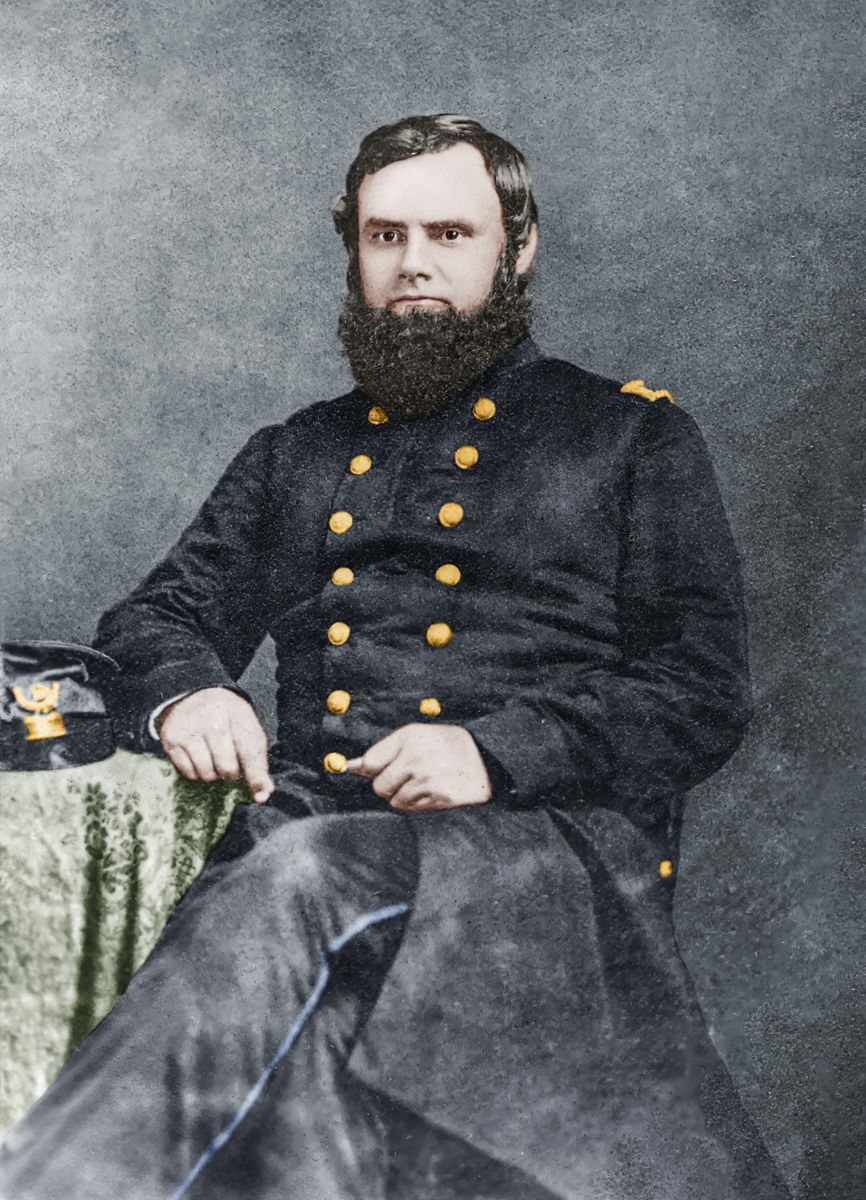
On October 7, the evening before the battle, Brig. Gen. Philip Sheridan, 3rd Corps, 11th Brigade, joined Terrill, Jackson, and Webster around a campfire. Sheridan had recently ended a feud with Terrill over a West Point brawl that had resulted in Sheridan’s yearlong suspension. During the pleasant evening Terrill assured Jackson and Webster “that the probability of his death remained small. The chances of all of them dying were next to impossible.” Of the four, only Sheridan survived the battle.
Sources:
◊ Noe, Kenneth W. Perryville: This Grand Havoc of Battle. The University Press of Kentucky, 2001.
◊ Kolakowski, Christopher L., The Civil War at Perryville: Battling for the Bluegrass. Arcadia Publishing, 2017.
◊ Tourgee, Albion W. The Story of a Thousand. Being a History of the Service of the 105th Ohio Volunteer Infantry, in the War for the Union from August 21, 1862 to June 6, 1865. Buffalo: S. McGerald and Son. 1896.
◊ United States, War Department. The War of the Rebellion: A Compilation of the Official Records of the Union and Confederate Armies. Washington: 1894. Series 1: Vol. 16, pt.1. pp. 87-90, 11131119.
Stephanie Hagiwara is the editor for Civil War in Color.com and Civil War in 3D.com. She also writes a column for History in Full Color.com that covers stories of photographs of historical interest from the 1850’s to the present. Her articles can be found on Facebook, Tumblr and Pinterest.
Brig. Gen. George Earl Maney, C.S.A. Colorization © 2024 civilwarincolor.com, courtesy civilwarincolor.com/cwn. (Virginia Historical Society)