
the truth at cassvile Was Joe Johnston honest
By Robert D. Jenkins Sr. · Originally published May-June 2024 · pp. 56–69
Cassville
Was Joe Johnston Honest with History? By Robert D. Jenkins Sr.
With selected images, maps, and excerpts from The Cassville Affairs: Johnston, Hood, and the Failed Confederate Strategy in the Atlanta Campaign, 19 May 1864, Mercer University Press, Macon, GA: 2024; special permission by Mercer University Press, illustrator and cartographer T.D. (Dave) Helton of H2B Creative of Dalton, GA, and the author.
For the past 150 years, students of the American Civil War and the Western Theater have followed the story, or narrative, of the first three months of the Atlanta Campaign, through the prism of the writings of the Confederate Army of Tennessee’s commander from December 27, 1863, to July 17, 1864, General Joseph E. Johnston. A decade following the war, Johnston penned his Narrative of Military Operations, which bolstered his war-time report of his participation in the campaign. Johnston’s official report, written October 20, 1864, at Vineville, Ga., a suburb of Macon, provided his first full explanation of the events of the Atlanta Campaign during his tenure in command.1 On February 15, 1865, Confederate General John Bell Hood published his own official report in which he included not only the operations of the Army of Tennessee during his tenure as commander (July 18, 1864, to January 23, 1865), but he also added a sharp contrast to several of the events portrayed by Johnston. One of these events was the dispute which had arisen between the two generals over the incidents at Cassville on May 19, 1864. Hood flatly denied Johnston’s version of events at Cassville and provided his own account. Subsequently, Johnston double-downed on his version through a series of post-war writings. Hood responded in like kind with his own post-war apology, Advance and Retreat, which was published a year following his death. He would not survive to refute Johnston’s final two articles. This dispute came to be known as The Cassville Affair.2 While it is called The Cassville Affair, there were two controversies, or affairs, at Cassville which led to the Southern withdrawal from the village without compelling a fight. The first one was the inability of the Confederate army to initiate a surprise attack on the morning of May 19. The second, which occurred on the evening of May 19, was the failure of the Southern force to remain at Cassville, or Manassas, as the city had come to be named in honor of the Confederate victory at the Battle of First Manassas, to fight the next day. After realizing that his opportunity for striking a blow against a portion of the pursuing Federals had passed, Johnston moved his army from a range of hills north and west of Cassville to a line of hills south and east of the town where he had his men entrench. There, he expected to receive and repel an attack by
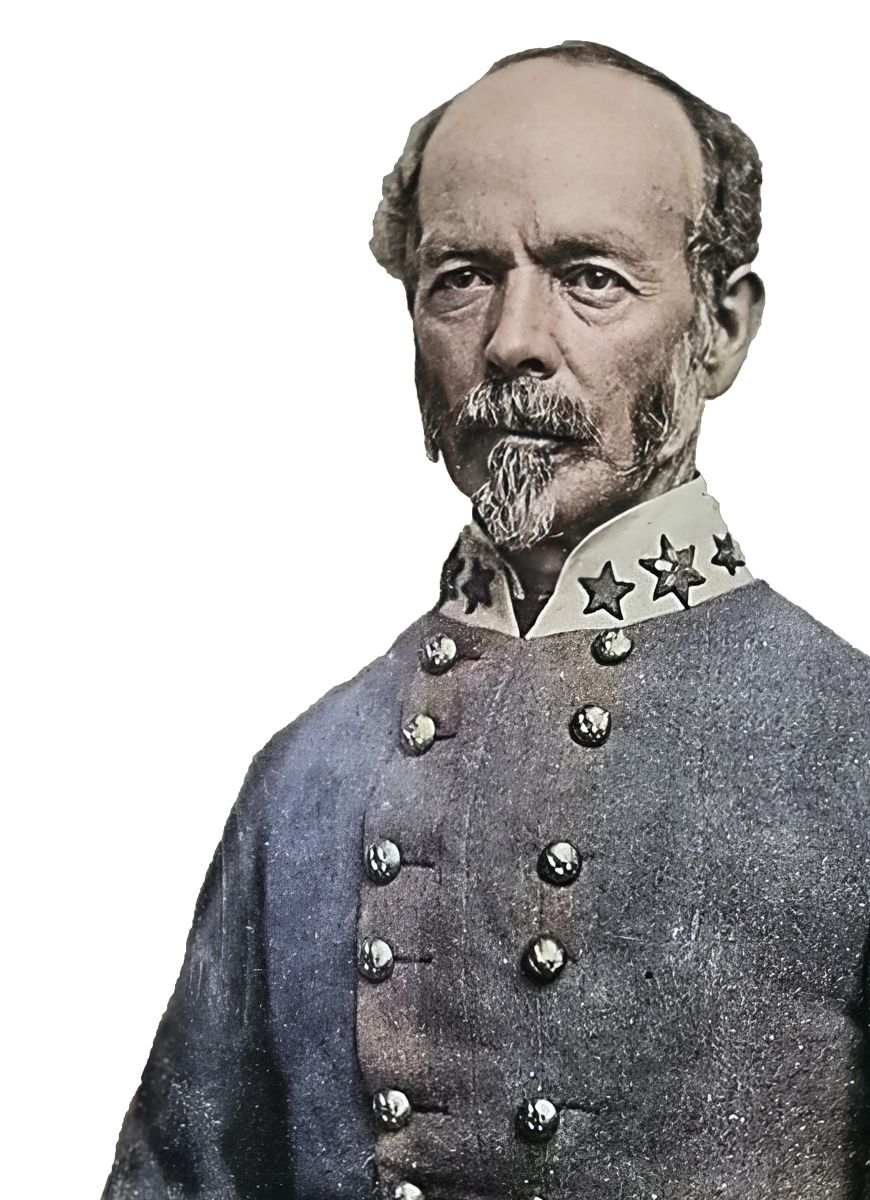
General Joseph E. Johnston. (Library of Congress)
Sherman’s legions the following day. Instead, following a dispute with two of his corps commanders, Lieutenant Generals John Bell Hood and Leonidas Polk, Johnston reluctantly withdrew his army south of the Etowah River to fight another day. Since then, historians have remained baffled over what happened at Cassville, and whether Johnston or Hood was telling the truth. In my new book, The Cassville Affairs: Johnston, Hood, and the Failed Confederate Strategy in the Atlanta Campaign, 19 May 1864, Mercer University Press, Macon, GA: 2024, with the help of a number of colleagues, we uncovered several significant records and maps that have been heretofore lost or disregarded in history. In the process, I discovered some critical and revealing errors in the Confederate intelligence, reconnaissance, cavalry screening, and mapping of the contested area, including misinterpretation of several roads and road names. In addition, I unfortunately discovered a troubling number of discrepancies in Johnston’s four published Cassville-related accounts, his wartime report, his Narrative, and two subsequent articles. Worse, Johnston falsified and manipulated a journal, or diary, purportedly written by one of his staff officers. The T.B. Mackall “Journal,” published in the Official Records, is not the same as Mackall’s original journal, and it has been significantly altered under the control of Johnston to bolster his version of the facts. In testing the veracity of each p a r t i c i p a n t ’s explanation of events for this study, I
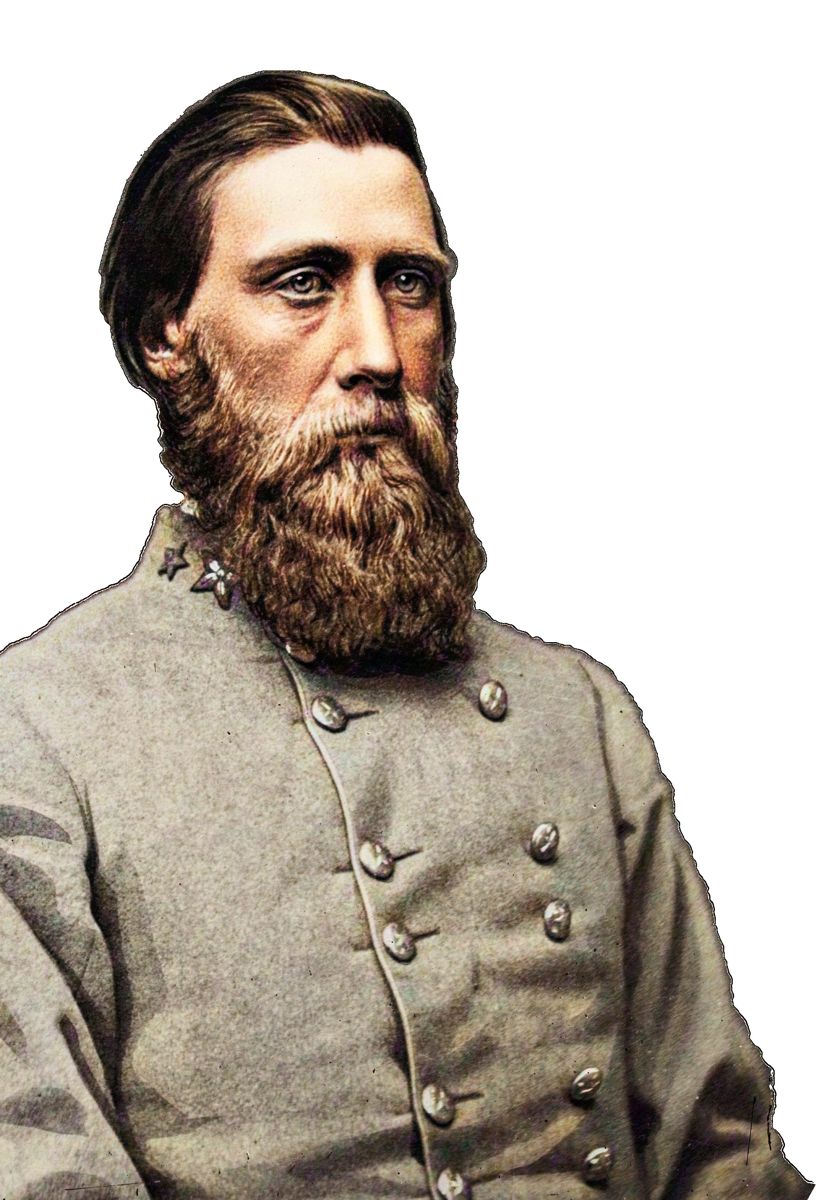
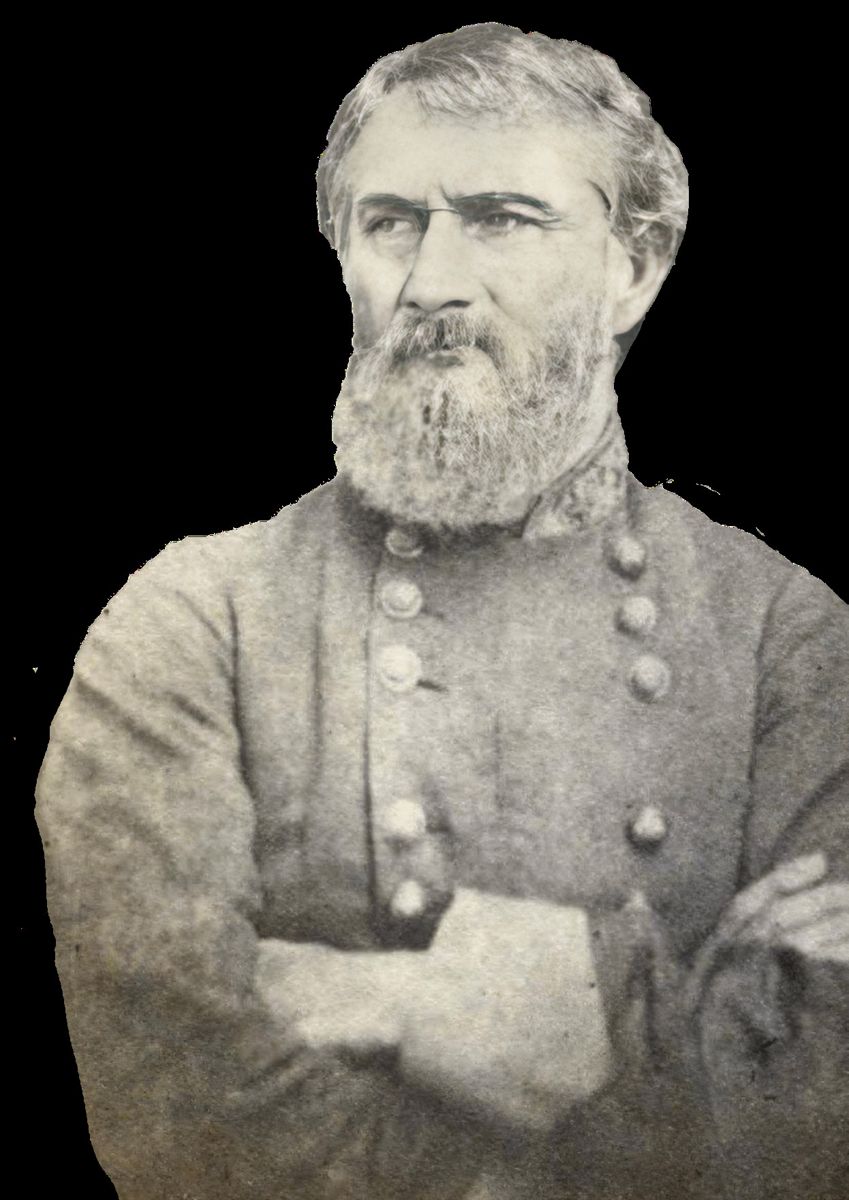
Lieutenant General John Bell Hood. (Library of Congress)
employed the Socratic Method used in law school and employed in various forms in our courts of law. In doing so, I followed a couple of legal principles. First, I assumed that all witnesses are believed to be telling the truth unless their testimony or statement is impeached by other conflicting evidence. Second, I applied traditional rules of evidence including admissions, hearsay, and authentication rules for all records and testimony (reports, diaries, letters, and memoirs). Through this analysis, I was able to uncover and disprove multiple statements by Johnston about Cassville and about other events during the first weeks of the Atlanta Campaign. For purposes of this article, however, we will stick to just the discrepancies surrounding Cassville. I discovered two errors in the Official Records relative to the events at Cassville, one apparently unintentional, and one quite intentional. The first one is found in Hood’s report, submitted to Adjutant and Inspector General Samuel Cooper on February 15, 1865, at Richmond, Va. In his report, Hood quoted Johnston: “You can, if you desire, move your corps to the Canton road and if Howard’s corps is there you can attack it.”3 In contrast, in Hood’s post-war account, Advance and Retreat, Hood referred to a road that he called the Ironton Road, a name that appears to have been ignored or not understood in all previous studies of Cassville. In Advance and Retreat, Hood explained that “Howard’s Corps having been reported on the Ironton road …, I asked his [Johnston’s] authorization to march my command across an open field, and attack this detachment of the enemy, in case the report was correct. He consented.”4 I discovered a copy of a New York Times article dated March 29, 1865, in which Hood’s report had been copied from a Richmond Enquirer edition dated March 25, 1865, and republished in its entirety. In the New York Times version, Hood’s quote of Johnston reads: “You can, if you desire, move with your corps to the Ironton Road, and if Howard’s corps is there you can attack it.” Just a few lines later, the Ironton Road is referenced a second time in lieu of the Canton Road.5 A copy of Hood’s report was included in the Appendix to Advance and Retreat, derived from his personal copy, and it includes Ironton Road in the same two places.6 There can be no mistake that Hood referred to the Ironton Road as the intended point of his attack, and that it was clearly a different road than the Canton Road. Hood never saw the Official Records error, published eleven years after his death, and he could never have anticipated the confusion it might cause for future historians. Hood did provide an ironic admonition to Johnston, however, about the importance of leaving a full and accurate “contribution for the use of the future historian.”7 John Bell Hood’s tarnished post-war record, due largely to the failed Fall 1864 Tennessee Campaign, served to discredit him and his version of the facts. That, coupled with Johnston’s post-war admiration by his soldiers who loved him for not sending them into futile frontal assaults during his tenure in command of the Confederate army in Georgia, compared to the perception that Hood did just that in the Atlanta area battles, and the reality that Hood did just that at Franklin, Tennessee, led to an imbalance of scrutiny and criticism for over a century following the war.
The second and most troubling revelation is found in the T.B. manuscript “N” for National Archives. This “N” version was very Mackall “Journal,” as published in the Official Records. Lieutenant different from the two sources labeled “A” and “B,” both of which Thomas Bennett Mackall was a cousin to Brigadier General were clearly written by T.B. Mackall. Importantly, this “N” version William Whann Mackall, Johnston’s chief of staff during the Atlanta was the one that was presented by Johnston to the War Department Campaign. Young Lt. Mackall kept a series of unofficial notes and published in the Official Records. McMurry referred to the in a “Journal,” which served as the apparent basis for document published Official Records version as “O” in his conclusions.10 Number 728 to Series I, Volume 38, Part III of the Official Records. In the original, or “A” version, of T.B. Mackall’s “Journal,” the It was purported to be a “Journal of Operations of the Army of following entry was recorded for May 19: “Heard first skirmishing Tennessee May 14 – June 4 [1864].” This report notably was “Kept on Adairsv[ille]. & Cassv[ille] rd. 10:20 AM. In ten minut[es], at headquarters Army of Tennessee by Lieut. T. B. Mackall, aideartillery on Sp[rin]g. Place road & on Ad[airsville] rd. After a de-camp to Brig. Gen. W. W. few guns Genl. M[ackall] Mackall, chief of staff, and “It is also important that you should sent [word] more en[em]y furnished by General J. E. close to H[ood] on Canton Johnston.” This statement rd. Lt. Genls sent for. with the enemy’s cavalry about Cassville. Wagons moved [to] rear. should raise suspicions of future historians.9 Line changed 2:25 PM. In 1971, Professor Richard but it should be done suddenly so as Change going on. Artillery M. McMurry discovered Hardee’s front. Change to produce a salutary effect and be of on two previously unidentified of line effected under moral force to you in after operations.” fire. Report of column on diaries in the Joseph E. Johnston papers at the Swem Canton Road not afterwards Library at William & Mary College, Williamsburg, Va. After confirmed. Battle expected next day. General Ross reports from determining that these were in fact the original diaries of Lieutenant Cartersville enemy across at Wooley’s Bridge. 10:20 PM Every tg Thomas Bennett Mackall, McMurry conducted a thorough study of [thing] to be packed.”11 the “Journal” and published his findings in 1974. One diary, referred In the rewritten, or “B” version, of T.B. Mackall’s “Journal,” to as the “A” sample by McMurry, appeared to be the original, the following entry was recorded for May 19: “Line of battle while the second account was referred to as the “B” sample which formed to attack enemy. First skirmishing on Adairsville & appeared to have been written by the same person as a rewrite, Cassville road 10:20 AM. Ten minutes later artillery heard in or more complete version, of “A.” McMurry also discovered a direction of Spring Place road. After a few discharges report manuscript in the National Archives that was not dated, but appeared recd. from Genl. Hood that enemy was advancing on Canton to have been written by at least two other people and did not appear road. Line of battle changed. At night army withdrawn.”12 to be the same handwriting of T.B. Mackall. McMurry labeled the In contrast, the published Official Records version, or “O” version, was much longer than the “A” or “B” version. A substantial amount of additional information was added to the “O” sample, which was over seven times larger than the original “A” sample. The “O” sample contains 74 lines of typed manuscript, measure your fighting qualities
I am sure you can beat them,
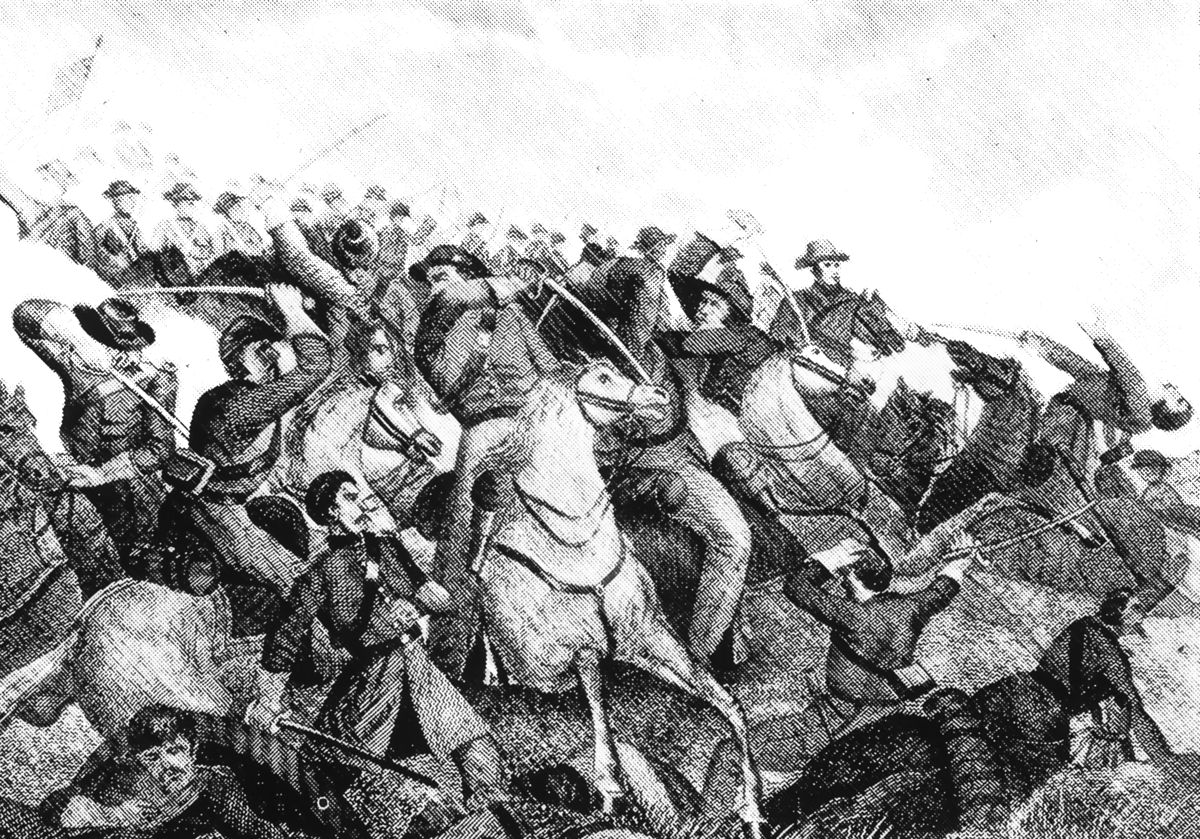
Federal Cavalry Charge at Cassville, Afternoon of May 19, 1864: Cavalry of McCook’s division in their charge at Cassville on the afternoon of May 19, 1864. While the artist is unknown, the sketch appeared in Dr. Homer Mead, The Eight Iowa Cavalry in the Civil War, Autobiography and Personal Recollections of Homer Mead, M.D., Augusta, Ill., Carthage, IL: S.C. Davidson, 1925. Dr. Mead participated in the attack with the Iowa regiment and lost his horse in the charge.
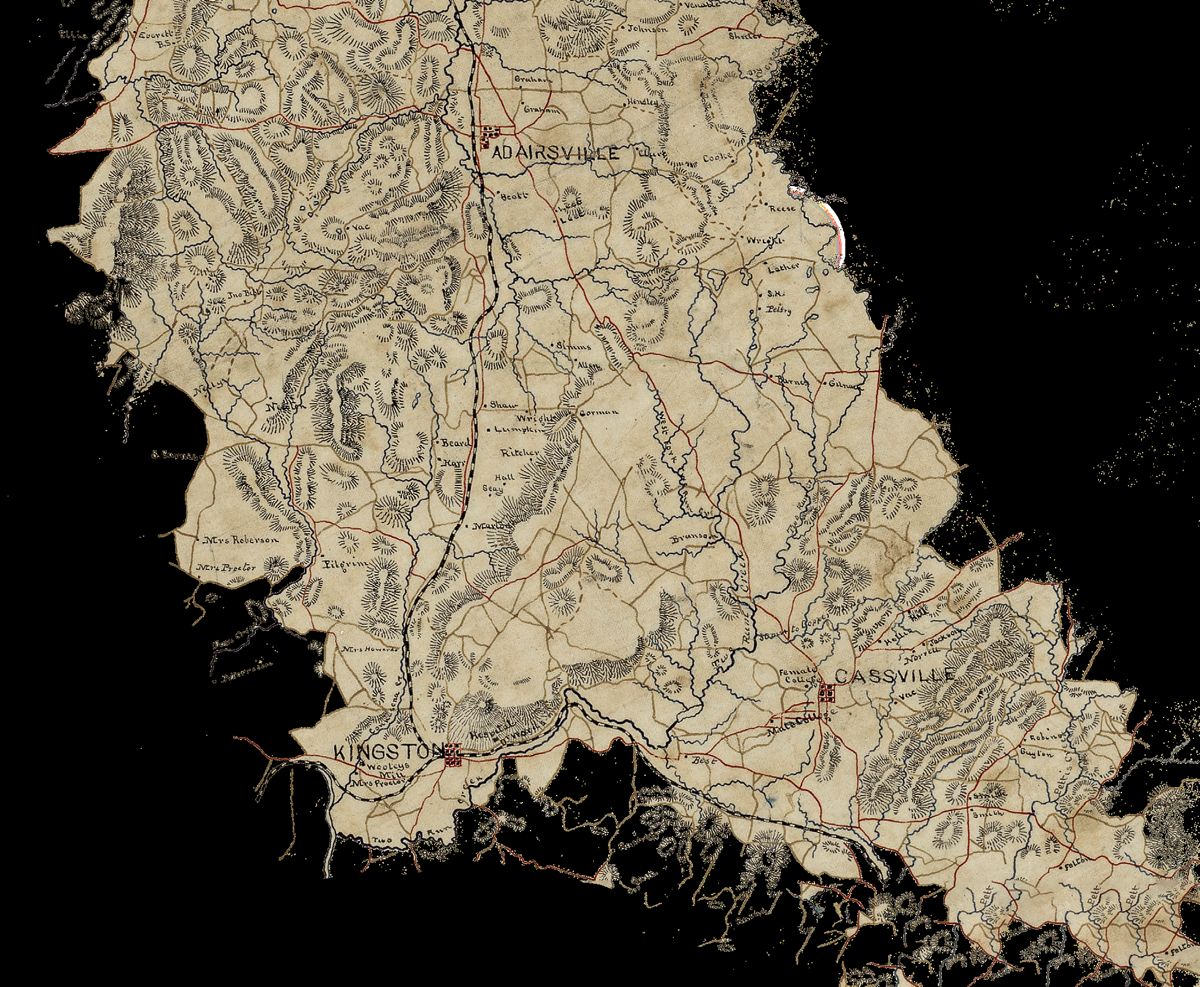
Foster Map: Commissioned November 1, 1863, by General Braxton Bragg, this map, as part of a series of three maps, was designed to provide the Confederate Army with a detailed description of the terrain and roads within ten miles on either side of the Western & Atlantic Railroad from Missionary Ridge to Atlanta, to include Rome and the Rome Railroad. Captain (promoted to Major on March 17, 1864) Wilbur T. Foster, Engineers Office, led the team of surveyors, engineers, and draftsmen who completed their work in the Spring of 1864. Although quite detailed for the area portrayed, this map failed to include the critical area northeast of Cassville, including the Five Forks intersection of the (3) Spring Place, (4) Pine Log, and nearby (5) Canton Roads (today found northeast of the TA Truckstop at I-75, Exit 296). Five Forks is located approximately nine miles east of the Western & Atlantic Railroad, at its closest point near Hall Station. Major Generals Will T. Martin and Joseph Wheeler and their teams of engineers relied on this map in preparing their maps during the Spring of 1864, and none of the Confederate maps included the connection of the Spring Place Road with Five Forks. General Joseph E. Johnston was still missing the Spring Place Road in the map that he included in his Narrative of Military Operations in 1874, at page 320b. Note the empty space in the northeast corner of this map and the one in Johnston’s Narrative. (See National Archives, Record Group 109, Georgia Maps, Map of Roads between Marietta and Dalton, Ga., ID number: 70652905, Captured Confederate maps, Macon, Ga., November 10, 1864, https://catalog.archives.gov/id/70652905?objectPage=4, accessed May 17, 2023.)
whereas the “A” sample consists of only 10 lines, and the corresponding entry for May 19 in the “B” sample is only five lines of typed manuscript. The “O” sample also contains several assertions negative to Hood which are not found in either the “A” or “B” samples. Critically, the published Official Records, “O” version, changed the first report of sounds of battle at 10:20 a.m. from “heard first skirmishing on the Adairsville & Cassville Road,” as it appeared in the “A” version,13 to “a few discharges of artillery on Adairsville and Cassville Road, and in ten minutes report of artillery in easterly direction.”14 These changes substantially altered the meaning and understanding of the circumstances at Cassville during the morning of May 19. First, the Official Records version dropped the all4 important word “heard” from the original versions. In other words, T.B. Mackall, from his position at Johnston’s headquarters located east of Cassville, recorded that he first heard skirmish fire from the Adairsville & Cassville Road at 10:20 a.m. This agreed with other reports of contact along that route at that time between Brigadier General William Ward’s Federal brigade of Hooker’s XX Corps, and troopers of Brigadier General Alfred Iverson’s Georgia brigade and Brigadier General William Y.C. Humes’ division of Confederate cavalry.15 Second, T.B. Mackall reported that he “heard” the sound of artillery ten minutes later from the Spring Place Road. This is supported by the account of Brigadier General Edward M. McCook, who commanded a division of Federal cavalry that approached Cassville from the Spring Place Road that morning, and the account of Lieutenant William B. Rippetoe, who led a two-gun section of the 18th Indiana Battery of 3-inch ordnance rifles which accompanied McCook along the Spring Place Road. It also agreed with Hood’s account of events east of Cassville, as well as the accounts of multiple officers under Hood.16 Rippetoe reported that he opened fire from his position on the Spring Place road on the Confederate infantry, Major General Thomas C. Hindman’s division, who were marching across a large field. Rippetoe’s claim accounts for the sounds of artillery heard by T.B. Mackall at 10:30 a.m., and is supported by multiple reports from Hood’s corps.17 McMurry cautioned historians against relying upon the “O” sample of the “Journal” due to its inherent corruption. However, in applying the evidentiary standard, its inclusion, or admission, by Johnston permits its use when a statement contained therein provides an inference which would tend to impeach Johnston’s position, or to repudiate his contradictory statements. It is called in courts, an admission by a party opponent. While I did not begin this study in a manner adverse to Johnston’s position, in the process of following the evidence and in cross-examining each piece of primary source material, I houses still surviving today, the route has remained largely concluded that the use of all the T.B. Mackall’s “Journal” samples, unchanged since the Dewey Crossroads settlement in 1850. provided multiple opportunities for the impeachment of Johnston’s Both the “A” and the “B” samples of T.B. Mackall’s Journal claims at Cassville.18 agree with all the other contemporaneous sources as well as Equally important were the changes in the published, “O” sample, with the geography of the area. Johnston’s inclusion of the “O” “Journal” version relative to the events to the east, or on the Spring sample, with its alteration of the Spring Place Road, was additional Place and Canton Roads. In the “A” and “B” samples, Mackall affirmation that: 1. The artillery heard by T.B. Mackall at 10:30 a.m. reported that he heard artillery about 10:30 a.m. on the Spring Place east of Cassville came from a direction that was unexpected which road. In the Official Records account, not only was no artillery threatened the Confederate rear, and 2. Johnston’s understanding of heard (only a report of artillery), but the reference to Spring Place the location of Spring Place Road was different than T.B. Mackall’s road was dropped, leaving merely (and Hood’s, and McCook’s, and a “report of artillery in easterly “Garrard and Murray to make all of the other contemporaneous direction.” In changing “Spring accounts).20 Place Road” to “easterly,” the In addition, I discovered that between Rome and Kingston (if the Confederate cavalry maps writer of this entry in the “N” not already done) tonight … If show only four roads leading sample, understood that the artillery heard at 10:30 a.m. was not done to-night there will be into Cassville on an arc between east of Cassville. Since Johnston Adairsville and Canton, as submitted the “N” sample to the may be envisioned between 11 Board of Publication of the Official Records, which then formed the o’clock to 3 o’clock on the face of the clock and omit the Spring basis for the “O” sample, Johnston affirmed that the artillery heard Place Road. In contrast to the Southern maps, the map used by at 10:30 a.m. by T.B. Mackall was east of Cassville. the Federals had a much clearer picture of the Gravelly Plateau. Vital to the analysis of the failed Cassville Offensive by the This map, prepared by Captain W.E. Merrill, chief topographical Confederates is the determination of the correct location of the engineer for the Army of the Cumberland, clearly shows five Spring Place Road. A previous study by William Scaife notably roads leading to Cassville across the Gravelly Plateau, not just claimed that it was at today’s Cedar Creek Road, but this location four as the Southern maps indicate.21 Also, in his report of his does not match any of the other contemporaneous accounts except deployment of troopers from Adairsville to the Canton Road, for the altered T.B. Mackall, “O” sample, supplied by Johnston. It Wheeler only covered four roads with his cavalry screen along does not conform with Hood’s detailed description of the Spring this arc, not five.22 Place Road as being to his right flank along with the Canton Road Commissioned on November 1, 1863, the engineering department to his rear. It is not consistent with McCook’s description, nor of (led by General Danville Leadbetter) was tasked by General those of his or Hood’s subordinates. And it does not fit the current Braxton Bragg with creating a set of maps from the Tennessee location of the route of the Spring Place Road, which can still border to Atlanta, Ga., along the Western & Atlantic Railroad, and be found today in Bartow County, Ga. With several antebellum for ten miles on either side. Captain Wilbur F. Foster led the task a dash at the railroad no use in doing it at all.”
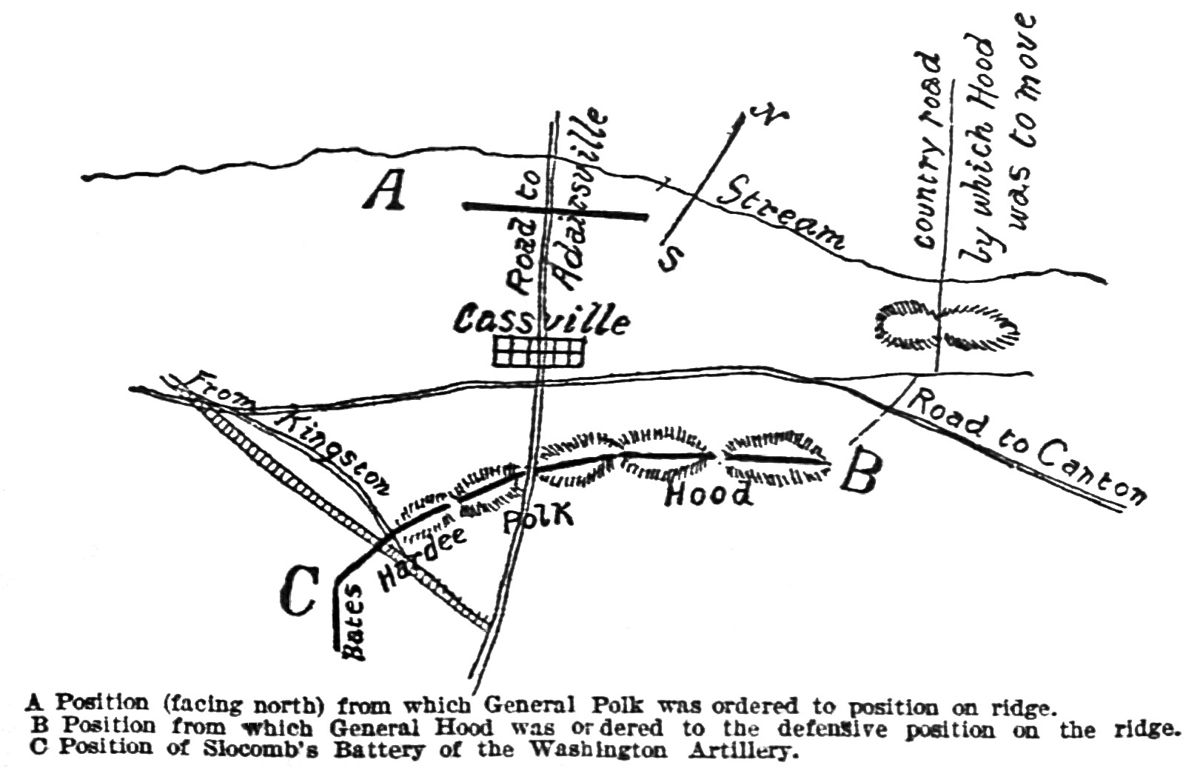
Johnston Map: Joseph E. Johnston drew this map and sent it along with a letter to Charles G. Johnsen, on June 19, 1874, from Savannah, GA. The letter was published in the Southern Historical Society Papers, R.A. Brock, Editor, Southern Historical Society, Richmond, VA: 1893, Vol. 21, 319. The letter and map were published in the Times Picayune, Sunday, October 22, 1893, New Orleans, LA. Johnston’s sketch fails to include either the Copper Mine/Ironton Road or the Spring Place Road, but it does include a “country road” at the location of today’s Brown Loop Road.
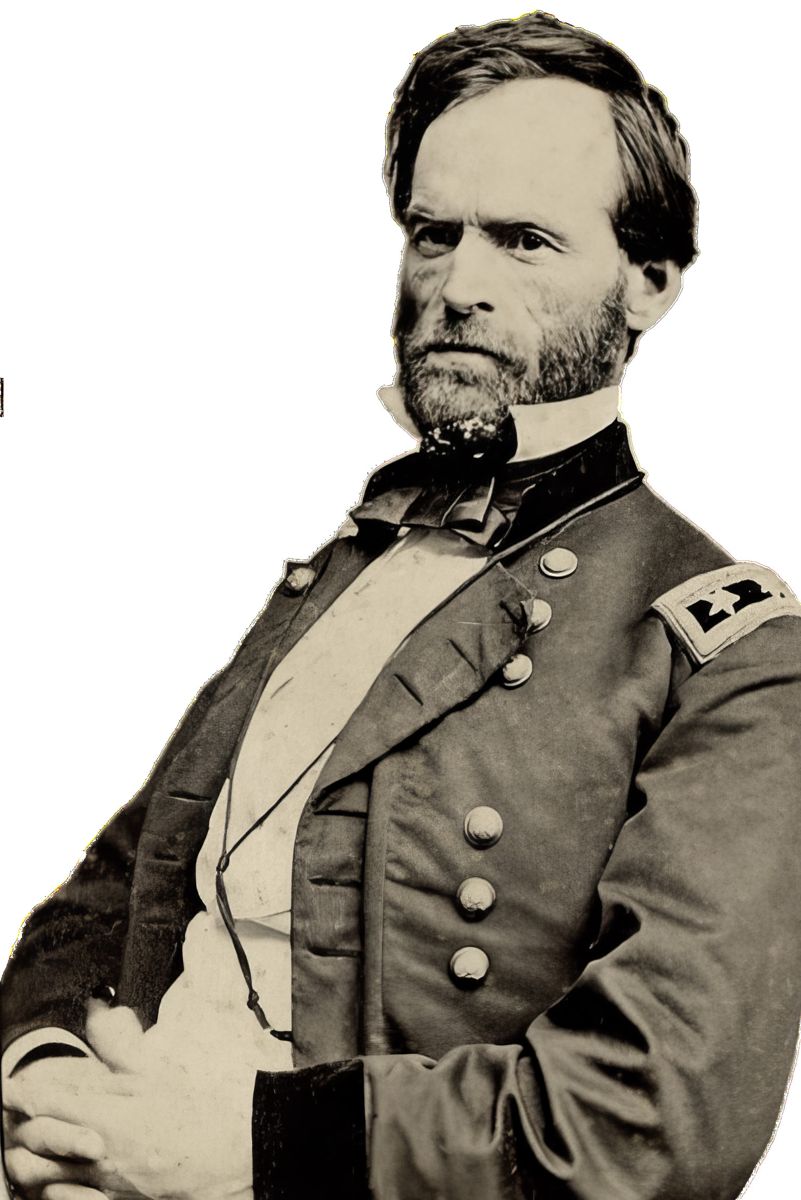
Johnston Narrative Map: This map, appearing in his postwar memoir, illuminates General Joseph E. Johnston’s lack of awareness of the incompleteness and inaccuracy of the Confederate maps used at Cassville. Even a decade following the war, Johnston was still using a version of the incomplete Foster map in defending his position. His failure to understand the correct location of the (new) Spring Place Road is understandable. His alteration of the Copper Mine/Ironton Road, to the (old) “Spring Place Road” in T.B. Mackall’s “O” sample “Journal,” is inexcusable. Johnston’s mistaken understanding of the Spring Place Road, coupled with his insistence on creating his version of the facts to preserve his reputation, and his deceitful use of the T.B. Mackall “Journal,” have served to cloud and confuse the events at Cassville for a Century and a half, and have shamefully disparaged the reputation of the performance of General John Bell Hood and the soldiers of his corps at Cassville. (See Joseph E. Johnston, Narrative of Military Operations, New York, NY: D. Appleton and Company, 1874, 320b.) Right: Major General William Tecumseh Sherman. (National Museum of American History)
force which completed their assignment just before the campaign began. It included five maps. The Foster Map failed to show the Spring Place Road and Five Forks because this area was more than ten miles east of the railroad and was thus “off the map.” Two subsequent Confederate maps, one for Major General Will T. Martin, and one for Major General Joseph Wheeler, were created using the Foster Map as a starting point. These two maps also fail to connect the Spring Place Road with the Pine Log Road at Five Forks.23 Even the map used by Johnston in his Narrative a decade after the war, failed to include the area northeast of Cassville, and failed to include the Spring Place Road or Five Forks.24 Upon discovering that Johnston’s main body had apparently retreated toward Kingston, Sherman was unsure of the Southern commander’s intentions. Sherman was faced with three possibilities: (1) Johnston was headed toward Cassville and the Hightower Bridge over the Etowah River; (2) Johnston was heading toward Rome and Alabama; or (3) Johnston, after sending his wagons and equipment south of the Etowah River via the Hightower Bridge, would make a brief stand at Kingston to allow time to cross his infantry over the river directly to the south of Kingston. Historian Dave Powell has astutely concluded that whichever direction Johnston chose, Sherman correctly followed the military maxim to drive toward the center at Kingston and then move to strike the enemy in detail as the situation developed before him. Like spokes of a wagon wheel, Sherman directed his infantry columns to converge on Kingston.25 Also, Sherman issued orders to his cavalry divisions to boldly strike the Confederate flanks and rear. At 6:15 p.m. on May 17, from his headquarters just north of Adairsville, Sherman sent an order to McPherson directing him to have “Garrard and Murray to make a dash at the railroad between Rome and Kingston (if not already done) tonight … If not done to-night there will be no use in doing it at all.”26 Sherman sent a similar order the same evening to Stoneman.27 To both Stoneman a n d McCook, w h o were
Right: Looking to withdraw safely from Adairsville in the face of approaching Federal forces believed to be marching toward multiple directions including Rome, Adairsville, and Hightower Bridge, Johnston’s army utilized three roads to make their escape. (1) Hardee’s corps, the Reserve artillery, and the Wagon train took the Kingston Road, (2) Polk’s corps and Stevenson’s division followed the Cassville Road, while the rest of (3) Hood’s corps, Stewart’s and Hindman’s divisions, positioned east of Iron Mountain, took the Copper Mine/Ironton Road to Cassville. The roads identified in this map are: 1-Adairsville-Cassville Road (today U.S. 41, Ga. 3, Joe Frank Harris Hwy.); 2-Copper Mine Road, Ironton Road, “old” Spring Place Road (1820s-1840s) (today, south to north, Kimsey Circle, Janice Lane, Cedar Creek Road); 2a-Mosteller’s Mill Road; 2b-Section of Ironton (Iron Mountain) Road (no longer in existence); 2c-By-Road (Wheeler) (no longer in existence); 2d-Unnamed cut off road from “the forks in the road” (Hooker’s term) (today Manning Mill Road); 2e-Section of Ironton (Iron Mountain) Road (no longer in existence); 3-Spring Place Road (since about 1851); 3a-“Country Road” (Johnston’s term) connected with the “new” Spring Place Road (Road 3)(today Brown Loop Road); 4-Pine Log Road, also Fairmount Road (today Cass-White Road); 5-Canton Road (today Old Cass-White Road); 6-Tennessee Road, also Jackson Military Road (1825), also Old Federal Road (today U.S. 411 and Ga. 61 Hwy.); 7-Adairsville-Pine LogCanton Road (today Ga. 140); 8-Adairsville-Kingston Road (today, Hall Station Road); 9-Kingston-Cassville Road (today Kingston Hwy, Ga. 293, Fire Tower Road); 10-Cartersville Road (today, Mac Johnson Road). (Courtesy Mercer University Press, T.D. Helton, and Robert Jenkins.) to attack the Confederate right between Cassville and the Hightower Bridge over the Etowah River, Sherman added, “It is also important that you should measure your fighting qualities with the enemy’s cavalry about Cassville. I am sure you can beat them, but it should be done suddenly so as to produce a salutary effect and be of moral force to you in after operations.” Sherman’s admonition for aggression by the Federal troopers would soon yield much fruit.28 In previous research for my book on the Battle of Peach Tree Creek,29
General Edward M. McCook. (Library of Congress)
I found multiple sources to corroborate the fact that Johnston had a well-conceived battle plan at Peach Tree Creek. Based on this experience, when I began this project, I expected to find substantial evidence for a battle plan by Johnston at Cassville. However, I did not. Worse, I found that he was at the controls of evidence tampering and of attempting, through his writings after the war, to influence the narrative to reflect more positively on his own role at Cassville. While post-event writings are understandably often written in a self-serving manner, Johnston went much further. His contribution to the altered T.B. Mackall “O” sample “Journal” was intentional, misleading, and dishonest. Richard McMurry, through his careful research, reached this conclusion decades ago, in 1974. Johnston’s distortions to the T.B. Mackall “O” sample “Journal” have served to cloud the issue, to confuse students of the Cassville Affairs, and unfairly to discredit Hood and disparage the men of Hood’s corps who faced Federal horsemen east of Cassville. Other historians have reached the conclusion that Hood was more likely truthful than Johnston, at least as far as the Morning Cassville Affair is concerned. In 1960, in an unpublished paper, Wilbur G. Kurtz criticized Johnston’s review of General Sherman’s Memoirs. In it, Kurtz, who had reviewed the Official Records, correctly found that the Federal units on Hood’s flank came from McCook’s and Stoneman’s cavalry divisions, and he concluded, according to historian Albert Castel, that “Johnston had lied about what happened on May 19 in order to preserve his reputation.”30 Kurtz found at Cassville, “there was a pitched battle which,
Left: At 10:20 a.m., (1) Ward’s brigade and Iverson’s troopers exchanged fire, while (2) Hood and the van of his column was nearing the Ironton Road. At the same time, (3) McCook’s cavalry appeared to the east on the Spring Place Road at Five Forks. There, McCook deployed Rippetoe’s two 3-inch rifles of the 18th Indiana Battery, and ordered the 1st Wisconsin Cavalry to dismount and provide support. (4) The 9th Mississippi Battalion and the 41st Mississippi of Sharp’s brigade were sent to develop the enemy. At 10:30 a.m., (5) Rippetoe opened on the Mississippians, firing six rounds from each gun, which killed four men and wounded several others. Meanwhile, (6) the 2nd Indiana Cavalry continued down the Canton Road until running into the 63rd Virginia of A. Reynolds’ brigade and firing a few shots which killed three and wounded two before withdrawing at a gallop. (Courtesy Mercer University Press, T.D. Helton and Robert Jenkins.)
according to Rippetoe, lasted six hours,” adding, “Didn’t Johnston wonder what all the shooting was about? Didn’t the noise of musketry and cannon rise ‘to the dignity of a battle,’ (one of Sherman’s phrases, facetiously quoted by Johnston)? Far from that, in Johnston’s book,” quipped Kurtz, “it didn’t rise to the dignity of a simple fact.” Kurtz summarized: “It is doubtful if any battle of its size, in world history, has been so effectually erased from its pages [by Johnston] by the simple process of declaring the commanding officer [referring to Hood] a deluded prevaricator, and an embattled enemy mere phantoms. Hood may have had a woeful countenance, but he never tilted with windmills.”31 Wheeler and his cavalrymen failed to cover the Spring Place Road. This failure proved to be Hood’s undoing on the morning of May 19 when McCook’s cavalry advanced on Hood’s flank and rear undetected. Coincidentally, Sherman ordered Schofield and the XXIII Corps who had spent the night at Mosteller’s Mill, to move at daylight on Hooker’s rear at the Jonathan McDow house on the Adairsville-Cassville Road. Thus, Schofield marched to the west, and not to the south toward Cassville, as he had originally requested of Sherman the evening before. If Schofield had gone in the direction that he originally wanted, then he would have headed into Hood’s trap. Sherman was wrong about Johnston’s direction of retreat, but he was right that aggression was the best policy, and this ultimately helped his forces win the day. Sherman ordered his cavalry units to show aggression. He wanted his men to erase some of the embarrassment of their earlier performances around Dalton and Varnell thereby increasing their confidence for future action. While two of his cavalry divisions struck an infantry line on two separate occasions—normally a recipe for disaster to cavalry—a combination of good fortune and quick, bold action helped them rule the day. Hood pointed out in both his report, dated February 15, 1865, and in his Advance and Retreat, that the better opportunity for a Confederate attack was on May 18, because the three Southern corps could attack Sherman from three separate points (and roads) south of Adairsville. Hood stated that Polk and Hardee both agreed with him while Johnston remained non-committal. Hood again raised the topic in his reply to Johnston’s Narrative of Military Operations when he complained: “in no part of his [Johnston’s] Narrative, can be found the slightest allusion to this matter.”32 One of my discoveries in this project was that Hood’s planned flank attack was toward the Ironton Road/Copper Mine Road (or today’s Cedar Creek Road), and NOT the Adairsville-Cassville Road that we have all believed for 150 years because of Johnston’s Narrative. If the battle plan had been as Johnston has stated, then Ward’s and Wood’s brigades would have been struck and likely destroyed, and we would have had multiple accounts from officers and soldiers in Polk’s Corps about their supposed offensive movement instead of merely sliding to the west, in a defensive posture. There are no such accounts. Moreover, Johnston would have sent William Mackall first to Polk to “hurry up,” and then to Hood, instead of just to Hood. After cheering to an order earlier in the day that had proclaimed that they were going to stand and fight, the Southern army was withdrawn during the evening to the surprise of the men. As the Confederate soldiers made their way south and across Hightower Bridge, confidence in Joe Johnston began to fade. After the strange set of events that had occurred in the morning followed by the evening disagreement at the William McKelvey house and cabin– Polk’s headquarters where he and Hood had quarreled with the Southern commander—Johnston’s confidence in John Bell Hood had begun to erode. Enmity had not yet taken root within the Confederate high command, but its seeds had been planted. With the passing of another two months and two more rivers, Johnston would be removed in favor of Hood. The former chieftain would always lament his failure to bring battle at Cassville. In time, his trickled over the past 50 years as people have stubbornly clung disillusionment with Hood, and the events of May 19, would fester to Johnston’s Narrative rather than search beyond it for answers. and grow into a passionate mission to leave his own version of the Hood never wavered from his statements about his recommendation day’s history. His views have dominated the literature ever since, for an attack of Sherman’s columns between Adairsville and Cassville, and they have clouded our understanding of the subject for over a while Johnston’s version has vacillated over his multiple opportunities century and a half. to leave a record for the historian. Three times in the two places that Tellingly, numerous historians, including Wilbur Kurtz, Albert Hood left a record, his statements were clear, concise, and consistent. Castel, Steve Davis, Richard McMurry, Stephen (Sam) Hood, There is an old adage that the truth never changes. Keith Hebert, and others have all concluded that Hood was most There is another principle in the law which provides that if the likely telling the truth about his version of the battle plan, and testimony of a party or witness is impeached by contradictory that Johnston was not, despite evidence, meaning that the not having the correct and full witness or party’s statement has road structure or the ability to been proven to be false, then all of the story, recited to set Sherman, do the comparative analysis of that witness’s testimony may that this project has been able to and everybody else, straight about be ignored or given no weight. accomplish. For one reason or Hood’s mendacity, fell somewhat Thus, in a courtroom setting, if another, each of these historians Johnston was found to have been essentially had to make an untruthful about any one of his “educated guess,” based upon claims at Snake Creek Gap, or the limited data available to each of them, but they all sniffed out Calhoun, or Adairsville’s defense, or about the size and strength of Johnston’s fibbing. Larry Daniel has also recently uncovered and his army, or about the number of casualties sustained by his men exposed another factual misstatement in Johnston’s Narrative in during his tenure, then it can be assumed that he was also untruthful his recent article on the defense at Adairsville which is anticipated concerning his statements on the events about Cassville, as well. to be published in an essay on the Atlanta Campaign. Historian Wilbur Kurtz did not believe that Johnston was truthful One of my “a-ha” moments in researching this project, was on a number of points in his Narrative, including his excuses for reaching the conclusion that Johnston’s story about coming up with Snake Creek Gap, his defense of Calhoun, or Adairsville, or his his game plan on the evening of May 17 at Adairsville was a complete supposed battle plan for Cassville.34 fabrication. What the Confederate leaders were “poring” over the In summing up a post-war map about at that time was trying to figure out how to move a 74,000meeting between Johnston man army out of harm’s way from the single road north of Adairsville and Sherman where via multiple routes south of the town before Johnston might be cut off Johnston had been asked either via Rome from the west, or Hightower Bridge to the east. They about the Cassville issue, were NOT planning a master counter stroke of divide and conquer Kurtz wrote: “Ironically, against Sherman on the evening of May 17, but simply were seeking Johnston’s version of the a safe evacuation by splitting their forces and reuniting at Cassville. story, recited to set Sherman, I suspect that Johnston invented this “May 17” story in his 1874 and everybody else, straight Narrative in an effort to get ahead of Hood’s anticipated post-war about Hood’s mendacity, book, and to get ahead of Hood’s claim that he had recommended an fell somewhat short of the attack on May 18, the day before the Cassville events. mark. Obviously, [it was] If there exists any contemporaneous account that would support a face-saving Johnston’s statement that he devised his master plan to divide and conquer Sherman on the evening of May 17, I have not found it. All I have found is that the first time this claim ever saw print was in 1874 in Johnston’s Narrative, and his story has been repeated numerous times over the years, first by veteran soldiers, and then by postwar writers and historians, even up and through today. In 1974, Professor Richard McMurry exposed Johnston’s alterations to the T.B. Mackall “Journal.” McMurry cautioned historians about the altered “O” sample “Journal” following his discovery. This discovery should have set off a flood of new research, interpretation, and historiography on the Atlanta Campaign given this new and blockbuster prism by which Johnston’s Narrative and the operations (and reports) of the campaign could be examined. Unfortunately, instead of a surge of Lieutenant General Leonidas Polk. new research, the new discoveries of the campaign have merely (Library of Congress)
“Ironically, Johnston’s version short of the mark.”
measure to rationalize his failure to fight at Cassville after his flaming proclamation. It could pass for history only as long as the complete story awaited access to certain records.”35 With the correction of the errors in Cassville’s historiography, her story can now be examined with more accuracy than before. The events there exposed the failure of the Confederate forces to gather accurate intelligence on their enemy. It revealed the incompleteness, inadequacy, and inaccuracy of the Southern maps. The events at Adairsville and Cassville also demonstrated a level of incompetency within the Southern high command. At Adairsville, Johnston did not anticipate the speed at which Sherman’s legions spilled into the plains below the Oostanaula River. And, most importantly, this work has advanced Professor McMurry’s previous finding that Johnston was deceitful in both his own writings, and in his intentional misuse of a distorted diary of one of his lieutenants. Because of our previous reliance on Johnston, the Cassville mysteries remained clouded and unsolved. By dissecting and exposing his false claims, and correcting the errors in the Confederate maps, the true story of Cassville can now be revealed. Perhaps now, the Cassville puzzle has finally been solved.
Robert D. (“Bob”) Jenkins Sr. is a trial attorney practicing in Dalton, Ga., where he has maintained a general and civil trial practice since 1990. A native of Hattiesburg, Miss., Bob grew up in Chamblee, Ga. Bob was graduated from Georgia Southern University in 1987 with a B.B.A degree in Business Management with Minors in History and Geography. Bob received his Juris Doctor degree from Mercer University in 1990 and regularly practices in the courts throughout Northwest Georgia. In 2013, Bob Jenkins completed a book titled The Battle of Peach Tree Creek: Hood’s First Sortie, (Mercer University Press, Macon, GA: 2013). In 2014, Bob completed a second book, titled To the Gates of Atlanta: From Kennesaw Mountain to Peach Tree Creek, 1-19 July 1864, (Mercer University Press, Macon, GA: 2015). In 2016, Bob wrote an extensive article on the “Battles for Dalton,” which was published in the Blue and Gray magazine, January 2016 (Vol. XXXII, Issue 1) issue. Bob is President of Save the Dalton Battlefields, LLC, and is Vice Chair of Whitfield County’s Historic Preservation Commission. Through their efforts, the County has acquired and opened Mill Creek Gap Park, Potato Hill Park, and Rocky Face Ridge Park. Bob has most recently completed his book on the Cassville controversies, The Cassville Affairs: Johnston, Hood and the Failed Confederate Strategy in the Atlanta Campaign, 19 May 1864 (Mercer University Press, Macon, GA: 2024), which was released in February 2024. Bob is married to Shari Ann Jenkins, and the two have four grown children. Bob and Shari love to travel, camp with their 5th wheel RV, and hike. Report of General Joseph E. Johnston, OR, Serial 74, 612-21; Johnston, Joseph E., Narrative of Military Operations, Directed During the Late War Between the States by Joseph E. Johnston, General, C.S.A., New York: D. Appleton and Company, 1874. Report of General John B. Hood, OR, Serial 74, 635; J.B. Hood, Advance and Retreat, Personal Experiences in the United States & Confederate States Armies, P.G.T. Beauregard: Hood Memorial Fund, New Orleans, LA: 1880, reprinted with an introduction by Richard M. McMurry, Da Capo Press, Inc., New York, NY: 1993, 99. Hood, OR, Serial 74, 635. Interrogation of a captured Federal soldier the previous evening led to the Confederate false assumption that Howard’s IV Corps would approach Cassville via the Ironton Road. OR Serial 74, 982-3. However, Schofield’s XXIII Corps would be coming from that route. OR Serial 75, 241-3 J.B. Hood, Advance and Retreat, 99. “Gen. Hood’s Report of the Operations of the Army of the Tennessee.” - The New York Times, https://www.nytimes.com/1865/03/29/archives/news-fromthe-south-gen-hoods-report-of-the-operations-of-the-army.html (7-23-2022). Hood, Advance and Retreat, 317-37, at 334. Hood, Advance and Retreat, 104. OR Serial 74, 978-91. OR Serial 74, 978. Emphasis supplied by author. Richard M. McMurry, “The Mackall Journal and its Antecedents,” Paul Rohmann, Ed., Civil War History: A Journal of the Middle Period (Kent, OH: Kent State University Press, December 1974), vol. 20, No. 4, 311-28. The “A” sample, “Journal” of [Thomas B. Mackall] with the Army of Tennessee in Georgia, May 5 - July 31, 1864, Joseph E. Johnston Papers (Mss. 39.1 J63), Special Collections Research Center, Swem Library, William & Mary College, Item - Box: 3, Folder: 2, Identifier: id112225. The “B” sample, “Journal” of [Thomas B. Mackall] with the Army of Tennessee in Georgia, for the period May 1 - July 9, 1864, Joseph E. Johnston Papers (Mss. 39.1 J63), Special Collections Research Center, Swem Library, William & Mary College, Item - Box: 3, Folder: 2, Identifier: id112227. The “A” sample. The “O” sample, OR, Serial 74, 983. In his article, “The Mackall Journal and its Antecedents.” Ward, Report, OR, Serial 73, 342; Colonel F.S. Smith (102nd Illinois) Report, OR, Serial 73, 353; Colonel Daniel Dustin (105th Illinois) Report, OR, Serial 73, 361; Colonel Benjamin Harrison (70th Indiana) Report, OR, Serial 73, 372; Captain Samuel A. West (79th Ohio) OR, Serial 73, 376; Wheeler, OR, Serial 74, 946; Mackall “Journal,” the “A” sample. McCook, OR, Serial 73, 752. Compare to Rippetoe’s Report in which he claimed artillery began shelling the enemy at about 10 a.m., OR, Serial 73, 801; Hood, Taylor Beattie letter, John Austin letter, Advance and Retreat, 98-103. See also Arthur M. Manigault, A Carolinian Goes to War, The Civil War Narrative of
Arthur Middleton Manigault, Brigadier General, C.S.A., edited by R. Lockwood Tower, Columbia: University of South Carolina Press, 1983, 185-6. Mackall “Journal,” “O” sample, OR, Serial 74, 983. See also Hood’s Report, OR, Serial 74, 635; Manigault, A Carolinian Goes to War, 185-6; see also, Beattie and Austin in Hood, Advance and Retreat. 98-103. William W. Mackall, “Memoranda of Operations at Cassville on May 19, 1864,” OR, Serial 74, 621-2. OR, Serial 74, 983. This conclusion may be reached by a comparison of the three samples of T.B. Mackall’s “Journal,” “A,” “B,” and “O” samples. C.E. Merrill, “Map Illustrating The Second Epoch of the Atlanta Campaign,” National Archives and Records Administration. Wheeler’s Report, OR, Serial 74, 946; Atlas to the OR, Plate 58, Map 1; also see Wilbur G. Kurtz’ 1949 hand-drawn map published in The Daily Tribune News, Cartersville, GA, November 8, 1949. Wilbur F. Foster, “Battlefield Maps in Georgia,” Confederate Veteran, vol. 20, Nashville, TN: S.A. Cunningham, 1912, 369-70; Foster Map, Martin Map, and Wheeler Map, Jenkins, The Cassville Affairs, Exhibits 26, 27, & 28. Johnston, Narrative, 320b. Dave Powell, The Atlanta Campaign, Vol. 1, Chapter 30: “The Cassville Affair,” El Dorado Hills, CA: Savas Beatie Press, [expected release June 2024]. Sherman, dispatch to McPherson, May 17, 6:15 p.m., OR, Serial 75, 227. Castel, Decision in the West, 202. Sherman, dispatch to Stoneman, May 17, Evening, OR, Serial 75, 224. Robert D. Jenkins, Sr., The Battle of Peach Tree Creek: Hood’s First Sortie, Macon, GA: Mercer University Press, 2013. Wilbur G. Kurtz, Sr., “General Joseph E. Johnston’s Review of Sherman’s Memoirs, published in Drake’s Annals of the Army of Tennessee, Nashville, April 1878,” Special Collections, Keenan Research Center, Atlanta History Center, Wilbur G. Kurtz, Sr., Collection, MSS.130, Box 81, Folder 3; Castel, fn 102, 590. Kurtz, Wilbur G., Sr., “General Joseph E. Johnston’s Review of Sherman’s Memoirs,” 17. Historian Steve Davis also found Kurtz’ remarks compelling for he included them in his book, John Bell Hood, Texas Brigadier to the Fall of Atlanta, 150. Hood, OR, Serial 74, 634; Hood, Advance and Retreat, 99. After the war, Johnston wrote William M. Mackall on multiple occasions in an effort to get Mackall to support him, and on one occasion he tried to get the elder Mackall to agree that Johnston planned the Cassville attack while at Adairsville, but Mackall would not do it (Johnston to Mackall, July 20, 1874 from Savannah, GA; William W. Mackall papers, special collections UNC Chapel Hill, 48, File 1299, Folder 5). Kurtz, Wilbur G., Sr., “General Joseph E. Johnston’s Review of Sherman’s Memoirs,” 1-18. Kurtz, 17-18. Emphasis added by author.
I Vision and Valor The War Through Women’s Eyes By Juanita Leisch Jensen Path to Participation as Individual Contributors.
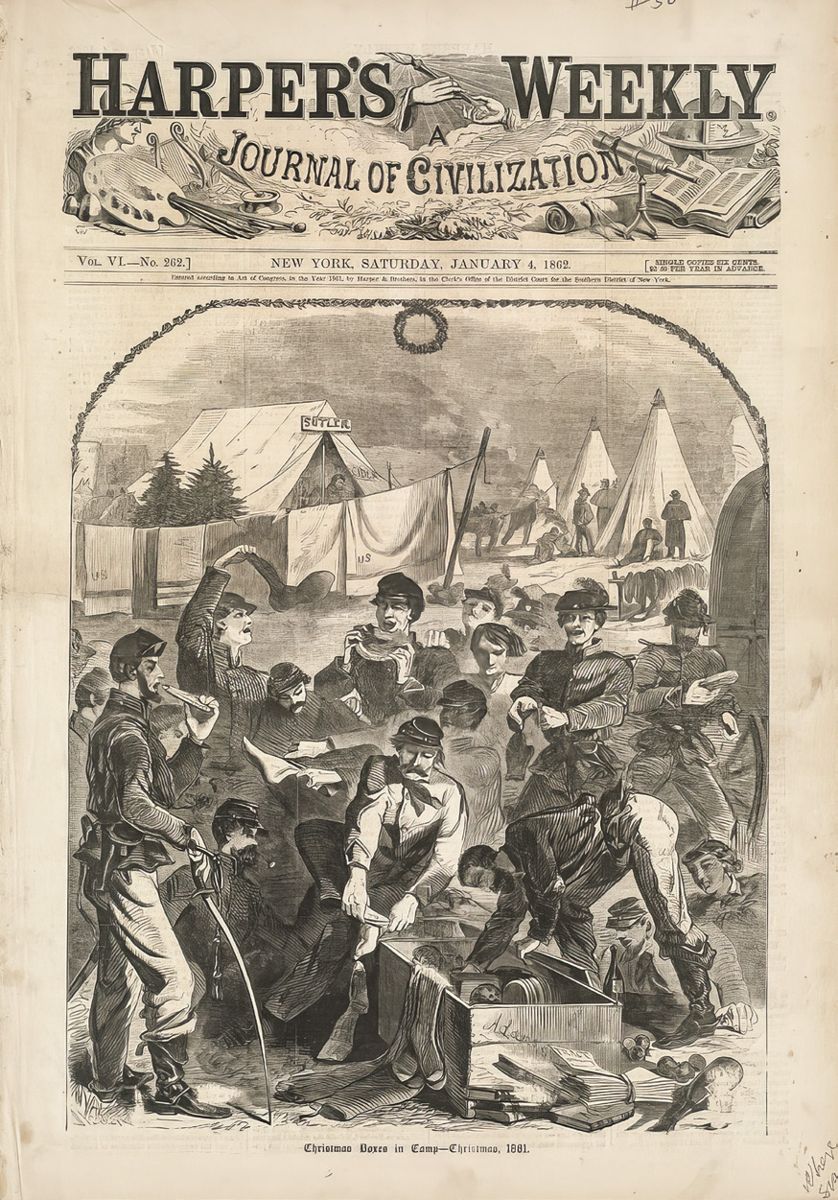
Nearly every one of the millions of women in America met, knew or was related to some soldier or group of soldiers to whom she offered assistance, whether by offering words of encouragement, knitting socks, handing out or sending off much-appreciated packages of goods, or finding some other way to make herself useful and helpful. The women taking this path to participation included women in all regions and in all socio-economic groups. Some of the richest sources of information on these activities are the diaries, letters, journals, and accounts of soldiers expressing gratitude for, and detailing the importance of, the support of family and friends. Right: “Christmas Boxes–Christmas 1861,” Harper’s Weekly, January 4, 1862. Left: “Filling Cartridges at the United States Arsenal, Watertown, Massachusetts,” Harper’s Weekly, July 20, 1861.
- Path to Participation as Production Workers.
Hundreds of thousands of women were employed during the war in the mass production of garments, tentage, ammunition, and other necessities. Petitions and other documents detail the difficulty of surviving on the wages paid these women, particularly given inflation in both north and south. As they spent every waking moment working to support their families on less-than-subsistence wages, it is not surprising that there are few letters, diaries, and personal accounts written by these women. In addition, an examination of Confederate pay records reveals that a majority signed for their pay with an ‘x’. The magnitude of their output made significant contributions to military operations, and is documented in financial and production records.
- Path to Participation as Organizational Volunteers.
Thousands of women found ways to support war efforts by volunteering or (working for pay) for and through local, regional, and national organizations. These included church-based groups that turned their attention to war efforts, community-based soldiers’ aid societies, and regional and national organizations which collected, coordinated and consolidated the contributions of local organizations for wider, more coordinated distribution. The women taking this path to participation tended to be those who were sufficiently comfortable to spend time away from tasks like running households or supporting their families. They tended to be better educated, socially more prominent, and more likely to write–and then publish–both accounts of their efforts and records of their organizations. In terms of published documents, the roles of these women are the most extensively documented of all roles of women in the War.
Scope
Even with only three paths to participation, women’s roles in the War expanded to encompass massive scope and significance. Expressed as a broad and bold brushstroke, women’s roles in the Civil War occurred anywhere “the imagination and ability of women met the needs of the military.” In other words, anywhere “women’s deeds met military needs.” More specifically, women provided social, spiritual, psychological, material, medical, monetary, mourning, memorial and (as spies, scouts, and soldiers) military support to the War efforts. They met many needs that were not, and could not, be met by other means. “So what?” Before you ask, I hasten to address the significance of women’s roles in the Civil War.
Significance
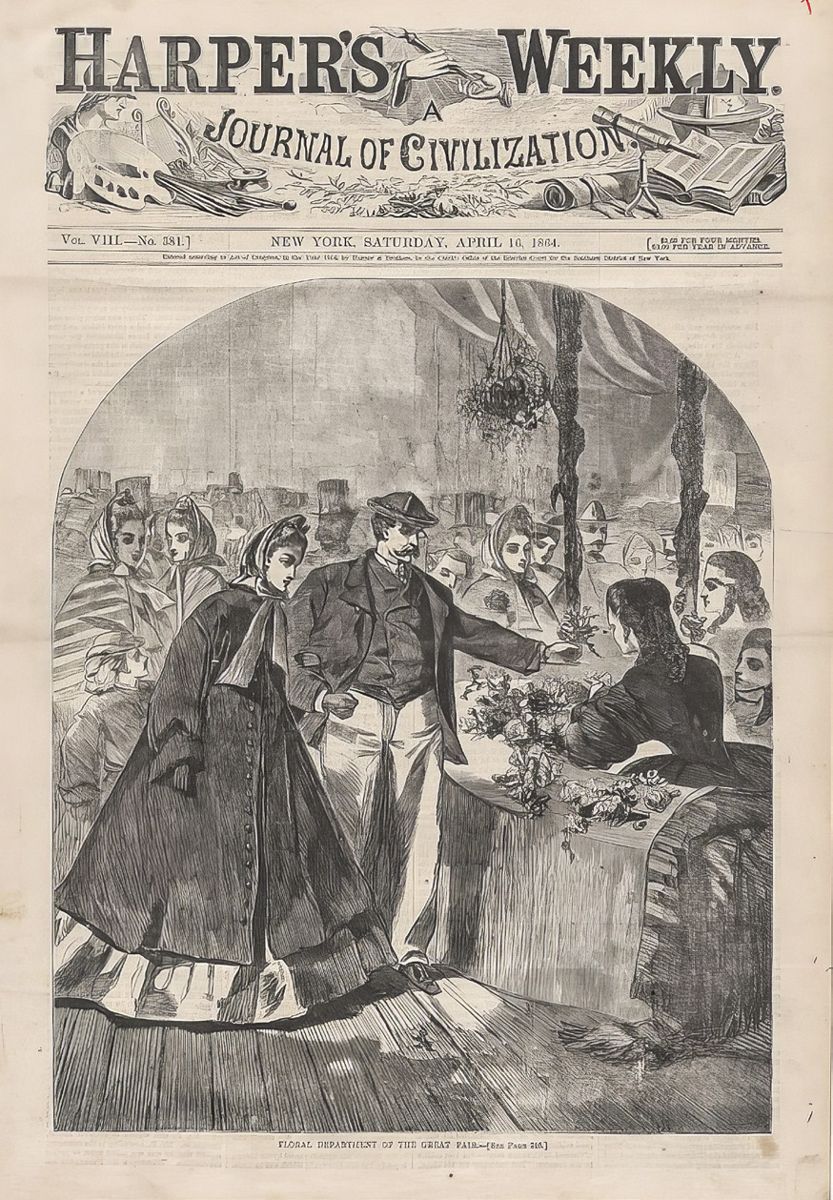
Women’s roles in the Civil War were acknowledged, lauded, and publicized during the War, and by the people who experienced them firsthand. Illustrated newspapers featured women in various roles in lead stories and even cover illustrations. In subsequent decades and centuries, authors, editors, and publishers often focused on more obviously important topics like strategy and tactics, campaigns and battles, unit histories and officer biographies, and so on. In the process, supply chains and other behind-the-scenes activities (like those generally performed by women) were sometimes edited out of history books. In the second half of the twentieth century, efforts were made to ‘write women back into history,’ and evidence of women’s roles—and their importance to—and impact on—military operations— has been rediscovered. When considering military topics, a commonly accepted criteria is to evaluate how effectively a person, activity or event impacted military operations and objectives. In a world that values sexual equality, women’s roles in the War can and should be evaluated by this same criteria. Were there, indeed, roles in which women contributed to more effective military operations and objectives? The answer is a resounding ‘yes,’ but a “Top Five” list based on this criterion may surprise. We must consider what were the most imperative needs of the military and how women’s deeds meet these needs. The thing the military most needed (and of which women most influenced the supply) were soldiers who were willing, able, and effective fighters. That last criteria, of being ‘effective’ largely eliminates the several hundred transvestite women who chose to dress and/or disguise themselves as male soldiers. Contemporary accounts indicate they were as often regarded as diversions and nuisances as contributors to military operations.
Our “TOP Five’ list of military needs for which women’s deeds provided significant contributions include: 1. food, 2. shelter, 3. clothing, 4. arms and ammunition, and 5. physical and mental health. The remainder of this article will provide an overview of women’s wartime roles in contributing to each of these “Top Five” needs.
Food
Whether voluntarily or by coercion, women shared food from their families with soldiers. They also kept the farms going and the crops growing, sometimes selling crops to the military, at other times seeing it destroyed or stolen. Beyond producing the raw material of food, women sometimes prepared and served food, or packed and sent it off to ‘their’ soldiers. From the start of the war, many units whose home communities were behind enemy lines suffered greatly, while others got far more than they needed. On railroads, priority was given to transporting soldiers over freight. Packages failed to reach their destinations or were left rotting in railroad depots. This was one of the issues that prompted the formation of regional and national organizations that would coordinate the distribution of donated goods. Among the few roles of women working directly for (and travelling with) military organizations was that of ‘cook’, and some accompanied military units in the field and on hospital transports while serving in this role. As production workers, some women worked in commissary kitchens and bakeries, and other food preparation and manufacturing facilities. Soldiers’ Aid Societies and other organizations often gathered, packed, and distributed food to soldiers at roadsides, railroad depots, and even “refreshment saloons” set up for the purpose. Regional and national organizations sometimes raised sufficient funds to have food manufactured for the purpose of sending it to soldiers.
Shelter
Whether voluntarily or by coercion, some women provided shelter for soldiers, often in their houses or barns. Beyond sharing lodging, some women became refugees, leaving behind their homes, which were burned, destroyed, or simply used by officers or soldiers. Women’s roles in the enormously booming industry of manufacturing tentage has been largely overlooked, but many thousands of women worked in both small-scale sail shops that retooled to make tentage, and in larger tentage factories. Some volunteer organizations funded, staffed, and provided other logistical support for facilities where soldiers were housed either while receiving medical or recuperative care, or while on hospital transports. Some also provided housing for soldiers—and their orphans—after the war.
Clothing
Individual women and families made and sent shirts, socks, mittens, and entire uniforms for soldiers. When logistics permitted, they also altered, mended, laundered and replaced old garments with new. The ‘commutation’ system operating in the south at the beginning of the War made individual and community efforts particularly important. Among the few roles of women working directly for (and traveling with) military organizations was that of ‘laundress,’ and some accompanied military units in the field while serving in this role. While officers privately procured uniforms made by (male) tailors, enlisted men in both the North and South (and especially after the demise of the commutation system) were issued uniforms manufactured in mass quantities by tens of thousands of needlewomen (as well as some female cutters and inspectors) employed by military depots and private contractors. Soldiers’ Aid Societies and other organizations often filled the need for garments needed but not issued (or not yet issued). The magnitude of these efforts are well documented in statistics maintained by local, regional, and national volunteer organizations. These organizations also organized massive operations to launder the linens used in hospitals.
Arms and Ammunition
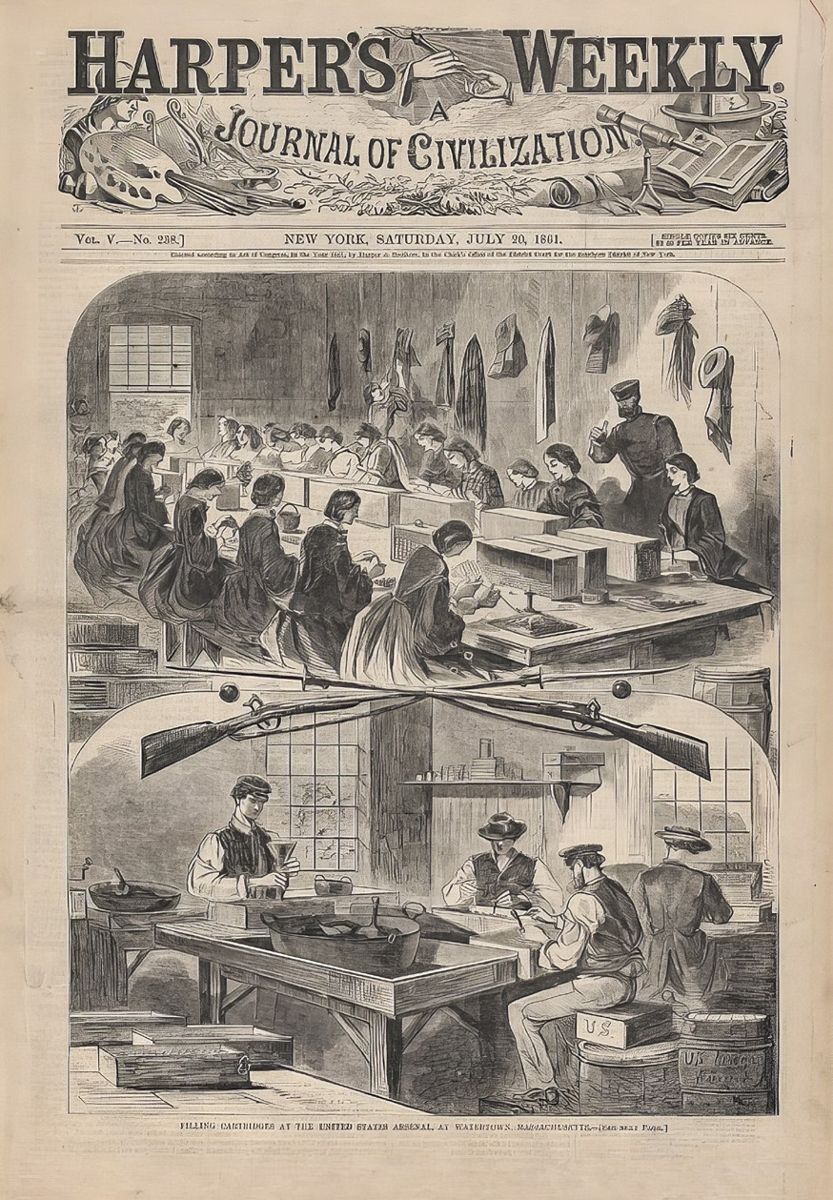
Thousands of women were employed in arsenals and facilities where ammunition was manufactured. Women employees were especially prized for their manual dexterity in rolling cartridges. These (and other jobs at arsenals) took place in facilities where explosions and other disasters sometimes resulted in the injury and even death of female operatives, including explosions at the Washington Arsenal in Washington D.C., the Allegheny Arsenal in Lawrenceville, Penn., and Brown’s Island in Richmond, Va.
Physical and Mental Health
In terms of mental readiness, one of the military’s biggest needs during the war was for volunteers. Women played a large part in encouraging (or
“Our Women and War: The Influence of Woman” was published in Harper’s Weekly on September 6, 1862.
Engraving captioned “Industry of Ladies in Cl othing the Soldiers and Zeal in Urging their Beaux to Go to the War.”
discouraging) men to enlist, to fight, and to keep on fighting. In the mid-nineteenth century, women operated in a ‘sphere of domesticity’ and with a sense of ‘Republican Motherhood’ that gave them responsibility for guiding the moral and ethical development of sons into the sort of men who would be willing to risk life and limb for a ‘cause.’ Many soldier letters include commentary on the responsibilities they felt to God, family, and country. Still others expressed the importance of knowing there was someone keeping the ‘homefires burning,’ anticipating and praying for their well being and their safe return home. Women had a strong role in raising sons willing to enlist, and to keep on fighting when times got tough. In terms of physical health, some women—with or without formal medical training—served as nurses while other women with medical degrees served as doctors and surgeons. Women provided both nursing care and logistical support to health care facilities, and ministered to sick, wounded, and recuperating soldiers. In addition, they proactively promoted the health and welfare of soldiers. The very name of the “United States Sanitary Commission” reflects its initial focus on promoting healthy practices like having cavalry and latrines downstream of (and well removed from) commissary operations.
Summary
Women’s deeds addressing these ‘Top Five’ areas of need— for food, shelter, clothing, arms and ammunition, and physical and mental health reflect the contributions of not hundreds, not thousands, but millions of women. Although less obvious than strategy and tactics, campaigns and battles, and so on—many women’s activities in logistics and other supportive roles— were exceedingly important to military operations. Further, this ‘Top Five’ list is only a sampling of women’s roles in the Civil War, and omits women who took on many, many roles previously reserved for or dominated by men, freeing up men to serve in the military. These include roles as varied as serving as lighthouse keepers, telegraph operators, clerks in government agencies, and even operators of firms that manufactured military accoutrements. In addition, there were individual women who operated in unique roles, like Rose Greenhow, who made significant contributions to military strategy and tactics by her activities as a spy, and who later served as a diplomat to a foreign country. While we join our fellow historians in celebrating the women whose names and biographies are known, and women in roles that occupied only dozens or hundreds of women, we are beginning this series of articles with the “Top Five” list, intending to highlight the roles of millions of women, including many whose names are “Known only to God.”
J uanita L eisch J ensen is a nationally known speaker , writer , researcher ( and avid collector ) of subjects related to civilians and the C ivil W ar . S he is currently serving as C hairman of the N-SSA 150 th C ivilian E vents T ask F orce which is planning special events at the fall , 2024 national skirmish . S he is a member , fellow , and former G overnor of the C ompany of M ilitary H istorians . S he is also a member and former P resident of the S ociety for W omen and the C ivil W ar . S he authored two books : W ho W ore W hat : W omen ’ s C lothing , 1861-65, and an I ntroduction to C ivil W ar C ivilians . J uanita and her husband , military historian L es J ensen split their time between homes in O range C ounty , N.Y., and S henandoah C ounty , V a . Rose Greenhow’s My Imprisonment: An Annotated Edition by Emily Lapisardi. Matamoras, PA: Winston Lewis Publishing, 2021.