
How Shall All These Would be Healed?
By Bob Zeller · Originally published May-June 2024 · pp. 48–51
CCWP
Fresh Views of tne War’s Most
The Center For Civil War Photography - History In Focus -
Famous Fort By Bob Zeller
Editor’s Note: This story and photo feature has been adapted from articles that appeared in the April 2013 and December 2014 issues of Battlefield Photographer, the photo history journal published by The Center for Civil War Photography. Past issues are at the non-profit’s website, www.civilwarphotography.org.
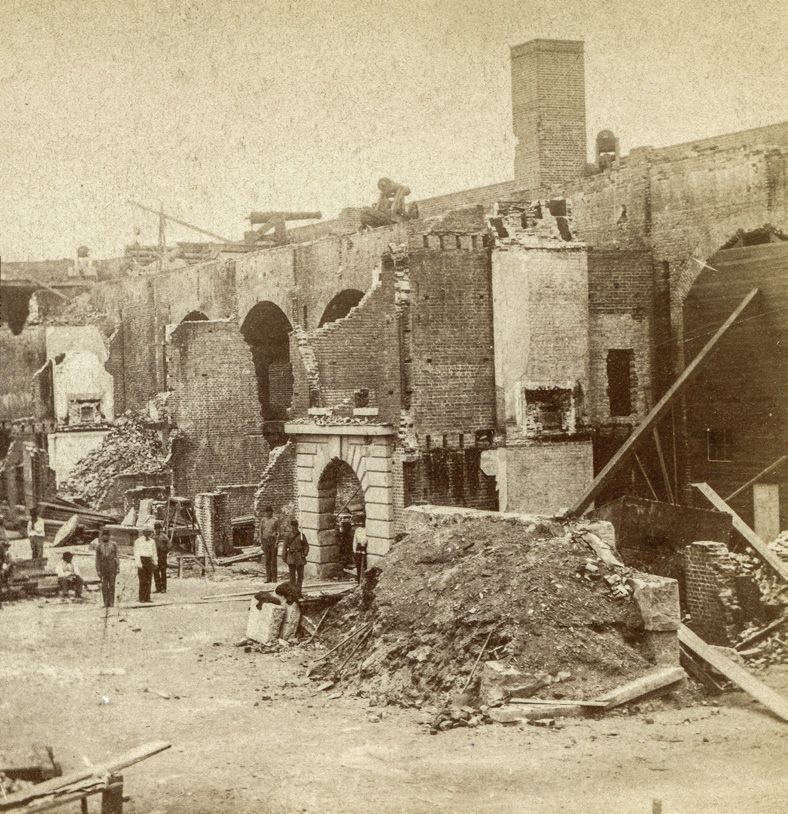
The opening engagement of the Civil War, the bombardment of Fort Sumter on April 12-13, 1861, was one of the most photographed events of the entire conflict. Two Charleston photographic studios produced and sold more than 50 photographs and stereo views in the days after the fighting, many showing the damage done to Forts Sumter and Moultrie. Considering the number of photographs that were taken, it goes to figure that previously unknown photographs from 1861 would surface; such has been the case in recent times with the emergence of three stereo views of Fort Sumter that show the bastion busy with activity a few weeks or months after the engagement. The most unusual view shows a long dining table occupied by civilian workers in the middle of the parade ground. It showed up on eBay in October 2012 and was acquired by CCWP member and Battlefield Photographer contributor Keith Brady. It is a rich, dark albumen print, 10 on a 10 scale; in the background, the elegant, brick-arched casements on the second tier of the three-level fort are closed off by wooden planks, with doors and windows cut in these makeshift walls. The image shows a busy fort in an active period of transition. Now that the Confederates had won the citadel, they were busy repairing the bombardment damage, restoring it to working order, and creating quarters for officers and soldiers by enclosing casemates. After seeing the picture, retired historian Rick Hatcher of Fort Sumter and Fort Moultrie National Historical Park exclaimed, “New history!” He said he had never seen a photograph of the fort with the casemates enclosed.
The appearance of the fort’s interior establishes that it was taken soon after the April 1861 bombardment and subsequent Confederate occupation. The caption on the back reads, “No. 51. Interior view of Fort Sumter, after the First Bombardment, April 1861.” We have no information to dispute that date, although it couldn’t have been among the many images taken immediately after the surrender because it took some time to enclose the casemates. Hatcher thinks it could have been made as early as a few days after the bombardment. “We know they wanted to get the fort back on line as quickly as possible because there was some concern U.S. forces might mount a rapid attempt to come back and take it,” he said. “Of course, that never materialized, but you can see the Confederates were getting pretty well organized, with all those slabs of stone or granite next to the large table where the men are eating.” The second-tier casemates visible in the image have been transformed into what appear to be living quarters, complete with windows. The huge slabs of cut stone obviously were to be installed somewhere in the fort, but no one knows where. There are almost no records of Confederate construction or repairs after the 1861 bombardment. Similar or identical slabs were used to cover the five cisterns in the fort, Hatcher said, but there are many more slabs pictured than what might be needed for that. Another image has since surfaced showing Fort Sumter with enclosed casemates that also shows the Confederate flag flying high over the fort. It was discovered and acquired by CCWP member and Battlefield Photographer contributor Andy House
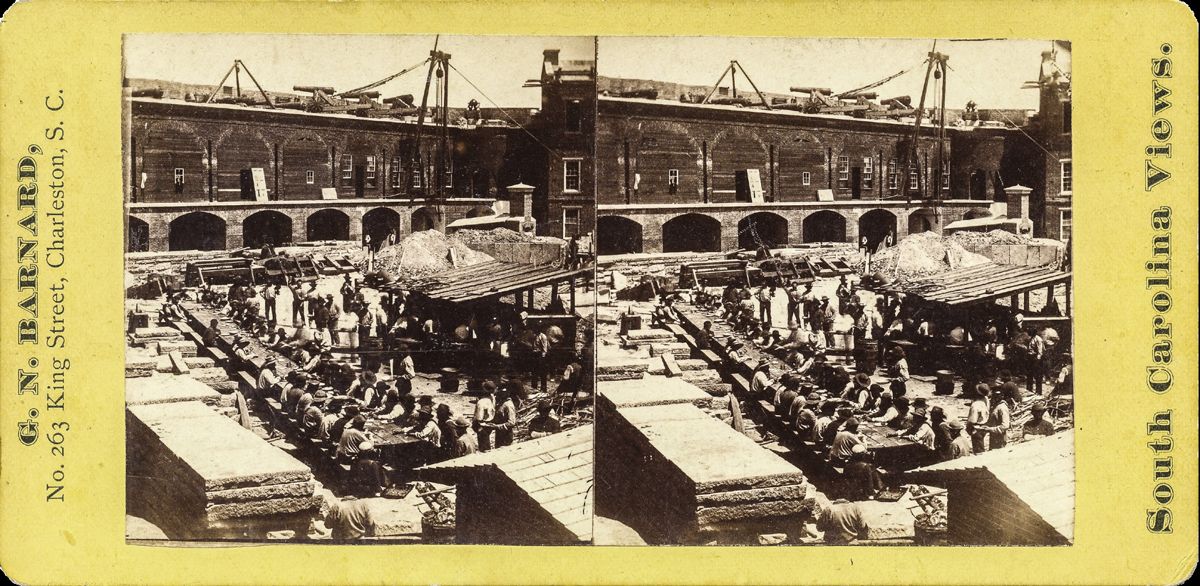
This photograph of Fort Sumter taken after the April 1861 bombardment is one of the most unusual images of the famous bastion. A long dining table stretches across the parade ground to accommodate Confederate workers making repairs and effecting other changes, such as enclosing casemates. (Collection of Keith Brady).
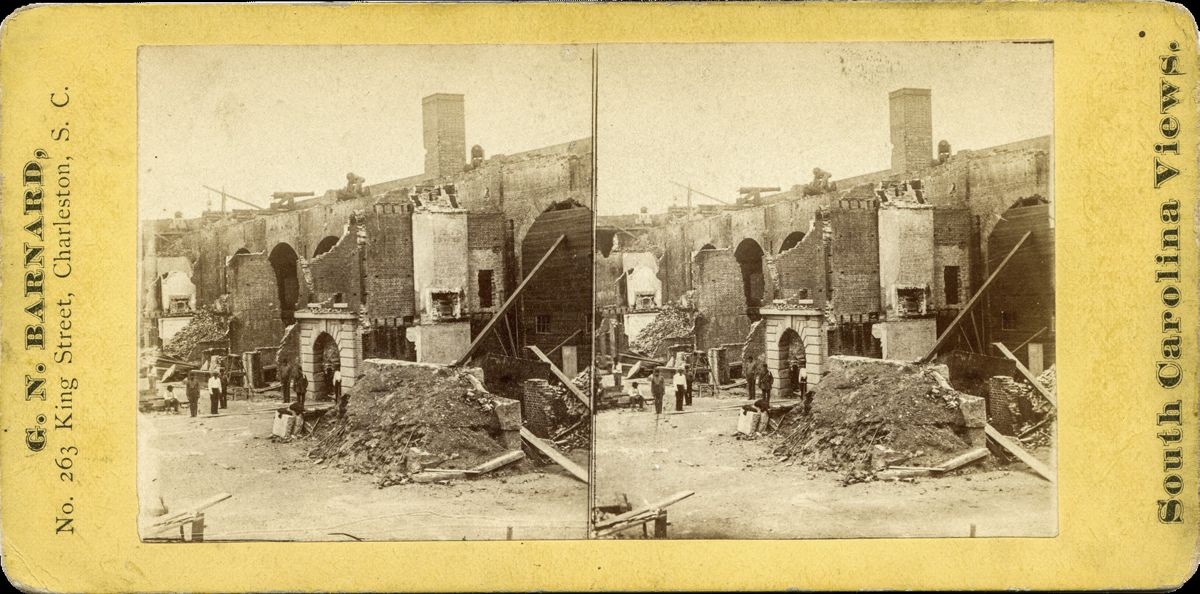
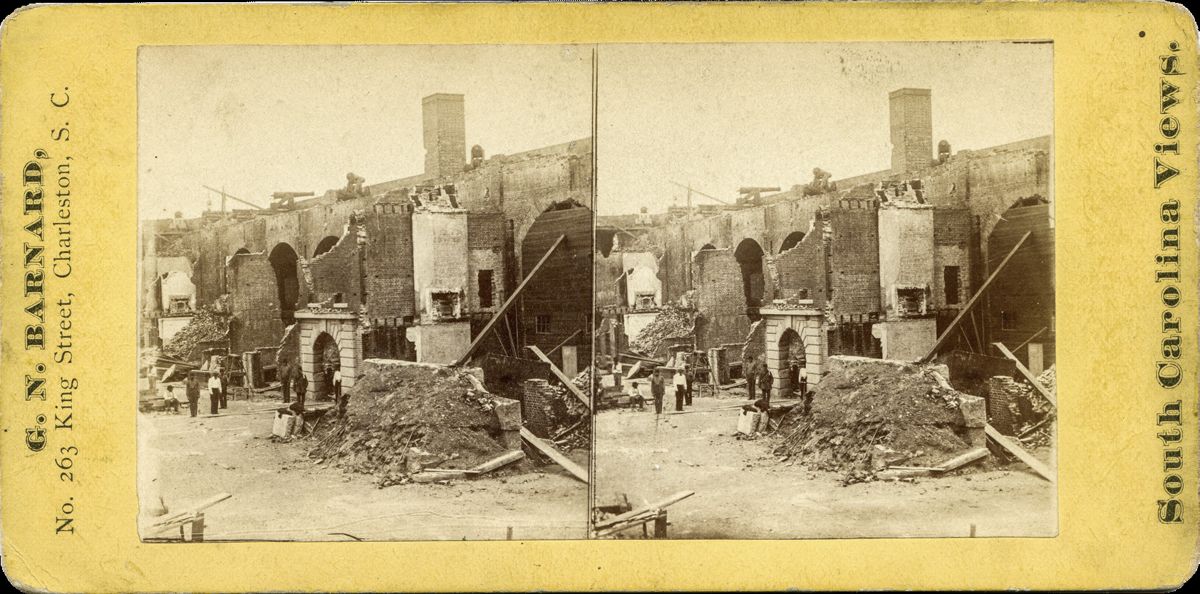
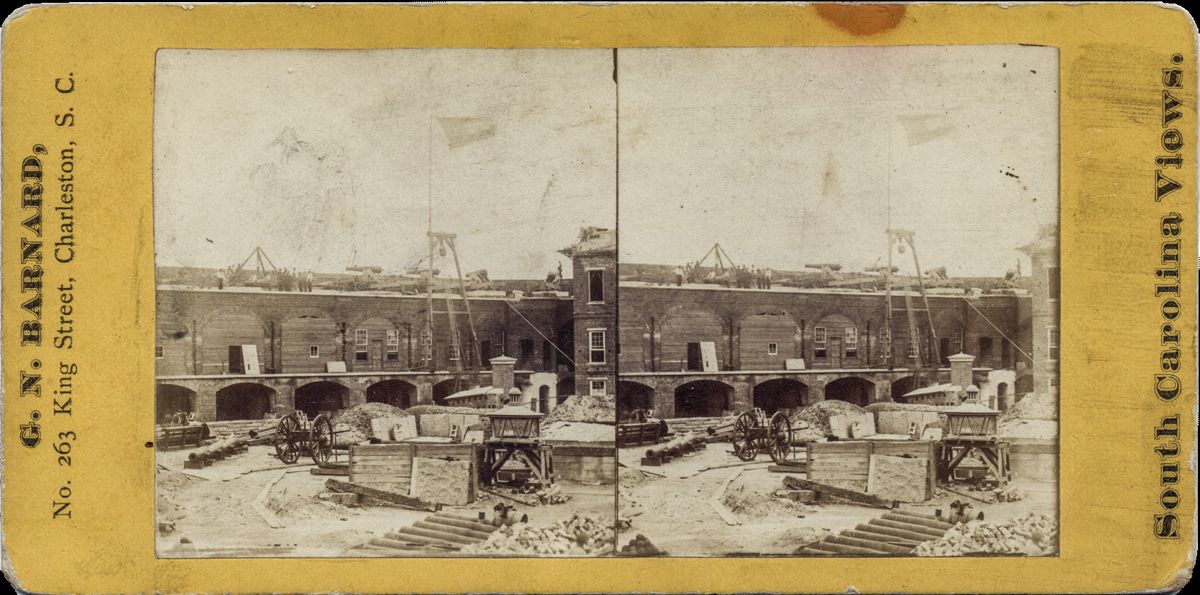
and first published on the cover in 2014. Hatcher said he had never seen this image either, adding that it was the fifth-known view showing the Rebel flag flying at the fort. A third view has surfaced showing Fort Sumter with work progressing after the bombardment, but with only a single casemate enclosed. This view, also owned by Brady, shows a different section of the fort interior. It is unknown whether the three views were taken on the same or on different days; the possibility that the photographer made multiple trips to the fort after the bombardment cannot be ruled out. All three stereo views were sold by photographer George N. Barnard, one of the Civil War’s most famous photographers. He did not take the images; he was never in Charleston until the War’s final weeks. The stereo photographs were most likely taken by Charleston photographers Osborn & Durbec, who operated a studio from 1858 to about 1862 and took more than 40 stereo views immediately after the bombardment. After the war, Barnard and other Charleston photographers continued to sell Osborn & Durbec views, but on their own imprinted cards. For unknown reasons, perhaps because the Barnard studio didn’t know better, the prints for two stereo views, the dining table and the Rebel flag, were made in reverse, or backwards. That becomes quickly apparent when comparing them to other 1861 images of the fort’s interior. To see the image in proper perspective, the twin photos on those two views need to be flipped horizontally. Although Barnard did not take the photograph, he left a legacy as one of the Civil War’s greatest photographers. He photographed the First Bull Run battlefield for Mathew Brady in 1862, as well as the Peninsula Campaign. In 1864, he was with Sherman’s army in Tennessee and followed it into Georgia, where he photographed Atlanta just before its destruction in November 1864. In March 1865, he was in Charleston with his cameras. He must have fallen in love with the city, battered as it was, because he returned in 1868 to settle there and apparently work for the Quinby & Co., gallery. In 1871, at the urging of his sister, Barnard moved to Chicago and opened a photo gallery, only to lose nearly everything in the devastating Chicago fire, ultimately abandoning the wagonload of papers and equipment he and an assistant were trying to save and wading into Lake Michigan to escape the inferno. “They carried a few of the best lenses and cameras into the cold water of Lake Michigan, holding them overhead as they watched the city burn,” wrote Keith Davis in his outstanding biography, George N. Barnard, Photographer of Sherman’s Campaign. (Hallmark, 1990). Barnard returned to Charleston in 1873 and opened his own gallery. He jump-started the business by buying out the S.T. Souder gallery for $7,000. The purchase included 7,500 negatives, most likely including these and other wartime views Barnard reprinted and sold. The length of the dining table in this image, enough room for almost three dozen workers with plenty of space to spare, exemplifies the effort the Southerners were making to repair a bastion that was more than a fort, but a legacy and a symbol of the Confederacy. Many of the men in this image may have been among the some 100 workers who were hard at work trying to finish construction of the fort when Union Maj. Robert
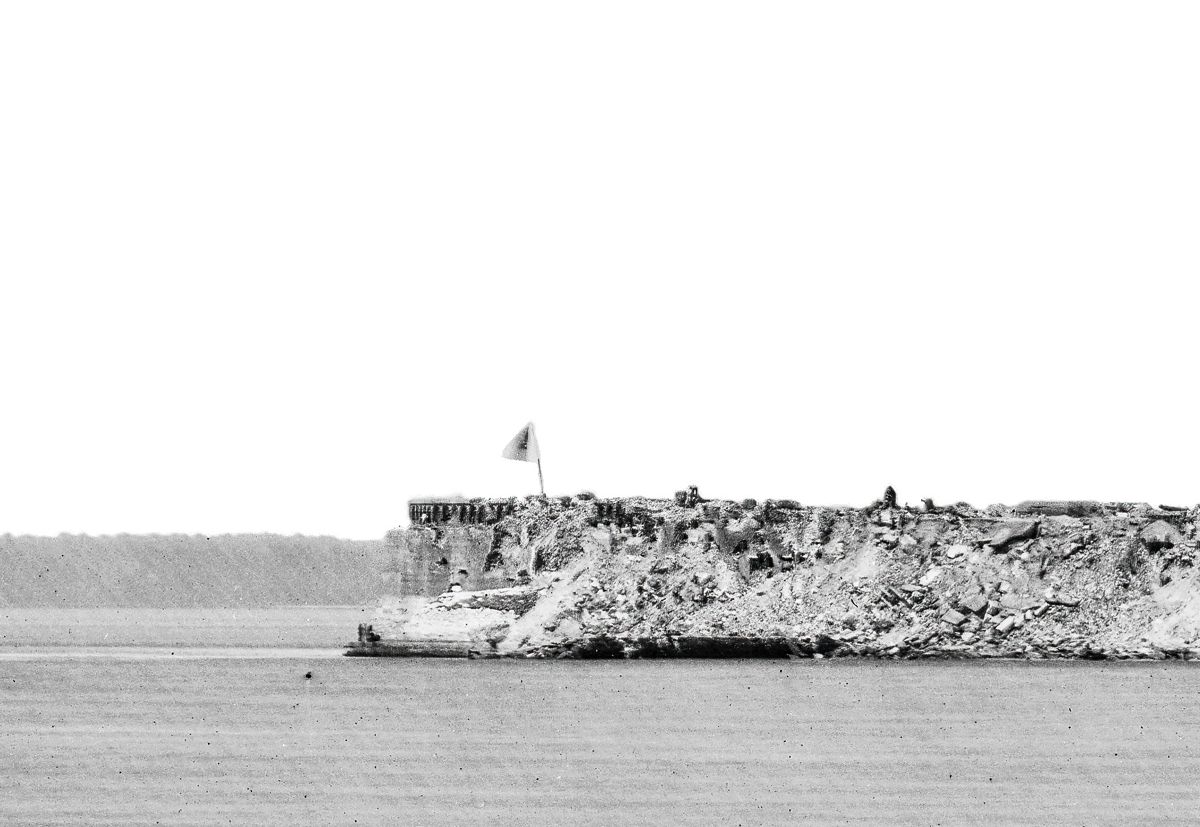
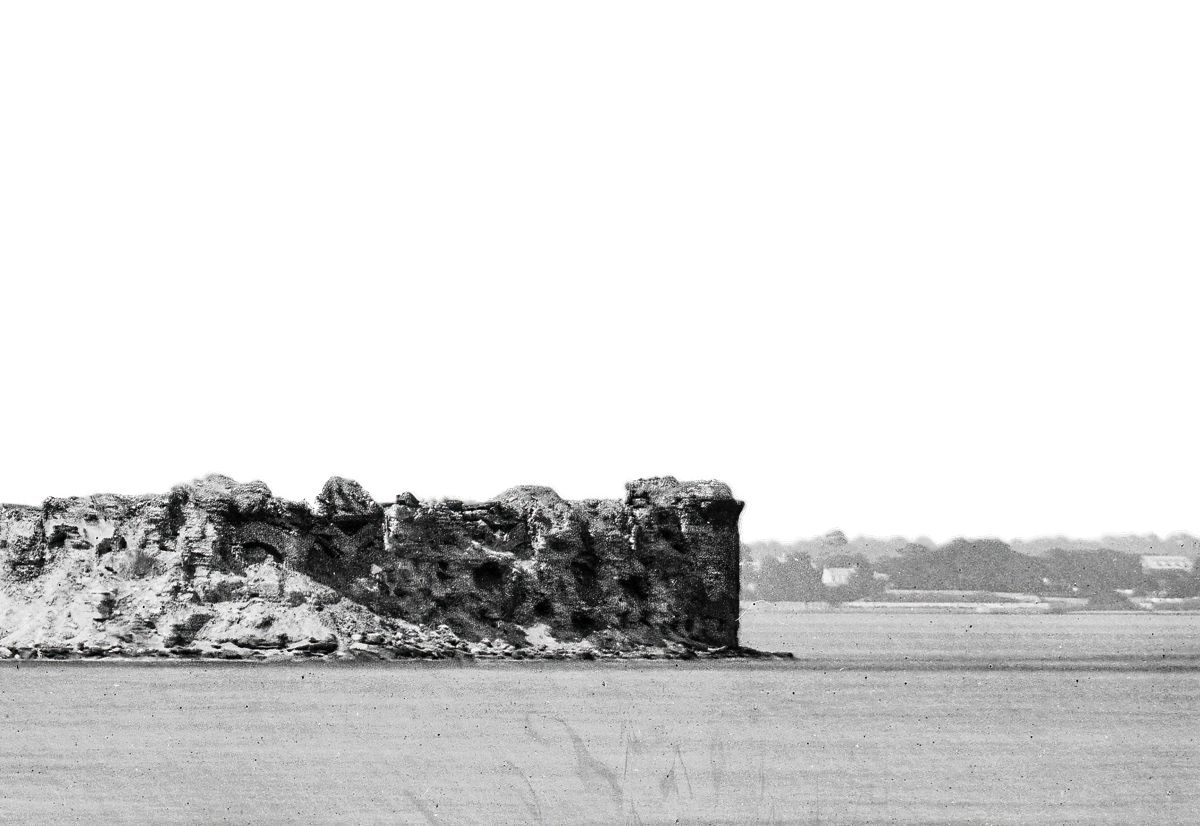
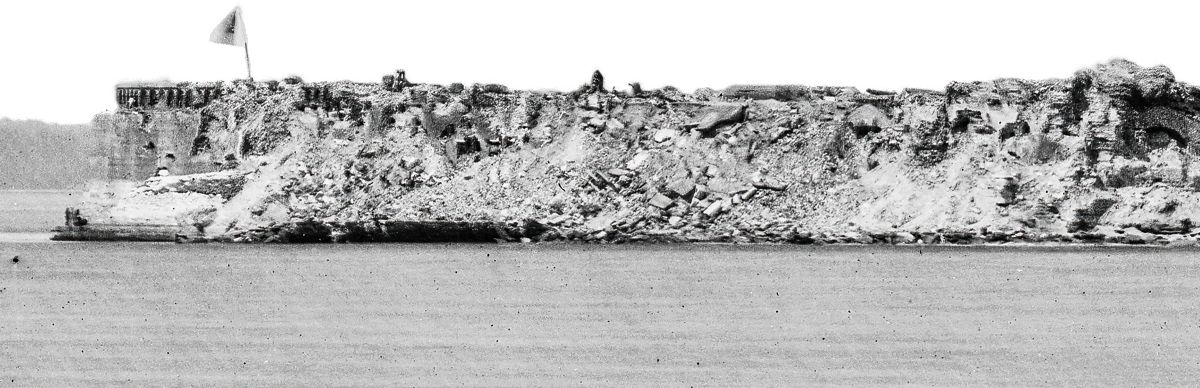
Left: A second Fort Sumter photograph that has surfaced in recent years shows the Confederate flag flying high over the fort. It also shows the unusual enclosed casemates. (Collection of Andy Douglas House). Center: This two-plate panoramic photograph of Fort Sumter is one of the first photos of the Civil War. It was taken on April 15, 1861, a day after the Union surrender, and shows the fort immediately after the bombardment, with none of the casemates enclosed. (National Archives). Right: This rare view of Fort Sumter, possibly published here on the printed page for the first time, shows the fort under repair after the 1861 bombardment. Only a single casemate is enclosed. It was sold by George Barnard after the war but probably taken by Charleston photographers Osborn & Durbec. (Collection of Keith Brady). Anderson occupied it on Dec. 26, 1860, precipitating the crisis that culminated with the Southern bombardment that started the war. Most of the workers were Charlestonians, and they departed when Anderson arrived. Hatcher said it is likely that the Confederates asked many of those same workers to return after the April 1861 bombardment to help repair the extensive damage and replace the gutted quarters. By December 1862, most or all the repairs had been completed, and the fort was in good enough shape to host a grand ball in the new officer’s quarters. “We had, as you heard, quite a ball at the fort,” Confederate Lt. William H. Grimball wrote on Dec. 15, 1862. “We had 100 guests of all sorts and sizes – too many by far for the small space we had to entertain them in.” Gen. P.G.T. Beauregard, the Confederate commander in Charleston, was there, as well as a “large number of ladies,” Grimball wrote. Fort Sumter became the target of incessant Union bombardment beginning in August 1863 and was largely reduced to rubble. Still, the Confederates held on to this prized possession until February 1865, when the war was almost over. The fact Barnard was still printing and selling 1861 stereo views of Fort Sumter after he opened his Charleston gallery in 1873 is a testament to their enduring popularity. Barnard was destined to be struck by yet another devastating loss, one that would leave these prints as the only known surviving records of the photographs. On the evening of Nov. 13, 1875, a fire broke out beneath the stairway to his studio, swept through the gallery, then spread to other businesses. The Charleston News and Courier reported, “Mr. Barnard, the well-known photographer, lost one of the finest and most complete stocks of photographic material in the South. His studio contained the negatives of all the places of prominence and interest in and around the city, and those also of probably two-thirds of the residents of Charleston, embracing the collection of nearly twenty years. The stock was valued at not less than $15,000, and was insured for $6,000 … It was totally destroyed.” Barnard soon returned to business, but the loss of this remarkable photographic record was a blow to his business, and to history. Fortunately, he made and sold these three stereo views before the fire; now that they have resurfaced, we can see more than we ever have of Fort Sumter in the heady first days of the Civil War.