
Shenandoah Shootout at the N-SSA 149th Nationals
By Bruce W. Miller · Originally published July-August 2024 · pp. 55–61
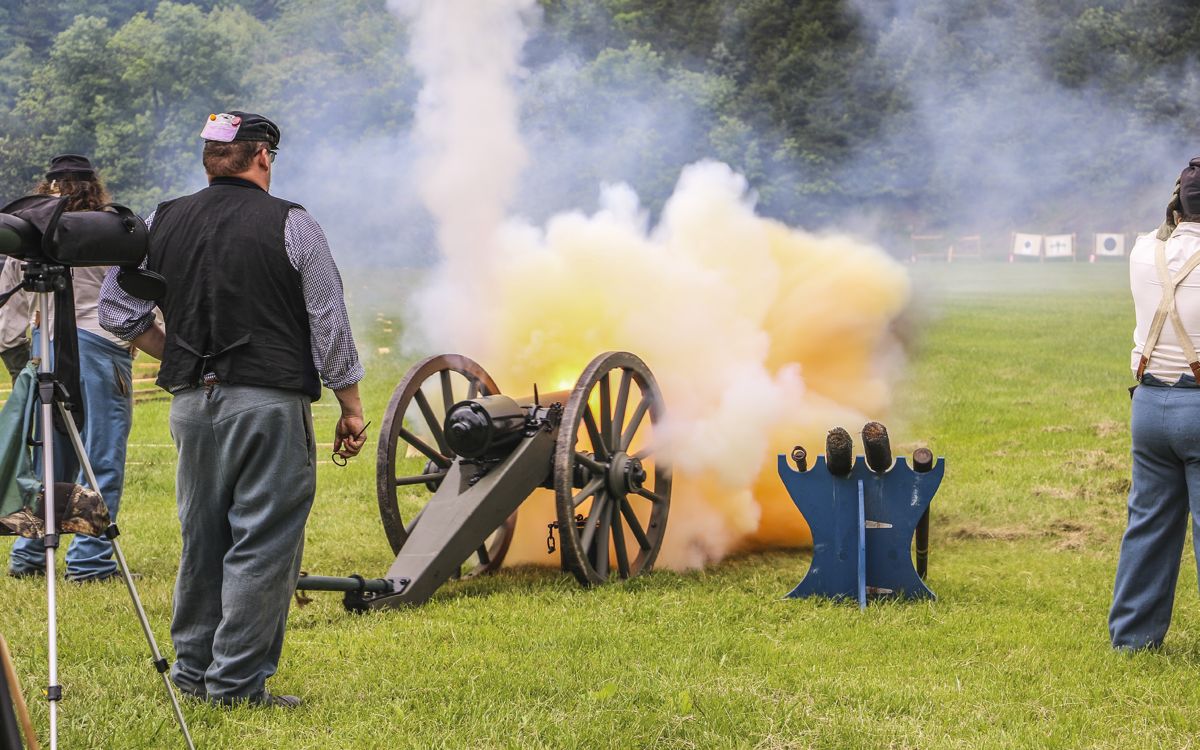
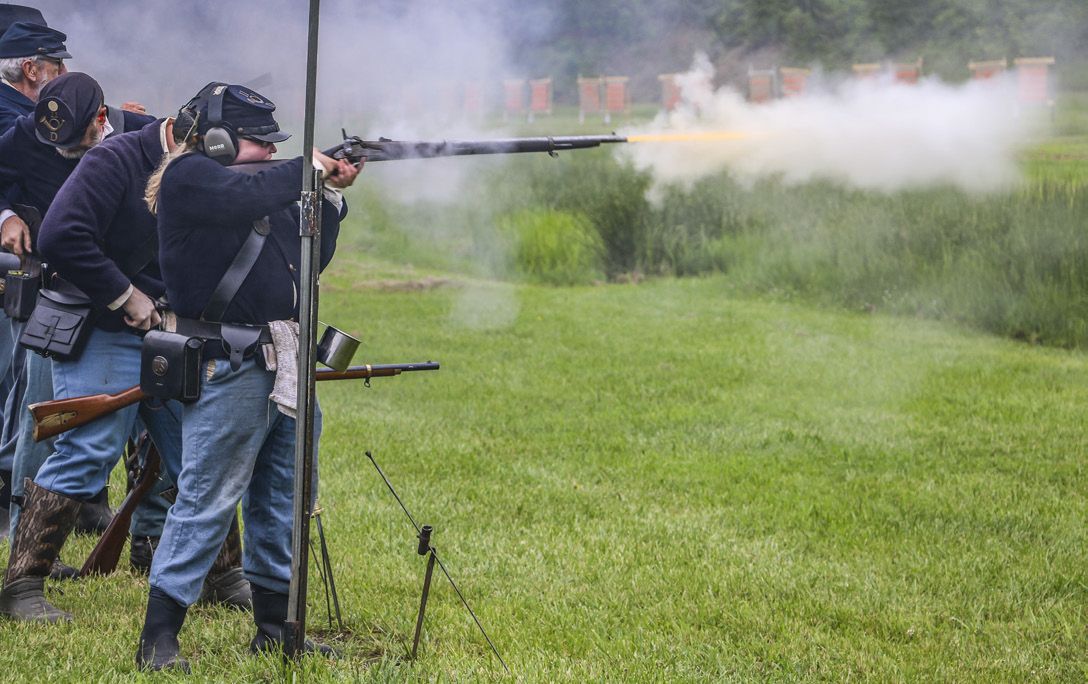
Winchester, Virginia, is an appropriate location for the North-South Skirmish Association’s home range. N-SSA units represent both Union and Confederate teams and Winchester changed hands an amazing 72 times. Located in the northern Shenandoah Valley, there were three battles at Winchester, two at neighboring Kernstown, and another if you count Cedar Creek less than ten miles away. When skirmishers are not competing at Fort Shenandoah, there are several outstanding museums including the newly renovated Courthouse Museum in downtown Winchester. A little farther south in the valley are two fine museums at New Market. On the battlefield is the Virginia Museum of the Civil War; just outside the entrance is the New Market Battlefield Military Museum. Unlike many historical attractions, the Museum’s emphasis has been on building its collection rather than tourism promotion. It houses fabulous artifacts from the 1700’s through today. This gem is worth the trip. Let’s get back to the history, competition, and camaraderie of the N-SSA that held its 149th National Competition May 17-19, 2024. Member units competed in live-fire matches with original or authentic reproduction Civil War period muskets, carbines, breech-loading rifles, revolvers, mortars, and cannon. It is the largest Civil War event of its kind in the country and attracts not only spectators but Civil War enthusiasts and shooting sports media coverage.
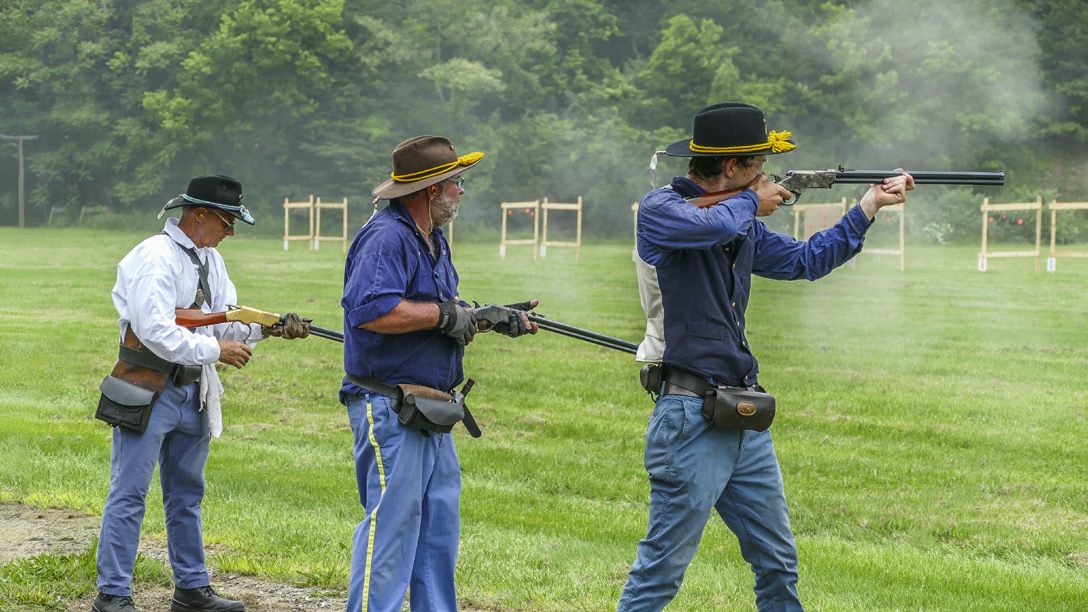
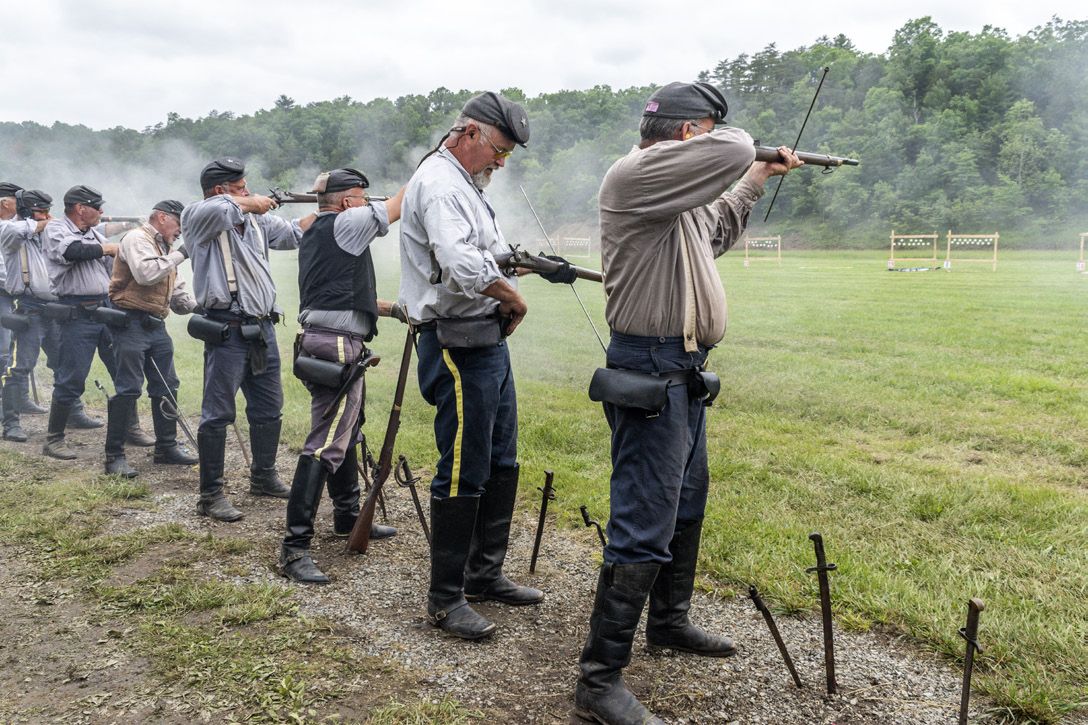
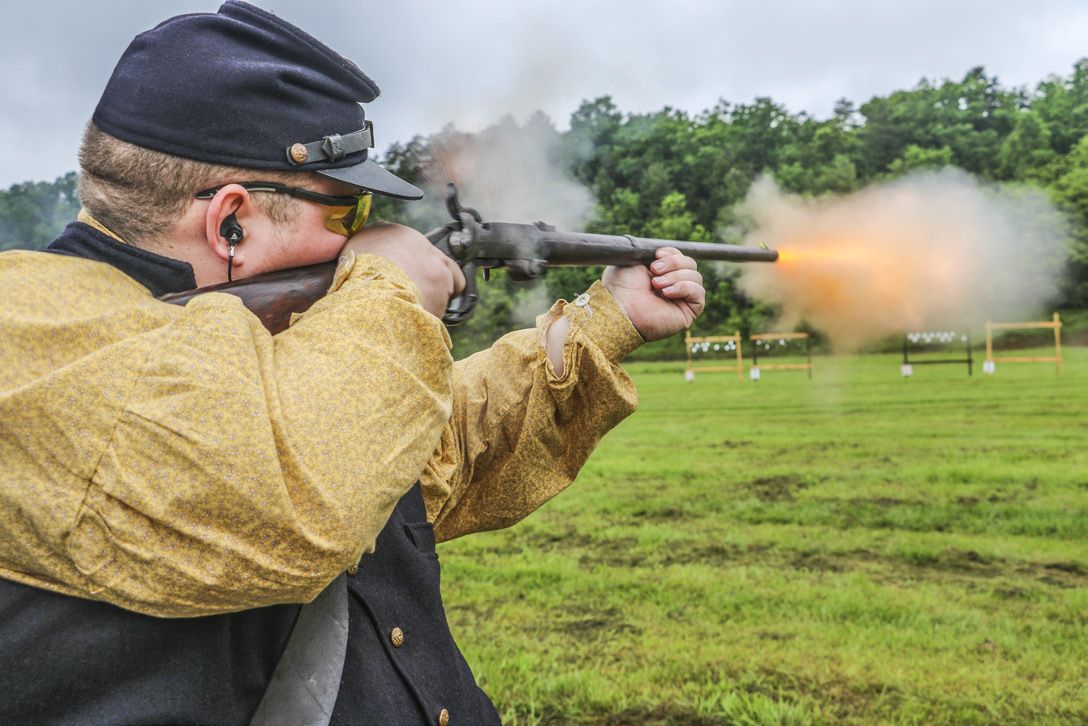
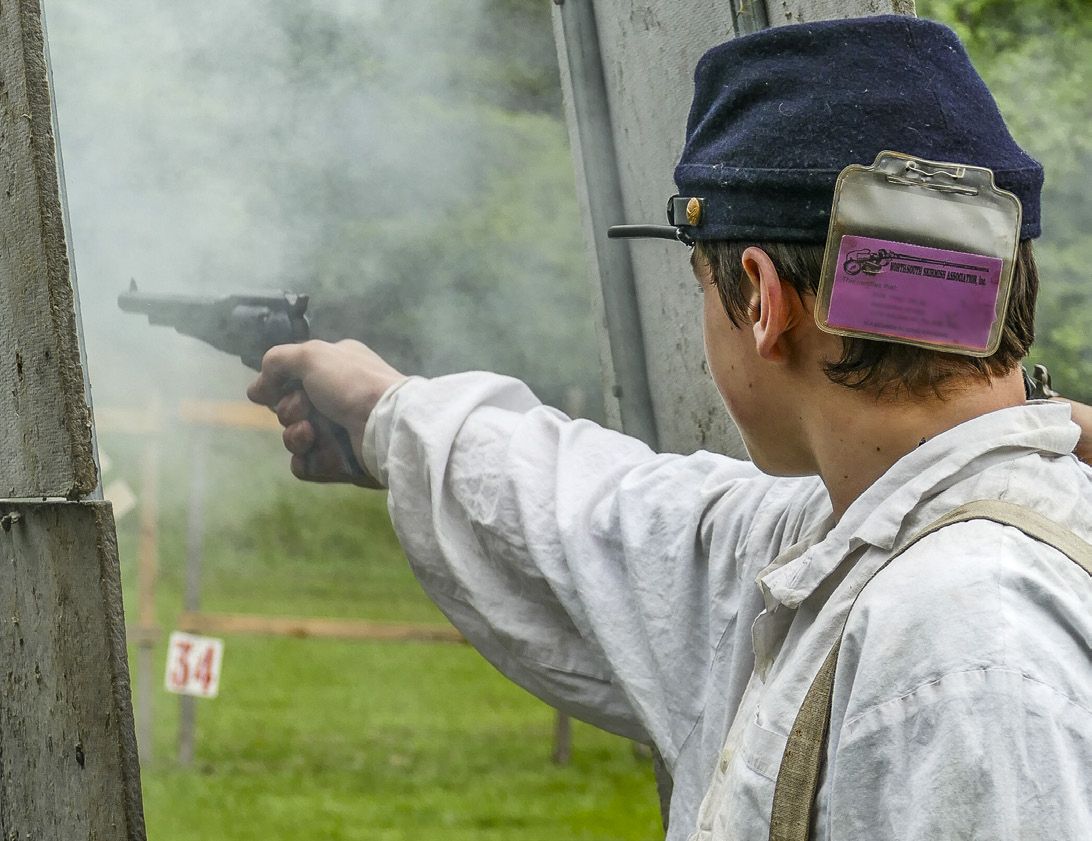
All N-SSA small arms matches are shot by classification, determined by averaging the company’s finish positions relative to other companies in its division for the three highest of the last four national skirmishes the company has participated. For example, companies are assigned the following classifications: A-1 is composed of the top 25% of companies; A-2 the next 25%; A-3 is the remaining 50% of a team’s A companies. B-1 is the top 50% of B companies; B-2 are the remaining 50% of B; C are all C, D, E companies, etc. For the purposes of this article, we will report only the “best of the best,” the A-1 classified winners. The 9th Virginia Cavalry won the musket team match with a time of 497.3 seconds for the five-event program. The Virginians beat out the perennial winners, the 110th Ohio Volunteer Infantry (OVI), by 15.2 seconds. One hundred forty-eight teams participated in this N-SSA signature competition. The 110th got their revenge by beating the 9th Virginia to win the carbine company match by almost a minute. The 110th OVI went on to a smashing victory in the smoothbore musket team match, defeating 135 other four-member teams. The Nansemond Guards bested 65 other teams to win the four-event revolver team match. The 110th OVI scored their third gold medal in the single shot rifle match while the 8th Virginia Infantry won the breech loading rifle match. The 1st Maryland Cavalry won the Spencer team match and the York Rangers won the new single-shot pistol matches. (Niki Bethke) (Lis Cole) (Niki Bethke)
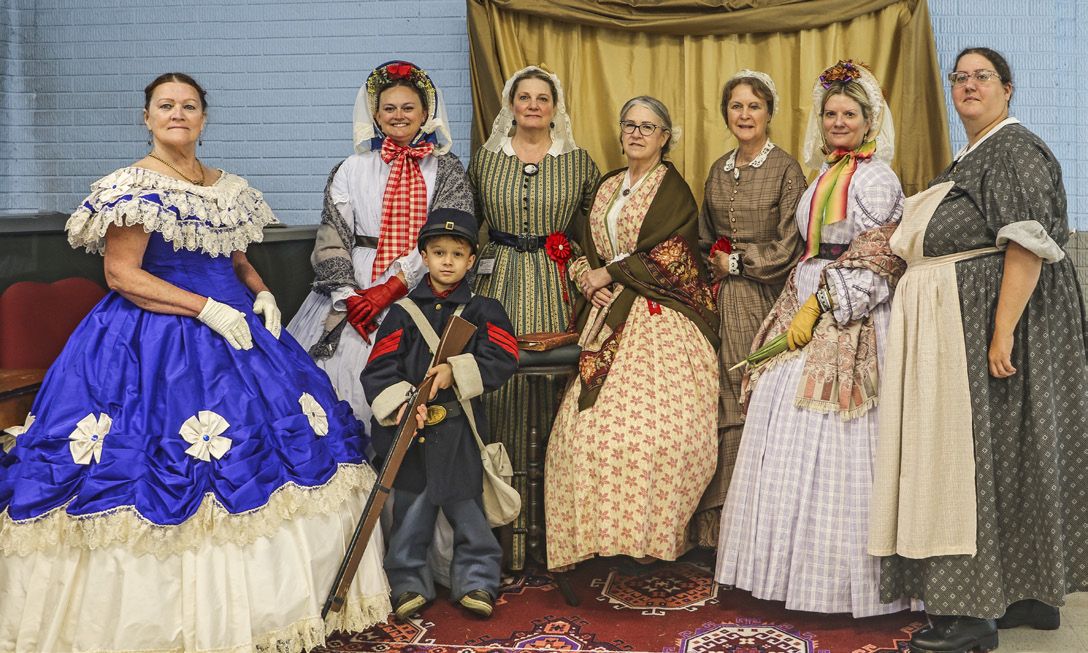
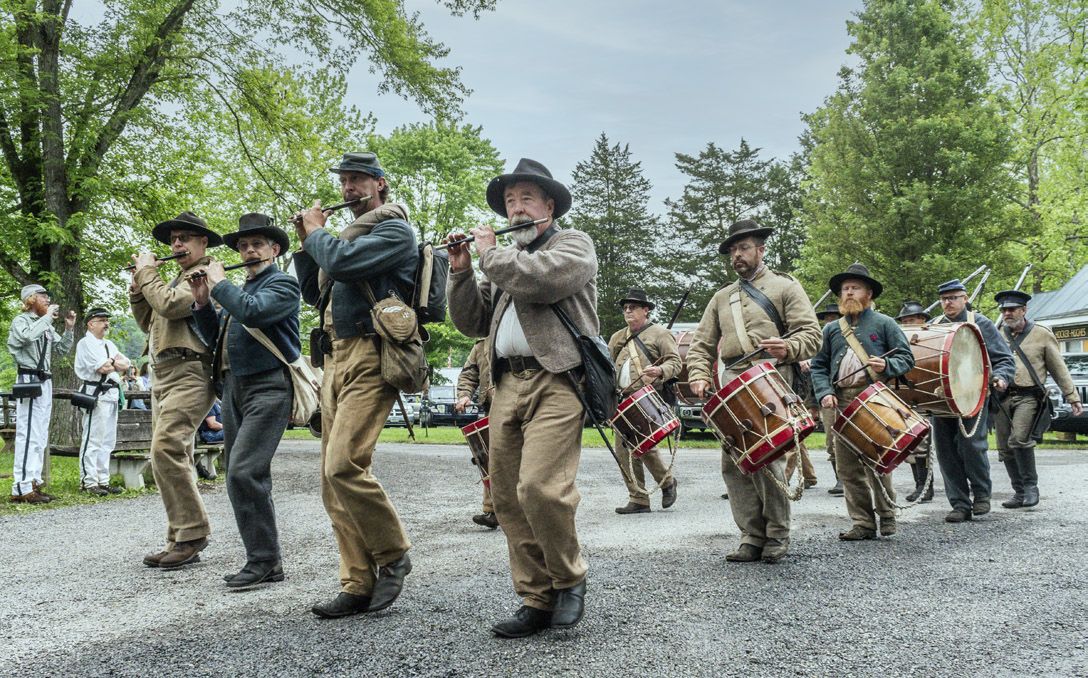
Adding to the period atmosphere of N-SSA National Skirmish is the authentically uniformed 1st Maryland Infantry fife and drum corps. The unit is composed of skilled musicians and is a crowd-pleaser as they march to the range before commencement of the Sunday morning opening ceremonies. (Ericka Curley)
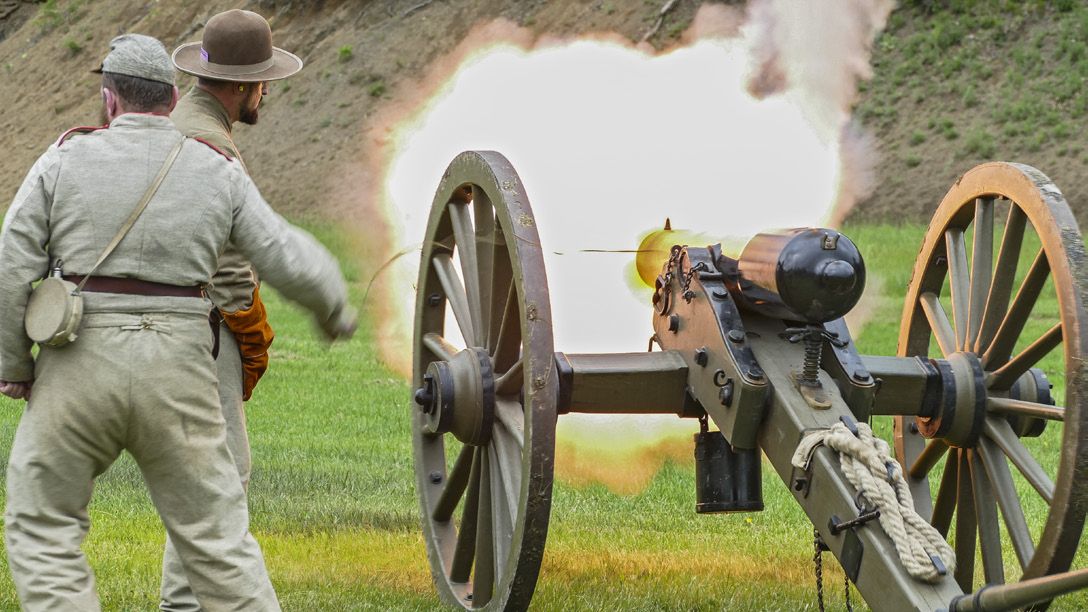
Thirty-seven guns participated in the artillery team matches. The range is reconfigured so that the cannon fire perpendicular to the small arms firing line and the guns are classified by type: smoothbore, rifled, howitzer, and rifled howitzer. Target frames with paper targets mounted on drywall backers are set up at a range of 200 yards for rifled and smoothbore guns and 100 yards for howitzers. Rifled cannon and smoothbore guns fire 12 solid projectiles, with a maximum of seven shots, at either of two targets: a bull’s eye and a silhouette of a cannon facing them that represents counter battery fire. The best five shots on each target count for a maximum of 25 points per target, with a perfect score being 50-5V. Howitzers each fire a maximum of 12 projectiles at their single bullseye target, with the 10 best shots counted and a perfect score being 50-10V. In the Smoothbore Class, the 1st Virginia Cavalry was the winner with 44-1V. In the Rifled Class, the 1st Valley Rangers won with an almost perfect score of 50-4V. The second place team, the 27th North Carolina State Troops also shot a 50-4V, but first place ties are broken by how close the best five shots are to the center X. The top five guns all shot 50-1V or better. In the Howitzer Class, the 1st Maryland Potomac Home Brigade won, shooting an impressive 50-5V. The 1st Maryland Cavalry took the Rifled Howitzer Class, scoring a very fine 50-4V. The accuracy of Civil War period cannon is truly amazing and N-SSA artillerists know how to get the most out of them. Thirty-five units participated in the mortar team match. The mortar teams fire seven shots at a stake 100 yards down range. Officials then carefully measure the distance from the stake and tally the best five shots for score. The Washington Grays took the gold medal by over 10 feet with an astounding five-shot aggregate score of 19 feet-11.5 inches. This is a particularly fun match to watch because with the mortars’ low muzzle velocity, you can actually see the flight of the projectile. The N-SSA is the country’s oldest and largest Civil War shooting sports organization with 3,000 individuals who make up its 200 member units. Each portrays a particular unit or regiment and proudly wears a uniform representative of the one they wore over 160 years ago. At the 149th National, 16 members were recognized for 50 years and three for 60 years of membership in the Association, quite an accomplishment. In addition, an Award of Merit, the highest non-shooting award in the N-SSA, went to long-time and recently retired Executive Secretary, Judy Stoneburner. The National Rifle Association award for the top Young Skirmisher (under 19 years of age) went to Benjamin Soars, 11th Pennsylvania Infantry, with an aggregate musket and carbine score of 147-1X and the Senior Skirmisher (over 65) award went to Chris De Francisci, Washington Blue Rifles, with a 179-5X. The 150th National Competition is scheduled for October 4-6, 2024, at Fort Shenandoah, just north of Winchester. Many special events are scheduled for this national including a night cannon exhibition. For more information about the N-SSA, visit the website at www.n-ssa.org.
Critic’s o r n Edward A. Pollard, e r By Stephen Davis
Southern History of the War (1865)
“Aclassic is something that everybody wants to have read,” Mark Twain once wrote, “and nobody wants to read.” Such is the case of Edward Alfred Pollard’s Southern History of the War, a 1,255-page tome whose heft alone discourages reading for many students.1 A native Virginian (1842–1872), Pollard was well-born and university-educated, He was also his own man, kicked out of law school at William and Mary for misconduct. He took on journalism and in his antebellum writings became a noted apologist for Southern causes. After the war began, he joined the staff of the Richmond Examiner.2 With editor John Moncure Daniel, he voiced disparaging opinions of President Davis and his administration.3 Based on his newspaper work, Pollard wrote what must be judged the first Confederate history of the conflict, the Southern History of the War (two volumes). He actually composed it serially as the war progressed: The First Year of the War (Richmond, 1862), The Second Year of the War (New York, 1864) and The Third Year of the War (New York, 1865). He stitched together these writings for his Southern History of the War (1865), which his biographer, Jack P. Maddex Jr., deems “the standard contemporary Southern account” of the conflict.4 Douglas Southall Freeman, in The South to Posterity (1939), calls Pollard “the first formal historian of the Confederacy.”5 Nevins, Robertson and Wiley’s Civil War Books (1969) similarly terms Pollard’s work “the first popular history of the war from the Confederate point of view.”6 Gallagher, Hughes and Krick (2006) acknowledge that Pollard’s observations on Jefferson Davis, one of his favorite subjects, are generally regarded as “too acerbic,” but that his volumes “contain a bountiful harvest of revealing opinions and observations about the Confederacy.”7 Pollard went on to write The Lost Cause (1866), Lee and His Lieutenants (1867) and Life of Jefferson Davis (1869), as well as such articles as “Stonewall Jackson—An Historical Study” for Putnam’s Magazine (1868). He died in 1872, having transformed himself from an ardent Southern apologist into a supporter of Reconstruction, at least the version championed by President Johnson and Northern Democrats in the several years following the war.8 Of Pollard’s writing in Southern History of the War, David J. Eicher has written, “this famous work is a wonderful historical curiosity.”9 Similar assessments beckoned us to take it on. In his very first paragraph, Pollard shows his secessionist sentiments. The notion that the Federal Union, once created, was intended to be perpetual was a “natal delusion” (volume I, page 17). And how could it not be, he reasoned, when the country’s two main sections were so different? The South enjoyed “a larger happiness, greater ease of life, and a superior tone of character,” while antislavery elements in the North were marked by “hypocrisy” and “secretiveness” (I, 22). Worse, when Northerners seized control of the federal government and the South lost its chance of equal voice in it, the North managed to impose an economic vassalage upon the Southern people through tariffs and taxation. Then came the creation of a Northern political party screeching its opposition to slavery, and nominating in 1860 for president “a man of scanty political record—a Western lawyer, with the characteristics of that profession—acuteness, slang, and a large stock of jokes—and who had the peculiar claims to a vulgar and demagogical popularity,” enhanced by tales of his youthful skills “in splitting rails, or in rowing a flat-boat” (I, 40). Nonetheless, Lincoln won the election and promptly filled his Cabinet with “the worst enemies of the South” (I, 41). “The radicalism of the Black Republican administration, and its hostility to the institutions of the South,” Pollard declares, “became manifest to every unprejudiced mind” (I, 163). The Southern states’ secession naturally followed. Then, when installed, Lincoln began to display “the ignorant conceits of a low Western politician, and the flimsy jests of a harlequin” (I, 48). During the Sumter crisis, “the perfidy of Abraham Lincoln and his advisers was openly and shamelessly consummated” (I, 58-59). By sending provisions to Anderson’s garrison, Lincoln knowingly provoked South Carolinians to fire the first shot—”an ingenious artifice” to evade responsibility for starting the war (I, 61). Then came the mobilization on both sides. In the South, “every village bristled with bayonets” as the people exploded with “a burst of genuine joy and enthusiasm,” now that the region’s years of humiliation were finally coming to an end (I, 73). The gross and vulgar proclivities of Yankeedom were on full display at Manassas, where herds thronged from Washington “with carriage-loads of champagne” to view the expected rout of the Rebels. “The indecencies of this exhibition of morbid curiosity and exultant hate,” Pollard recorded with his usual hyperbole, “are simply unparalleled in the history of civilized nations” (I, 105). Instead, the voyeurs were treated to the sight of a Federal army routed from the field. “For ten miles, the road over which the Grand Army had so lately passed southward, gay with unstained banners, and flushed with the surety of strength,” he wrote, “was covered with the fragments of its retreating forces, shattered and panic-stricken in a single day” (I, 120). Out west, too, in the first battles in Missouri, Southern victories demonstrated “the unflinching courage and fixed determination of men fighting for their homes” (I, 152). On the battlefield, Confederates showed “a valor that was invincible against largely superior numbers of the enemy” (I, 211). Later, in the Trent Affair of December 1861, the Northern government showed a “meanness and cowardice unparalleled in the political history of the civilized world” (I, 215). Indeed, Pollard critiques the entire Union war effort as a mercenary calculation, “an immense money job” (I, 346). The author actually absolves Lincoln, in whom Pollard discerns “no attractions of genius” (I, 652). Instead, the Northern president is dismissed as “the puppet of the vile despotism that rules by brute numbers” (I, 650). He blames the fanatical Republican contingent in the Northern Congress for the enemy’s vengeful prosecution of the war. “The stupendous lunacy and knavery of this body,” Pollard exclaims, “will be regarded in all coming time as a blotch on civilization and a disgrace to the common humanity of the age” (I, 650). The author did not scrimp in his invective against the enemy, particularly on the topic of “race war.” We can never go back to the embraces of the North. There is blood and leprosy in the touch of our former associate. We can never again live with a people who have made of this war a huge assassination; who have persecuted us with savage and cowardly hate; who gloat over the fancies of starving women and children; who have appealed to the worst passions of the black heart of the negro to take revenge upon us; and who, not satisfied with the emancipation proclamation and its scheme of servile insurrection, have actually debated in their State Legislatures the policy of paying negroes premiums for the murder of white families in the South (I, 655-56). Pollard did not try to hide his opposition to some of the Richmond government’s practices, which had been so evident in the wartime pages of the Examiner. “In the administration of the civil polity of the Southern army, as distinguished from its command,” he asserted, “there were abuses and defects which were constant subjects of newspaper comment”—as if referring to his own paper (I, 223). Early defeats, such as the loss of Roanoke Island in February 1862, marked the onset of “the period when the people had their confidence weakened in the government” (I, 240). Jefferson Davis was a special target, guilty in the writer’s eyes of “the mismanagement of public affairs” (II, 81), a charge he does not elaborate upon. Indeed, he goes so far as to argue that “we do not know of any real or substantial particulars in which the administration of Mr. Davis has contributed to this war” (II, 182). But to cite one instance, Pollard argued that bungled finances, such as the excessive printing of currency, led to a wild inflationary spiral that “corrupted the patriotism of the country” (II,
188). The Cabinet too (“intellectual pigmies”) came under fire. Naval Secretary Stephen Mallory, for instance, “was remarkable for his obtuseness, slow method, and indifferent intellect” (I, 243, 272). In contrast, the wartime sacrifices of the Southern people drew his praise. Steeling themselves to the task, Confederates fought with a “personal valor which made our troops invincible” (I, 304). Pollard particularly lauded “the women of the country, with the tenderness and generosity of their sex,” for loading railroad cars with supplies for sick and ailing soldiers and those serving in the field. “They made large pecuniary contributions, took charge of the hospitals established by the States, and, as matrons of those institutions, carried cleanliness and comfort to the gallant soldier, far from home and kindred” (I, 225). In territory they had conquered, Yankee soldiers showed their malignity. At Nashville and elsewhere, their misconduct “converted lukewarm Southern districts into Secession strongholds” (I, 255). The editor-turned-historian had no trouble cataloging numerous instances of Yankee perfidy. McDowell’s troops were sent off to Bull Run equipped with handcuffs for captured Rebels. After Manassas, they hoisted the white flag ostensibly to bury their slain, but instead erected batteries under its protection. At Pensacola “they repeatedly and deliberately fired upon our hospitals.” At New Bern “they attempted to shell a city containing several thousand women and children” (I, 262). In short, Northerners repeatedly exhibited the most ferocious and brutal expedients of the war, arming the slaves, breaking faith on every occasion of expediency, disregarding flags of truce, stealing private property, ravishing women, bombarding hospitals, and setting at defiance every law of civilized warfare (I, 263). Only too slowly did the Southern people realize “that they were opposing an enemy who had proved himself a foe to mankind, religion, and civilization” (I, 269). Typifying the Yankee character was Beast Butler, the “vulgar tyrant of New Orleans,” whose notorious woman order “surpassed the atrocities of Haynau.” (It is doubtful that most of Pollard’s readers caught this allusion to the ruthless Austrian general [1786–1853]. On the other hand, in 1862 General Beauregard branded Butler as “the Haynau of the North.”10) “Brutality in war was mistaken for vigor,” Pollard notes (I, 436), and the vigor of the Yankees’ prosecution of the conflict was one of the author’s constant themes. The slaves were to be armed and carried in battalions against their masters. The invaded country of the South was to be pillaged, wasted, and burnt; the Northern troops, like hungry locusts, were to destroy every thing green; the people in the invaded districts were to be laid under contributions, compelled to do the work of slaves, kept in constant terror of their lives, and fire, famine, and slaughter were to be the portion of the conquered (I, 438). In contrast to the well-supplied and outfitted Northern hordes in Virginia, there stood Lee’s invincible troops, “the ragged, barefoot, half-starved soldiers of liberty” (I, 478). Their fight at Sharpsburg entitled Lee to a claim of victory, despite the Yankees’ triumphant boasts. Lincoln seized upon the Maryland campaign as occasion for his announcement of emancipation: “at last the Abolitionists of the North had had their wild and wicked will” achieved, he notes (I, 529). Lincoln’s declaration showed that “conquest, extermination, and emancipation were the real objects of the war” (I, 531). Pollard was eager to recount instances of Yankee viciousness. “The records of the Spanish and Moorish struggles, the wars of the Roses, and the thirty years’ war in Germany,” he declared, “may be safely challenged for comparisons with the acts of barbarity of the Yankees” (I, 548). As an accomplished propagandist, Pollard could perceive bloody Murfreesboro as “a Confederate success” (I, 566), at least due to the enemy’s high casualties. In the first day’s fighting, December 31, he supposed that Federal killed and wounded totaled “probably six or seven thousand” (I, 565). This is a good guess; historians count nearly 13,000 for the three-day battle.11 Like many wartime Southerners, Pollard railed against Northern war aims. The enemy’s intent, he charged, was not the restoration of the Union so much as “the subjugation and destruction of the Southern social system, the massacre or exile of the inhabitants of the Southern country, and the confiscation of their entire real and personal property” (I, 597). In short, the conflict between the North and South could be reduced to that between “self-sacrificing patriotism” versus “ruthless despotism” (II. 376). The war’s first Confederate chronicler was not without blemish of misstatement. When Forrest ran down Yankee raiders in north Alabama, Pollard wrote that their hapless leader was “Stuart,” not Streight (I, 605), doubtless repeating misspelling that appeared in Confederate newspapers. At Chancellorsville Lee was able, Pollard claimed, to “kill and wound some twenty-five thousand men” (I, 612)—again, echoing numerical exaggerations common in the Southern press. (As we know, Hooker’s casualties amounted to some 17,000 K & W.12) Pollard was a distinct advocate of hard war—retaliation for the Yankee armies’ pillaging of Southern homesteads. General Lee had that opportunity when he led his army into Pennsylvania, but instead he exhibited toward Northern property owners an “excessive magnanimity” (I, 628). “At the time the Yankee armies, particularly in the Southwestern portion of the Confederacy,” Pollard wrote, “were enacting outrages which recalled the darkest day of medieval warfare,” Southern soldiers were actually protecting Pennsylvania citizens’ property—” a display of stilted chivalry,” he calls it (I, 629), which he frankly found disgusting. By 1865, Robert E. Lee was already ascending into the pantheon of Confederate heroes, so it is more than usual— astonishing, really—to read Pollard’s assessment of the great soldier. “No one had ever accused General Lee of genius,” he writes, in a tone that must have shocked Jube Early, Fitz Lee and others of “the Lee cult,” as Thomas L. Connelly has termed it.13 “This modern copy of Washington,” he continues, “had nothing with which to dazzle mankind, but much with which to win its sober admiration” (Vol. II, 21).
Pollard’s treatment of Gettysburg occupies fully sixteen pages of tight text, something of a feat when, just a year after the war, expository writing on the battle was as yet rather slim. He excuses Lee’s retreat on account of “the strength of the enemy’s position; the reduction of our ammunition; [and] the difficulty of securing supplies.” Throughout, however, Lee’s men retained their zeal, courage, devotion and “unbounded confidence” (II. 43). Pemberton is found chiefly at fault for the disaster at Vicksburg, especially for his failure to unite with Johnston and attack Grant when they still had the chance. This drew President Davis in for some of the blame, for Pemberton was “a favorite of the Richmond administration” (II, 70). Chickamauga, of course, was occasion of unrestrained exultation for our polemicist. Longstreet’s assault on the second day “was one of surpassing sublimity and grandeur,” Pollard wrote (as if he had been there). “The whole field was carried triumphantly, and the enemy driven as chaff before the wind” (II, 131).Yet Pollard blamed Bragg for not following up his victory and mauling the retreating Yankee army—“conspicuous among the varied fruitless victories gained by the Confederates,” he terms it, adding in his distinctive style that the battle wound up “among the least pardonable blunders and shortcomings of history” (II, 137). Just two months later came “the disaster of Missionary Ridge [which] was not only a great misfortune, but a grievous disgrace” (II, 165). On the Virginia front, Pollard keenly followed the maneuverings of Lee and Grant in the Overland Campaign. The Wilderness, May 5-6,1864, was “a marked success for the Confederates” (II, 315). He relates “Lee to the rear” at Spotsylvania, and notes that after Cold Harbor, Grant with his thousands of casualties was no closer to Richmond than McClellan had been back in ’62. Lee had countered the enemy’s every move in “this greatest of all his campaigns— undoubtedly one of the finest in the war” (II, 338). Meanwhile, Johnston was contesting Sherman’s advance in Georgia, stymieing his progress so skillfully as to produce a “dead-lock at Atlanta” (II, 359). Pollard’s take on Davis’ removal of Johnston was predictable, as he characterized General Hood, the successor, as “brave, headstrong, incompetent; who had the heart of a lion, but, unfortunately, with it a head of wood” (II, 382). Old Woodenhead showed his stuff in three attacking battles in late July. Pollard terms Peachtree Creek “one of the most reckless, massive, and headlong charges of the war.” He declares that in the engagement of July 22, Confederates drove the enemy from his position at several points, took two thousand prisoners and hauled in twentytwo guns, despite their ultimate repulse. But he is forced to acknowledge the Yankees won at Ezra Church thanks to their trenches and “skilful formation of their lines.” Finally, Sherman’s victory at Jonesboro made necessary Hood’s evacuation of Atlanta. “The sum of Hood’s disasters was now complete,” he laments (II, 383-85). Naval affairs are not overlooked, including the AlabamaKearsarge encounter off Cherbourg on June 19, 1864. The Confederate commerce raider had destroyed Northern shipping worth eight to ten million dollars and caused 478,000 tons of American vessels to fly other flags. It was therefore of little wonder that when word of the Alabama’s demise reached the North, “the news of her loss was received on the exchanges of New York and Boston with a joy far livelier than would have been conceived by these commercial patriots, if they had heard of a great victory over Lee’s army in Virginia” (II, 341). At Mobile, though Farragut’s battle of August 5 had effectively closed the port, Pollard finds “the Yankee success…was not of any great importance” (II, 381). When Cushing blew up the Albemarle with a torpedo in the Roanoke River, Pollard sees in the “dastardly” exploit an “exhibition of cowardice.” “It is a peculiarity of the Yankees,” he sniffs, “that the success of an ingenious device of cowardice is more highly extolled than any exhibition of real courage” (II, 391-92). Pollard’s estimation of Sherman’s and Sheridan’s 1864 campaigns is predictable. As Sherman advanced into the interior of Georgia he laid waste the country, fired the houses, and even did not hesitate at the infamous expedient of destroying the agricultural implements of all those who produced from the soil subsistence for man (II, 351). Of Sheridan’s ravages in the Valley, Pollard attests, “the horror and crime of this devastation was remarkable even in Yankee warfare” (II, 405). After the fall of Atlanta, far from criticizing Hood for determining to march into Tennessee, our author terms it “one of the most extraordinary campaigns of the war” (II, 419). He refrains from even estimating Confederate casualties at Franklin, at the end of which battle “the foe was flying across the field” (II, 422). But Pollard freely criticizes Hood’s decision to push on to Nashville, a move that resulted in his “complete and disastrous failure” (II, 424). The newspaper editor was no military man, but this did not stop him from suggesting that Hood should have bypassed Nashville, raided into Thomas’ rear, and thereby forced the Yankees to retreat. Meanwhile Sherman was heading for the sea. The enemy’s march, Pollard admits, was a psychological blow to Southerners, one which “afforded a painful exhibition of the decay of the spirit of the Confederates” (II, 432). As Sherman’s columns marched through the Carolinas, Confederate generals strained to determine his objectives and found themselves unable to concentrate their outnumbered forces to counter him. “This want of concentration,” Pollard was compelled to admit, “was the secret of Sherman’s success” (II, 445). Throughout the winter of ’64-65, Lee had managed to hold his Petersburg lines, but the end came at Five Forks on April 1, and the evacuation of Richmond the next day. “The disintegration of Lee’s army commenced with its withdrawal from the Richmond and Petersburg lines,” Pollard ruefully acknowledged (II, 504). The Confederate surrender at Appomattox was therefore a foregone conclusion. The author was able to reproduce the text of Lee’s and Grant’s correspondence, April 7-9, that led to the capitulation, as well as Lee’s famous General Order No. 9. Johnston’s, Taylor’s and Kirby Smith’s surrender followed.
“The quick succession of these surrenders—the suddenness and completeness of the catastrophe,” Pollard concludes, “show plainly enough that there was a widely spread rottenness in the affairs of the Confederacy, and that its cause went down in a general demoralization of the army and the people” (II, 525). Thus the Confederacy’s first chronicler laid the blame for defeat indirectly upon the government’s misguided policies, but also implied that the Southern people had not willed themselves hard enough to ensure victory. As the bibliographers declare, such an assessment of Confederate defeat may well be regarded as “too acerbic.” But it is quintessentially Pollardian—the quality of historiographical journalism that makes Southern History of the War worth pulling down from one’s bookshelf. I’m glad that I did. Endnotes
E. A. Pollard, Southern History of the War (New York: Fairfax Press, 1977 [1865]). Jack P. Maddex, Jr., “Edward A. Pollard” in Richard N. Current, ed., Encyclopedia of the Confederacy, 4 vols. (New York: Simon & Schuster, 1993), vol. 3, 1228-29. E. Merton Coulter, The Confederate States of America 1861-1865 (Baton Rouge: Louisiana State University Press, 1950), 499. Jack P. Maddex, Jr., The Reconstruction of Edward A. Pollard: A Rebel’s Conversion to Postbellum Unionism (Chapel Hill: University of North Carolina Press, 1974), 5. Douglas Southall Freeman, The South to Posterity: An Introduction to the Writing of Confederate History (New York: Charles Scribner’s Sons, 1951 [1939]), 27. Allan Nevins, James I. Robertson, Jr. and Bell Irvin Wiley, Civil War Books: A Critical Bibliography, 2 vols. (Baton Rouge: Louisiana State University Press, 1967, 1969), vol. II, 175. Gary W. Gallagher, Nathaniel Cheairs Hughes and Robert K. Krick, In Taller Cotton: 200 More important Confederate Books for the Reader, Researcher, and Collector (Wilmington NC: Broadfoot Publishing Company, 2006), 57. Maddex, Pollard, 5-6, 78, 97, 99. David J. Eicher, The Civil War in Books: An Analytical Bibliography (Urbana: University of Illinois Press, 1997), 248. OR, vol. 10, 531. Mark Mayo Boatner III, The Civil War Dictionary (New York: David McKay Company, 1959), 808. Ernest B. Furgurson, Chancellorsville 1863: The Souls of the Brave (New York; Alfred A. Knopf, 1992), 330. Thomas L. Connely, The Marble Man: Robert E. Lee and His Image in American Society (New York: Alfred A. Knopf, 1977), 47.
Stephen Davis writes from Cumming, Georgia. He has written Confederate General John B. Hood. Texas Brigadier to the Fall of Atlanta: John Bell Hood was published in 2019 (503 pages). The next year there came out Steve’s Into Tennessee & Failure: John Bell Hood (340 pp.) Dr. Davis is oldfashioned, and writes out his manuscripts in pencil. His next books are The Campaign for Atlanta & Sherman’s March to the Sea, Vol. 3 (with Theodore Savas, eds.) this summer, and The National Tribune Remembers the Atlanta Campaign (2025), both from Savas Beatie. extensively on