
Sykes’ Regulars at Chancellorsville’s First Day
By Tim Talbott · Originally published January 2024 · pp. 22–23
Compared to the other corps in the Army of the Potomac, the V Corps saw relatively little combat action during the
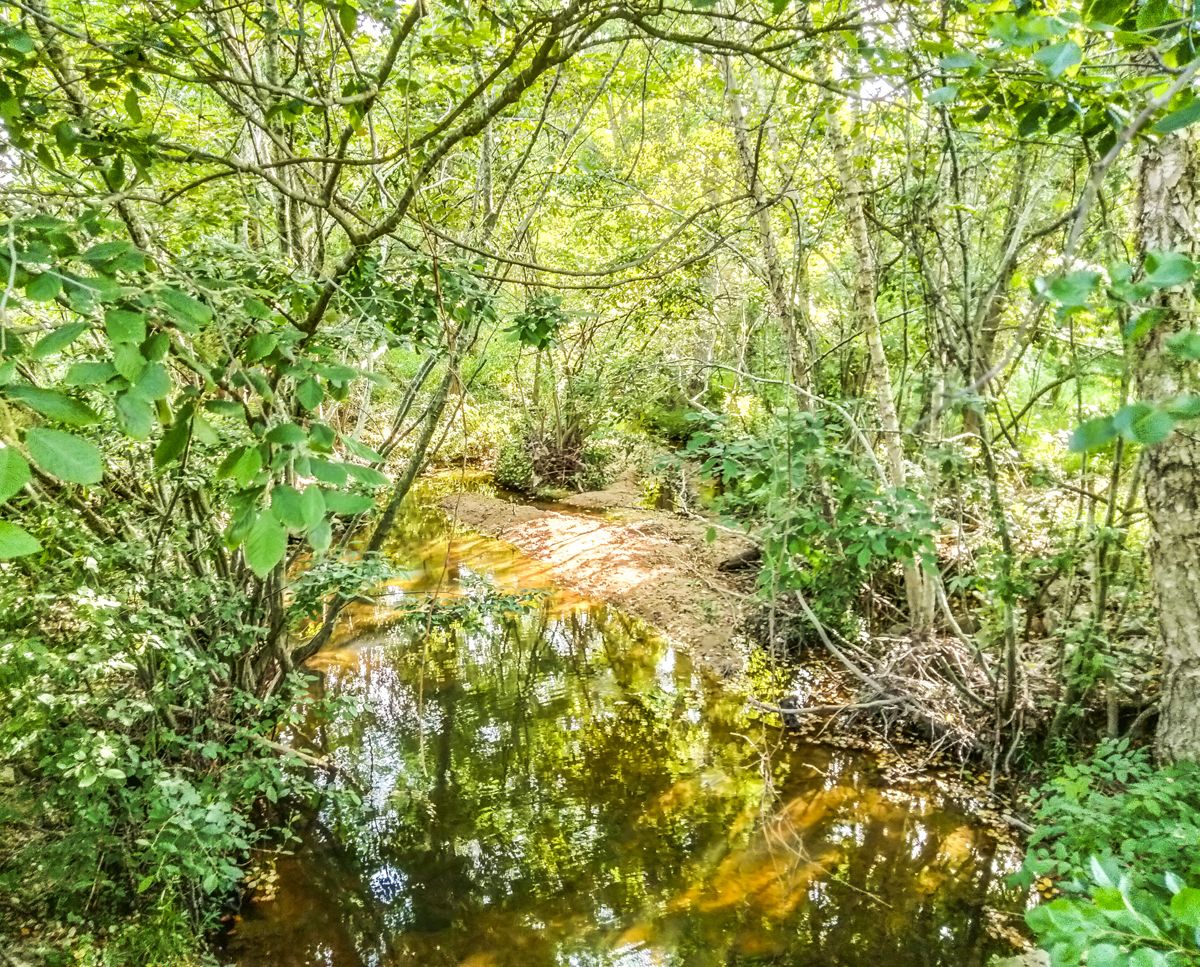
Brig. Gen. Romeyn Ayers led a brigade of Regulars during the May 1, Mott’s Run, sometimes called Lick Run, runs across the First Day Chancellorsville battlefield. Some soldiers 1863, fighting at Chancellorsville. (Library of Congress) who fought there noted it in their comments about the fighting. (Tim Talbott) CivilWarNews.com in front of a heavy forest, and in range of some rifle pits and breastworks on our left. Lending assistance was Battery I of the 5th U.S. Artillery commanded by Lt. Malbone Watson, “who opened an effective cannonade” from the road. Opposing Sykes were the Virginia and Georgia brigades commanded respectively by Brig. Gen. William Mahone and Brig. Gen. Paul Semmes, along with their artillery support. To avoid being flanked by the longer Confederate line, Sykes deployed Ayers’ Brigade to the left and six companies from 146th New York to the right of Burbank’s Brigade. During the fighting on the far left, Sgt. John Young of the 14th U.S. Infantry, mentioned in a later letter home that, “We opened the ball… .” But Young soon found that it was not a party atmosphere. “The first shell that the rebels throwed killed one man on my left, the third man from me. He was in the ranks and I was the file closer. Well, I thought all the side of my head was gone, there was a piece of shell went so close to my ear, but it did not touch me.” For that Young was thankful. However, the Confederate artillery continued to toss shells their way. “One cut one of our color-guards right square in two and killed three more. We never heard it struck. It looked hard to see our men fall so fast,” Young penned. Fighting to the right of Sgt. Young and the 14th was the 12th U.S. Infantry’s Sgt. Charles T. Bowen. In a letter to his wife Kate on May 7, Sgt. Bowen wrote about the events of May 1st: “This morning our division was ordered out to worry them a little, & see if we could not coax them out of their holes.” Sgt. Bowen noted, “When we came out of the woods in sight of their first line, they opened on us with shell at long range, but their guns were not very well served & we only lost a few men here.” Advancing steadily and approaching closer “they put in grape & canister but we did not wait to see who fell but charged with a regular Yankee cheer… .,” and captured numerous Confederates, Bowen explained. The 7th U.S. Infantry fought along the north side of the Orange Turnpike. The battalion suffered two killed, nine wounded, and five missing in the action. Corp. Stephen C. Neill received special mention from Capt. David Hancock in his afteraction report. Hancock noted,
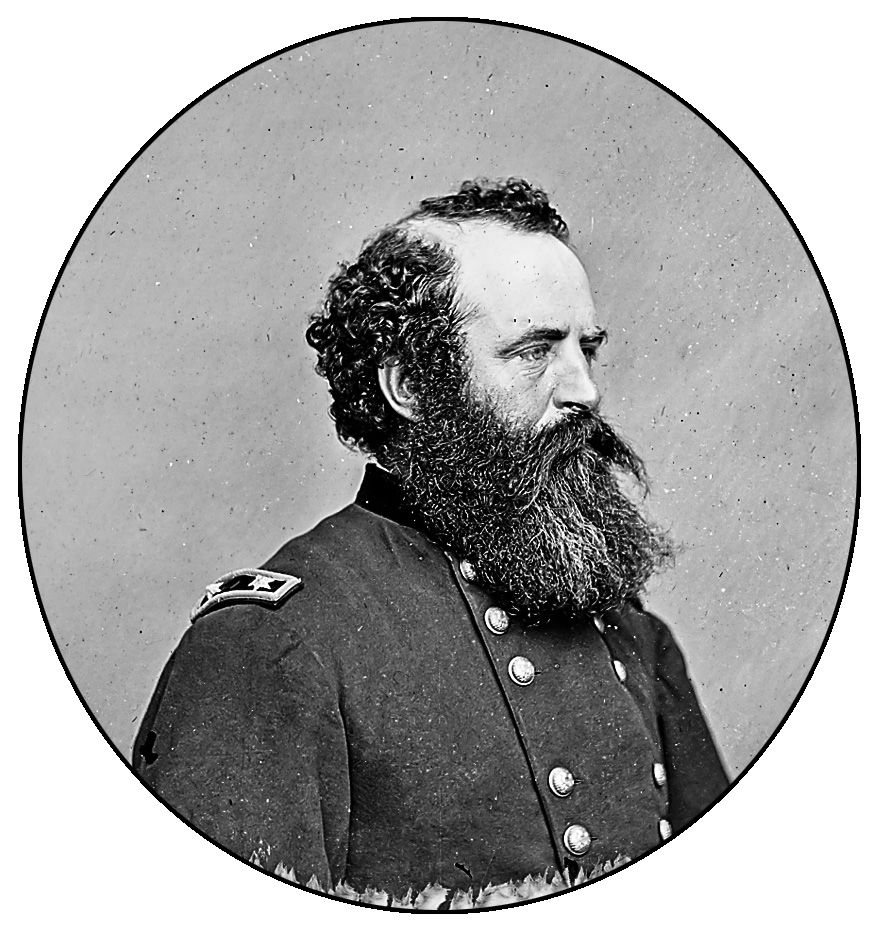
Chancellorsville Campaign. The primary exception for the V Corps was Maj. Gen. George Sykes’ Division, who fought on May 1, 1863. Composed of three brigades, Sykes’ Second Division, V Corps boasted two brigades of U.S. Regulars: one led by Brig. Gen. Romeyn Ayers containing companies from the 3rd, 4th, 12th, and 14th U.S. Infantry regiments, the other headed by Col. Sidney Burbank, consisting of companies of the 2nd, 6th, 7th, 10th, 11th, and 17th U.S. Infantry. The nonregular brigade, commanded by Col. Patrick O’Rourke, contained the 5th, 140th, and 146th New York Infantry regiments. Breaking their assigned camps near Falmouth April 27, 1863, and carrying 60 rounds of cartridges and eight days rations, Sykes’ Division bivouacked at Hartwood Church that night. The following day they continued trekking northwest toward Kelly’s Ford on the Rappahannock River, where they crossed the morning of April 29. Then, marching southeast, they crossed the Rapidan River at Ely’s Ford that night. On April 30, they headed toward U.S. Ford on the Rappahannock “with orders to attack the enemy if found there.” Surprised by the Federal approach, the
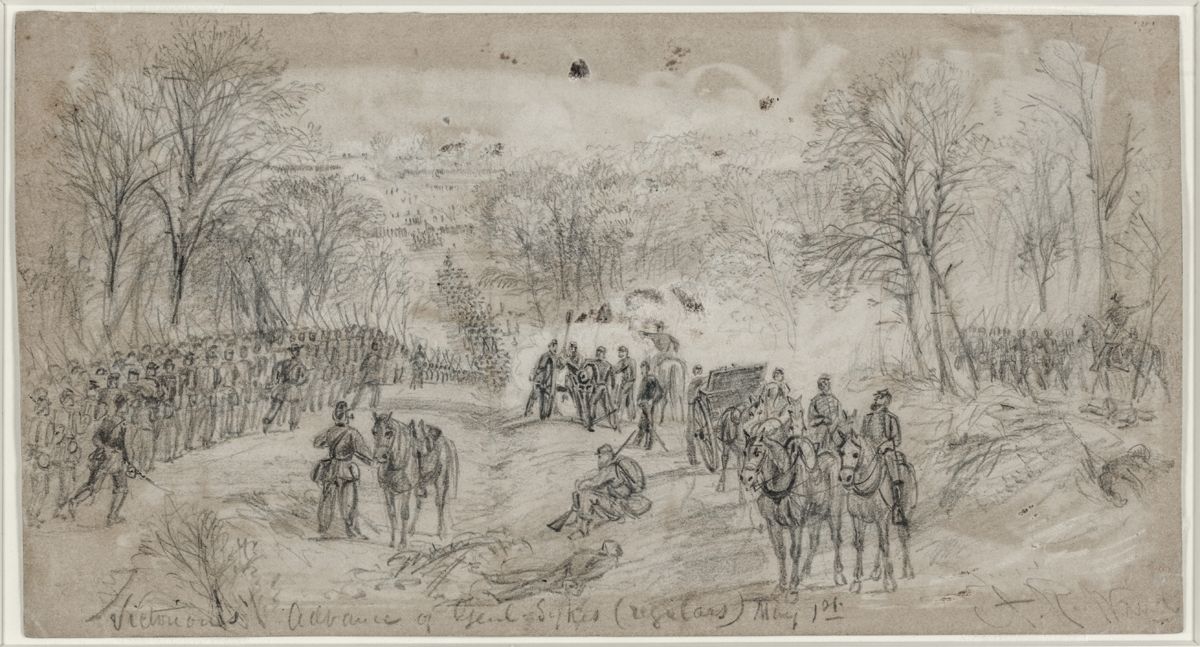
Confederates defending the ford retreated and Sykes’ men moved on to Chancellorsville. In his Chancellorsville report, Sykes explained that on May 1 he “was directed to move [east] on the old [Orange] turnpike road leading from Chancellorsville to Fredericksburg … to turn to the left, cross Mott’s Run,” and link up with Charles Griffin’s Division moving on the River Road. Encountering the 8th Pennsylvania Cavalry tussling with 12th Virginia Infantry’s skirmishers about a mile and half east of Chancellorsville, Sykes noted that the horse soldiers “were giving ground, and by their behavior, giving confidence to the enemy.” To help maintain their ground and hopefully regain what terrain the cavalry lost, Sykes deployed his division. Sykes placed the Second Brigade under Col. Burbank in the lead role, basically straddling the turnpike. The advance’s skirmishers were from 17th U.S. Infantry. Sykes noted “By sharp fighting, we soon recovered the lost ground, drove in the enemy’s pickets, and took possession of the crest just
CivilWarNews.com “when the color-bearer was shot down, [Neill] gallantly picked [the colors] from his hands, and bore them during the remainder of the engagement.” Neill later received the Medal of Honor for his heroism. Fighting on the left of the 7th U.S., the 10th U.S. captured 27
prisoners including an officer. According to Lt. Edward Bush, the 10th’s flag-bearer, Sgt. John Crotty, “distinguished himself by his soldierly conduct under fire and capturing one of the enemy.” The 10th U.S. lost 12 men wounded. The 11th U.S., serving as Col. Burbank’s left flank unit, endured losses of seven killed, 16 wounded, and five missing totaling 28 casualties, tying them with the 2nd and 6th U.S. for the most casualties among the Regulars. Maj. Delancy Floyd-Jones reported that his men “advancing steadily and with a will” were “exposed to a sharp fire from musketry and artillery.” They drove Mahone’s men back and captured prisoners, sharing some with the 10th U.S. on their right. Maj. Floyd-Jones praised “the coolness and bravery exhibited by the officers and the men” on May 1. On the south side the road, the 6th and 2nd U.S. battled Semmes’ Georgians and Brig. Gen. Joseph Kershaw’s South Carolinians. During the fighting, the two Regular units lost contact with each other, as Capt. Samuel McKee noted in his report, “owing to the thickness of the woods through which the Second Regiment had to advance.” The enemy, only about 150 yard distant, “opened a heavy fire of musketry, which was replied to briskly by the battalion, silencing the enemy, who apparently fell back.” Throwing out a platoon of skirmishers to protect their right flank, they shoved back the Confederate skirmishers. When orders came to fall back, Capt. Salem Marsh, who “was commanding the battalion, a gallant and valuable officer, fell” dead, and McKee assumed command. The 6th lost one killed (Capt. Marsh) and 27 wounded.
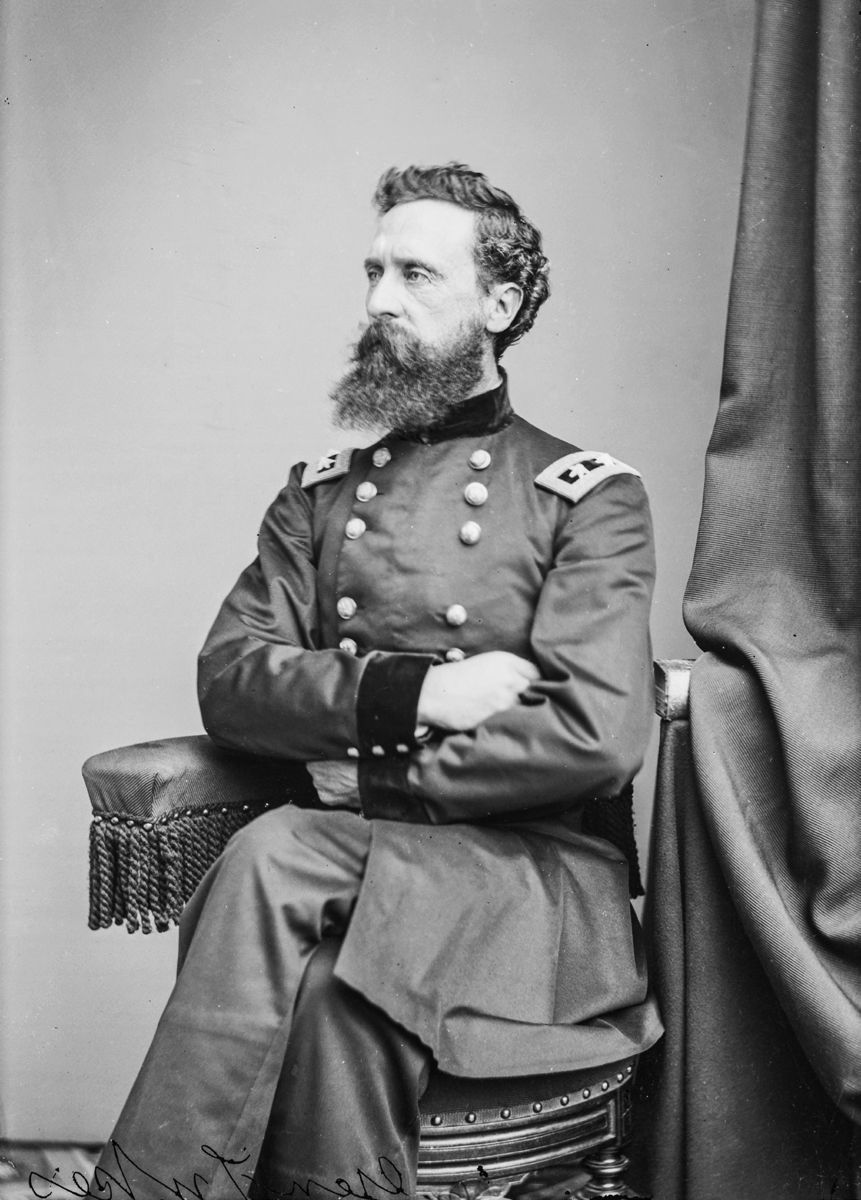
Despite providing the Army of the Potomac with a successful advance on May 1, 1863, the Regulars and other Federal units received orders to fall back to Chancellorsville. Gen. Sykes explained in his report that although he did not receive support while in his advanced position “still I determined to hold it as long as possible. At this period General [Gouverneur K.] Warren, chief engineer of the Army of the Potomac, who had accompanied me, rode to the major-general commanding the army [Joseph Hooker], to explain the state of affairs, and, on his return, I was directed to retire in the direction of Chancellorsville.” While Meade and Sykes both later offered tempered reports, Meade was apparently aghast at Hooker’s order to withdraw to Chancellorsville and thus give up the initiative, losing the ground so hard earned by Sykes’ Regulars. Tim Talbott is the Administrative Officer CVBT.
Chief with
The mission of CVBT is to preserve land associated with the four major campaigns of: Fredericksburg, Chancellorsville, Mine Run, and the Overland Campaign, including the Wilderness, and Spotsylvania Court House. To learn more about this grassroots preservation nonprofit, which has saved over 1,700 acres of hallowed ground, please visit: www.cvbt.org.