
The Graphic War
Huddy and Duval and the Militia
By Salvatore Cilella · Originally published January 2024 · pp. 28–29
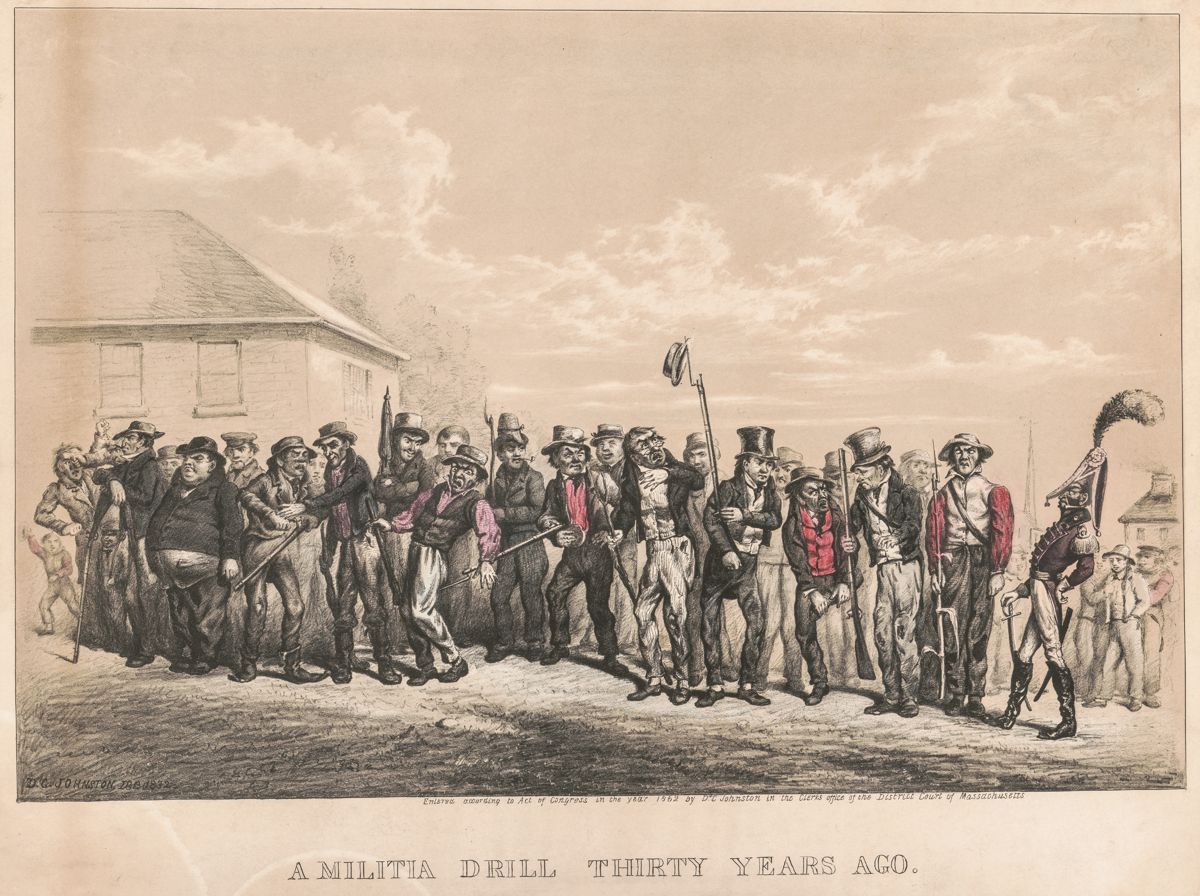
The Graphic War highlights prints and printmakers from the Civil War discussing their meaning and the printmaker or artist’s goals. From its inception as a nation, the United States of America has held a deeply ingrained aversion to a standing national army. This backlash against King George III and his ministers was nearly universal. In its place, state militias came into existence and were enshrined in the Second Amendment of the Constitution. The amendment has been the center of contention since its adoption and, in the last several years, a subject of judicial and political scrutiny. The recent controversy focuses on the last phrase, not the first: “A well-regulated Militia, being necessary to the security of a free State, the right of the people to keep and bear Arms, shall not be infringed.” According to the Oxford English Dictionary, “the word militia dates back to ancient Rome, and more recently to at least 1590 when it was recorded in a book by Sir John Smythe, Certain Discourses Military with the meanings: a military force; a body of soldiers and military affairs; a body of military discipline. The word Militia comes from ancient Latin, in which it meant defense service, as distinguished from a body of (armed) defenders.” Militia was conceived of as a defense system with strict military discipline. The Latin term, militia, meant defense service. Figure 1. During the Revolution, the militia became more a hindrance than an asset. Washington is partly to blame for the negative image held by the militia during the War for Independence. He conceded that they were good at what we today would call “guerilla warfare,” and stealth attacks on enemy supply lines and depots, but “were unreliable when summoned to the front to support the Continental Army during a major campaign.”1 Washington “characterized militiamen as habitually ‘dismayed [and] Intractable,’ as given to a ‘want of discipline [and] unwillingness, nay refusal to submit to that order and regularity essential in all Armies’.” Washington wrote that “to place any dependence upon Militia is, assuredly resting on a broken staff. The Dependence which the Congress has placed on the Militia…I fear will totally ruin, our Cause.”2 In a letter to his nephew, Lund Washington, Washington wrote, “I am wearied to death all day with a variety of perplexing circumstances, disturbed at the conduct of the militia, whose behavior and want of discipline has done great injury to the other troops, who never had officers, except in a few instances, worth the bread they eat.” Washington added, “In confidence I tell you that I never was in such an unhappy, divided state since I was born.”3 With the start of the Civil War, the Lincoln administration had to rely on state militias for the first few months of the war. Federal regular troops were scattered throughout the country, numbering around 14,000 in total. It wasn’t until volunteers from the loyal states swelled the ranks of the Union Army, that the militia could be used in a more supportive role. Twenty years prior to the Civil War, Philadelphia lithographers
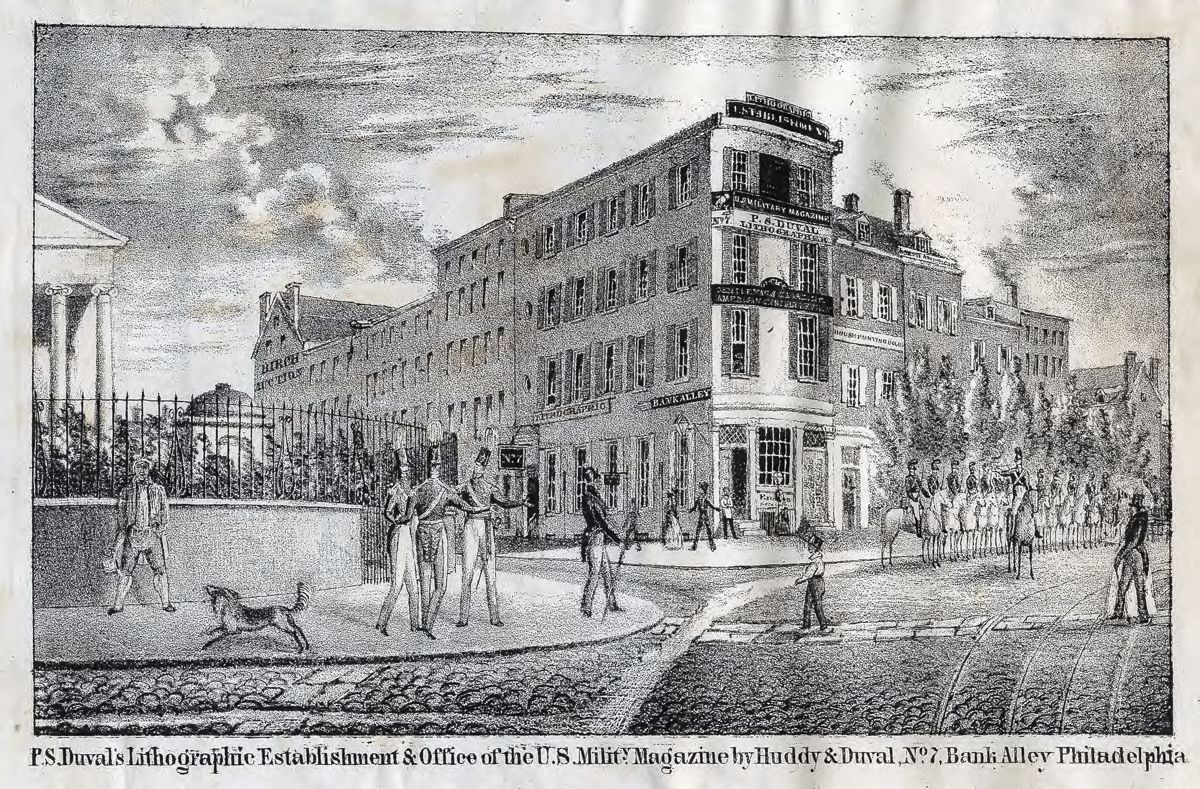
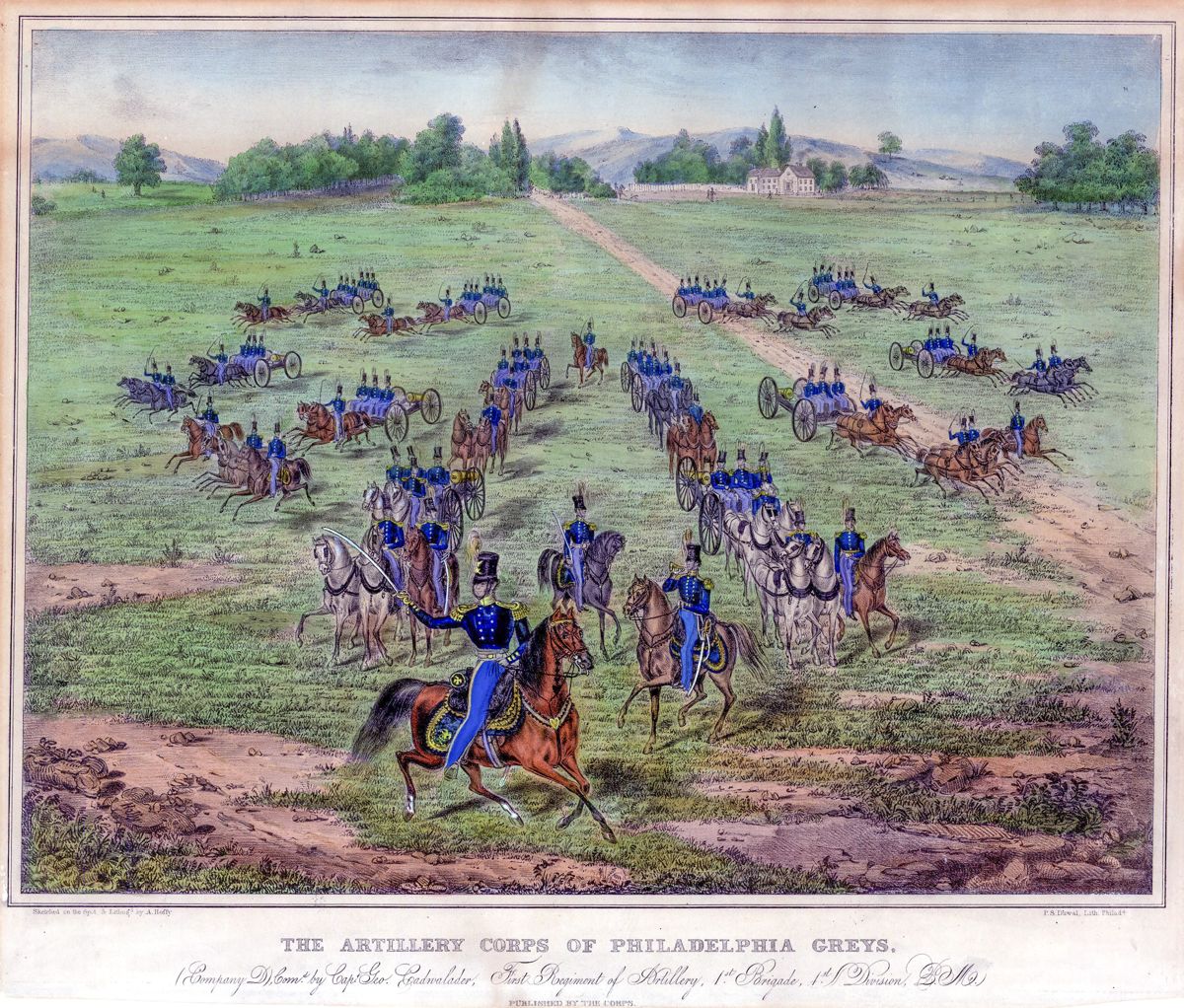
William M. Huddy and Peter S. Duval, partnered in 1839 to publish the monthly U. S. Military Magazine. They established their office at No. 7, Bank Alley in Philadelphia. (Figure 2) They devoted their periodical to the activities of Philadelphia’s volunteer militia groups. Each issue included an illustration of a militiaman wearing his unit’s uniform, most of which were drawn by Huddy, lithographed by Alfred Hoffy, and printed by Duval.4 Huddy, born in 1807, became a first-rate artist, lithographer, publisher, and editor and is primarily remembered as Duval’s collaborator on the magazine. Duval, a French émigré, began his career with the lithography firm of Childs and Inman. He broke away and formed his own business where he specialized in advertisements, pictorial views, certificates, sheet music covers, book and periodical illustrations, maps, and portraits.5 According to print scholar Harry T. Peters, the firm of Duval and Huddy produced three volumes of “The United States Military Magazine and Record of All the Volunteers, together with the Army and Navy.” The volunteer companies were featured in the first and third volumes; the Army and Navy in the second. There were twelve issues in each volume featuring either black and white illustrations or colored. Huddy and Duval’s agents solicited new illustrations from militia companies: “Any company sending a correct sketch of their corps, endorsed by their commanding officer, can be inserted in the magazine by taking fifty colored plates, at the established price or one hundred plain.” The same offer was made to individual officers who wanted their images immortalized by the firm, 50 cents for colored renditions, 25 cents for black and white. He adds, “the prints have astonishingly decorative and dramatic values. The eagle was screaming, the young men dreamed of heroism, olive drab had not been invented, and playing soldier was so very smart.”6 The plates were “gloriously colored by…[Duval’s]…retinue of female water-colorists.”7 One of Huddy and Duval’s most exuberant recognitions of the militia was its 1845 view of the Philadelphia Greys in drill. (Figure 3). As the Library of Congress notes in its catalog of this print, “The drill takes place on a large field near Powelton in West Philadelphia. In the foreground, Captain George Cadwallader is seated on his steed, commanding the drill and signaling a change of formation with his raised saber.
Two officers, one blowing a bugle, trot behind him between two lines of men mounted on horses, seated on horse-drawn limbers and caissons, or driving cannon forward behind horses. Other men on mounts, in carriages, and pulling cannons have broken from the old formation and fan out alongside the lines. The militia men wear blue uniforms comprised of trousers, jackets with epaulets, and tall shakos with plumes.”8 The artist for this particularly animated print was Englishman Alfred M. Hoffy, an ex-major in the British Army, who worked with Huddy and Duval on the magazine. Upon his immigration to the U.S., he became the principal illustrator involved in the magazine’s production. He was paid $75 for creating the original artwork and drawing the design on the lithographic stone. Duval printed and published it.9 By the time of the Civil War, the militia was mostly replaced by a large, volunteer and/or draftee army, and Huddy and Duval’s vibrant snapshots of a moment in American military history faded from view. Endnotes: 1.
John Ferling, Almost a Miracle: The American Victory in the War of Independence. Oxford University Press, 2007, 208. Ibid. This Day in History: 1776 General George Washington complains about his Militia. https://www.history.com/thisday-in-history/washingtonblames-militia-for-problems. Nicholas B. Wainwright, Philadelphia in the Romantic Age of Lithography. 1958, 38. Erica Piola, Philadelphia on Stone, Commercial Lithography in Philadelphia 1828–1878, 3233; 103. Harry T. Peters, America on Stone, 226. Wainwright, 38. Library of Congress, Item Description, https://www.loc.gov/item/2021670231/. Piola, 103-104.
After 43 years in the museum field, Cilella devotes his time to collecting American prints and maps and writing. He has written extensively on Emory Upton: Upton’s Regulars: A History of the 121st New York Volunteers in the Civil War (Kansas, 2009); a two-volume Correspondence of Major General Emory Upton, (Tennessee, 2017), received the 2017– 2018 American Civil War Museum’s Founders Award for outstanding editing of primary source materials. He edited Upton’s love letters 1868-70 to his wife—Till Death Do Us Part (Oklahoma, 2020) and The Memoirs of Dewitt Clinton Beckwith of Upton’s Regulars (McFarland, 2023).