
Civil War News, a transformation of the Civil War Book Exchange, turns fifty
By Stephen Davis · Originally published January 2024 · pp. 1–5
That’s right, we’re a halfThe year was 1974, the time century old. when… Civil War News was founded by • People Magazine hits the Kay and the late Pete Jorgensen, newsstands (Mia Farrow on who both grew up surrounded by its front cover) historic sites and had a lifelong • President Nixon resigns, passion for history. The couple facing impeachment over got married a year after they Watergate first met as Boston University • “Happy Days” debuts on graduate students studying ABC journalism. Afterword, Kay • Patty Hearst is kidnapped by worked in various journalism members of the Symbionese positions for five years. She was Liberation Army a daily newspaper reporter, an • The Sting wins Best Picture English department instructor and at the Oscars newspaper advisor at a college, • Pepsi becomes the first U.S. and a summer weekly newspaper company to sell products in reporter. Pete held positions as Russia a weekly editor and corporate • Hank Aaron breaks Babe publications director during this Ruth’s all-time home run time. Their goal was to purchase record with his 715th and manage a newspaper. • “Monty Python’s Flying 2016In 1969, the Jorgensens bought Circus”Advertising is first televised Rates on their publication, a suburban &first Deadlines PBS Boston weekly newspaper, which • Civil War News is born a chain of six related titles. Ten years later, they started The Artilleryman magazine because of Pete’s passion for artillery. In 1986, they bought the Civil War Book Exchange from its founder, Mike Cavanaugh, after selling their weekly titles. April 1989 saw the launch of Civil War News, a current events “for people with an interest in the Civil War today,” by the Jorgensens, who had decided they actually missed the news industry and were considering the feasibility of a book review-only journal. We were founded in 1974 by Mike Cavanaugh of Bethlehem Pa. as the Civil War Book Exchange, an eight-page typewritten newsletter. Since then we have morphed into a fortypage (11”x15”) compendium of articles and photographs showcasing American’s secondmost (after golf, I guess) popular hobby. Recent issues demonstrate our variety, and our awareness that CWN readers include reenactors, relic collectors, battlefield trampers, historic preservationists, bookworms, photography buffs, and enthusiasts of every other stripe. A regular feature, occupying usually two pages with color photos, is Chris Mackowski’s “Emerging Civil War,” with notes on books and authors from the Savas Beatie series of the same name. Dr. Mackowski is ECW’s editor-in-chief, assisted by Sarah Kay Bierle, managing editor. In a recent column, Sarah reflected on her weekend in Gettysburg where the film Gettysburg got a special 30th anniversary showing. Stars of the 1993 film were there, including my friend from New York Patrick Falci—who, as A.
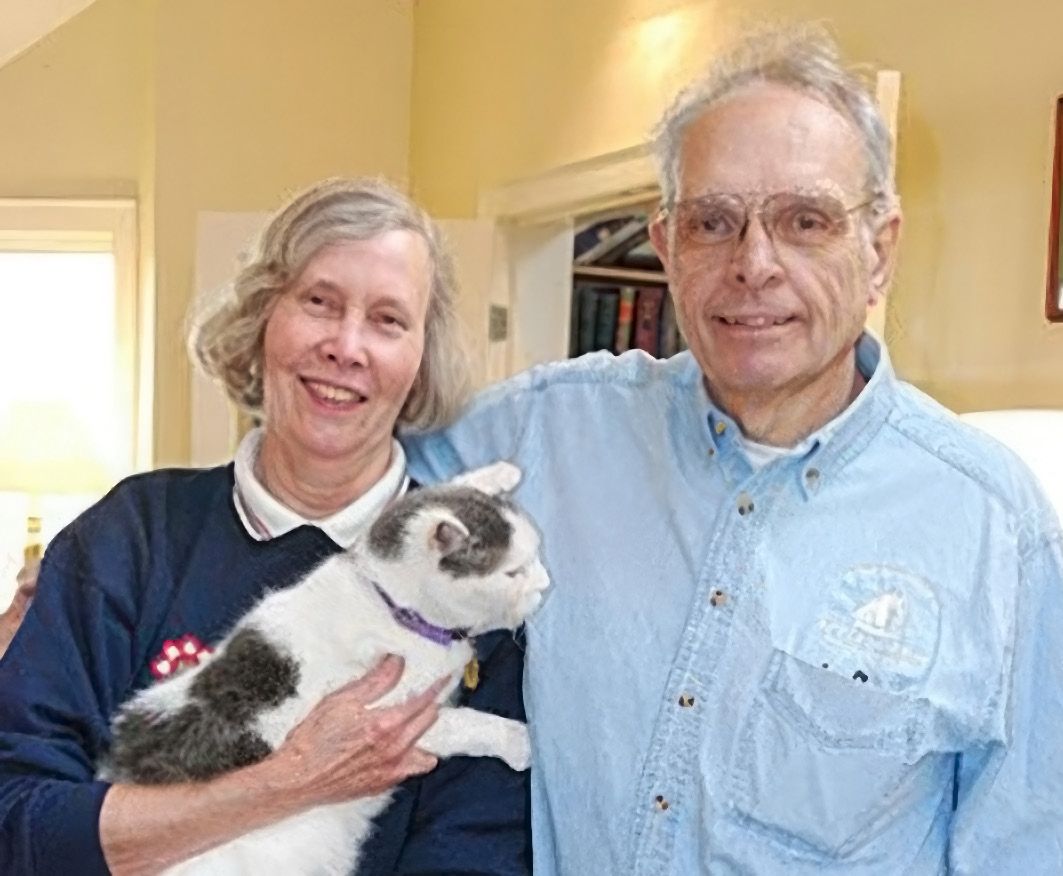
Kay and Pete Jorgensen. P. Hill, is always wearing that red shirt! Many pictures we publish are taken by event participants and sent to us. For instance, when film director Ron Maxwell and stars of Gettysburg got together at the town for the reunion, Leon Reed, of Gettysburg, was there to photograph the event. The film’s heroes Stephen Lang (Pickett) and Tom Berenger (Longstreet) look older, of course. But as Stevie Nicks sings, “I’m getting older too.” When the picture came out in Atlanta, I proudly cadged the promotional poster for the film from a local theater, with its catchy tagline, “SAME LAND. SAME GOD. DIFFERENT DREAMS.” Craig Barry, of Charlottesville, Va., is one of the country’s leading experts on Civil War arms, and graces us with his monthly “The Unfinished Fight.” His piece on the Enfield Short Rifle described the weapon, how it was imported (thank you, Caleb Huse) and used. Craig’s article last August on George Thomas mentions how, after the Virginian decided to stay with the Union, some Northerners voiced suspicions as to his loyalty. Grant was critical of Thomas’ penchant for careful battle preparation, and was about to fire him when Thomas at last ordered his attack at Nashville that broke up Hood’s army. (No wonder his Virginia relatives disowned him.) Stephanie Hagiwara, resident of California, writes her monthly “Through the LENS” column, featuring wartime photos of scenes and soldiers whose images have been expertly colorized by David Richardson. Other regular contributions come from Tim Talbott, of Spotsylvania, Virginia, updating us on the Central Virginia Battlefields Trust, of which he is Chief Administrative Officer. CVBT helped save more than 400 acres of Fredericksburg battlefield land, reminding us that the fight to preserve historic acreage is far from over. A hobby, pastime or avocation (whatever it is that we do) is as young and vibrant as its participants, and reenactor events are routinely covered in CWN.
Bruce Miller’s excellent article (December issue) on the NorthSouth Skirmish Association highlighted N-SSA’s recent national competition. Jack gave four pages in a big, colorful spread for photos submitted by Niki Bethke, Ericka Curley and Lis Cole. Civil War News’ long interest in battlefield preservation is also demonstrated by the considerable space we give to the American Battlefield Trust. Residential development and commercial sprawl are constant threats to historic land. Our November number hailed ABT’s fundraising efforts to save more than 300 acres at Gaines’ Mill/Cold Harbor. Our newspaper has always been a hardscrabble production, so everyone knows that our sinewy budget doesn’t provide for contributors’ stipends. Thus we are delighted when Joan Wenner, attorney in N.C., sends us such pieces as that on the Medal of Honor’s first recipient, Jacob Parrott. Where would we be without Gould Hagler? A retired lobbyist for the Georgia Independent Insurance Agents, Gould lives in north Atlanta and enjoys visiting such battlefields as Griswoldville, Georgia. His eclectic war interests are reflected in the title of his column, “This & That.” Last August, for instance, Gould featured Lt. George McClellan’s service in the Mexican War. “One episode in Sears’s biography especially caught my attention,” he writes in a sidebar, referring to Stephen Sears’ excellent biography of the young Napoleon (1988). His writing style is personable, even chatty. Firstperson, conversational prose is a rarity in journalism (and nonexistent in academia). It’s just the kind of writing that Jack Melton looks for in our paper’s offerings.
We’ve recently had to say sayonara to Michael Shaffer’s regular column, “The Source.” Mike has turned his attention to topics as varied as the New York Times’ war reporting and the two dozen varied volumes turned out from 1956 to 1965 by the Confederate Publishing Company of Tuscaloosa. (William C. Harris’ Leroy Pope Walker: Confederate Secretary of War [1962] graces my Confederate biography bookcase.)
Regular, paying subscribers are sine qua non, of course. But we could not do it without our advertisers. Mike Kent runs his full-page schedule of upcoming shows. (See you in Dalton!) By the way, that’s Mike pictured in his ad, resplendent in a cavalryman’s uniform. I’m personally grateful to Jack and Peggy Melton for giving me opportunity to write my monthly “Critic’s Corner” for Civil War News. Growing up with Civil
War Times Illustrated, I was always fascinated by James I. Robertson’s regular feature, “The War in Words,” which ran from April 1972 to December 1987 (whew!). Well, a couple of years ago I proposed writing something of the same sort for Civil War News, and Editor Melton said yes. So we were off: my first piece
(CWN March 2022) approached Thomas DeLeon’s Four Years in Rebel Capitals (1893). Since then, we’ve looked at such war-era authors as Robert G.H. Kean and Charles C. Coffin, as well as offered appreciation for noted scholars of our time (e.g., Albert Castel, remembered in our column for August 2022).
The Romans used to have a saying: Deo volente et rivulo non crescente. Well, maybe they didn’t, but we Southerners do. So as long as Lord is willin’ and the creek don’t rise, we’ll keep reflecting on Our Great Civil War and its voluminous literature. To read more about the founding of Civil War News visit the story about the Jorgensens on the American Battlefield Trust’s website https://www.battlefields.org/preser ve/ champions/kay-jorgensen. Stephen Davis studied at Emory under the great Bell Wiley. His first research paper, on Price’s Missouri Raid of 1864, got a “B,” for which Professor Wiley judged his writing style was “overly long and heavy. My intention is to help you improve your style.” Since then Steve has been working on his narrative writing, with the happy result of his recent several works written on the War. Dr. Wiley would be pleased that he is writing for Jack’s newspaper.