
The Unfinished Fight
Barnett and Eli Whitney
By Craig L. Barry · Originally published January 2024 · pp. 18–19
Eli Whitney and J.E. Barnett furnished some of the first contract rifles and rifle-muskets to arm the Union and the Confederacy in 1861. Both had long been producers of military arms, dating back to the late 1700s. Prior to Eli Whitney’s foray into gun-making, all muskets were made by hand, and the parts from one gun were unlikely to fit another gun, even of the same model. There was a great deal of skill involved in shaping the parts with hand tools and building an integrated firearm out of raw materials. The United States in the 1790s, lacking Britain’s “Guild System” of trained craftsmen, was particularly short on skilled labor. Whitney’s idea was to produce identical parts from a template by machine and then assemble the parts into virtually identical weapons. Whitney first needed to build his factory (called Whitneyville) near New Haven, Conn., and then create his “jigs, dies, and fixtures.” It took Eli Whitney eight years to turn out the first 10,000 weapons, but only two years to produce the next U.S. contract for 15,000. Tests on a variety of surviving muskets from Whitney’s first contracts suggest that they are not completely parts interchangeable to the standard of military gauges, a detail which will return to haunt the firm again in the future. Whitney wryly observed, “A good musket is a complicated engine and difficult to make… because the conformation of most of its parts correspond with no regular geometric figure.” Eli Whitney passed away in 1825, and years later his only son, Eli Whitney Jr., took over operation of the Whitneyville Armory. The first government contract procured by Eli Jr. was for the U.S. Model 1841 Percussion Rifle, actually four amended contracts from 1842 to 1854, for a total production of 22,500. The contracts specified
“parts interchangeability,” and the U.S. government performed random inspections on each shipment to see if the rifles were military gauged. Many were not accepted and by the late 1850s Whitneyville found itself with a large inventory of “reject” parts. Whitney said he lost money (“never made a cent”) on those earlier 1841 rifle contracts and was determined to use his inventory of condemned parts to some advantage. Whitneyville procured other “reject” parts from Harpers Ferry and Springfield Armory, creating what they termed “good and serviceable arms not subject to government inspection of gauges.” In addition to the U.S. 1841 rifles, during this time (pre-1860) he produced out of condemned parts a variation on the P-53 and P-56/58 Enfield (with three different sight variations), and the U.S. Model 1855 type with rejected U.S. Armory tape primers, and also without the tape primers along the lines of the early “hump back lock plate” Richmond rifle-muskets. The Southern states were among Whitney’s customers. The state contracts were particularly attractive to Whitney because they were less stringent about parts interchangeability and only inspected the final finished arm. Whitney procured several state contracts during the early 1860s, all with the “good and serviceable arms” language stipulated. Whitney was also quick to get his share of the new business when the Civil War broke out, having some arms already made on speculation. Since they had the capacity to facilitate the fratricide coming into America, Whitney openly sold arms to both sides. Whitneyville Armory was still shipping contract arms to the Southern states in mid-1861 when the Federal government stopped it, and only then by agreeing to provide them a Federal contract for rifles and rifle-muskets to make up for the lost business from the Confederate States. Barnett, J. E., & Sons. (Courtesy South Carolina Confederate Relic Room and Military Museum.)
Of that newly acquired Federal contract work, Whitney allowed, “I expect to be more particular in my government work than in my State work as the State inspection is not with gauges.” There are, of course, many examples of Whitneyville arms used by the Confederate states, particularly U.S. 1841 percussion rifles and their “put together” Enfields made of parts from the failed Robbins & Lawrence (Windsor) venture, as well as condemned national armory parts. The locks on the Whitney Enfields were the old-style hook type and had no tumbler link, everything being as cheaply made as possible. Across the pond in London, there was a gun-maker similar to Eli Whitney in many respects, BARNETT & SONS, gunmakers, contractors to the Crown,
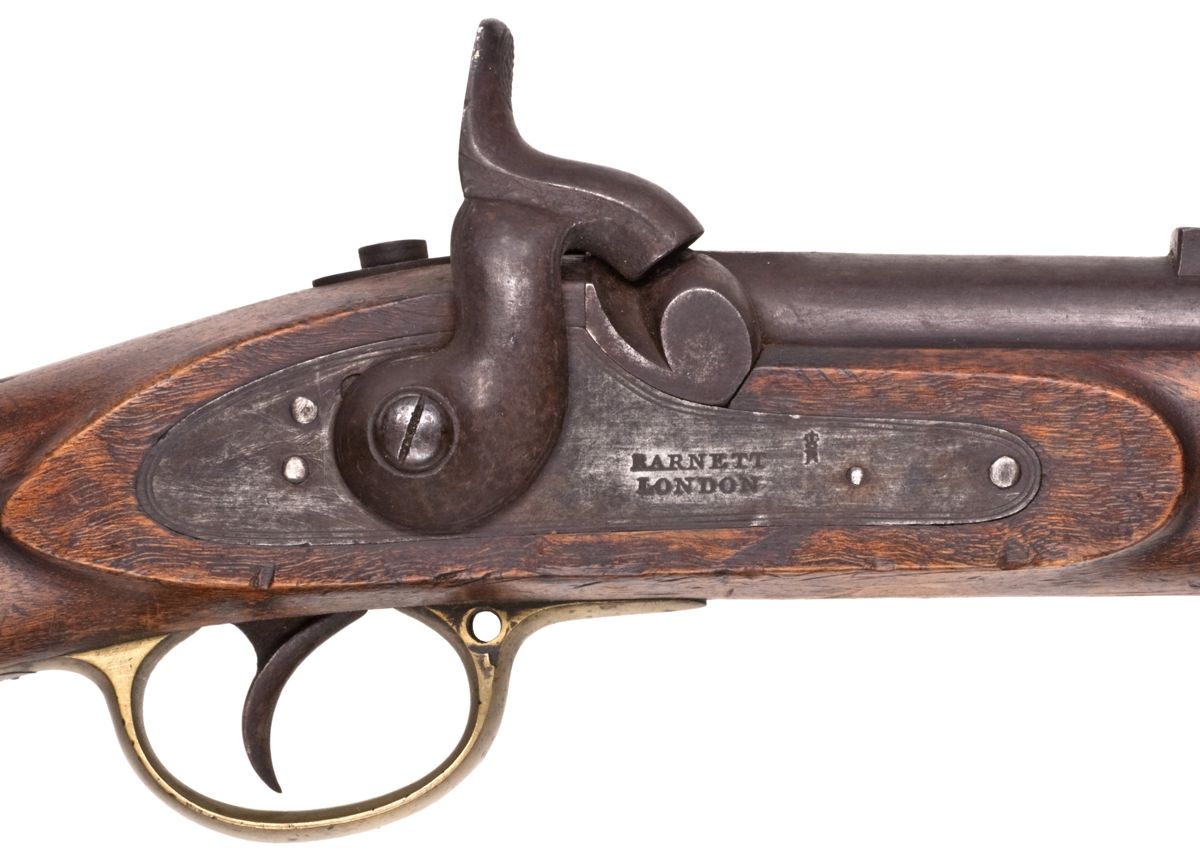
Close up of Whitney Enfield rifle musket lock with standard lock markings.(Tim Prince)
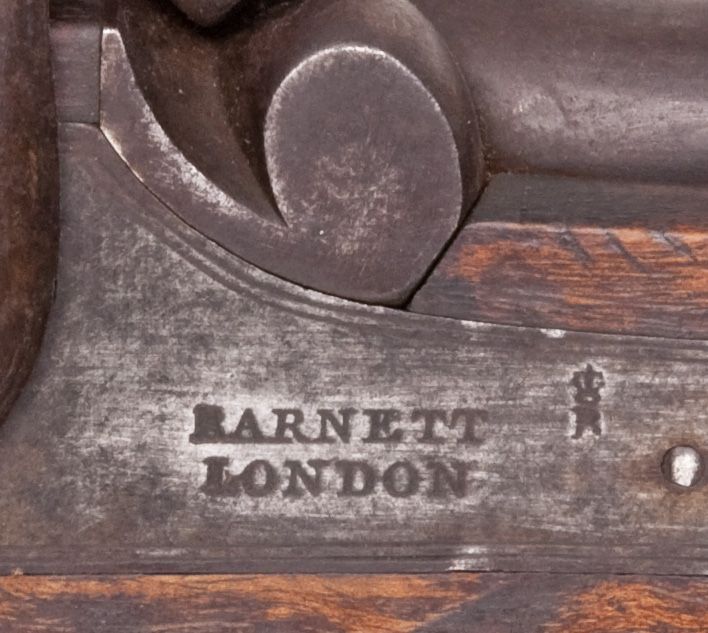
CivilWarNews.com East India Co. and Hudson’s Bay Co., 134 Minories, from 1842-59; 134 Minories and Brewhouse Lane, Wapping. Thomas Barnett was a well-established gunmaker in the 1790s producing “trade guns” for the Hudson Bay Company in British America, as Canada was known at the time. T. Barnett supplied arms, some listed as “Tower” guns, from 1793 to 1818 at which time the firm changed names to Thomas Barnett & Sons, then later John E. Barnett (& Sons). The firm did business at various London addresses throughout the remainder of the 19th century. An interesting item about Barnett is that their trade muskets were considered “the standard” that other contractors had to meet. Northwest trade gun contracts sometimes used little language in terms of specifications other than that the musket be “equal to the Barnett.” This certainly would not have been the case for the majority of their later military arms. London gun-maker Thomas H. Potts (Potts & Hunt) was an apprentice to Barnett prior to becoming a freeman in 1846 and opening his own firm. Barnett had long been major producers of military long-arms, both for the British government and the commercial market. The original shipment of 6,500 P-53s that landed in Savannah, Ga., on September 18, 1861, aboard the blockade runner Bermuda included Enfield rifle-muskets which were “Barnett marked.” Large numbers of Barnett arms saw Civil War service, many with the Confederacy. To use a rough analogy, Barnett was the “Eli Whitney” of the British gun trade.
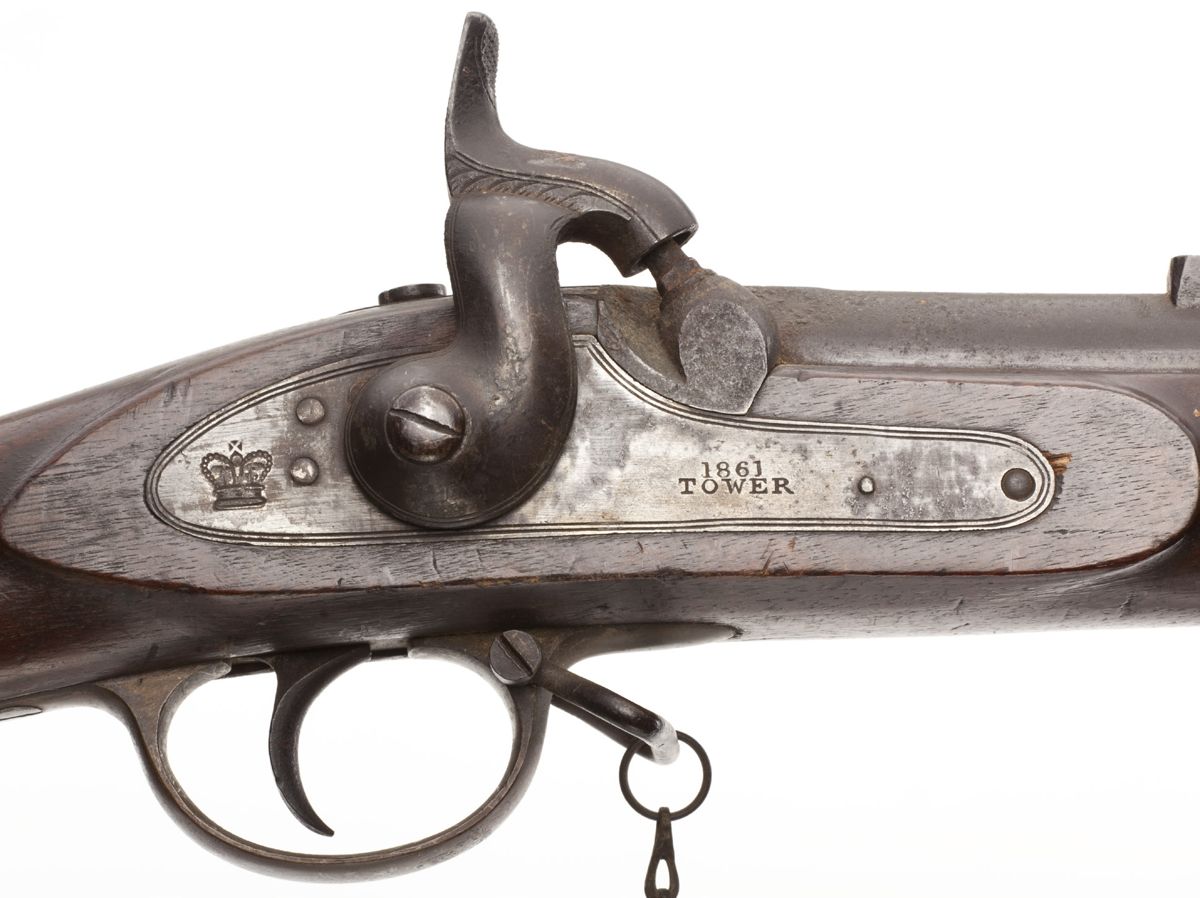
Ironically, not all the earliest Confederate Enfields were British imports; as stated previously the “Whitneyville” Armory produced an Enfield variation on contract for the Southern states. Barnett was an opportunist producing firearms that ranged in quality from class 1 rifle-muskets to “trade guns” assembled from surplus or rebuilt parts. Like Whitney and other gun-makers, Barnett produced grade 2 hand-fitted arms that had locks, hammers, and hardware resembling those on first class (grade one) arms but were not parts interchangeable. Also, the firm sometimes stamped their locks with a cipher consisting of a letter B surmounting a downward pointing arrow, which resembled the British government crowned broad Arrow acceptance mark. They apparently did this for reasons that could be called deceitful and less kindly be termed fraud. Likewise, Whitneyville often stamped over government condemnation marks on their parts, much like an openrange cattle rustler changing the brand on a maverick steer. Such were the practices in the gun trade during the early 1860s. Barnett produced many variants of locks, some marked with the crown and “TOWER” behind the hammer and marked Barnett in front of the hammer, some stamped in italics, some reading simply Barnett, London and usually with no date. Barnett is the only London gun-maker known to use the “Tower” mark under the crown. The “Tower” mark was more commonly found on Birmingham commercial lock plates and originally meant the arm passed an inspection with government gauges. However, it is difficult to believe the “Tower” marked Barnett Enfields would have passed any government inspection with gauges, and in fact, as commercial contract guns, they were not required to. The Crown seems to have accepted the “Tower” misrepresentation as long as the guns were being exported and not intended for government service. Locks marked Barnett on the outside will often be found to have internal markings of another maker, such as Pritchett, who occasionally supplied the lock or complete arm to Barnett; conversely, some locks with standard Tower markings and dates are marked Barnett on the inside of the plate. Some P53s have been encountered with Barnett barrels and Liege (Belgian) marked locks. Occasionally, a barrel will be encountered on a Barnett or other maker’s P53 that is stamped on the bottom “The Gun Barrel Company.” Those barrels may also be marked Barnett and may have Birmingham or Belgian proofs (sometimes both). Like Whitney, the contract rifle-muskets from J.E. Barnett can fairly be called a mixed lot in terms of their overall quality. No single gun-maker made “best grade” firearms all the time, but Whitney and Barnett furnished mostly inferior arms. Whatever their various deficiencies might have been, both J.E. Barnett and Eli Whitney sold a volume of contract rifle-muskets that shot well, and they were both ready to supply their weapons to the highest bidder. At least one Confederate contract with J.E. Barnett went into Union hands when the Confederates did not pay in a timely manner. U.S. Consul FH Morse reported to the Secretary of War on November 6, 1861: I have the satisfaction of informing you that one of the gun manufacturers here who had a contract with the rebels running to March (1862) has had a difficulty with them, broken the contract, and will hereafter send his guns, Enfield rifles, to New York on his own account. His name is Barnett, and his rifles stand very well here. Craig L. Barry was born in Charlottesville, Va. He holds his BA and Masters degrees from UNC (Charlotte). Craig served The Watchdog Civil War Quarterly as Associate Editor and Editor from 2003–2017. The Watchdog published books and columns on 19th-century material. He is the author of several books including The Civil War Musket: A Handbook for Historical Accuracy (2006, 2011), The Unfinished Fight: Essays on Confederate Material Culture Vol. I and II (2012, 2013). He has also published four books in the Suppliers to the Confederacy series on English Arms & Accoutrements, Quartermaster stores and other European imports.