The Battle of Aiken Attracts Thousands
By Pete Peters · Originally published April 2024 · pp. 16–17
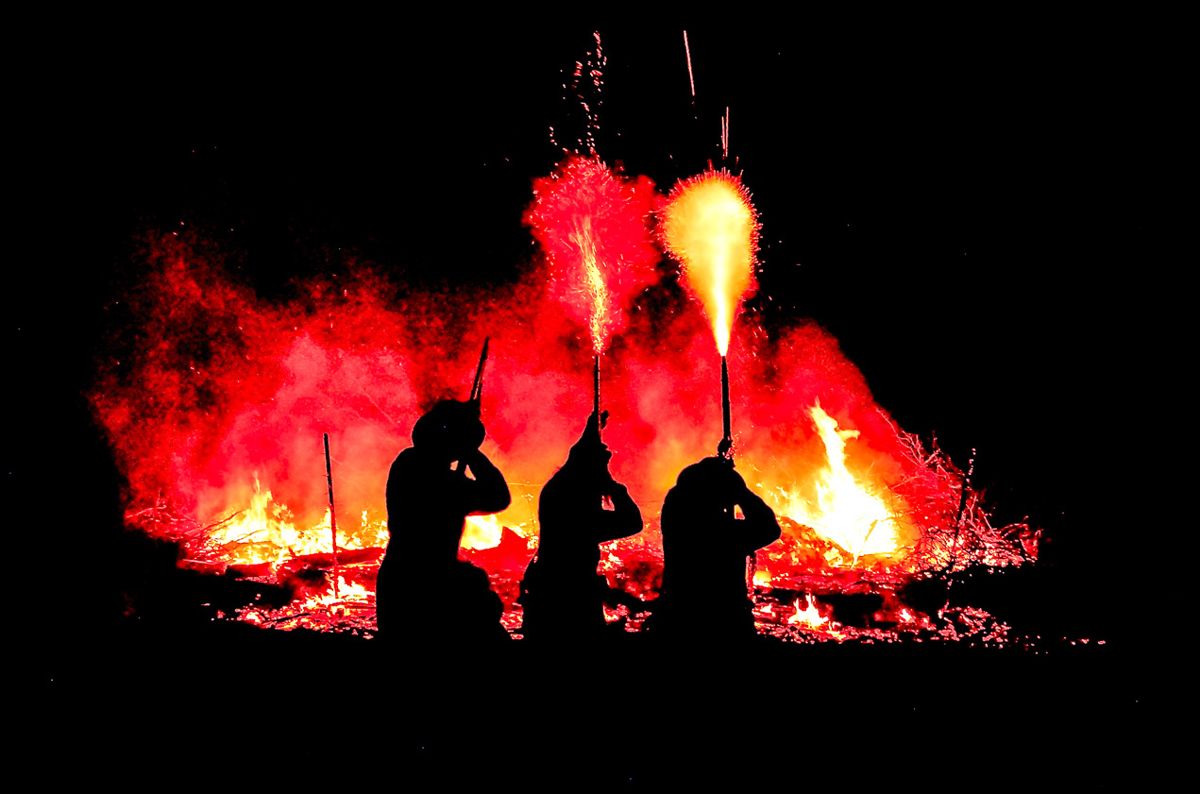
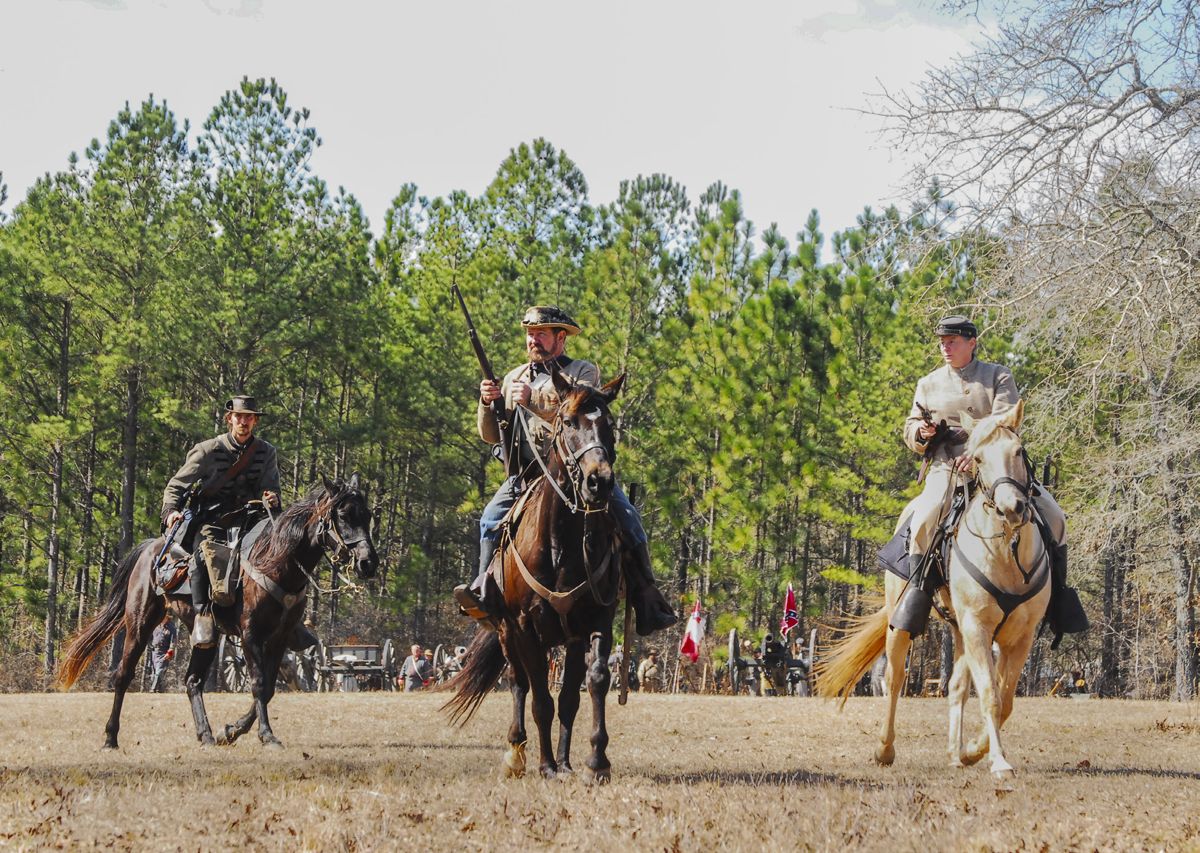
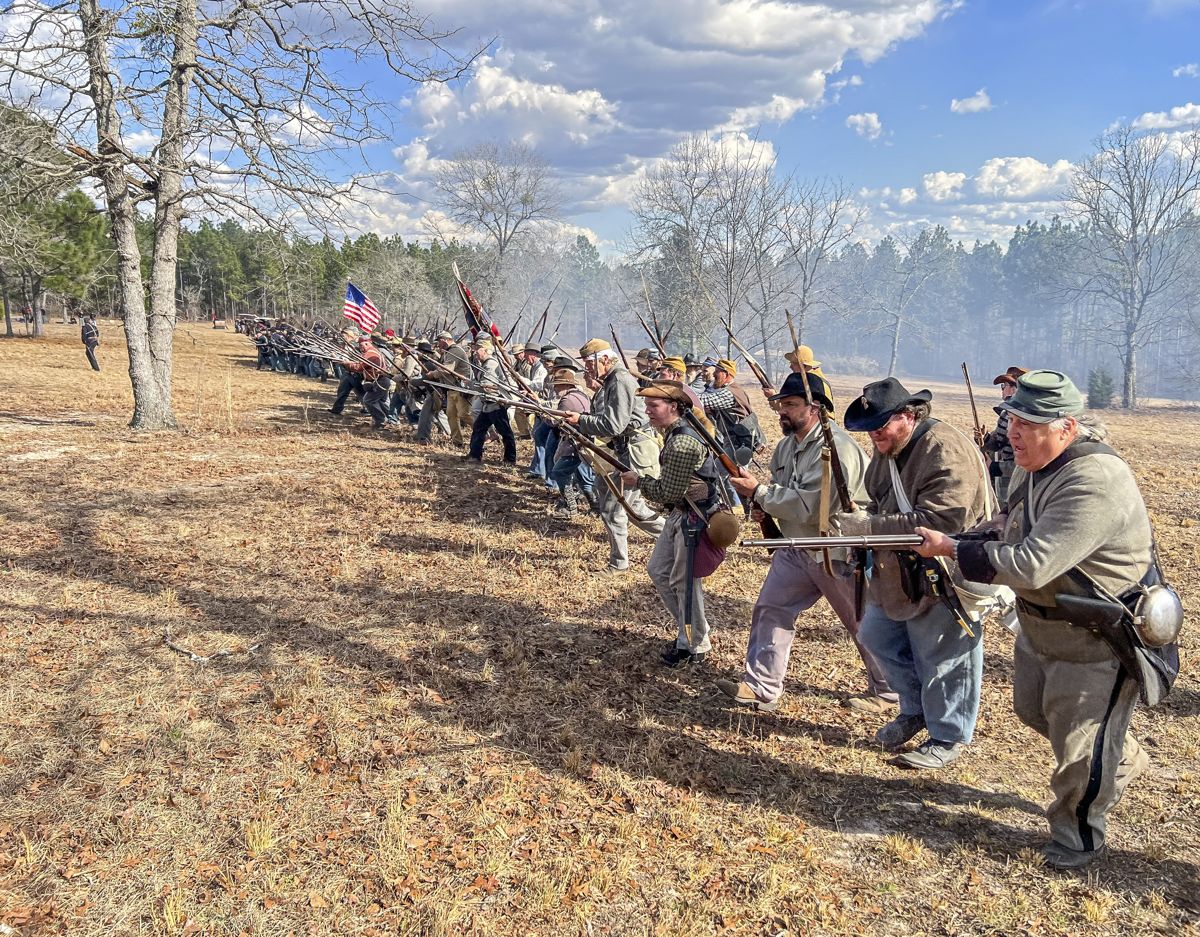
William Tecumseh Sherman, resting his troops in Savannah in 1865, declared, “When I go through South Carolina, it will be one of the most horrible things in the history of the world. The devil himself couldn’t restrain my men in that state.” Sherman’s cavalry commander, Brig. Gen. Hugh Judson Kilpatrick, reportedly spent $5,000 in Savannah for matches for his troopers. At Savannah, he told his corps, “In after years when travelers passing through South Carolina shall see chimney stacks without houses, and the country desolate, and shall ask who did this, some Yankee will answer, ‘Kilpatrick’s Cavalry!” The invasion of South Carolina then began in February 1865. This year, at the 30th Annual Battle of Aiken reenactment, Sherman and Kilpatrick received a little help. The reenactment usually has a mock cabin fired at night to represent the Carolina homesteads burned by Sherman. This year, the event’s living historians of the Military Time Line brought an original battle used WWII flame thrower to demonstrate at the night firing. These time travelers torched the cabin and had it engulfed in flames in seconds. Confederate infantry then moved towards the flames and shot the Federal house burners, who were also blasted by a Confederate artillery battery. Spectators, who had stayed late for the nighttime scenario, cheered with delight. Movie film crews were also on hand to film the night scenario for the upcoming independent movie Hampton’s Iron Scouts by Christopher Forbes. The original battle was one of many involving Sherman’s left wing’s cavalry commanded by Kilpatrick as he marched into South Carolina towards Augusta, Ga. For Sherman, the move towards Augusta was just a feint. His right-wing left Savannah by ship and landed in Beaufort. That was also a feint to make Confederates think that Charleston was his ultimate target. Sherman’s plan was to keep Confederate forces pinned down in Augusta and Charleston, as he marched between them into the middle of South Carolina to attack Columbia. General Kilpatrick’s adversary was Major General Joseph Wheeler, CSA, who decided to make a stand at Aiken, eighteen miles from his hometown of Augusta, Ga. Wheeler planned a trap to destroy Kilpatrick and thus protect Augusta. On February 10, two thousand of Wheeler’s cavalry road throughout the day and night to consolidate in Aiken. Wheeler carefully planned to trap and destroy Kilpatrick. In the town of Aiken, Wheeler deployed his cavalry in the shape of the letter ‘V.’ Wheeler used Aiken’s houses and trees to conceal his cavalrymen in this ‘V’ formation. Wheeler believed that Kilpatrick would be rash and would march into the center of the ‘V.’ The Confederates would then collapse the tops of the ‘V’ around Kilpatrick, surrounding and then destroying him. On February 11, Kilpatrick left two-thirds of his force five miles from Aiken in a defensive position and then approached Aiken between the top tips of the ‘V’. Wheeler’s good plan fell apart when an Alabama Confederate skirmisher fired too soon. Wheeler immediately charged into the Federals, but the plan was ruined as only a part of Kilpatrick’s forces had entered the ‘V’. These Union cavalrymen were surprised and surrounded. Hand-to-hand combat began along with the close use of swords, pistols, shotguns, and carbines. The surrounded Federals had to cut their way out of the ‘V’ through the Confederates to rejoin the rest of their command. In the chaos, Kilpatrick ordered a retreat. The retreat became a mad horse race with Confederate horsemen close on the heels of the Union cavalry for five miles all the way back to the Union defensive position. Aiken was saved. The Battle of Aiken was the last Confederate victory in South Carolina and one of the last in the Eastern theatre of the war. The victory saved Aiken from being burned. Ironically, Aiken would later welcome Northerners. After the war, Aiken became a winter resort for the wealthy elite of the North. None of this would have happened if Kilpatrick had defeated General Wheeler and burned Aiken. Hotels had survived the Battle to welcome these post-war northern tourists. Col. Leland Summers, of the Palmetto Battalion, was in overall command of the 30th Battle reenactment. Col. Perry Sutherland, 137th New York, commanded the Union infantry, while Lt. Col. Stan Fulmer,
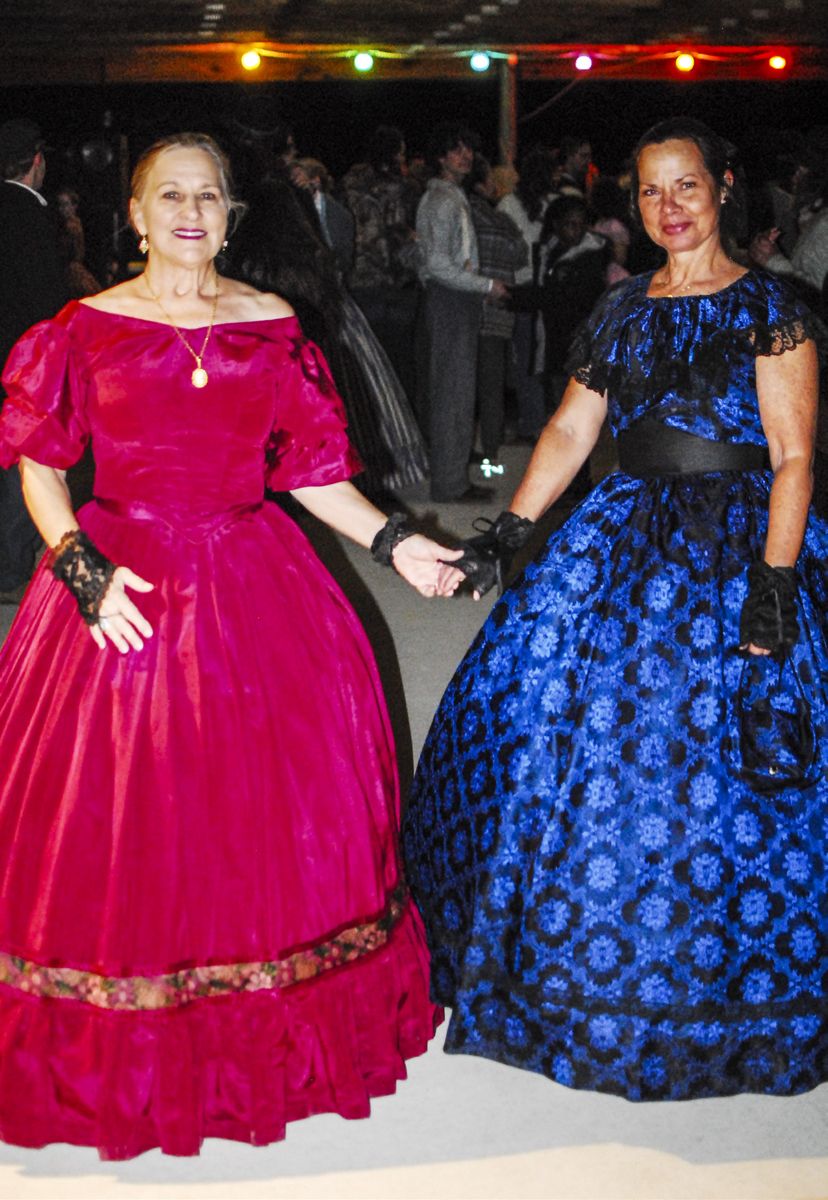
Palmetto Battalion, commanded the Confederate infantry. Artillery was commanded by Lt. Col. Matt Aul, of the Palmetto Battalion. The Cavalry was commanded by Major Jeff Reno of the 5th Ga. Cavalry, GDRA. The event started Friday with the annual History for Kid’s school field trip. Over a thousand students attended to see history come alive. The kids enjoyed the Military Time Line’s Korean War Veterans firing demonstration of weapons. The highlight came when Major Eric Junger, Paris Island Living History Detachment, USMC, fired the WWII battle flame thrower that shot flames out about 40 yards to thrill the kids. Saturday featured two battles, a post war gun fight, a night fire exhibition, and concluded with the annual dance that several hundred people participated in. Sunday services featured Chaplain Joey
CivilWarNews.com Young of the Georgia Volunteer Battalion and concluded with the final afternoon battle. Fred Cota, Barnard E. Bee Camp, Sons of Confederate Veterans, organized the first reenactment in 1995 to commemorate the 130th Anniversary of the original battle. The reenactment was so successful that the Bee Camp decided to make it an annual event. The non-profit reenactment grew into South Carolina’s largest living history event. The Battle was able to buy their current property in 2004. The purchase allowed them to make permanent improvements such as running water lines to all camp sites, building a dance pavilion, and recreating four historic buildings. The event has been recognized by the SC Parks, Recreation, & Tourism Department as South Carolina’s Best Tourist Event. It also has received the national Dr. James B. Butler Best Historical Project Award. Unfortunately, one of the first 1995 battle participants, Donny Christopoulo, passed away a few days before this year’s event. Lt. Commander Christopoulo was Historian of the Barnard E. Bee Camp and a former reenactor with the 14th South Carolina. He also served as coordinator of the Battle’s Military Time Line exhibit. Members of the Palmetto Battalion attended his funeral on Friday and fired a salute in his honor. This 30th Anniversary Battle attracted thousands of spectators. The event served in some ways as a practice run for next year’s special 160th Anniversary of the Battle to be held Feb. 21- 23, 2025. Pre-registrations are already coming in, with a Pennsylvania six-gun battery being the first to register on Monday after the event. There are no reenactor fees for those who pre-register. Registration forms and other information about Aiken can be found at www.battleofaiken.com. Living history is alive and well in Aiken.