
First To Flee Andersonville Prison
By Joseph F. Wilson · Originally published April 2024 · pp. 14–15
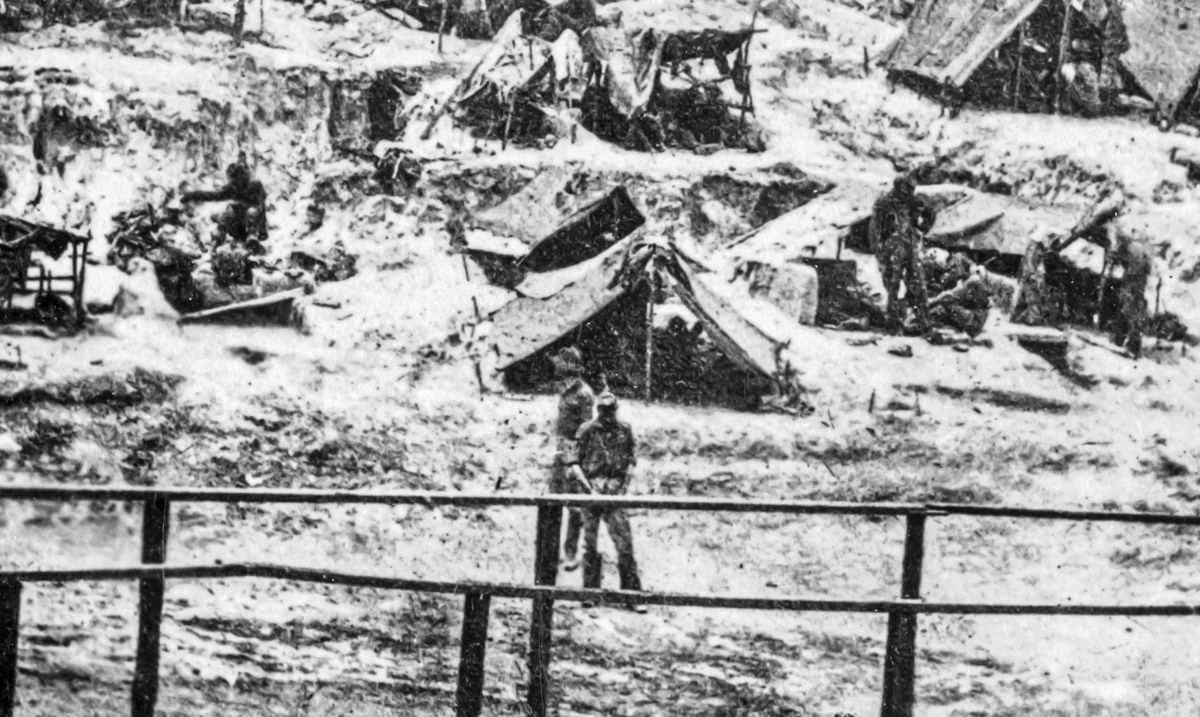
Only a handful of Union prisoners escaped Georgia’s notorious Andersonville Prison. Nearly every successful escape occurred after September 1864, when the scaled-down prison served mainly as a hospital with reduced security. Private Sidney Moore, 154th New York Infantry, defied tremendous odds by successfully escaping in early July at the peak of the prison’s existence. Moore raced for the woods in a mad dash for freedom when guard strength and tracking dogs made an escape from Andersonville nearly impossible. Records indicate that Sid’s departure marked the first time a captive escaped from Andersonville and rejoined his regiment. Sidney shouldered a musket once again to continue fighting in General Sherman’s quest to capture Atlanta.
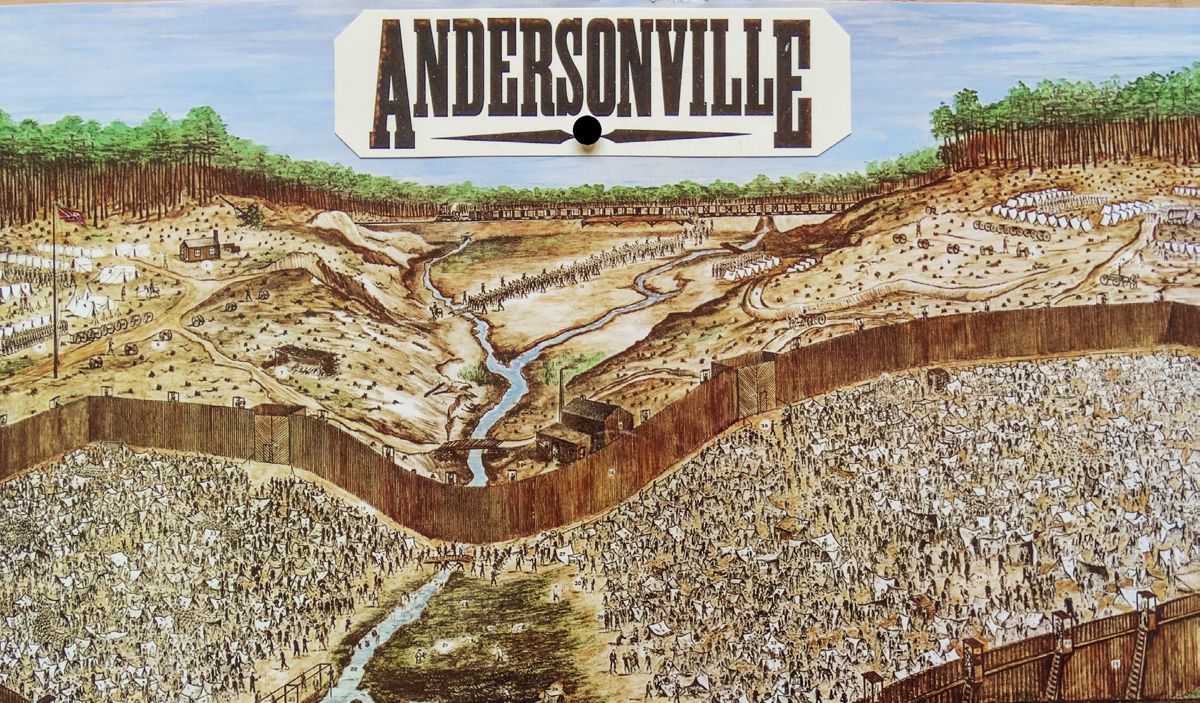
Andersonville Prison drawing.
National Park Service records indicate that 351 prisoners escaped from the stockade, with practically all of them being tracked down by the bloodhounds and brought back. According to the NPS, only 32 prisoners who escaped the prison returned to Union lines. Dates and available records show that all 32 came after Moore bolted from the stockade. Almost all those escapes came in the fall when the Confederates didn’t have the manpower to chase after them. Many former prisoners who claimed to have escaped from Andersonville did so by absconding from trains while being transferred to other prisons after Sherman’s proximity to the prison forced a mass evacuation. The prison population dropped from 33,000 prisoners in August to approximately 5,000 captives in October. Men also ran away between October 1864 and April 1865 when security eased at the stockade, as General Johnston’s Confederate army needed every man who could fire a musket. Before Moore’s capture, every 1864 soldier knew that if captured, their final destination would be the dreaded Andersonville Stockade. All knew some would never make it out alive. On May 8, 1864, the 154th attacked the heights in the Battle of Rocky Face Ridge north of Atlanta. Ten of the regiment, including Moore, fell into Confederate hands, and landed in Andersonville. Four of the ten captured at Rocky Face Ridge went into the Andersonville National Cemetery burial pits. While being escorted to Andersonville, fellow captive Corporal Thomas Aldrich observed Sid arguing with a Confederate officer. Aldrich later recorded the incident, revealing
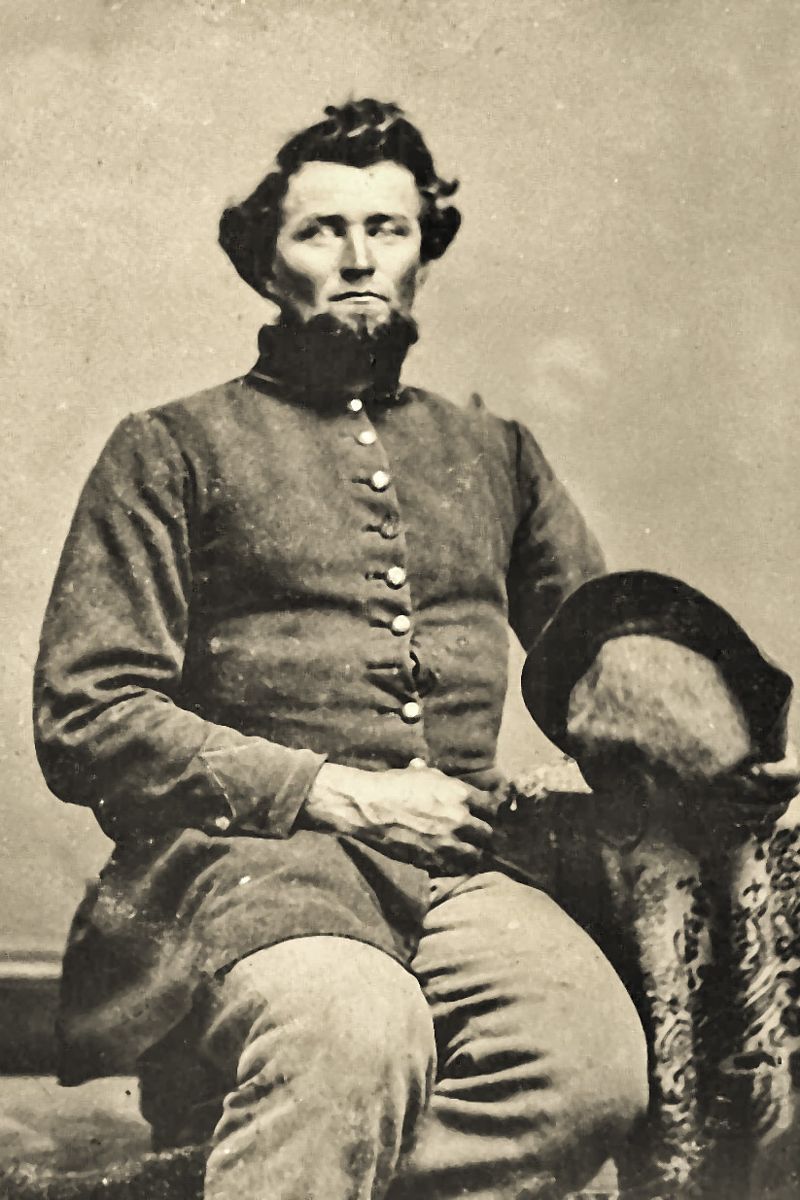
Sid’s stubborn disposition, when he later wrote, “…they wanted to know how we felt in regard to the war, as we gave it to them left and right. I thought at one time a Reb officer would shoot Sid Moore. He drew his revolver and ordered Sid to shut up, but that was not what Sid was known to do, and I believe he would have shot him if I didn’t interfere and spoke to the officer.” Sidney’s obstinate character would serve him well during his imprisonment and audacious escape. Sid was a carpenter by trade. When a call went out for volunteers to build a bakery in exchange for extra rations, the New Yorker offered his service. Receiving additional rations likely never figured into the equation. Moore must have already concluded that Southern hospitality wasn’t to his liking; the lodging arrangements and culinary offerings simply didn’t meet his expectations. Watching comrades perish from disease and starvation only added more incentive. So, the disgruntled prisoner decided on July 8, 1864, it was time to leave. In many failed attempts, some prisoners managed to crawl through dozens of tunnels in exchange for a few days of freedom before being recaptured. Most escapees ran away from various work details outside the stockade, but to no avail. All returned to punishment in the stocks or were fitted with a ball and chain. That didn’t discourage Moore. Returning to the vile prison with an ankle bracelet attached to a 12-pound ball wasn’t in his plan. Sid Moore must have had a better tactical plan. In the early morning of another scorching hot day in July, Sidney Moore passed through the gate to resume working on the bakehouse outside the prison. It would be the last time he saw the inside of the stockade. At some point, the moment came when the rambunctious New Yorker sprinted like a deer in full flight and disappeared into the pine forest surrounding the prison. The daring Yank never looked back. Moore lit out for more friendly confines despite southern horsemen, bloodhounds, a bounty on his head, and being 125 miles from Sherman’s lines. Escaping the bloodhounds was no easy task. Many returned escapees attested to the dogs’ Sidney Moore.
skill. The most important part of escaping the dogs was to put as much distance as possible between yourself and the pursuing hounds. Since Sidney spent only seven weeks in prison, it’s reasonable to assume he still possessed adequate health. Being strong and determined may have allowed the fugitive to run great distances for extended periods of time, an advantage few long-term prisoners suffering from various maladies could match, making any attempt at escape an exercise in futility. Sid probably knew that dogs have trouble following a scent in water. Moore could have traveled by the waterways, creeks, and rivers to throw off the dogs. Not far from Andersonville, the Flint River runs north to south. The fugitive New Yorker may have found the river’s shallows an ideal highway to cover his scent and guide him upstream away from the baying dogs. Still, the runaway Yank needed good luck to reach Sherman’s lines. Sid had to dodge numerous bounty hunters, rebel cavalry, and pickets at every turn. Roads and towns had to be avoided. Traveling by day wasn’t an option. Concealed in the darkness, only the moonlight guided his every step. When the setting sun dipped below the horizon, the rested Yank was on the move again. Along the way the fugitive received help from an unlikely source. Moore found friends among black folks. Running for your life can stimulate quite an appetite. While roaming through the heart of Georgia, stumbling onto a plantation had to be easy. What proved difficult was sneaking around trying to get the attention of a slave toiling in the field. Befriending a slave meant getting something to eat. If the white overseer spotted the prisoner, returning the runaway to Andersonville came with a reward. It became well known in postwar narratives that black people helped escaping Yankees by giving them a bite to eat or an article of clothing in their bid to make it north. Slaves knew what the Yanks were fighting for, so black folks gladly lent a hand. Their risky actions created an unusual “reverse underground railroad” that saw black people helping white people make their way north to freedom. If caught helping a Yank, a severe beating awaited. With a little food from a friendly slave satisfying Sid’s hunger, the wayward traveler kept on running. Without knowing it at the time, Sid’s good fortune began unfolding in Sherman’s camp.
CivilWarNews.com At the same time, Sid wandered desperately through the Georgia woods far south of Atlanta, Sherman’s army still battled General Johnston’s army well north of the city. In a plan to cut off Atlanta’s supplies, Sherman devised a plan to send General McCook and General Stoneman on a daring raid to destroy the rail lines south of the besieged city. Sidney Moore’s chances just got a little better. Luck swung considerably in his favor when the Union cavalry received their orders to mount up. On the morning of July 27, “boots and saddles” sounded throughout the cavalry camp from Yankee buglers. McCook and Stoneman’s troopers mounted their horses with their repeating rifles and shiny sabers dangling by their sides. The plan called for the two generals to split their forces and meet at Lovejoy’s Station south of Atlanta, but plans often go awry. Stoneman and hundreds of his troopers fell into the hands of General Joseph Wheeler’s cavalry before ever connecting with McCook. Andersonville gained hundreds of new residents, but Stoneman landed in the Macon camp for officers. When McCook realized Stoneman wasn’t coming, he burned Lovejoy’s Depot and galloped west for the Chattahoochee River to escape Wheeler’s pursuing cavalry. Once across the river, the barrier offered a natural defensive position. About the same time McCook and his troopers destroyed the depot and tore up the tracks, a tired and hungry Sidney Moore resumed his hike north under cover of darkness. Had Moore followed the Flint River, its northern course would have taken him west of Lovejoy’s Station directly into the path of McCook’s cavalry. It’s unknown if Moore followed the Flint River, but it would have made sense. Whatever trail he followed the errant hiker’s good fortune carried him straight into the raiding Union cavalry somewhere south of Atlanta on July 28. Seeing the glorious American flag flapping in the breeze had to be a grand sight. After tramping through miles of Georgia woodlands, Sid was back among friends. Stumbling into the midst of the Union cavalry after hiking over 125 miles must have brought shouts of joy from the elated New York private. Private Moore rejoined his regiment on August 6, 1864. Being a known talker, Moore likely huddled around the campfire with fellow soldiers, entertaining them with his bold exploits through Georgia. Back at Andersonville, death swept through the stockade in August, carrying away even the strongest at a rate of 100 per day. Every day, wagon loads of dead bodies went to the cemetery, which quickly grew to be much larger than the 26-acre prison. All the survivors of Andersonville Prison exulted at finally being free after the war. Thoughts of comrades buried among the 13,000 dead in the red clay soil of Georgia always brought tears. Every prisoner, including Sid, had friends who went out of the stockade feet first to the trenches in Andersonville National Cemetery. Records show a total of 90 boys from Sid’s 154th NY Infantry died in prison. The plucky private from New York decided from the moment of capture that he wasn’t going to be one of them. With a few meals, some rest, fresh clothes, and a new musket, Private Sidney Moore took up the march again with Sherman driving to take Atlanta. Moore picked up right after he left off at Rocky Face Ridge, exchanging gunfire with Johnny Reb. The Union army captured Atlanta on September 2. Seeing Atlanta as a captor instead of a captive had to be satisfying for Moore. On October 30, officers detached Moore for service with the XX Corps to guard wagons of ammunition in Sherman’s infamous “March to the Sea” across Georgia. A fascinating journey through the Civil War came to an end for Private Moore after more fighting in the Carolinas. Sid proudly marched with his regiment in the Grand Review in May. With the war finally over, Moore mustered out on June 11, 1865. At reunions following the war, veterans often enjoyed sharing stories of their experiences in the war. Sometimes even stretching the truth a bit. Sidney Moore had an authentic tale that rivaled any war story and needed no embellishment. Joseph F. Wilson is a member of Old Baldy CWRT and The General Meade Society. The writer lectures on Civil War topics and is the writer and producer of the documentary “Civil War Prisons – An American Tragedy” available on Amazon. His YouTube channel is – “Joseph F. Wilson.” Email [email protected].