
Through The Lens
Burning Alabama
By Stephanie Hagiwara · Originally published April 2024 · pp. 10–11
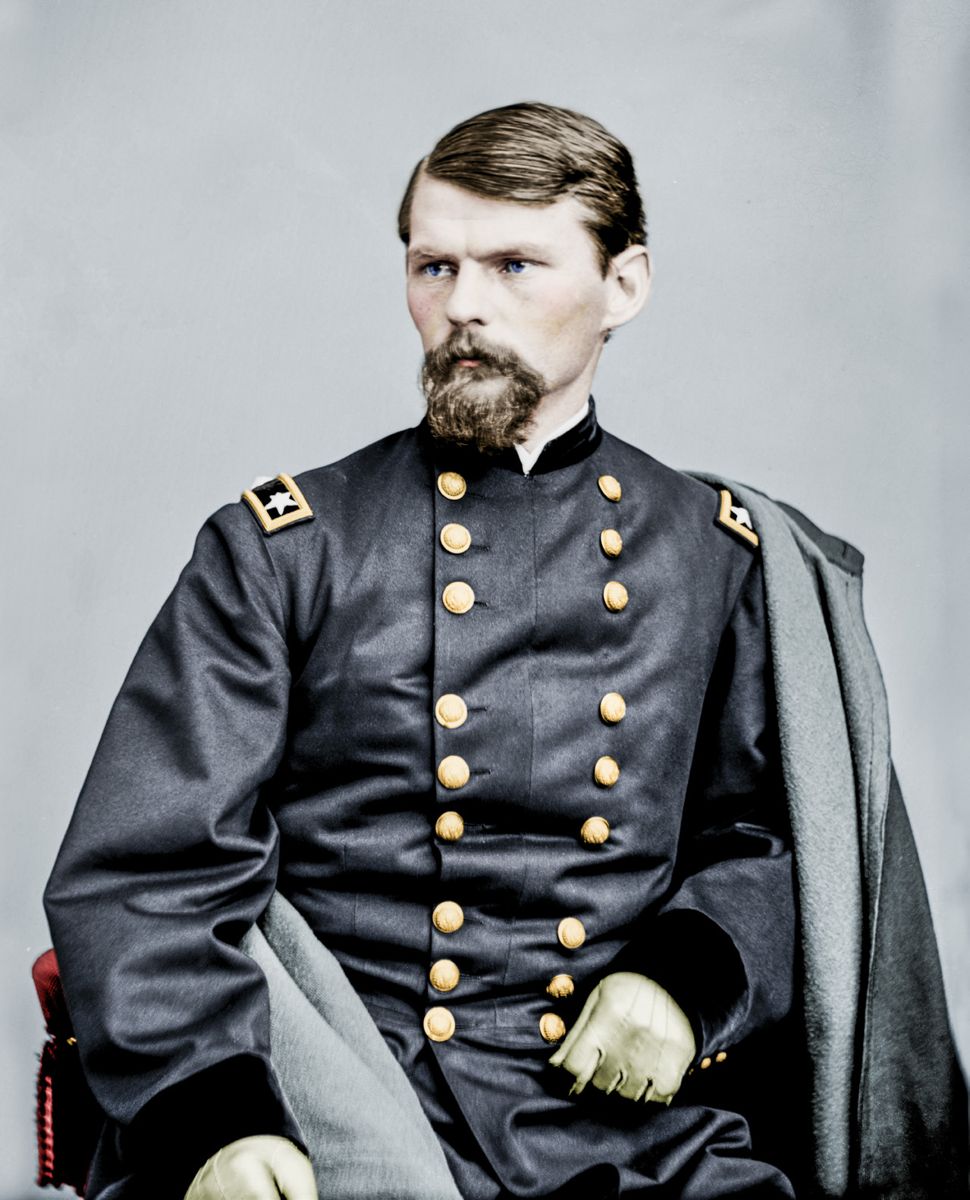
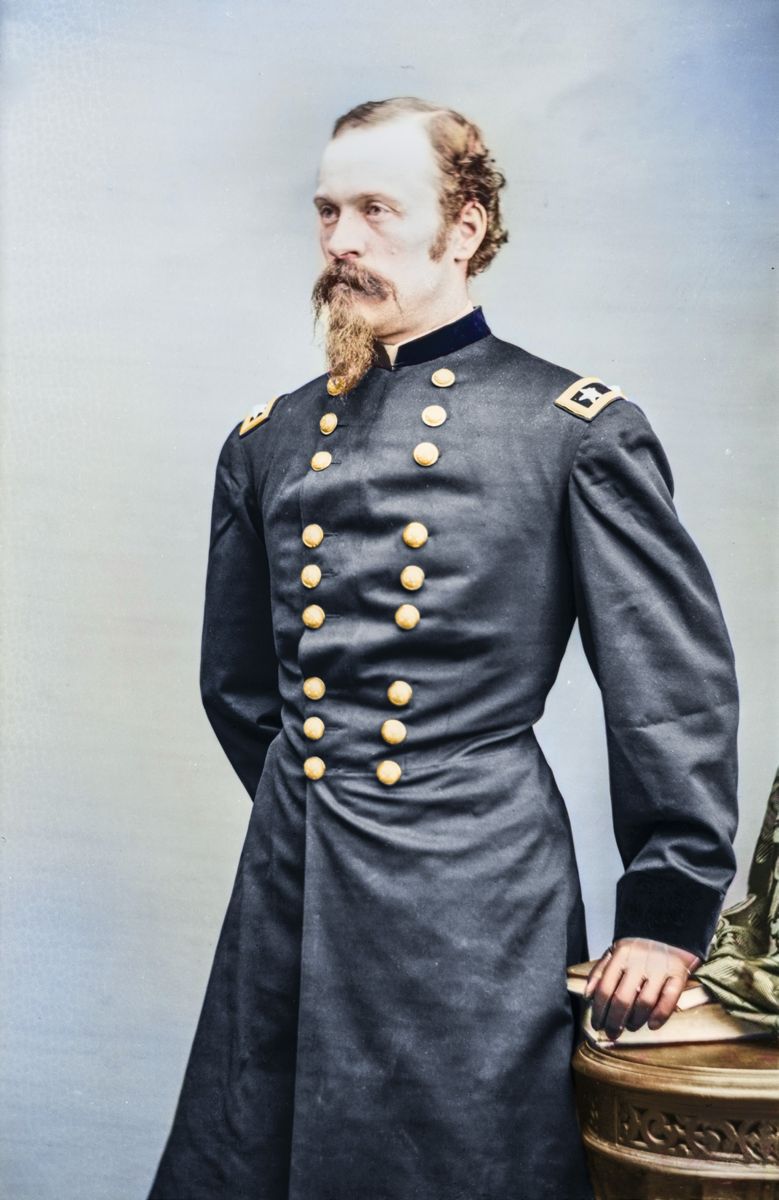
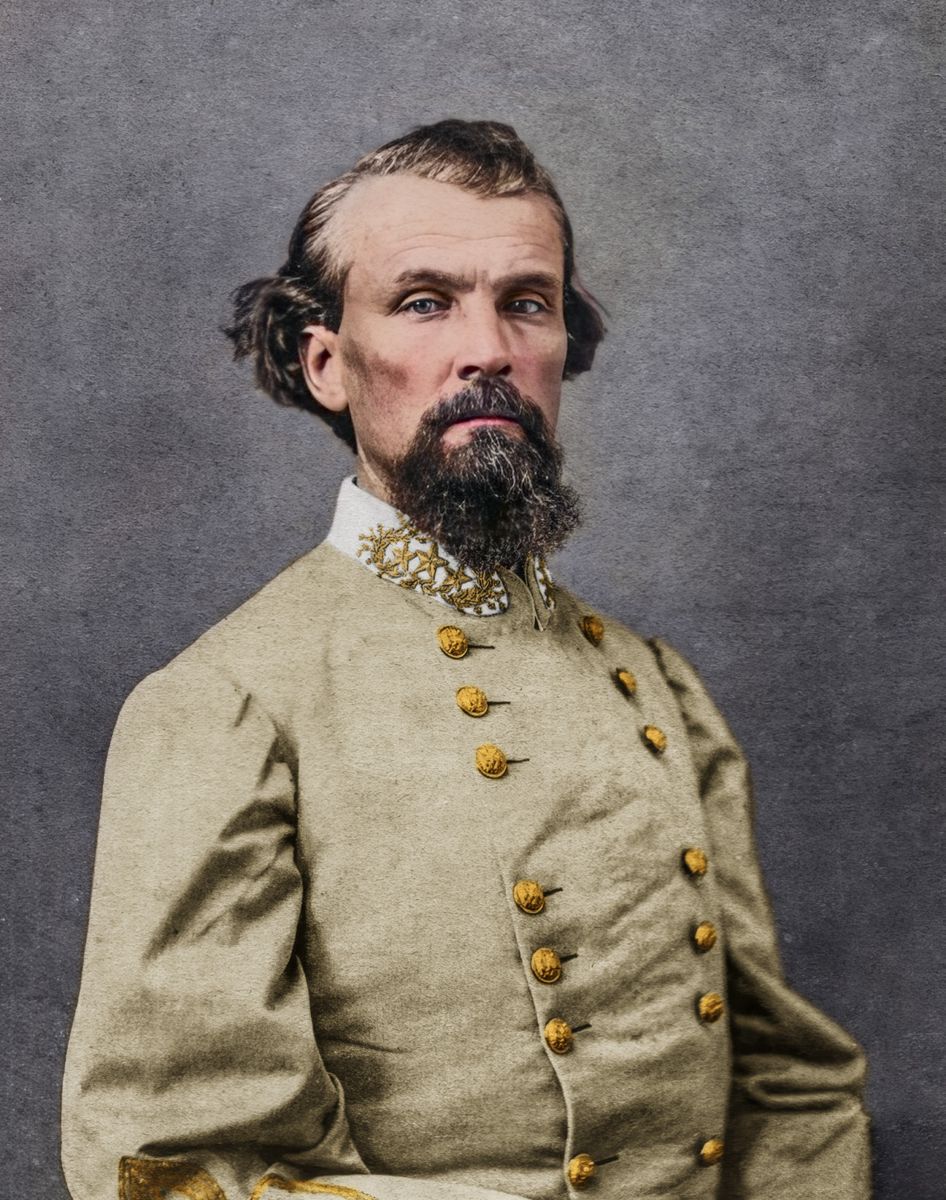
Burning Alabama “If that boy had known enough to give me the point of his saber instead of its edge, I should not have been here to tell you about it.” – C.S. Lt. Gen. Nathan Bedford Forrest In February 1865, Ulysses S. Grant, General-in-Chief of the Armies of the U.S., wanted to prevent the War from dragging on another year. His army was going to be driving C.S. Gen. Robert E. Lee’s Army of Northern Virginia towards the Confederate capitol of Richmond, Va. Grant wanted to eliminate the option of the Confederate Government reestablishing itself elsewhere. He ordered a demonstration in Alabama. U.S. Gen. James H. Wilson responded with a proposed raid on Selma, Ala., and Columbus, Ga., the South’s largest manufacturing locations untouched by the War. Grant approved Wilson’s 60-day raid with all “the latitude of an independent commander.” Wilson was a protégé of Grant. As chief of the Cavalry Bureau, the 27-year-old West Point graduate had raised its efficiency. During the War, the cavalry had generally been used by both sides for scouting, destroying railroads, and fought dismounted. Wilson armed his horsemen with rapidfire Spencer seven-shot repeating rifles. The ammunition for the Spencer had the added advantage of using metallic cartridges, making it waterproof and resilient to the jostling common on long marches. Wilson had also revamped the cavalry into a swift moving fighting force. Wilson knew his men would be fighting C.S. Lt. Gen. Nathan Bedford Forrest. Forrest had recently been promoted to command the 10,000 cavalry men in Alabama, Mississippi, and Louisiana. He had a history of beating larger Federal forces, but at the Battle of Franklin, Tenn., Wilson was able to repulse Forrest’s flanking attack. Intense rainstorms delayed Wilson’s departure. He took advantage of the time to put his men through additional training. Having served under Gen. George McClellan, Wilson knew how to maintain morale. On March 11, Wilson reviewed Gen. Eli Long’s men. The band played riding on white horses. “Every movement was executed with precision, and it seemed as though the music was timed to the cavalry hoof-beats.” The only blemish to the occasion was the lack of ladies, newspaper correspondents, and members of Congress as an audience. On March 22, Wilson departed on his raid. Over pontoon bridges, 13,500 men, three batteries of four guns each, and 250 supply wagons crossed the swollen Tennessee River. Each man carried five days rations and 80 rounds of ammunition. Wilson moved his men along three divergent routes. The wagons were ordered to return as soon as emptied to aid rapid movement. Raids typically did not result in lost territory. Forrest’s attention was on the Federal forces massing near Mobile, Ala., where he expected the Selma attack to originate. His men were scattered to avoid stripping any one spot of food and forage. Morale was low as the “… prospects for a successful and honorable ending of the war are gloomy.” Men kept busy with recreational games that “escalated to gambling, horse racing and indiscriminate gunfire.” On March 28, 25-year-old U.S. Gen. Emory Upton’s 4th Division, reached Elyton (now Birmingham). A saber charge drove the rear of C.S. Col. Joshua Patterson’s 5th Ala. Cavalry from the town. The Federals burned the iron works and mills. On March 30, the still burning fires dyed the sky red.
U.S. Gen. John Croxton was ordered to divert 70 miles to the University of Alabama’s Corps of Cadets in Tuscaloosa. It was 1,500 veteran troops vs. 300 teenage cadets. The university president and the cadets’ commander decided the cadets would retreat. Croxton exploded their ammunition and burned the campus.
Forrest ordered Gen. William “Red” Jackson to Centreville. Wilson countered by moving his men to the railroad junction town of Montevallo. The next day, the Confederates prepared a stand a few miles south of Montevallo. The 5th Iowa turned a “gallant charge” into “a four-mile chase. … Our Spencers and enthusiasm is too much for them, and we see their backs in retreat.” The next 48 hours would turn into a running fight over the 50 miles between Montevallo and Selma. On April 1, a Confederate courier was captured while carrying dispatches. Wilson “now knew exactly where every division and brigade of Forrest’s corps was, that they were widely scattered and that if I could force the marching and the fighting with sufficient rapidity and vigor, I should have the game entirely in my hands.” Wilson’s “greatest danger” was the possibility that Jackson could cross the bridge at Centerville and attack his rear. Wilson immediately ordered Gen.
Map of Selma, Alabama, from the Official Records Atlas. Spencer Model 1860 Cavalry Carbine. .56 Rimfire Spencer, 22-inch barrel. These 7-shot, metallic cartridge repeating carbines held 7 rounds of 56-52 caliber (sometimes called 56-56) rimfire ammunition in the tubular magazine in the buttstock.
CivilWarNews.com Edward M. McCook to capture the bridge and scatter the enemy, which he did. The Confederates made a fighting retreat eight or ten miles to Ebenezer Church, north of Plantersville. Forrest sent a message to Lt. Gen. Richard Taylor to evacuate Selma. He messaged Gen. James Chalmers to make haste. Forrest with about 2,000 men drew up a short line of battle to slow the 9,000 bluecoats. About 4 p.m. Long broke the Confederate line using his Spencers. The 17th Indiana Mounted Infantry charged with their saber battalion. The charge turned into a “running fight.” Capt. James Taylor, 72nd Ind. Volunteer Infantry dashed up to Forrest, wielding his saber. Taylor fiercely slashed Forrest on his head and shoulders as their mounts raced at the same speed. It took a few moments before enough space opened to shoot Taylor dead. On April 2, about 10 a.m., Forrest arrived in Selma; “… both horse and rider covered in blood, and announced the enemy at his heels and I must leave at once to escape capture,” recalled Gen. Taylor. About 2 p.m., the general barely escaped. Federal soldiers fired at his departing locomotive “before headway was attained.” The Selma Naval Gun Foundry and Ordnance Works was a vast complex that sprawled over 50 acres. It employed 10,000 workers at its peak. The best known piece the foundry manufactured was the 6.4-inch Brooke rifle. Other enterprises produced items as varied as shovels and buttons. Selma was protected by six miles of earthworks and trenches. The fortifications were designed for 10,000 defenders. Forrest had 2,200. Wilson also had the advantage of Upton having captured an English engineer who had plotted Selma’s fortifications. Wilson had a pencil sketch of the fortifications, topography, number, and gun positions in his hands. Wilson launched his attack as dusk approached. Long’s 1,500 cheering men charged the works. Upton’s 300 men charged through a swamp. The defenders responded with cannon and small arms. The Federals dove into a ravine twenty feet before the breastworks. C.S. Lt. Col. Frank Montgomery, 1st Miss. Cavalry, fired five times into the “struggling mass, and had commenced to reload when I heard wild cheering to the right.” Another Rebel recalled, “We thought we were getting the advantage when a shell exploded amongst the horses and they stampeded, thus a break was made through the militia.” Montgomery knew, “all was lost.” Forrest called for a retreat and made it out of the city. It was Forrest’s last battle. Wilson led a charge to break up a reforming Confederate interior line. Wilson threw himself “out of the saddle” when his horse faltered, shot in the chest, but the horse regained its footing and Wilson rode it the rest of the night. The Federals rushed into Selma and were greeted with pandemonium. Buildings burned. Marauders plundered. Panicked citizens filled the streets. Heavy rain quenched the fires. Order was restored about 11 p.m. At last, Wilson’s wounded horse was taken to the veterinarian. Wilson considered the victory at Selma, “the greatest day in the history of the Cavalry Corps. M.D.M.” Sources: • Wilson, James Harrison. Under the old flag; recollections of military operations in the War for the Union, the Spanish War, the Boxer Rebellion, etc: D. Appleton and Company, 1912 • Trudeau, Noah Andre. Out of the Storm: The End of the Civil War, April-June 1865: Little Brown & Co., 1994 • Bowman, S. L. (1992). Ahead of Its Time: Wilson’s Cavalry Campaign of 1865. Army History, 23, 12– 20. http://www.jstor.org/stable/26302814 • Montgomery, Frank A.. Reminisces of a Mississippian In Peace And War. The Robert Clarke Company Press, 1901
Stephanie Hagiwara is the editor for Civil War in Color.com and Civil War in 3D.com. She also writes a column for History in Full Color.com that covers stories of photographs of historical interest from the 1850’s to the present. Her articles can be found on Facebook, Tumblr and Pinterest.