
The Mule Shoe Struggle
By Jeffry D. Wert · Originally published September 2023 · pp. 6–9
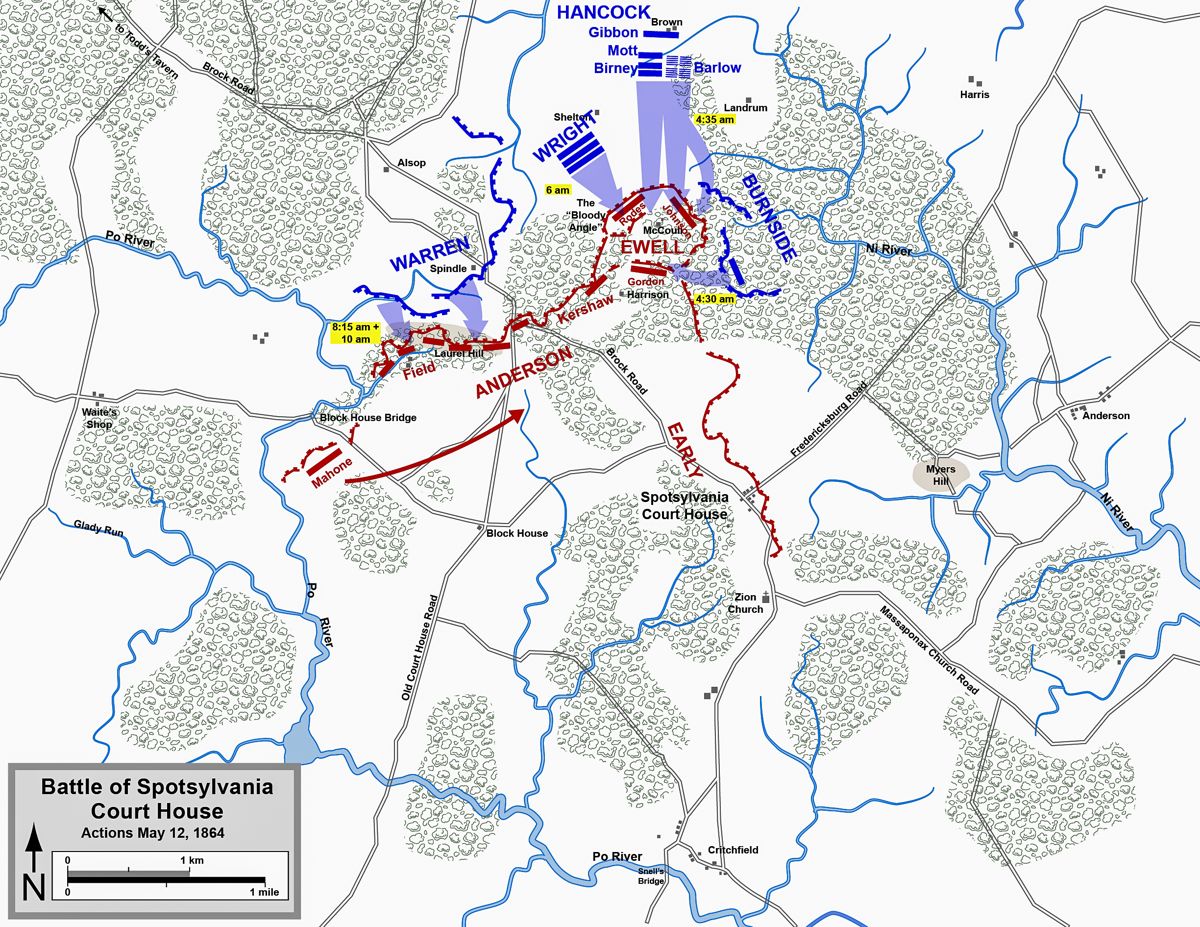
The Union assault on the Confederate position known as the Mule Shoe near Spotsylvania Court House, Virginia, on May 12, 1864, began a hellish ordeal without parallel in the four-year conflict. The Federals charged at 4:35 a.m., pouring over the salient’s breastworks and routing the Rebel defenders. What ensued after the breakthrough was relentless combat between the foes at the length of a rifle barrel amid downpours of rain for some twenty-two hours. For these veteran troops on both sides, the fearful struggle surpassed anything in their collective experience. The fighting around the crossroads village of Spotsylvania Court House was the second major engagement of the Overland Campaign. The renewal of active operations in the war’s fourth spring began when Union General-in-chief Ulysses S. Grant ordered the 119,000-man Army of the Potomac across the Rapidan River against General Robert E. Lee’s 66,000-man Confederate Army of Northern Virginia on posix.com/CWmaps/.
Battle of Spotsylvania Court House (May 8-21, 1864). Situation May 12.
May 4. It was a bright spring day that heralded darkness. The ensuing two days, May 5 and 6, witnessed a furious engagement between the old nemeses in the “demonic” Wilderness, as a Yankee soldier called the forbidding landscape. Another soldier described the fighting as “a blind and bloody hunt to the death, in bewildering thickets, rather than a battle.” The Confederates held the battlefield after two days, with total casualties exceeding 29,000. On May 7, Grant ordered the army southeast toward Spotsylvania Court House and more open terrain. Both armies raced throughout the night and the next day. The Confederates arrived first by the narrowest of margins, seized Laurel Hill, and began repulsing the initial Federal attacks. Throughout May 8 and into the night, the armies converged on what became a sprawling 12-day battlefield. One of the final Confederate units to arrive on the field was the 4,000 officers and men of Edward Johnson’s Division. Johnson halted his veteran infantrymen in the darkness on a slight
The Mule Shoe Struggle
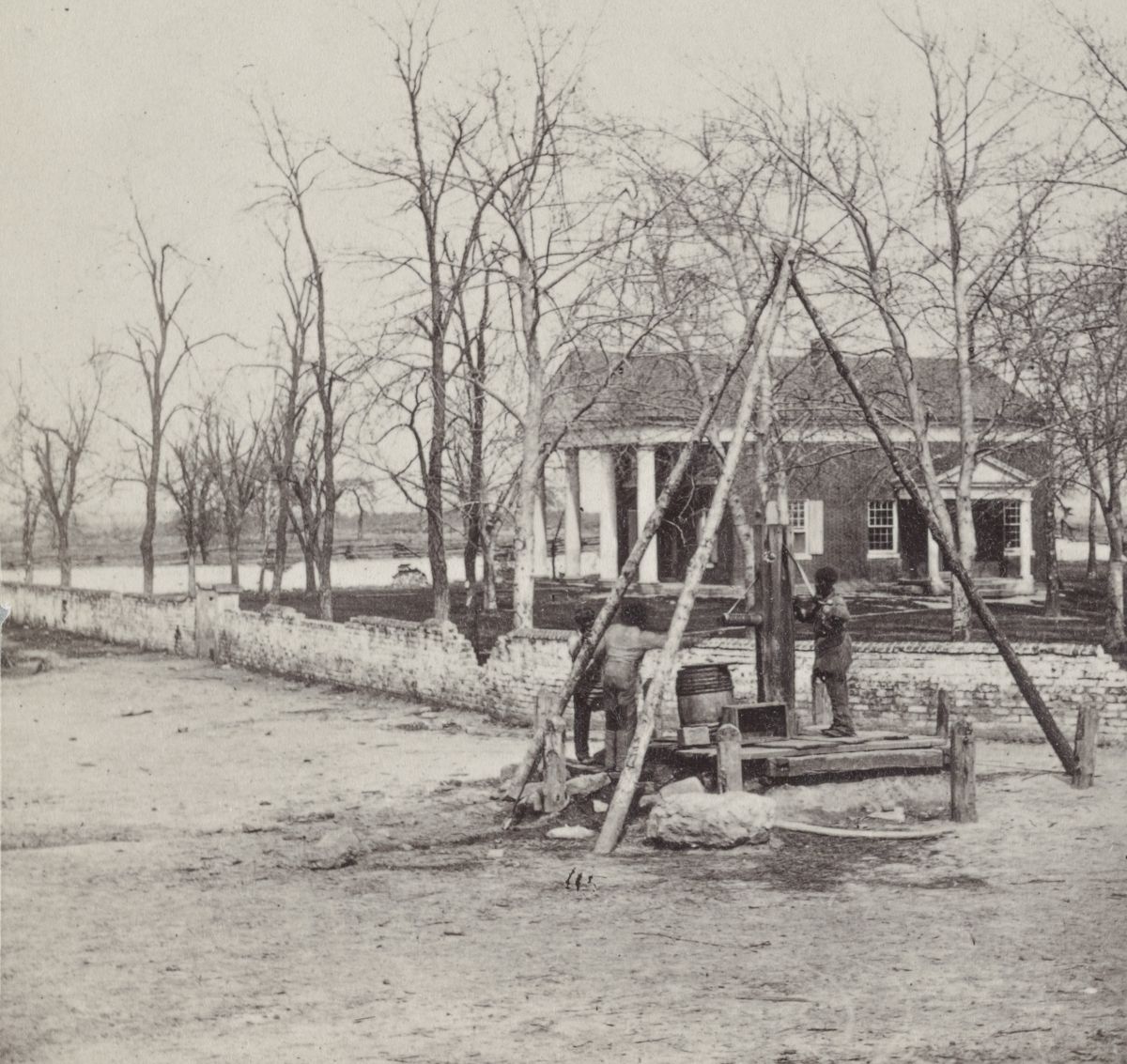
Three African American men at the water pump in front of the Spotsylvania County Court House. (Library of Congress)
ridge. This position was part of Neil McCoull’s “Woodshaw Farm.” Johnson instructed his men to erect fieldworks, but the exhausted infantrymen lay down and slept. Lee visited Johnson’s position the next morning as the troops were constructing log and dirt breastworks. A Georgian depicted the crescent-shaped defenses as “an awkward and irregular salient to the northward.” When finished, the “horse shoe” or “mule shoe,” in the words of its defenders, covered some 250 acres, a half mile deep and roughly 1,160 yards, less than three-fourths of a mile wide. The completed works stood four feet high, with a head log and firing slot, and a twofoot-deep trench on the inside. The Rebels built steps to stand on whten firing from the position. When Lee saw the trench line’s shape, he knew the salient could be subjected to enemy fire from three sides, he allegedly declared: “This is a wretched line. I do not see how it can be held.” The army’s Second Corps commander, Richard S. Ewell, argued with Lee that Johnson’s men held the higher ground and, if the position were abandoned, it would be seized by the Yankees. Lee relented reluctantly, directing twenty-nine cannon into the salient as support for the infantry. The Federals knew about the Confederate position but never learned the vulnerable shape of the defenses or how many enemy troops and artillery batteries manned the works. Nevertheless, when Union Colonel Emory Upton proposed an attack on the enemy lines, Grant and army commander George G. Meade approved. Upton requested a dozen regiments to be formed in four lines, three regiments abreast, with the support of an infantry division and artillery batteries. Georgians of George Doles’ brigade charged at 6:30 p.m. on May 10, striking a slight bulge in the Mule Shoe’s western face known as Doles’s Salient for the Georgians George Doles’s brigade. The Yankees penetrated the salient’s main works and overran a Rebel battery. Upton’s 4,500 officers and men clung to
CivilWarNews.com the captured works for an hour before Confederate reserves drove them back across open ground. The expected support from the reserve infantry division failed to appear. When Grant learned of Upton’s initial success, he thought an assault on a larger scale might break Lee’s lines. He ordered attacks across the army’s front, with a renewal of attacks on Laurel Hill and an advance by Ambrose Burnside’s IX Corps on the Mule Shoe’s eastern face. Grant assigned the 20,000 officers and men of Winfield Scott Hancock’s II Corps to the main thrust against the Mule Shoe. He designated the offensive to start at 4 a.m., Thursday, May 12. Lee, meanwhile, received a message from his son, cavalryman William H. F. “Rooney” Lee. Referring to Burnside’s units, the younger Lee reported: “There is evidently a general move going on. Their trains are moving down the Fredericksburg road, and their columns are in motion.” If his opponent were marching south again, Lee wanted to pursue, either interdicting the movement or barring its route. Lee could not know if the intelligence was correct, but he needed to prepare a counter-movement. Lee ordered the twenty-nine cannon removed from the Mule Shoe to expedite a possible march. His willingness to hold the salient had been predicated on these guns posted within the defenses. E. Porter Alexander, artillery commander of the army’s First Corps, observed later, “The withdrawal of these guns was the one fatal Confederate blunder of this whole campaign.” To be sure, Lee miscalculated, but his decision was based on intelligence he had received. He left the infantry divisions of Johnson and Robert E. Rodes in place until the next morning and ordered a pair of four-gun batteries into the salient. Hancock’s blue-coated officers and men marched overnight toward their assembly point on the farm of John and Elizabeth Brown, located three-fourths of a mile north of the Mule Shoe’s apex. “Of all our many night marches,” grumbled an enlisted man, “this one took the cake.” Rain fell, and another soldier remembered, “It was so dark that it could almost be felt.” A dense morning fog settled in, delaying the assault until 4:30 a.m. All Hancock and his division commanders knew was that “a large white house [McCoull’s] known to be inside the enemy’s works.” To the south, meanwhile, Confederate pickets lying along the Willis Landrum farm lane heard the Yankees gathering on the Brown farm. They alerted Johnson, reporting that the enemy was preparing to attack. Johnson ordered his veterans into the trenches an hour before daylight. Union bands had been playing songs for hours, the sounds filtering through the rain and fog to the Confederates. At last, the music ceased. Before long, a staff officer reported to Johnson,
“General, they are coming!” Hancock’s infantrymen struck the Mule Shoe’s eastern face and 300-yard-long apex, overwhelming the defenders. The Confederates had built numerous traverses inside the salient to protect their inner flanks if an enemy breached the works. Described as twelve to fifteen feet three-sided works, the Rebels likened them to “pig pens” or “horse stalls.” Along the trenches and in the traverses, Johnson’s veterans resisted briefly before being overwhelmed by the many Yankees, who captured upwards of 3,000 officers and men, including Johnson and Brigadier General George Steuart. The enemy had gouged a threequarter mile gap in Lee’s lines northwest of Spotsylvania Court House. A disorganized mass of Federals began penetrating deeper into the Mule Shoe. In front of the surging Federal attack stood 4,600 Rebels, the three brigades of John B. Gordon, who admitted later “that the situation was critical.” An instinctive fighter, Gordon counterattacked with one brigade and advanced the other two brigades toward the salient’s base, where a second line of works had been built earlier on Lee’s orders. Before the Virginians and Georgians stepped forward, Lee joined Gordon. The army commander appeared as if he might want to lead a counterattack, but Gordon promised that his men would not fail. A Virginia sergeant took the reins of Traveler, Lee’s horse, and led the general to the rear. Gordon’s men surged toward the works, arriving almost simultaneously with the Yankee host. The Rebels triggered volleys of musketry; the Federals staggered, and then turned rearward. Gordon’s veterans pursued and, joined by the third brigade, reached the eastern side of the original salient. The momentum of the assault had been blunted. The Federals held the apex, the east and west angles where the works bent slightly south, and the traverses. Lee decided the broken lines had to be retaken while a second line of works was being erected by fugitives from Johnson’s Division farther south. He ordered counterattacks by Confederate brigades drawn from other defensive sectors. Lee needed a tactical stalemate in the Mule Shoe, but for those already there and for those who would be drawn in, ahead loomed a testing unlike any before in the conflict. During the next three hours, six Confederate infantry brigades entered the struggle, which became in a Union private’s words, “a seething, bubbling roaring hell of hate and murder.” Two brigades from Rodes’s Division, Cullen Battle’s Alabamians and Stephen Dodson Ramseur’s North Carolinians, led the counterattack. While Gordon’s troops fought along the Mule Shoe’s eastern face, the Alabamians and North Carolinians angled toward the western face. “This was a serious time with us,” recalled one of Ramseur’s veterans, “and would have been more so, if we would have really realized our position.” The Confederates crossed a reserve or inner line of works, then charged into the trenches along the main breastworks. They drove the Federals in a handto-hand melee over the works, where the foes continued to kill and maim each other on opposite sides of the parapet. The Yankees lunged over the works, trying to retake the trenches. “We pitched many of them with the bayonet right over the ditch,” declared a North Carolinian. William Wofford’s Georgians and Abner Perrin’s Alabamians came up next, filing into the trenches to the left or south of Battle and Ramseur. Like their comrades before them, Wofford’s and Perrin’s veterans charged into a wall of musketry from Yankees holding the apex and some traverses. The rifle fire struck Perrin as he leaped his horse over the inner works, mortally wounding the general. The musketry was relentless, coming in waves like a “very river of death,” according to a Rebel.
Outside the entrenchments, brigades from the Union VI Corps joined in the fury. Finally, the last pair of Confederate brigades, Nathaniel Harris’s Mississippians and Samuel McGowan’s South Carolinians, charged into the fray, a clawing advance from traverse to traverse. They reached the breastworks along a section of the apex and where the entrenchments bent south at the west angle. By roughly 9 a.m., the fighting had dissolved into a bloody stalemate. “The deathgrapple of the war,” claimed a Yankee. So, it would continue without cessation, hour after hour into the afternoon and evening. The combat was, thought a New Englander, “so bloody, and had such an aspect of savagery about it.” A lieutenant in a South Carolina regiment admitted, “The question became, pretty plainly, whether one was willing to meet death, not merely run the chances of it.” A North Carolinian declared, “At noon the water so bloody in the ditches, that one inexperienced would have taken it for blood entire.” Men on both sides leaped onto the breastworks, firing down into their enemy faces while
CivilWarNews.com comrades passed them loaded rifles. Few survived such acts. A lieutenant in a Pennsylvania regiment remembered these men and wrote, “I never during over four years of active service in the army witnessed so many individual acts of daring and foolhardiness on the part of soldiers as on this day.” Thunderstorms rolled in late in the afternoon, adding to the misery. Still, the butchery continued. Union regiments and brigades rotated in and out of the fearful struggle, but the graycoated defenders were trapped. Reports reached the Confederates that the new line of works should be completed by 6 p.m. when they could begin withdrawing. The hour passed, however, with no orders to abandon the Mule Shoe. A Mississippi private described the shared ordeal better than anyone when he declared: “I don’t expect to go to hell, but if I do, I am sure hell can’t beat that terrible scene. Indeed I am sure that the hell on earth is a pledge for the hell after death.” About midnight a red oak tree behind the west angle crashed to the ground. The hours of musketry and artillery fire sawed it off five feet above the ground. The stump measured 22 inches in diameter and 61 inches in circumference. No place in this carnage-steeped field was the area grislier than around the west angle, which the Confederates were already calling the “Bloody Angle.” At three o’clock on the morning of May 13, the Mule Shoe’s defenders began quietly evacuating, retiring to a new position. On a ridge nearly threefourths of a mile south of the Bloody Angle, pioneer troops and Johnson’s fugitives had finished a new line of fieldworks. The Federals never detected their enemy’s withdrawal. One of the Rebels noted: “We looked like a lot of painted devils. We could hardly tell one another apart.” When he and his comrades halted, many of them lay down and slept. When daylight revealed the empty trenches, a Union brigade conducted a reconnaissance, halting when it came upon the new Confederate works. Details began collecting the wounded and burying the dead. The Federals finished the gruesome work that day, followed by Confederate details on May 14. Upwards of 55,000 Americans, 38,000 Northerners; 17,000 Southerners, had fought at the Mule Shoe. The killed, maimed, and captured amounted to 17,500, the most casualties on a single day of fighting in the East between July 3, 1863, at Gettysburg, and April 9, 1865, at Appomattox. Grant’s army-wide offensive failed, except for the initial penetration at the salient. On Laurel Hill, more Federals fell before the rifle and artillery fire of its defenders. On the Mule Shoe’s eastern face, Burnside’s attack went forth hours late and succeeded in briefly occupying a small section of the Confederate works before being repulsed. In the afternoon, Rebel troops attacked Burnside’s flank, nearly capturing a Union battery. In turn, Lee had been spared a possible crippling defeat by the stalwart defense of his battle-tested officers and men. Thursday, May 12, had been unlike any other during the war both for the proximity of the foes and the duration of fighting. Years later, an Ohioan visited the battlefields around Fredericksburg. Guided by a Confederate veteran, the fellow eventually stopped at the Bloody Angle, remarking, “It is a dark spot.” The former soldier replied, “It is the heart of hell.” Jeffry D. Wert is a retired high school history teacher and award-winning Civil War historian, whose most recent book is The Heart of Hell: The Soldiers’ Struggle for Spotsylvania”s Bloody Angle.