
Critic's Corner
Raphael Semmes’ Memoirs of Service Afloat During the War Between the States (1869)
By Stephen Davis · Originally published September 2023 · pp. 30–31
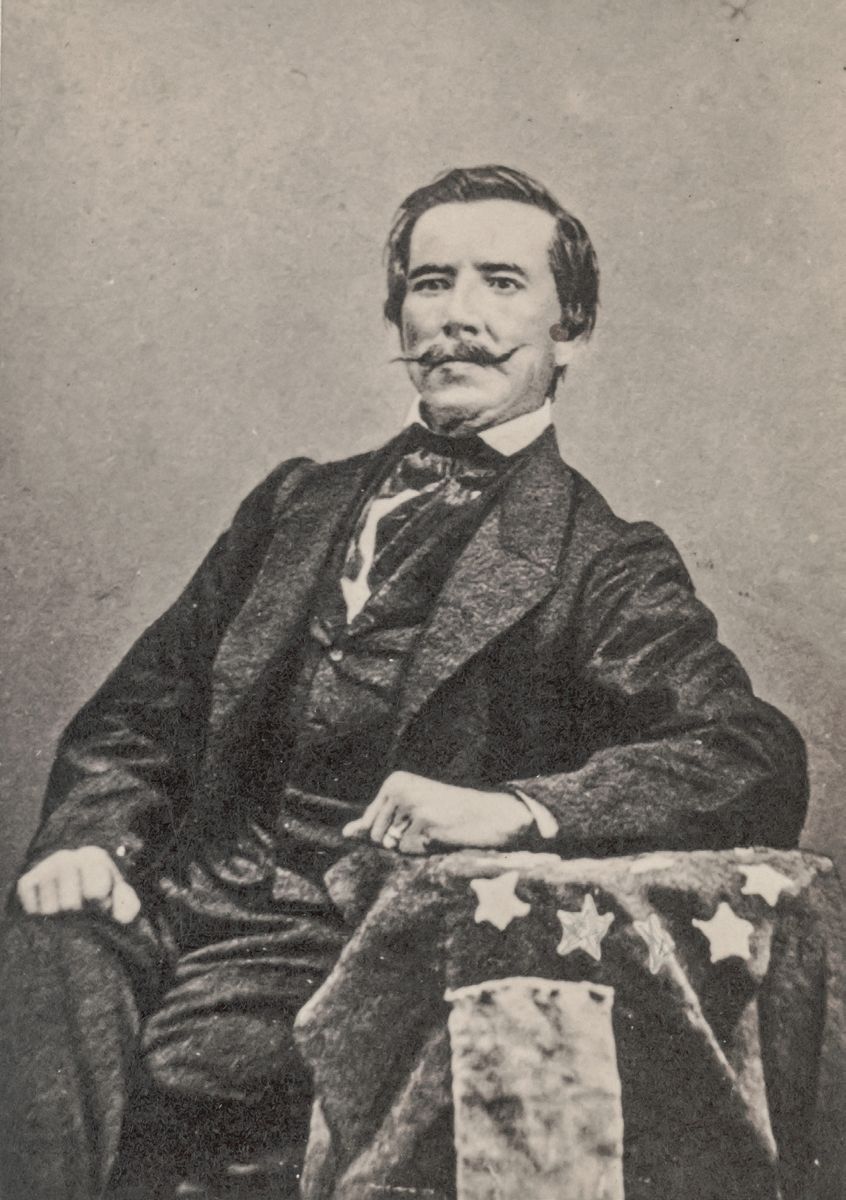
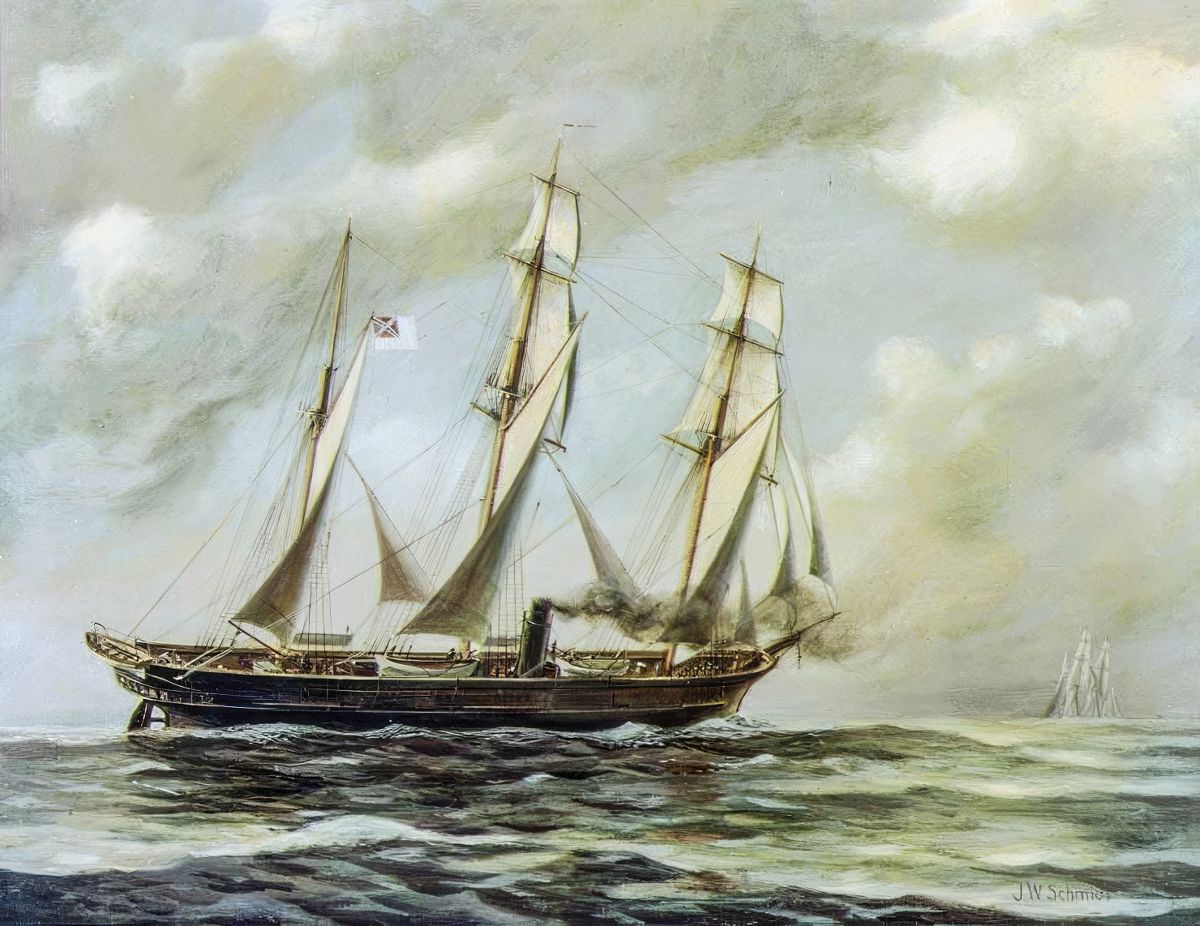
One of the pleasures of—and reasons for—reading the memoirs of participants in important events is to get at their recollections, ongoing thoughts and ruminative feelings. Historians and even biographers have a way of casting filters between “primary sources,” such as autobiographies and reminiscences, and our reading of them. Indeed, the very objectification of the writings of dramatis personae as “primary sources” is to render them as something “scientific,” to be studied like organisms in a Petri dish. As if aware of this filtering, Confederate Rear Admiral Raphael Semmes (1809–1877) set out soon after the war to compose his memoirs as a life-story that no one could tinker with. At times he drew from a journal he kept during the war, allowing him to recall, for instance, the vexatious delta mosquitos (“these little picadores”). He wrote truthfully and voluminously (over 800 pages), as if not even caring whether anyone would read his work at all. In other words, he was writing for himself. Or maybe not. “The writer has discarded the didactic style of the historian,” Semmes explains in his Preface, “and adopted that of memoir writing, as better suited to his subject.” In this vein Semmes chose to write with something approaching the emotions of wartime. “Feeling is an important element in the real drama that is passing before the eyes of the beholder,” he announces, as he declares that he was writing with the sensibilities of a Southerner. “That his book,” Semmes added, “will be generally read by the Northern people he does not suppose.”1 More to the point, he just didn’t care. Some memoirs begin with a summary of their writer’s biography. Raphael Semmes chose not to, so it is for us to set the stage. Semmes was born in southern Maryland in September 1809 and grew up in Georgetown, D.C. After being orphaned at the age of nine, he lived with an uncle involved in the merchant marine. Young Semmes thus became enthralled with the sea. Another relative helped him win appointment as a U.S. Navy midshipman at the age of sixteen. The navy had a practice of placing officers on leave without pay, so young Semmes read the law, passed the bar in 1833, and opened a practice in Cincinnati. But he wanted to be a seaman. Four years later he was a naval lieutenant and husband. Following postings, he moved his family to Pensacola, then Mobile; he came to call the latter place home. There he performed various shore duties. During the Mexican War he commanded four vessels. A month after Alabama seceded Semmes resigned his commission. When war came Semmes was 53. “I had already passed the prime of life,” he admitted, “but I thanked God, that I had still a few years before me, and vigor enough of constitution left, to strike in defence of the right.” In Montgomery he met with President Davis, who was eager to enlist the services of a tried naval officer. On April 4 he was appointed commander in the infant C.S. Navy. Semmes asked naval secretary Stephen Mallory for a vessel suitable for commerce raiding—seizing Northern merchantmen as prizes—and was given the Sumter, a fivegun cruiser. On June 30, 1861 he sailed the Sumter out of New Orleans and into the Gulf of Mexico. “I reflected upon my mission, to strike for the right! To endeavor to sweep from the seas the commerce of a treacherous friend, who had become a cruel and relentless foe.” In six months he captured eighteen Northern vessels, burning them at sea when he was denied access to bring them into neutral ports such as Cienfuegos, Cuba. He at first had trouble there; the port authorities “did not know what to make of the newborn Confederate flag.” Sailing across the Atlantic, Semmes took his ship to Gibraltar for repairs. When Union warships blocked the way out, Semmes left the Sumter behind and made his way to London.2 In England, Cmdr. James Dunwoody Bulloch had arranged for a prominent builder, the William Laird and Sons Company of Liverpool, to construct a warship suited to raiding commercial vessels on the high seas. 290—Laird’s 290th ship-was formally commissioned in August 1862 as the Alabama. Semmes took command, hired a crew, and set out. “The great object now,” he recalled, “was to destroy, as speedily as possible, the enemy’s commerce, and to this I devoted all my energies.”3 During its almost two years at sea, Semmes and the Alabama captured/destroyed 54 Northern vessels—“more enemy vessels than any other ship in naval history,” writes Warren F. Spencer.4 At the same time, the captain was scrupulous in following maritime law: if cargo on a commandeered vessel was documented as foreign-owned, he let it alone. On the other hand, “in the absence of sworn proof, the rule of law is imperative, that all property found on board of an enemy’s ship is presumed to belong to the enemy.” Such was the case of the New York bark Olive Jane, which the Alabama ran down on Feb. 21, 1863.5 Semmes kept sharp discipline among his crew (drawn from around the world), except when allowing them to occasionally carouse while in port. Afloat in the evenings, he enjoyed the men’s pitching into song, especially when “Dixie” came around. “The whole ship would be in an uproar of enthusiasm” he recalled, “sometimes as many as a hundred voices joining in the chorus; the unenthusiastic Englishman, the stolid Dutchman, the mercurial Frenchman, the grave Spaniard, and even the mysterious Malayan, all joining in in the inspiring refrain,—‘We’ll live and die in Dixie!’”6 High seas privateering required a little sneakiness. When approaching a suspected enemy ship, Semmes had the U.S. flag flown until closing in on his prey. In October 1863, the Alabama was cruising the Java and South China Seas when she came upon a New York clipper, the Contest. Hoisting at first the Stars and Stripes, Semmes then hauled it down and ran up the Confederacy’s Second National Flag, the Stainless Banner. “We were now wearing that splendid white flag, with its cross and stars,” Semmes writes, “which was so great an improvement upon the old one” (meaning, the Stars and Bars).7 Semmes and his vessel finally met their match on June 19, 1864 off Cherbourg. There they encountered the U.S.S. Kearsarge, which blocked the channel. “Semmes decided that the ship should fight rather than rot in a French port,” writes Dr. Spencer. After an hour of trading shots, Semmes’ vessel started sinking. “We fought her until she could no longer swim,” Semmes recalled, “and then gave her to the waves.”8 Semmes was proud of his accomplishments. He set out
CivilWarNews.com hoping that his commerce raiding would force the enemy to draw blockading warships from the Southern coast. But he settled on knowing that his preying on Northern merchantmen was driving up insurance rates for them, forcing many to stay at home, cowering in port. In December 1861 he recorded, “the enemy was fast losing his Mediterranean trade, under the operation of high premiums for war risks.” By the spring of 1863, American shippers were avoiding the common transoceanic routes out of fear of the Alabama. Even though the Union Navy declined to siphon away from the blockade, “his success against merchantmen,” writes Dr. Spencer, “led merchants worldwide to refuse to ship under the U.S. flag.” Before the war, the American merchant marine was second in the world; it never recovered.9 Semmes wrote proudly of his damage to Northern commerce. During the war, “It went down to zero, and since the war it has not revived.”10 As a good Confederate, Semmes opens his book with a lecture on the constitutional validity of secession. Aside from arguments over slavery and the tariff, Yankees and Southerners were so different in their origins and cultures as to have become “two distinct nations.” Semmes’ unabashed partisanship is shown in this passage from his Memoirs: The Yankee is certainly a remarkable specimen of the genus homo. He is at once a duck, and a chicken, and takes to the water, or the land, with equal facility. Providence has certainly designed him for some useful purpose. He is ambitious, restless, scheming, energetic, and has no inconvenient moral nature to restrain him from the pursuit of his interests, be the path to these never so crooked. In the development of material wealth he is unsurpassed, and perhaps this is his mission on this new continent of ours. But he is like the beaver, he works from instinct, and is so avid of gain, that he has no time to enjoy the wealth that he produces. Some malicious demon seems to be goading him on, in spite of himself, to continuous and exhausting exertion, which consigns him to the tomb before his time, leaving a “pile” of untouched wealth behind him.11 Semmes enjoys telling how his vessel ran down enemy ships, “overhauling her enemy, with the ease of a trained courser coming up with a saddle-nag.” As he burns Northerners’ vessels, he is mindful of their government “starving an entire people, women and children included.” “Whenever we heard a Yankee howl go up over a burned ship, we knew that there were fewer dollars left, with which to hire the canaille of Europe to throttle liberty on the American continent.12 For his accomplishments Semmes was promoted to rear admiral in early 1865. He was in Richmond when the capital fell.
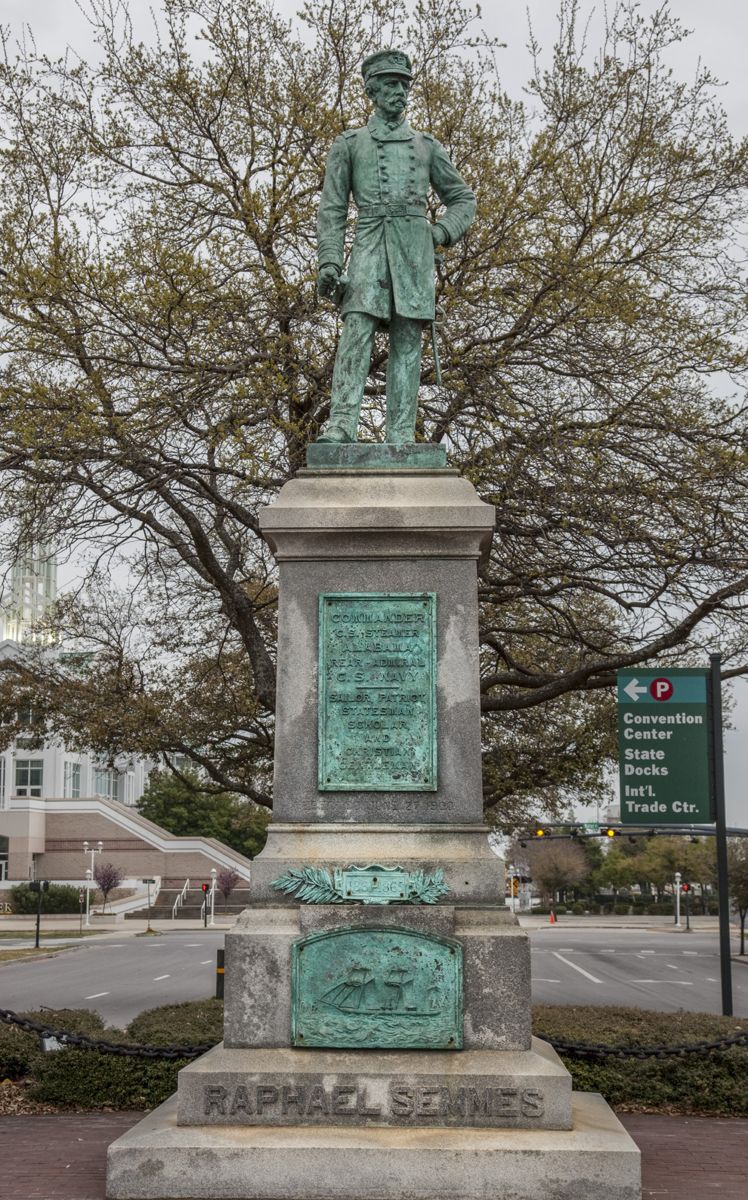
As the Confederacy collapsed and President Davis was fleeing the city, he appointed Semmes a brigadier, commanding a small contingent of troops accompanying Davis’ entourage. Semmes thus holds the singular distinction of having served the Confederacy as both navy admiral and army general. He was dispatched to Johnston’s army in North Carolina, where he surrendered and was paroled. Returning to Mobile, Semmes bean a law practice. In the next few years he composed his lengthy memoir. He left this life in 1877 and is buried in Mobile’s Catholic Cemetery with his wife Anne. The UDC and SCV have dedicated a biographical tribute alongside their grave.13 Semmes ends his reminiscence with commentary of the Reconstruction strife then ongoing between President Johnson and the Congress. He did not sound optimistic: “The form of government having been changed by the revolution, there are still other acts of the drama to be performed.”14 Boy, was he right. Endnotes
- Raphael Semmes, Memoirs of Service Afloat During the War Between the States (Secaucus NJ, 1987 [1869]), 8-9, 112. 2. Warren F. Spencer, “Raphael Semmes” in Richard N. Current, ed., Encyclopedia of the Confederacy, 4 vols. (New York: Simon & Schuster, 1993), vol. 3, 1392-1393; Semmes, Memoirs, 119, 138. 3. Warren F. Spencer, “Laird Shipyards” in Richard N. Current, ed., Encyclopedia of the Confederacy, 4 vols. (New York, 1993), 904; Semmes, Memoirs, 666. 4. Spencer, “Laird Shipyards,” 904. 5. Semmes, Memoirs, 578; William
Marvel, The Alabama & the Kearsarge: The Sailor’s Civil War (Chapel Hill, 1996), 120. 6. Semmes, Memoirs, 455. 7. Marvel, Alabama & Kearsarge, 191; Semmes, Memoirs, 693. 8. Spencer, “Raphael Semmes,” 1394. 9. Semmes, Memoirs, 289; Spencer, “Raphael Semmes,” 1393. 10. Semmes, Memoirs, 697. 11. Semmes, Memoirs, 285, 481-82. 12. Ibid., 576, 614, 623. 13. William C. Davis, “Raphael Semmes,” in Davis, ed., The Confederate General, 6 vols. (Harrisburg, 1991), vol. 5, 141, 143. 14. Semmes, Memoirs, 833. Like many boys, Steve Davis grew up with the hobby of dinosaurs. (He can still draw a mean tyrannosaurus.) Since the fourth grade, though, the Civil War has been his passion. In high school he entered an historical essay contest and wrote on Matthew Fontaine Maury—and won a prize! Of course, at Emory he took Bell Wiley’s Civil War class. A Master’s from Chapel Hill followed, then a Ph.D. at Emory, where he devoted his dissertation to the role of the Civil War in the Southern arts. (A descendant lent him some of Allen Redwood’s drawings; they’re now at the Museum of the Confederacy.) He’s now written ten books, edited a couple more, and written hundreds of articles and book reviews. At seventy-five, Steve shows no signs of slowing down. Savas Beatie will publish his The National Tribune Remembers the Atlanta Campaign next year. And watch for that counterfactual coming out from Shotwell Publishing!