
The Unfinished Fight
Private Orrin Cook, 22nd Massachusetts Company B
By Craig L. Barry · Originally published September 2023 · pp. 10–12
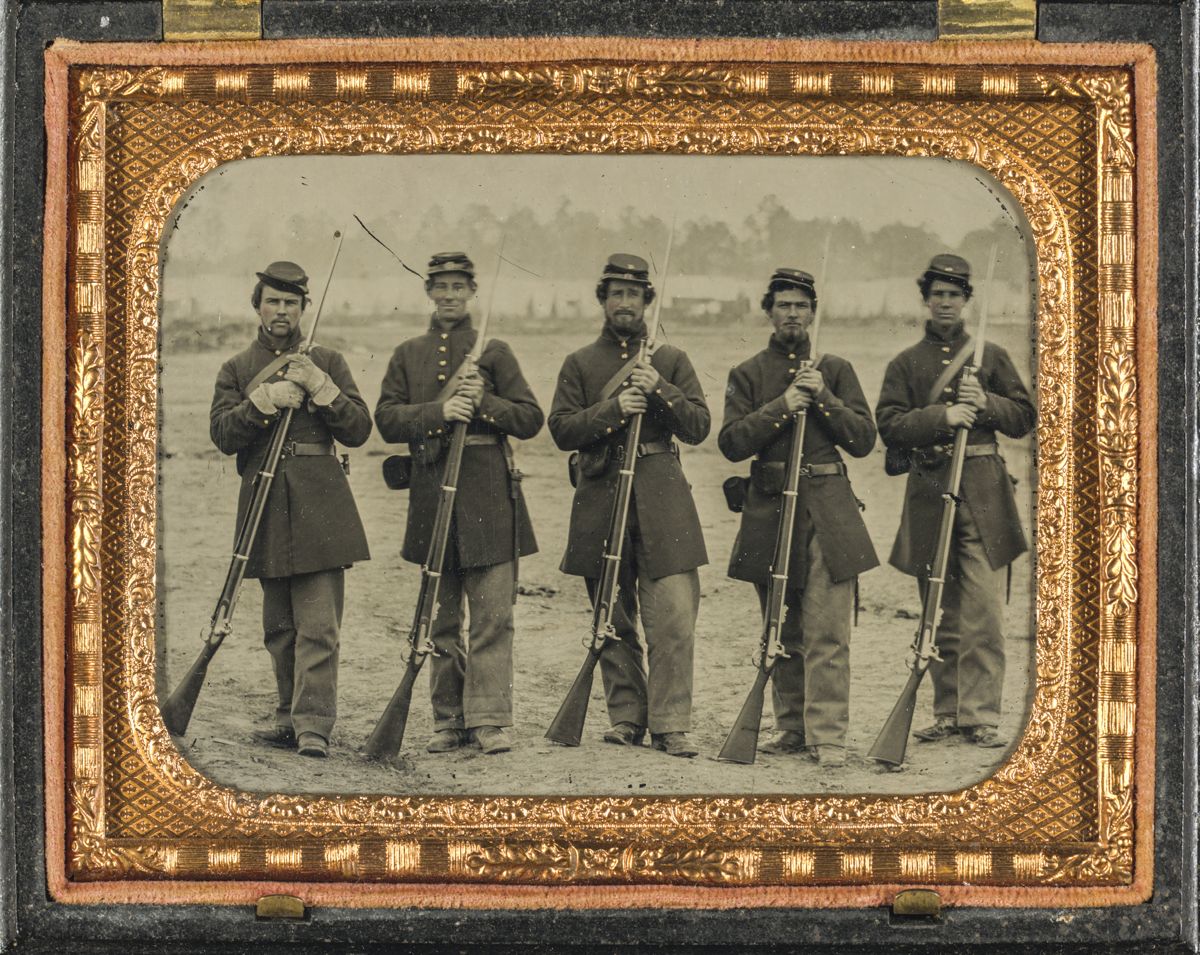
Private Orrin Cook, 22nd Massachusetts Company B “Some of our boys got Austrian rifles, some Enfield, and others Springfield. I got the Enfield, and Bob got the finest arm of the whole lot, a fine United States Springfield rifle. Training in the use of these weapons was startlingly belated and haphazard.” – Diary of Pvt. Orrin W. Cook, Company B. 22nd Regt. Massachusetts Volunteers, November 1863. Orrin W. Cook was a lumberman in western Massachusetts when the U.S. Civil War began. He later worked as a billing clerk for Robinson, Marsh & Company, a lumber yard in Springfield, Massachusetts. Cook avoided volunteering for military service until he was drafted during July 1863. Cook’s father offered to pay for a replacement but Cook declined and mustered in to the 22nd Massachusetts and was assigned to Company B. Cook was badly injured in both legs at the 1864 Battle of the Wilderness, then captured by the Confederates, and spent five months recuperating at the hospital in Lynchburg, Va. He was lucky to have survived his injuries. Cook was also lucky in that he was paroled in one of the last 1864 prisoner exchanges before General Grant stopped the practice. Pvt. Cook got a surprise though when he learned upon his return that “…the authorities are sending to the field all men that are fit to go.” Cook notes in his diary with a sense of relief that the Assistant Surgeon at the hospital ruled that “…my legs were hardly fit for field duty.” Pvt Cook served out the remainder of the Civil War as a clerk with the Navy in Annapolis, Md., and mustered out in November 1865. The 22nd Massachusetts Regiment entered the war in 1861 as ninety-day recruits. They were assigned to the Army of Potomac (AoP) and fought in the Peninsula Campaign at Gaines Mills, followed by Second Manassas, Antietam, Fredericksburg, including an illfated charge at Marye’s Heights, and the remaining men were at Chancellorsville although largely held in reserve. Whatever the case, by Gettysburg in July 1863, the 22nd Massachusetts Regiment was down to 127 active soldiers. Rather than create entirely new regiments composed of all new recruits, the AoP command structure began refilling existing regiments. This policy was in effect when Orrin Cook and his fellow recruits arrived during November 1863. The theory was that by mixing new recruits in with seasoned veterans, the learning curve for (Library of Congress)
the newer soldiers would be greatly reduced. Instead, Cook found the veterans were resentful and largely dismissive of the “fresh fish.” He notes in his diary that he felt somewhat “ill at ease” among them and wonders why he is “so generally regarded with aversion.” It is another good observation recorded by Pvt. Cook and a worthwhile subject for another day. Also of interest is what Pvt. Cook notes about infantry arms issued to the 22nd Massachusetts, compared to what the records indicate for U.S. and C.S. units in 1864. The appendix of Earl Coates & Dean Thomas, An Introduction to Civil War Small Arms, was compiled by William O. Adams who is extremely reliable. Here is a graphic representation of the totals to summarize the distribution of Union arms in the ranks by 1864: The table paints a surprising picture, particularly the large number of Union regiments still outfitted entirely with the imported Enfield P53 long rifle as late as 1864, about a year after the U.S. government contracts with Birmingham Small Arms Trade were canceled. The contracts were canceled because of the newly manufactured U.S. M1861s were available in sufficient quantities to replace them. If many still harbor the impression that M1861s were issued en-masse to Union troops as replacements during 1863, it appears this is not the case. This chart also supports the observations of Pvt. Cook in terms of the variety of rifled arms potentially issued to the 22nd Mass Regt in late 1863. It is understood that due to shortages early in the Civil War, most small arms were issued as they became available. For example, the U.S. Ordnance Department shipped 114 cases to Michigan units, which arrived in on Nov. 4, 1861. If the records are to be trusted, 30 of these cases contained new Enfield P53 riflemuskets and the remainder held what were broadly described as “Prussian muskets.” In all likelihood these “Prussian muskets” were older, large caliber, smoothbore weapons from a number of sources, including Belgium. Hence, regiments armed on or after Nov. 4, 1861, received a mix of infantry arms consisting of some modern rifle-muskets, and some clunkers. However, to make amends, by mid-February 1863, the U.S. Ordnance department re-issued to these same Michigan units 50,000 new Model 1861 rifle-muskets. As might be expected, those still armed with the obsolete second (or third) class “Prussian muskets” received the new M1861s and those with previously issued Enfield P53 rifle-muskets would have retained them if they were still serviceable. These regiments are no doubt included on the above chart listed among the 6% armed with “mixed P53 and M1861s.” Also, depending on availability, the replacements were not always exclusively M1861 or U.S. model 1863 rifle-muskets until well into the year 1864. According to Pvt. Cook’s diary, in November 1863, the 22nd Massachusetts Company B was issued a mixture of various type rifled arms including the Austrian rifle Model 1854 (Lorenz), M1861s and P53 Enfield long rifles. The only attempt at standardization if there is any, appears to be a rifled arm in the bore diameter of the U.S. standard .58 (or the close approximate .577) caliber. While the Lorenz could be found in a multitude of bore diameters, most U.S. contracts by 1863 specified .58. At least the same size ammunition would work (in theory) for all these arms, which was something the Confederacy struggled with for the entire war. It is important to consider the system in place for issuing small arms during the Civil War, and it appears to be virtually the same system for both the U.S. and C.S. Ordnance. When a soldier was injured, killed, or disabled he did not retain his weapon or accoutrements or have them buried with him. These items were government property and returned to the Ordnance Department for reissue. If an injured soldier recovered and subsequently returned to a line unit, he would be issued another stand of arms at that time. In modern parlance, Ordnance was “recycled.” The decision to re-issue arms was based on two factors. First, the field command had to complete a requisition to the Ordnance Department for replacements. This is the opposite of the Quartermaster Department where items such as jackets, coats, trousers, socks,
Firearm Regts Enfield P53 U.S. Model Austrian Rifle (Lorenz) U.S. M1842 musket Mixed P53 and U.S. M1861 U.S. M1841 rifle Enfield short rifle
CivilWarNews.com boots, tents, and rations were issued on a semi-regular basis. The Ordnance Department did not automatically issue new arms or accoutrements as replacements on any regular basis. Second, the Ordnance Department had to determine whether they could fill the requisition and to what extent. An order for M1861s which had been previously promised as an inducement to a group of new recruits was sometimes filled with whatever was on hand. John M. Gould noted in History of the First-Tenth-Twenty-ninth Maine Regiment: “Oct. 21st, muskets were delivered to the men, and this furnished another excuse for a hearty growl from the 1st Mainers. “Had we not been promised new blue uniforms and new [U.S. Model 1861] Springfield muskets…look at these Enfield muskets with their blued barrels and wood no man can name.”
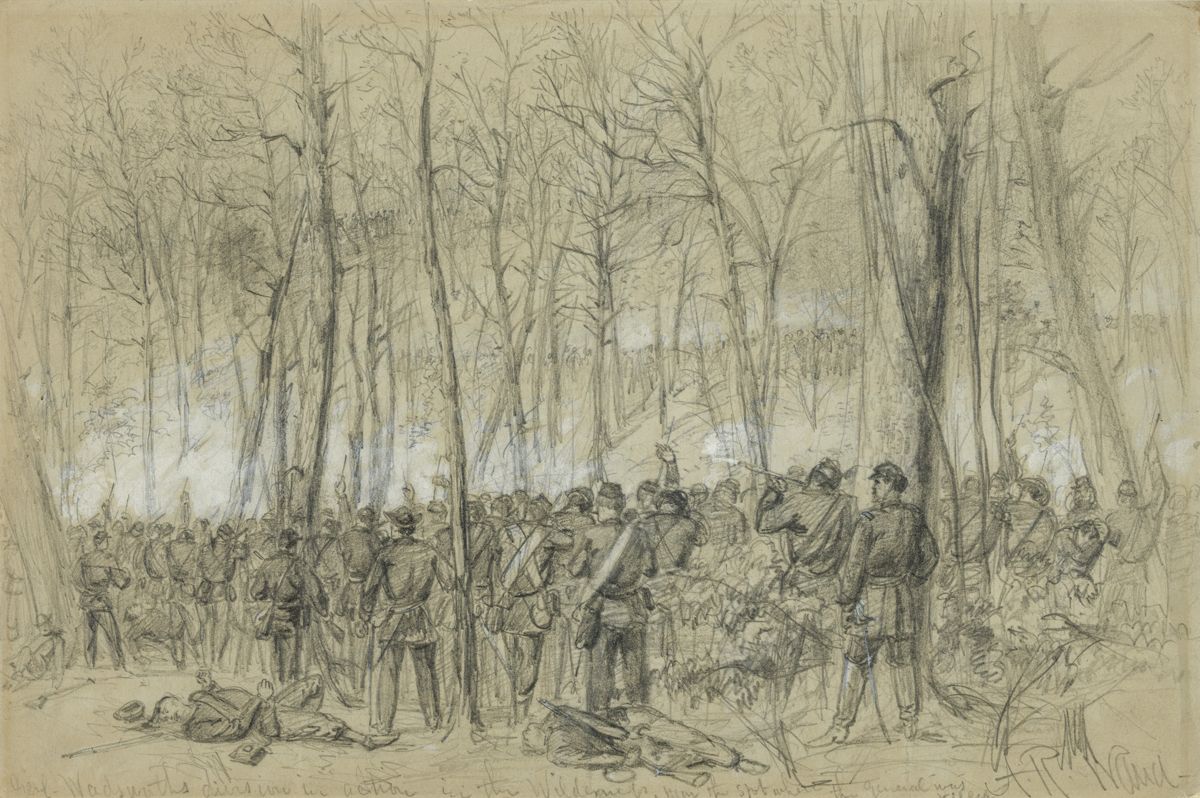
Wounded escaping from the burning woods of the Wilderness. (Library of Congress)
In another such instance, an order for new M1861s from General Irvin McDowell received the following response from Chief of Ordnance General James Ripley: “We have no Springfield arms but will send the best of what is in the Washington Arsenal in fifty-eight calibre… the best foreign arms in depot and in New York have been ordered to you.” Accoutrements were also filled through the Ordnance Department and there are many recorded instances of mismatched sets. For example, a soldier who turned in his .69 caliber smoothbore musket for a newer model .58 caliber rifle-musket would not simultaneously receive a new matching set of .58 sized U.S. accoutrements. The soldier was expected to keep his old set until it was no longer serviceable, never mind if the smaller size ammunition fit in the box or the different bayonet fit properly in the scabbard. Hence, we don’t know if all new U.S. model rifle-muskets were requisitioned for the 22nd Massachusetts recruits in late 1863, but most likely it would not have mattered. Pvt Orrin Cook and his comrades ended up with whatever mixture of serviceable weapons were available, some of which would have likely already seen previous action and some which may have been refurbished. Only after the existing stockpiles of returned serviceable small arms were back in the ranks, would recruits in the 22nd Massachusetts receive new arms, the coveted prize which Pvt. Cook refers to as the best arms of the whole lot, “a fine United States Springfield rifle.” There are no documented examples during the Civil War of any soldier on either side discarding a serviceable U.S. M1861 rifle-musket in favor of something else. Craig L. Barry was born in Charlottesville, Va. He holds his BA and Masters degrees from UNC (Charlotte). Craig served The Watchdog Civil War Quarterly as Associate Editor and Editor from 2003–2017. The Watchdog published books and columns on 19th-century material and donated all funds from publications to battlefield preservation. He is the author of several books including The Civil War Musket: A Handbook for Historical Accuracy (2006, 2011), The Unfinished Fight: Essays on Confederate Material Culture Vol. I and II (2012, 2013). He has also published four books in the Suppliers to the Confederacy series on English Arms & Accoutrements, Quartermaster stores and other European imports.