
Brig. Gen. William H. Morris: A Forgotten Casualty of Spotsylvania
By Tim Talbott · Originally published September 2023 · pp. 13–14
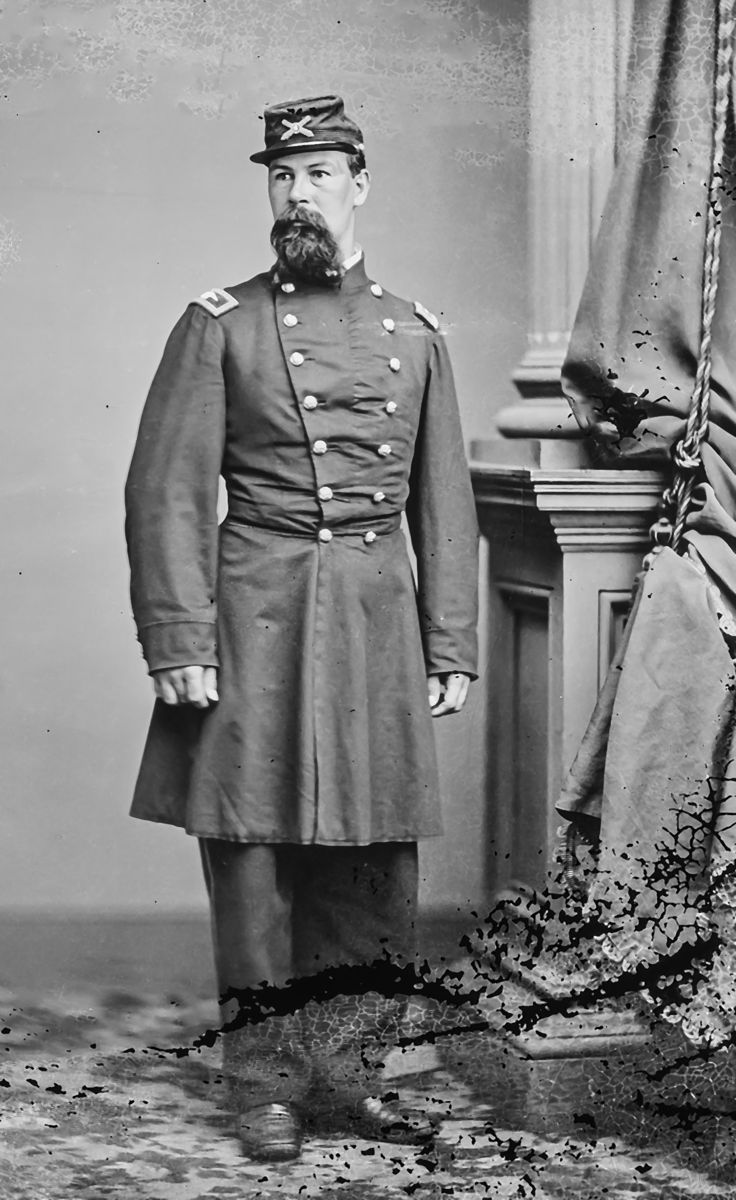
Brig. Gen. William H. Morris: A Forgotten Casualty of Spotsylvania By Tim Talbott The opening three days of fighting at Spotsylvania Court House proved deadly for several general officers in the Army of the Potomac. On May 9, 1864, VI Corps commander Maj. Gen. John Sedgwick fell victim to a sharpshooter’s bullet. The following day, Brig. Gen. James C. Rice received a mortal wound while commanding his V Corps brigade. In addition, Brig. Gen. Thomas G. Stevenson, who led a division in the IX Corps, still technically independent from the Army of the Potomac at this time, fell on May 10 as well. Interestingly, each of these men killed in action was later honored by the naming of three forts at Petersburg for them that were all in close geographical proximity to each other. In addition to those killed or mortally wounded during the opening days at Spotsylvania were the woundings of V Corps divisional commander Brig. Gen. John C. Robinson on May 8, and Brig. Gen. William Hopkins Morris, who commanded a brigade in James Ricketts’ division in the VI Corps on May 9. Morris is probably the least remembered of these five general officer casualties.
Morris wrote several books on tactics, including the second volume of his Infantry Tactics, published in 1865. (Public domain)
CivilWarNews.com Born in New York City in 1827, William Hopkins Morris came from a family with deep ties to American history. His lineage included two ancestors who signed the Declaration of Independence. As a young man, Morris seemed to have an affinity for military matters. He enrolled as a cadet at West Point in 1846 and graduated 27th out of 51 in his class of 1851. Serving in the U.S. Army as a second lieutenant, Morris spent time at Fort Columbus and Fort Wood in New York and then transferred west to Fort Yuma, California, until he resigned his commission in 1854. That year Morris returned to the Empire State to help his father edit the New York Home Journal newspaper. Morris also copatented the Conical Repeating Rifle with partner Charles L. Brown in 1859, which proved to be an unsuccessful attempt as an inventor. When the Civil War erupted, Morris enlisted and initially helped man the defenses of Washington D.C., serving on the staff of Gen. John J. Peck as assistant adjutant general. Peck’s brigade eventually received orders to participate in the Peninsula Campaign. As part of the IV Corps, commanded by Brig. Gen. Erasmus Keys, Peck’s regiments fought at Yorktown, Williamsburg, and Fair Oaks. Their limited role in the Seven Days’ Battles occurred at Malvern Hill. On September 1, 1862, Morris became colonel of the 135th New York Infantry, later redesignated as the 6th New York Heavy Artillery. Morris led this unit while stationed at Baltimore until December 1862. Moving to the Harper’s Ferry area that month, Morris received promotion to brigadier general in March 1863, and commanded a mixed infantry, artillery, and engineer brigade there. Although a participant in the Gettysburg Campaign, Morris’ brigade remained in a reserve role. That fall, they were involved in the Army of the Potomac’s movements between the Rapidan River and northern Virginia and back. Later transferred to the Third Corps, Morris’ brigade participated in the fighting at Mine Run. Morris did not file an official report on his brigade’s actions at Mine Run, but they did receive mention in division commander Joseph Carr’s report. Carr explained that he ordered Morris’ brigade “to charge and drive them from it [fence], which he did, driving the enemy through the fields beyond.” Morris and his brigade performed well, as Carr also added, “The enemy made repeated attempts to advance in front of the brigades of General Morris and Colonel Keifer, but were repulsed each time with heavy loss.” Fighting in the Wilderness, but now in one of two brigades in James Ricketts’ Third Division of the VI Corps, Morris’ brigade saw little action on May 5. After being shelled early in the day and losing three killed and 19 wounded, Morris received orders from Sedgwick to support the right end of the corps line that had been flanked, “I changed front so as to face to the right, in order to injure the enemy as much as possible with my fire as he advanced,” Morris reported. Later, while repositioning after a discussion with Sedgwick, Morris noted that in doing so, “The shells of the enemy were severe upon us…” May 7 and 8 were primarily days of movement and maneuvering for the brigade. They left the Wilderness battlefield on the night of May 7, marching toward Spotsylvania. Morris noted their route as “along the pike and plank road to Piney Branch Church, through Chancellorsville. We were on the march fifteen consecutive hours.” They arrived at Spotsylvania on the afternoon of May 8 and went to support the V Corps. Being positioned and reposited several
Capt. William Hopkins Morris began his Civil War career on the staff of Brig. Gen. John J. Peck. Morris appears third from the right in this photograph of Peck and his staff. (Library of Congress)
times during the day must have annoyed Morris and his men. On May 9, following orders to realign a couple of his regiments and while riding along his line, Morris “was wounded by a rifleball and rendered unfit for service in the field.” The shot apparently struck him near the right knee. Morris was still at the divisional field hospital the following morning, May 10, where he wrote his brigade’s official report that covered the Battle of the Wilderness to his wounding at Spotsylvania. A Confederate sharpshooter, or sharpshooters, made life along the VI Corps line particularly miserable on May 9. The marksman, or marksmen, made it dangerous for Battery H, 1st New York Artillery to operate their guns. A soldier in the 15th New Jersey noted that, “a rebel rifleman was posted on our right, in a tree. He seemed to kill at almost every shot and was said to have taken twenty lives.” One of the victims was the color sergeant for the 15th New Jersey, Samuel Rubadeau, who was shot through the chest. The same bullet also wounded Sgt. Israel Lum in the thigh. Was the harassing Confederate marksman who shot Brig. Gen. Morris the same one who shot these men and soon after killed
The repeating rifle that William Morris and Charles L. Brown developed before the Civil War never went into production. Charles L. Brown became major of the 34th New York Infantry and was killed at Malvern Hill on July 1, 1862. (Public domain)
This sketch by Alfred Waud shows the spot where Maj. Gen. John Sedgwick was killed. Morris was wounded nearby on the same day, May 9, 1864. (Library of Congress)
Sedgwick? It is difficult to know definitively, however, Sgt. Berry Benson, a sharpshooter in the 1st South Carolina Infantry, hinted in his memoirs of who he thought it was. Benson explained that a soldier named Ben Powell (officially a member of the 12th South Carolina), who was also in Gen. Samuel McGowan’s brigade but operated independently as what we would today call a sniper, came in from his day’s work on May 9 and said that “he had killed (or wounded) a Yankee officer.” Powell utilized a long-distance shooting Whitworth rifle with a telescopic sight for his work. Benson noted that “[Powell] had fired at long range at a group of horsemen he recognized as officers. At his shot, one fell from his horse, and the others dismounted and bore him away.” Benson speculated that Powell’s officer victim was Sedgwick and left it at that. However, several pieces of evidence indicate that Sedgwick was standing, not mounted, when killed; but Morris was riding, and his staff probably helped carry him to get medical attention. McGowan’s brigade was not in the area on May 9, but if Powell operated independently, as Benson explained, Powell might have wounded Morris. Morris spent several months recuperating from his painful wound. Although not requiring an amputation, he did not return to the field, serving instead on court martials in Washington D.C. until he formally left the service in August 1864. A doctor’s report on January 1, 1865, noted that Morris’ wound still “has not healed, and the limb remains swollen and painful.” After leaving the army, Morris stayed busy writing. He published Infantry Field Tactics in 1864 and Infantry Tactics (two volumes) in 1865. He also served in the New York Constitutional Convention in 1866. Morris received a brevet major general of volunteers rank from Congress in 1867. In addition, Morris continued editing the New York Home Journal. In 1879, Morris published another tactics book for troops using breechloading and repeating weapons. Dying at age 73 in 1900, Morris rests in Mountain Avenue Cemetery in Cold Spring, N.Y. CVBT has helped save over 150 acres of Spotsylvania battlefield land. The mission of CVBT is to preserve land associated with the four major campaigns of Fredericksburg, Chancellorsville, Mine Run, and the Overland Campaign, including the Wilderness and Spotsylvania Court House. To learn more about this grassroots preservation non-profit, which has saved over 1,700 acres of hallowed ground, please visit: www.cvbt.org. Tim Talbott is the Chief Administrative Officer of the Central Virginia Battlefields Trust.
General Sedgwick A Short Note
On May 9, 1864, during the Battle of Spotsylvania Court House in Virginia, General Sedgwick met his untimely end. He was standing with his staff and troops when Confederate sharpshooters began firing at them from a distance of about 1,000 yards. As the soldiers sought cover, Sedgwick reportedly showed characteristic bravery and dismissed the danger, declaring, “They couldn’t hit an elephant at this distance.” Tragically, those were his last words, as moments later, a bullet struck him just below the left eye, killing him instantly. The news of Sedgwick’s death spread rapidly, sending shockwaves throughout the Union ranks and eliciting profound grief from soldiers and civilians alike. He had been a highly respected and effective leader, known for his calm demeanor, strategic acumen, and genuine concern for his men’s welfare.