
The Graphic War
Photographers and Lithographers: A Fragile Co-existence Part II
By Salvatore Cilella · Originally published October 2023 · pp. 28–29
Photographers and Lithographers: A Fragile Co-existence Part II The Graphic War highlights prints and printmakers from the Civil War discussing their meaning and the printmaker or artist’s goals. Throughout the last half of the 19th century, printmaking and photography shared the stage of image making in America. As we have seen in the Robert E. Lee iconography, the two technologies worked hand in glove. Sometimes they acknowledged the “collaborative” efforts; other times they merely “appropriated” images available under loose or non-existent copyright rules. As we have noted in several earlier columns, printmaking before, during, and after the war was dominated by northern engravers, lithographers, and publishers. Foreign printmakers particularly saw an opportunity in the print market. One prominent European player was the Parisian firm of Goupil & Cie.
Founded in 1850, the company specialized in a worldwide trade in original art, reproductions, and art auctions. It quickly grew to include offices and galleries in London, Brussels, Berlin, and America. In conjunction with his business partner, Theodore Vibert, Jean-Baptiste Goupil established a company branch at 289 Broadway in New York City in either 1846 or 1848 (dates are vague and uncertain). Michael Knoedler, a Goupil employee from Baden-Wurttemberg, Germany, was sent to America to open and operate the branch.
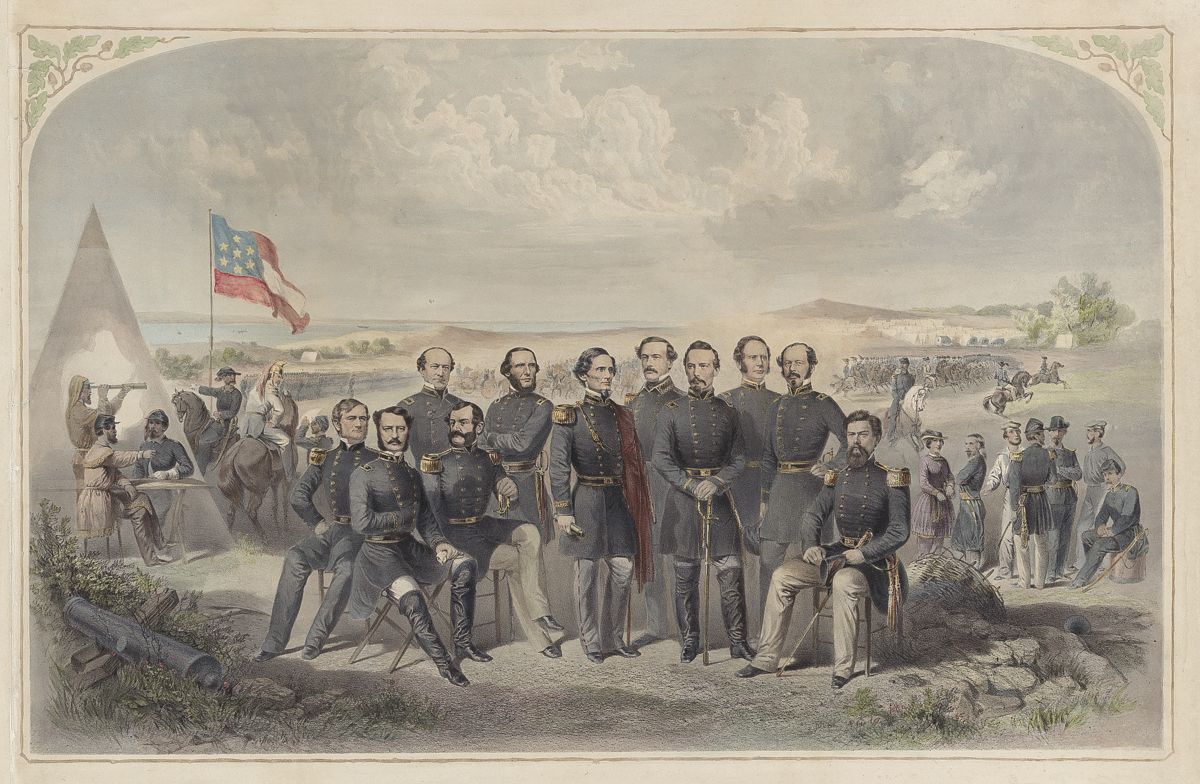
Although he eventually bought out Goupil, Knoedler continued to work with the firm. In 1861, they were one of the earliest to produce a Civil War print. Unfortunately, the artist is unknown, but Knoedler and Goupil were listed as the publishers. Entitled Jefferson Davis and his Generals, it is a rare documentation of the brain power of the early Confederacy. (Figure 1). It is also a commentary on the vicissitudes of politics and warfare. Pictured are Jefferson Davis, front and center surrounded by his earliest commanders, “several of whom were soon forgotten.”1 From left to right: Leonidas Polk, John Bankhead Magruder, a General Simmons, George N. Hollins, Ben McCulloch, Davis, Robert E. Lee, P.G.T. Beauregard, Sterling Price, Joseph E. Johnston, and William J. Hardee. As Holzer et. al. revealed, “The likenesses of several of the generals—Johnston, Lee and Hardee…were based on Mexican War era photographs more than a decade out of date.”2 It’s unclear who General Simmons is but he may be South Carolinian James Simons who served “as a brigadier general of militia commanding on Morris Island during the Fort Sumter bombardment.”3 The National Portrait Gallery, Smithsonian Institution, identifies him as Georgian Thomas Jefferson Simmons (1837–1905). According to his biography, he saw action in Virginia in A. P. Hill’s Division of Longstreet’s Corps as a colonel from 1862.4 The date of the print may be in error as Lee’s reputation as a “hero” or “leader” was cemented later, after he assumed command of the Army of Northern Virginia following the spring 1862 defense of Richmond. There is no record of Simmons’ promotion to general. What is most striking about this print and similar other ones is that they resemble a tableau or stage scene. Close examination reveals that it, and those that followed, consists of two major elements. The gathering of heroes in the center front appears to be a set piece plopped into an active scene or scenes of warfare. On the left is the ersatz Confederate flag that seems to resemble the paddle steamer CSS Curlew’s seven star First Naval Ensign.5 It is surrounded with busy officers receiving and dispatching orders.
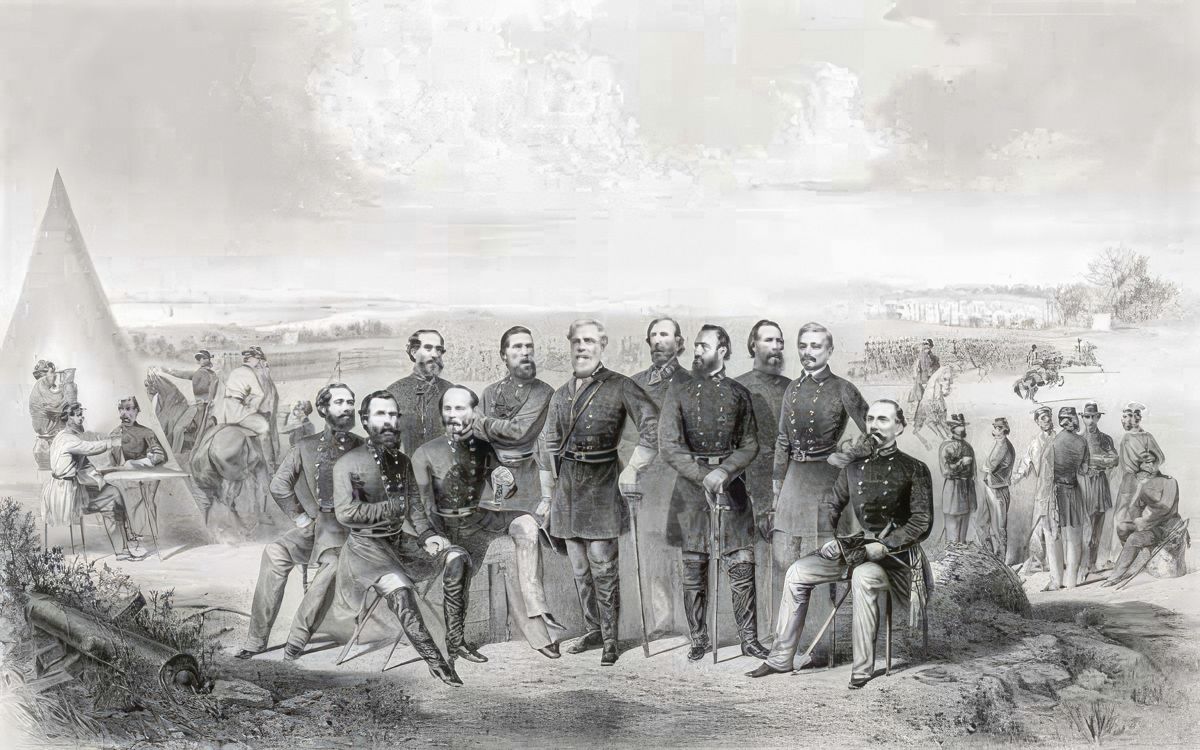
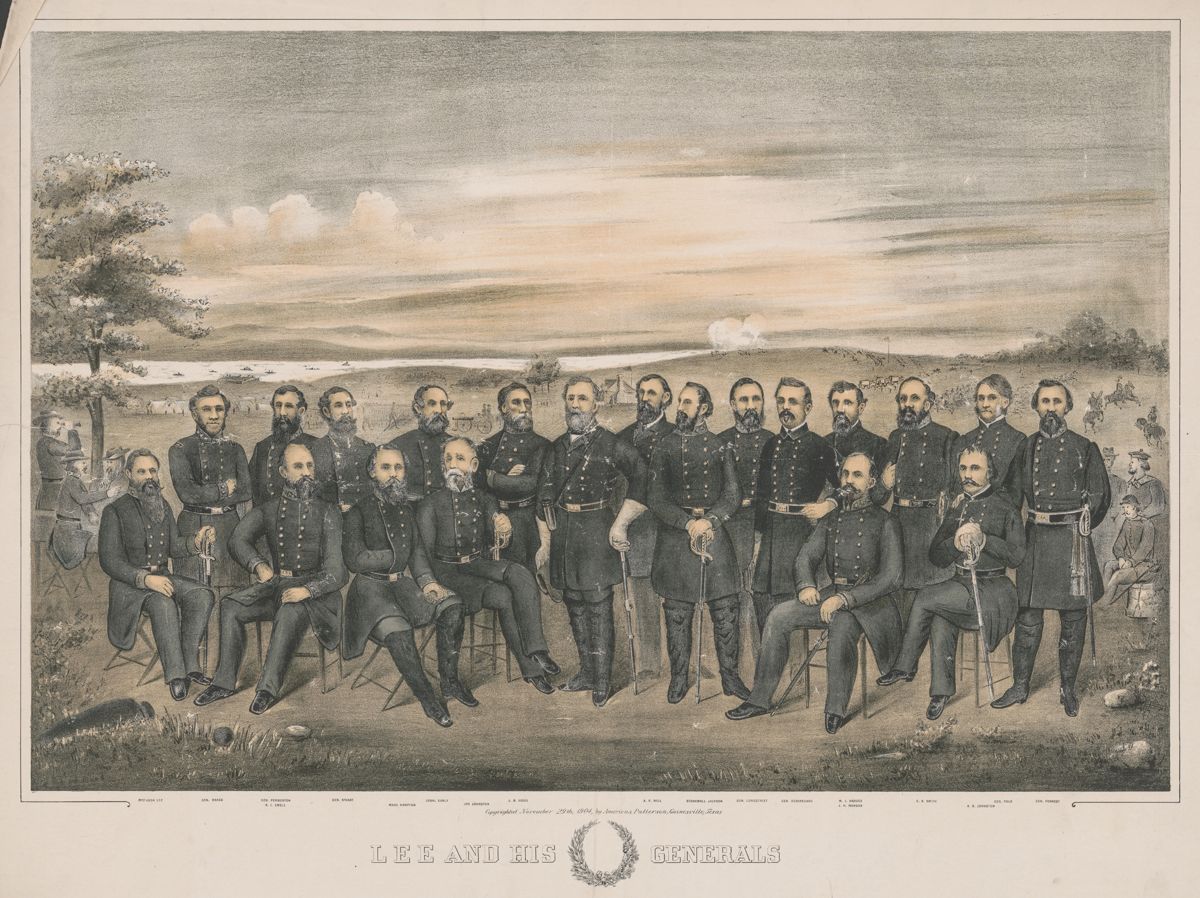
On the right, a cavalry maneuver is executed in the background as staff and other personnel converse in the near foreground. Near the end of the war, Goupil issued a new version of its ca 1861 print. This lithograph, with tinting, featured Robert E. Lee in place of Davis, and included only the best known and most accomplished Southern generals. They are (left to right) Wade Hampton, James E.B. CivilWarNews.com Stuart, Jubal A. Early, Joseph E. Johnston, John B. Hood, Robert E. Lee, Ambrose P. Hill, Thomas J. Jackson, James Longstreet, P.G.T. Beauregard, and John H. Morgan. It is striking in that it includes Longstreet. These portraits are based on more recent photographs; the central tableau has been replaced by a new one. On the left, the “confederate” flag has been removed and the large tent has been emphasized; the right background and foreground remain essentially the same. Remarkably, in this black and white edition of Lee and his generals, all are dressed in dark uniforms. In the colored lithograph of Davis and his generals, they are dressed in Federal blue. With the war barely over, John Kelly copied earlier Goupil and Knoedler group portraits of Lee and His Generals. They were issued ca. 1865. (Figure 3). Once again, a tableau shows the Marble Man with 19 of his leading commanders. All the generals are identified in the print’s title margin, except for Lee, who was already immediately recognizable at war’s end. The print includes six who died during the war; J.E.B. Stuart, Stonewall Jackson, A.P. Hill, John Hunt Morgan, Albert Sidney Johnston, and Leonidas Polk. In the landscape, infantry and cavalry regiments are assembled, preparing for battle. An unknown river, perhaps the James, flows in the background. The origin and attribution of this particular image is murky. According to the National Portrait Gallery, this print was designed by John L. Giles a New York artist active from the mid1860s to 1882. He had worked on previous iterations of Lee taken from Minnis and Cowell’s photographs. Lee sports the same pose as earlier photos and prints with the sword in his left hand dropped to the ground. According to the Library of Congress, this print was not produced until 1904 and in Texas by an artist named Americus Patterson; a fact Holzer et. al. call “notable.” They suggest that the portraits are from photographs, however, the facial rendering of every individual is crude and poorly executed; it is possible none were taken from photographs. Remarkably, all of “Lee’s Lieutenants” are clad in blue uniforms.6 Holzer, et. al. erroneously attribute this print to Thomas Kelly of Philadelphia and New York.7 Thomas Kelly practiced only in New York; John Kelly had establishments in New York and Philadelphia. John Kelly published William Robertson’s Lee and His Generals, which has much more accomplished portraits and lacks the laurel wreath in the title margin. John was known for his Lincoln, Lee, and Davis portraits, and a lithograph depicting the 15th Amendment Print. Thomas Kelly was predominately known for his domestic and horse racing scenes. Historian Harry Peters praised Kelly and his Lee and His Generals for its “very excellent portrait of almost every Confederate leader of major importance.”8 Endnotes: 1. Mark Neely, Harold Holzer, & Gabor Boritt, The Confederate Image: Prints of the Lost Cause, University of North Carolina Press, Chapel Hill, 1987. Plate 2. 2. Ibid. 3. Bruce Allardice, More Generals in Gray, Baton Rouge: LSU Press, 1995, 209. 4. h t t p s : / / p r a b o o k . c o m / web/thomas_jefferson. simmons/105844. 5. h t t p s : / / e n . w i k i p e d i a . o rg / w i k i / F l a g s _ o f _ t h e _ Confederate_States_of_ America. 6. Ibid., Figure 87 caption, 64. 7. Ibid., 100. 8. Harry Peters, America on Stone, 248. See Plate 118. After 43 years in the museum field, Cilella devotes his time collecting American prints and maps and writing. His most recent books are Upton’s Regulars: A History of the 121st New York Volunteers in the Civil War (U. P. Kansas, 2009). His two-volume Correspondence of Major General Emory Upton, (U. of Tennessee Press, 2017), received the 2017–2018 American Civil War Museum’s Founders Award for outstanding editing of primary source materials. He has edited Upton’s love letters 1868-70, Till Death Do Us Part: (Oklahoma University Press, 2020). He has edited the Memoirs of Dewitt Clinton Beckwith of Upton’s Regulars (McFarland Press, 2023).