
Captured at Fairfield and Imprisoned at Belle Isle
By Gordon W. Gribble · Originally published October 2023 · pp. 16–17
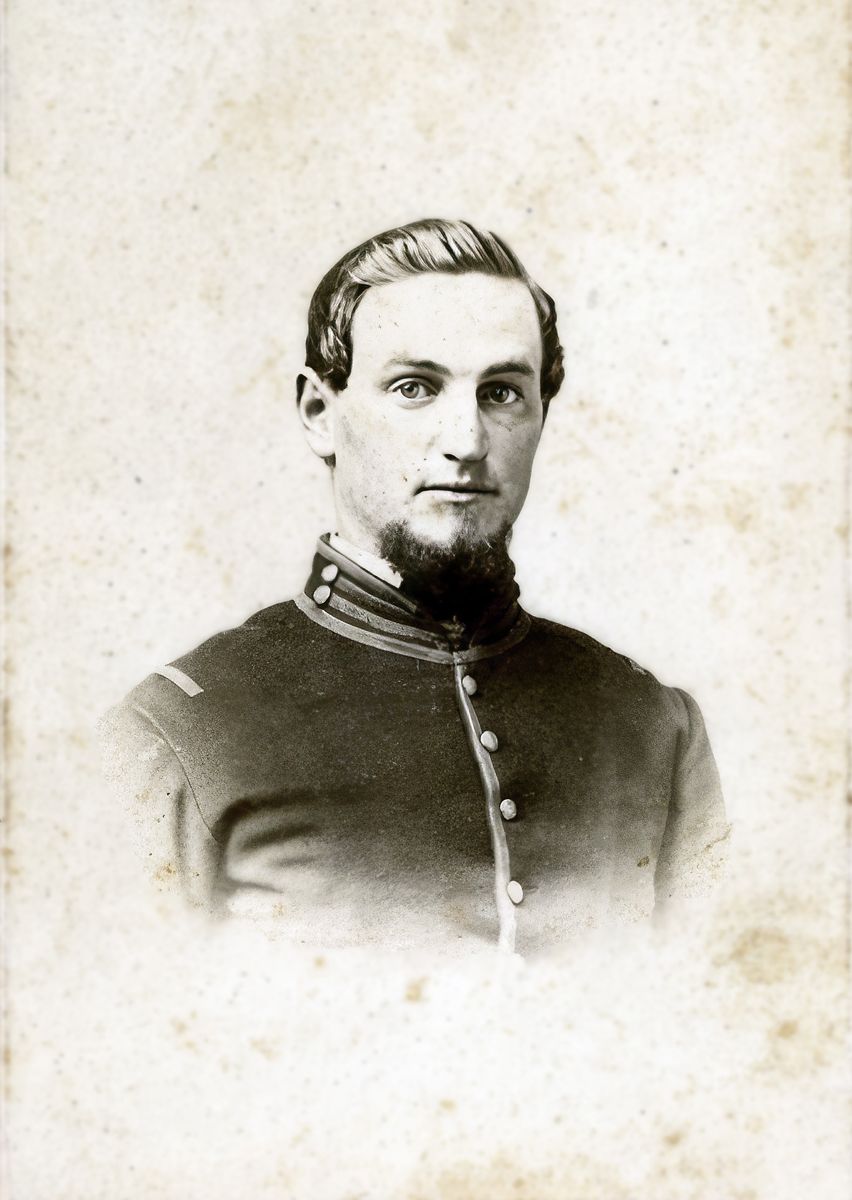
Captured at Fairfield and Imprisoned at Belle Isle Sgt. Harry Whitlock Lewis, 6th U.S. Cavalry
By Gordon W. Gribble Harry Whitlock Lewis was born in Harbor Creek, Penn., on August 30, 1840. He grew up in nearby Fairview on Lake Erie. He first enlisted on May 21, 1861, in the three-months McLane’s Regiment; then on July 29, 1861, he enlisted in Company G, 6th U.S. Cavalry as 1st Sergeant under Captain John Irwin Gregg. Following the horrendous fighting at Gettysburg on July 1–2, 1863, the morning of July 3 Harry Lewis and the Army of the Potomac’s Reserve Cavalry Brigade, consisting of 2,000 officers and men under General Wesley Merritt, were patrolling roads around Emmitsburg, Md., well behind the Confederate Army of Northern Virginia, and some 11 miles from Gettysburg. Sometime that morning a man, ostensibly a local citizen, rode into Merritt’s headquarters to report a lightly guarded Confederate supply wagon train in a valley just north Fairfield, about 10 miles north. There was some suspicion that this “citizen” was a Confederate spy, perhaps William Richardson who was subsequently captured and hanged on July 7 in Frederick, Md. Eager to capture the prize, Merritt detached the 6th U.S.
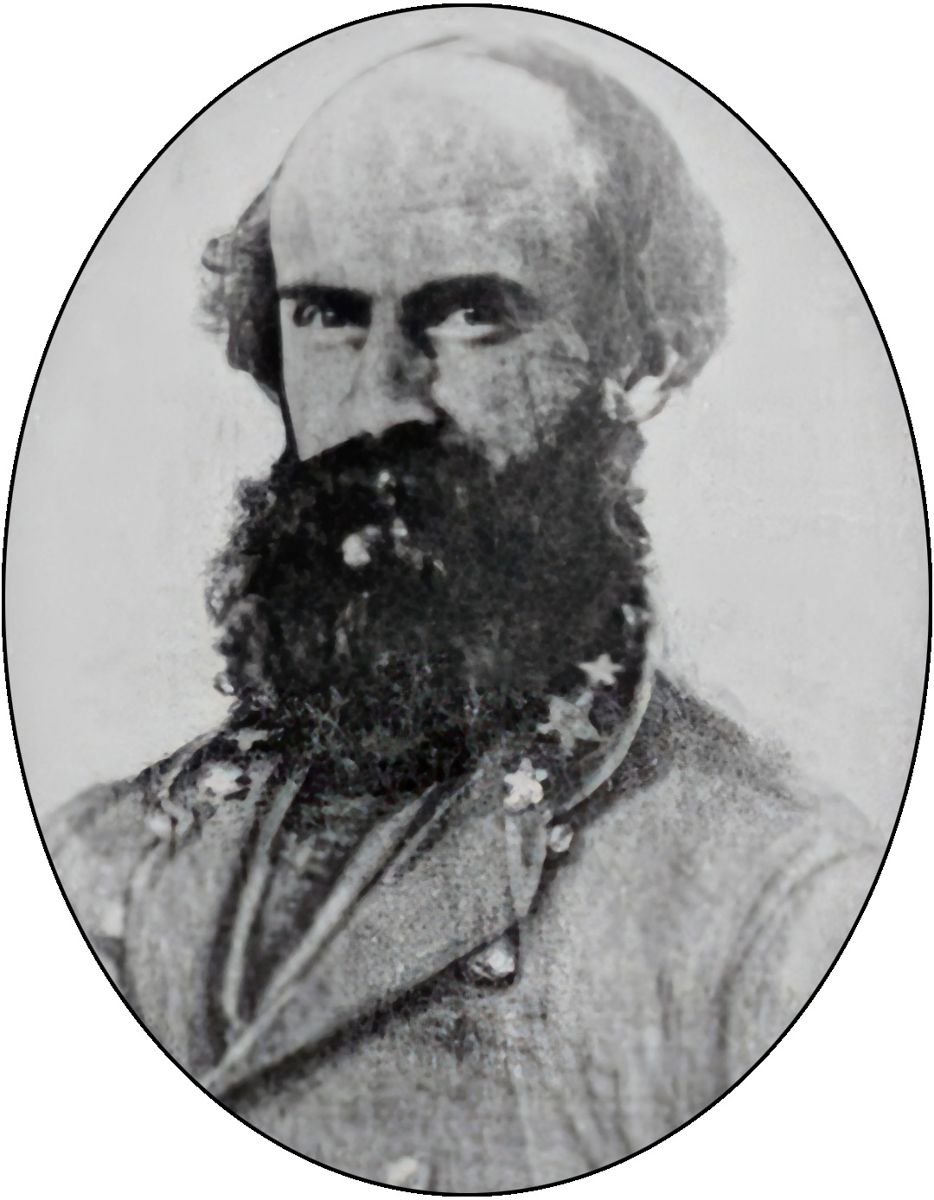
Cavalry’s some 400 officers and men under Major Samuel Henry Starr to seize these wagons. Approaching the wagons on the Fairfield-Orrtanna Road north of Fairfield and seeing only a small picket force guarding the wagons, Starr detached two companies (about 60 men) under Lt. Christian Balder to capture the wagons. Balder chased the retreating wagons, along with their guard, the 7th Virginia Cavalry, further north for about a mile. Suddenly, Balder and his men were confronted near the Marshall farmhouse stands today [1051 Carrolls Tract Road], not by a small picket force, but by the General William “Grumble” Jones’ full brigade, including the 6th, 11th, and 7th Virginia cavalry regiments, some 1,600 officers and men, along with Robert Chew’s Horse Artillery battery with five guns and 95 men. Balder realized he was outnumbered and withdrew in the direction of Fairfield. Viewing the situation, Major Starr sent the full complement of his Sixth U.S., 320 troopers to engage the Virginians. The resulting clash was short but intense; the badly outnumbered Yankee cavalrymen were solidly whipped and retreated toward Fairfield where many survivors were captured. The Sixth lost six men killed, 28 wounded, and 208 captured, a loss of 60%, while General Jones’ 1,600 men had a total loss of 58 killed, wounded, and missing. Major Samuel Starr lost an arm and Lt. Christian Balder was among the dead. A bright spot for the Sixth was that Private George Crawford Platt saved the regimental flag when the flag bearer went down amidst the swarming Confederates. Platt was awarded the Congressional Medal of Honor. The captured men, including Harry Lewis, were initially marched from Fairfield to Gettysburg where they were joined by thousands of other Union prisoners from the three-day battle. The Federal captives faced a long march to a Richmond prison. During the consolidation of Union prisoners, a new prisoner in the group from Gettysburg shouted out, “What troops are these?” Harry Lewis was actually standing nearby and replied, Part of the Sixth U.S. Cavalry.” The other man replied: Is Sgt. Harry Lewis there? Harry answered, “Yes, and as there were no guards between us, I walked over to them. Here was Cpl. John Starr of Co. B of the 145th PA volunteers. He told me that my brother, Lieut. Horatio Lewis, had been badly wounded [July 2 in the Wheatfield, cf., The Gettysburg Experience, May 2022], shot in both legs, his left leg broken (bone shattered) near the body, that while they were trying to carry Horatio off the field, the rebs who had gained their rear, had captured them, and that the lieutenant would probably bleed to death.” Harry never knew until he returned home that Horatio lived until July 20, but succumbed after his leg was amputated. Harry’s account continues, “Early the next morning, part of Longstreet’s corps marched past us on the retreat. Soon we started on the march; sometimes we were marched along beside the troops, at other times between two of their brigades. We saw Gen. Longstreet several times during the day. We prisoners and Longstreet’s corps passed through Fairfield in the afternoon of the 5th; they marched us nearly all night (it was very dark). Several of us tried repeatedly to escape, but each time were driven back at the point of a bayonet. There were two lines of guards on each side of us. One of our boys escaped by standing behind a tree in the road until the column passed.” The total prisoners included 3,500 enlisted men and 180 commissioned officers. The route of Harry’s march to Richmond was described by fellow prisoner Lt. Tattnall Paulding, also of Company G.
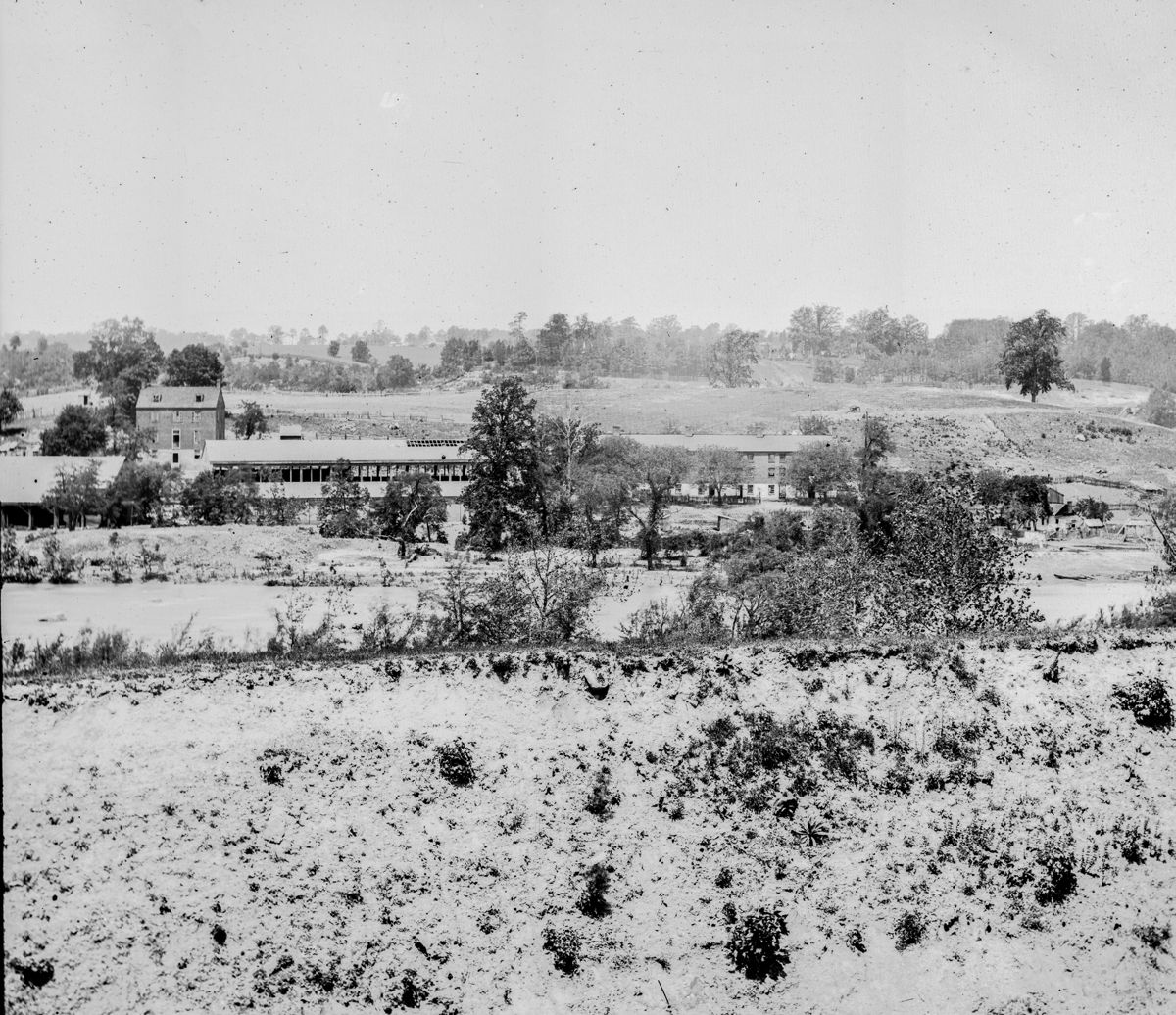
Paulding’s account began on Sunday July 5, “Marched at 9 A.M. Passed through Fairfield in the afternoon & thence over the mountains (Catoctin) & at midnight camped at Monterey Sta. [Pass] completely worn out.” They were marched through Waynesboro, Hagerstown, Williamsport, Martinsburg, Winchester, Strasburg, Harrisonburg, and Staunton where they boarded a train to Richmond. Paulding arrived at Libby Prison on July 18; Harry arrived somewhat later. The march to Harrisonburg was about 180 miles, averaging 13-14 miles per day. It appears that the prisoners typically first arrived at Libby Prison, and then the enlisted men were transferred to Belle Isle Island in the middle of the James River. Thus, Harry Lewis and Charles F. Miller (Company I) were housed on Belle Isle, whereas Lt. Tattnall Paulding (Company G) remained at Libby. Letters sent by Paulding from Libby were typically censored but a few were smuggled out. Paulding wrote, “Hunger, cold, exposure, and vermin combine to make them [enlisted men at Belle Isle] wretched beyond description.” Disease and death were common occurrences as both prisons were severely overcrowded, replete with vermin, and lacked sufficient food, clothing, and blankets. Libby was designed to hold 3,000 prisoners but by early 1864 there
CivilWarNews.com were more than 8,000. There were a combined 9,116 prisoners in Libby and Belle Isle in early 1864. The winter of 1863–1864 was especially brutal. At Belle Isle the only shelter was shallow pits scratched into the soil. Food and blankets were scarce at best; on one occasion the men killed and ate the commandant’s dog. At Belle Isle there were “as many as six thousand men, exposed in summer to the burning sun, without the shadow of a single tree, and in winter to the cold damp winds from the river with a few miserable tents….The prisoners had no access to the river, and all the water they had was obtained by digging holes deep enough so it would leach in from the river.” The limited food given to the prisoners was barely edible. Lice, mites, fleas, and other vermin plagued the men. Miller noted, “I have, for curiosity, counted, so I could average how many “Grays” [body lice] and “Linebackers” I had slaughtered during my incarceration. From 200–300 per day…estimated the lower number of 36,000 during 180 days in Belle Isle.” Miller described a soup made of peas which so literally swarmed with bugs that I might justly name it “Bug Soup.” Before this could be eaten, it would have to stand to let the bugs rise to the top to be skimmed off, and the sand settle to the bottom.” Miller also mentioned a “mere youth” who failed to be counted for his rations and went without food for days. Finally, the Commissary Officer ordered a full pail of soup for the starving man. Miller sadly concluded, he was not long in devouring the contents, and before the sun set he was carried out of camp and laid in a row with others awaiting burial.” Harry also wrote about his march to Belle Isle and incarceration. “While a prisoner of war, from Gettysburg until we struck the Va Central RR at Santun, we had to wade all streams from ankle to waist deep (the bridges being gone), once for 17 days it rained nearly all the time, no Shelter no chance to dry or change clothes, no blanket, only pants, shirt and blouse to ware, barefooted nearly all the 4 months, exposed to rain – hot Sun and chilly nights, with the camp teaming with untold billions of body lice, knawing the lifes blood out of you, and only 1/4 enough food, was under cover only two weeks just before being paroled.” Sgt. Jacob Osborn Coburn, 6th Michigan Cavalry, was also on Belle Island and noted in his diary that “the majority of cases died of chronic diarrhea [from which he died on March 8, 1864]. During the past month [February 1864] 337 cases suffering from this disease were admitted [to the hospital]. The deaths from this disease during the month sum up to 265. Dysentery and typhoid fever also caused many deaths; the latter’s death rate was 65% in a typical month.” During the brutal winter of 1863–1864, “the new horror was frostbite. Hands and feet of some were amputated and others were so neglected that the limbs were rotting and fall off from the limbs, and death usually followed.” Pvt. George Dingman of the 27th Michigan Infantry noted “During January [1864], the men would run all night to keep warm, and in the morning, I would see men lying dead; from three to six or seven; they were frozen. This was nearly every morning I was there; the men would run to keep warm, and then lie down and freeze to death; we made an estimate and found that 17 men died a night from starvation and cold, on an average.” Prisoners in Libby also suffered from the cold as Capt. Robert Thompson Cornwell of the 67th Pennsylvania Infantry noted in a diary entry for January 9, 1864, “Last night was very cold. Oh! What must our men on Bell Island [sic] have suffered without wood, few blankets, and only 1/4 rations. I am credibly informed that three of our men froze to death last night. It pains me to think of it.” On January 11, 1864, Cornell wrote that, “I still hear that our men on Bell Island [sic] are absolutely freezing to death. Last night was bitter cold. I cannot give expression to my feelings when I think of this terrible outrage on humanity.” By comparison, life at Libby was a luxury. Cornwell wrote on March 15, 1864, “Pleasant, No particular news. My day for cooking. Had fried potatoes, dried beef fried with flour, gravy, pancakes & tea for breakfast. Boiled potatoes, rice pudding, pancakes & tea for dinner – Only two meals. Quite a batch of Yankee prisoners passed here on their way from the [Belle] Island to Americus, Georgia [Andersonville Prison]. They looked hard, and some were hardly able to waddle.” Cornwell played chess extensively, read many books, cooked food, and kept warm, in stark contrast to the horrors suffered by the inmates in Belle Isle, just a mile away across the James River. After over three years’ service, Sgt. Lewis received an honorable discharge at City Point, Va., on July 7, 1864. He returned to Erie County where he engaged in farming and became the postmaster of Swanville for four years. In 1881 he received an appointment as Custom House Inspector. Eight years later, on July 1, 1889, he was appointed a mail carrier at Erie where he worked until 1909. For eleven years he was Officer of the Day of his G.A.R. Post and a member of the Royal Arcanum. Harry married Susan Myers of Fairview on June 10, 1865, and they had six children. Harry died March 9, 1912, in Erie. Up until his death Harry was a prolific family correspondent and wrote weekly letters in the Erie Daily Times on a wide variety of subjects of local and historical interest. Sources: •
•
•
•
•
•
•
•
•
•
•
Carter, William H. From Yorktown to Santiago with the Sixth U.S. Cavalry. The Lord Baltimore Press, 1900. Caughey, Donald C. and Jones, Jimmy J. The 6th United States Cavalry in the Civil War. McFarland & Co., Philadelphia, PA, 2013. Thomas, Sarah S., Smith, Tim, Kross, Gary, and Thomas, Dean S. Fairfield in the Civil War. Thomas Publications, Gettysburg, PA, 2011. Boaz, Thomas M. Libby Prison & Beyond. Burd Street Press, Shippensburg, NJ, 1999. Shevchuk, Paul M. “Cut to Pieces: The Cavalry Field at Fairfield, Pennsylvania, July 3rd, 1863.” The Gettysburg Magazine, No. 1, pp 105–117, 1989. Wittenberg, Eric J. Gettysburg’s Forgotten Cavalry Actions, Chapter 5. Thomas Publications, Gettysburg, PA, 1998. Miligram, James W. “The Libby Prison Correspondence of Tattnall Paulding.” The American Philatelist (December), 1975. Lewisiana: A paper published in 17 vols. January 1887–June 1907. Library of Congress Call No. GS69 (microfiche), compiled by Deborah Miller. Petruzzi, J. David “Annihilation of a Regiment, Battle of Fairfield 1863.” America’s Civil War No. 20, No. 3, pp 27–33, July 2007. Miller, Charles F. “With the 6th NY (sic US) Cavalry in the Civil War.” Historical Wyoming Vol. 19, No. 2, pp 38–50, 1966. Allison, Don Hell on Belle Isle – Diary of a Civil War POW. Faded Banner Publications, Byran, Ohio, 1997.
Gordon W. Gribble is a native of San Francisco, Calif. Following his education, he was appointed Professor of Chemistry at Dartmouth College in N.H, where he has taught since 1968. He is now Emeritus. He is the great-great grandson of the Rev. Ammi Merchant Lewis, one of Harry’s brothers. Professor Gribble spent a sabbatical year (2006–2007) at Gettysburg, where he spent many hours on the battlefield. He currently lives in Lebanon, N.H.