
The Graphic War
Photographers and Lithographers: The Lost Cause Part III
By Salvatore Cilella · Originally published November 2023 · pp. 28–29
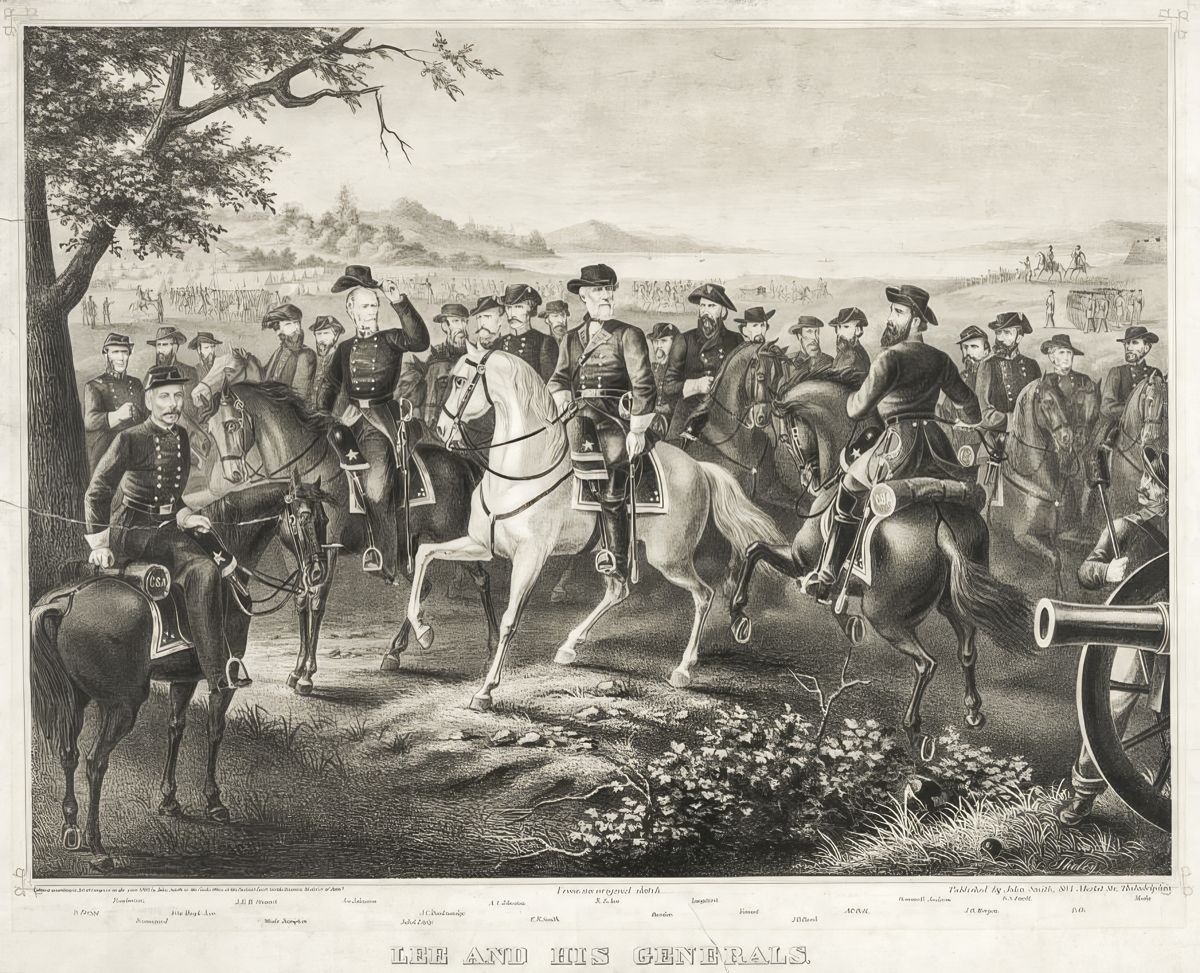
Photographers and Lithographers: The Lost Cause Part III The Graphic War highlights prints and printmakers from the Civil War discussing their meaning and the printmaker or artist’s goals. At war’s end American, particularly Northern American printmakers, found themselves beneficiaries of battlefield carnage and horror. The war had been “good” to them as Northern customers eagerly looked to the printmaking field to either decorate their walls with images proclaiming their loyalty to the Union or were seeking information provided by occasional images of newsworthy content portrayed by Currier and other lithographers. Essentially there was no Southern market. The four years of devastation left many major southern cities in ruin while Northern cities grew and thrived with little or no major interruption. A majority of battles had been fought on Southern soil. Approximately 500,000 Southern men had been killed, wounded, captured, or were missing; nearly a million had served. Civilian deaths were unknowable as records were sparse and nonexistent. During the war, the South, although interested in the finer cultural amenities offered by the arts, was reduced to concentrating on survival. Northern printmakers initially ignored the Southern market. As the myth of the Lost Cause gained acceptance, “popular prints, especially portrait engravings and lithographs of Confederate civilian and military heroes, became popular in homes, schools, and veteran’s lodges as visual records accompanying a sentimental renaissance of the Lost Cause.”1 As Holzer, et. al. surmise, losing the War and accepting its devastation was so great, it was almost “unthinkable.” Therefore, fighting the War must have been a just cause. The leaders weren’t losers, they were heroes fighting for the ideals and the lands of the cavalier. The leaders couldn’t have been wrong to sacrifice so many of the South’s sons. They needed to be remembered. Initially Northern printmakers catered to various demographics such as Catholics, Protestants, Democrats, and Republicans. Now they turned to images of other groups, Confederate and Union leaders.
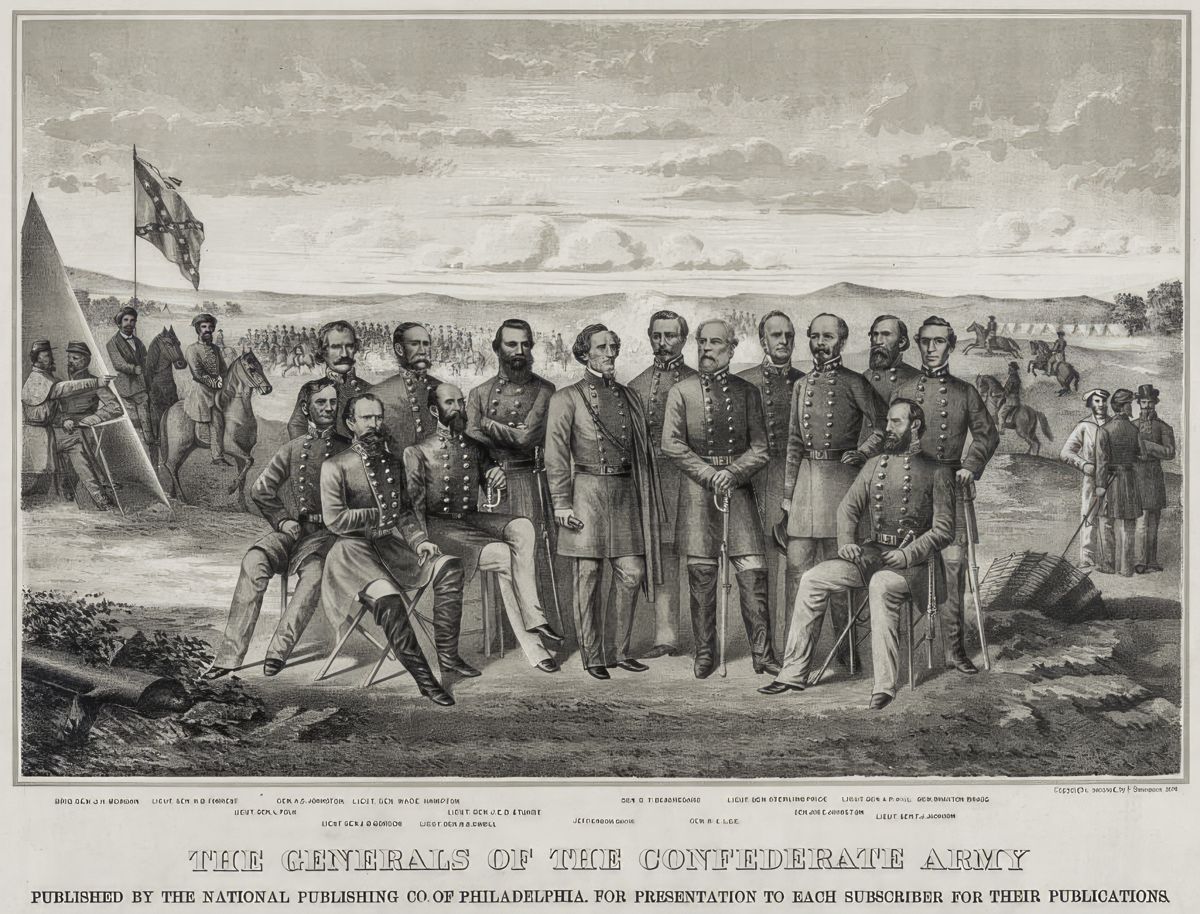
The same presses that turned out portraits of Lincoln and Grant were now also publishing pictures of Jackson and Lee. “The printmakers’ cause after 1865 was profit, not patriotism.” American printmakers engagement in “seemingly incongruous production did not suggest divided loyalties—only a keen sense of marketing that knew few political restrictions.”2 In 1867, the Tholey brothers produced with printer Joseph Hoover and publisher John Smith of Philadelphia, their version of the group leadership theme. (Figure 1). This time, Lee is on horseback surrounded by his commanders, all whom are depicted from photographs. As described by Holzer, et. al., all are “on improbable bodies and horses…. The council of war… never took place, nor did Lee ride a white charger; Traveller…was gray.” To the average Southerner, “eager for heroic images of their Lost Cause Saints,” it didn’t matter.3 Just as Reconstruction was ending, Philadelphia artist Frederick Bourquin, copied the essence of the Goupil/Knoedler lithographs of 1861 and 1865 (See Figures 1 and 2, Part II of this brief series). The 1861 version showed Jefferson Davis front and center. Lee was been relegated to the rear. In the 1865 version, Lee replaced Davis. In Bourquin’s new and improved 1879 version, they are together, sharing the stage, front and center. (Figure 2) The title has been changed to The Generals of the Confederate Army and Davis is shown in a military uniform. Now the uniforms are gray, and the number of heroes has grown to sixteen from eleven.
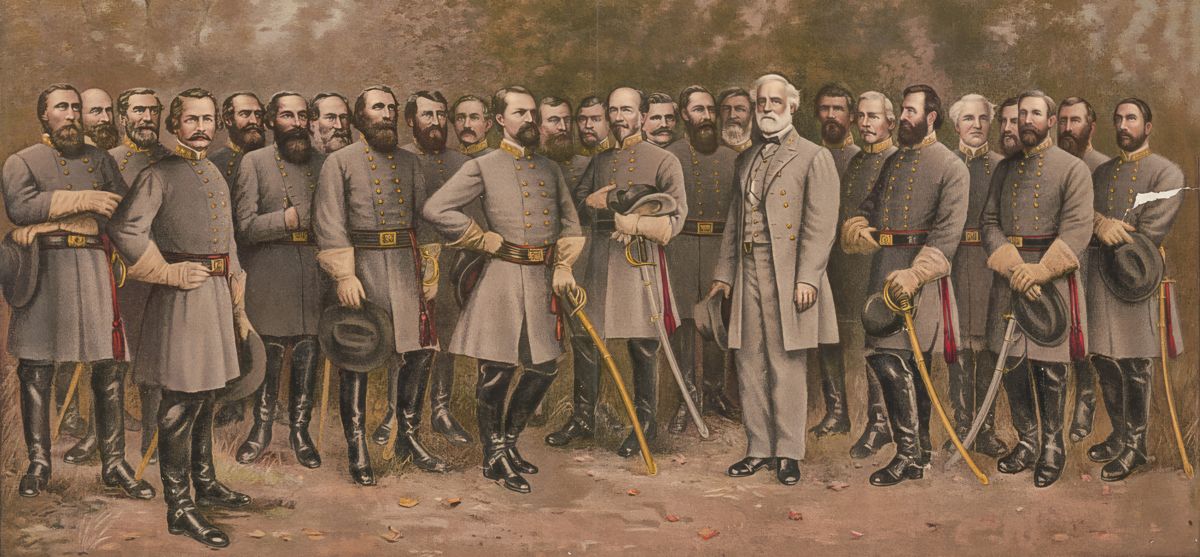
Five in the “earlier print have been replaced…by generals who earned their reputations after the first year of the war.” General James Longstreet has been omitted possibly for questioning Lee or for joining the Republican Party.4 The Confederacy’s national flag has been replaced by the St. Andrews Cross; a fitting retort to the end of Reconstruction and the beginning of Jim Crow.5 At the height of the Jim Crow era, Virginia artist George B. Matthews produced his version of Lee and his Generals in 1907, the centenary of Lee’s birth. (Figure 3) It is neither a lithograph, photograph, nor an engraving but a photogravure. Matthews was known for his portraits of Lee, Jefferson Davis, and Stonewall Jackson. In this assemblage, all 26 “heroes” pictured were never in the same room at the same time during the war. As in previous depictions, a number of the generals were dead by the war’s end. All are identified with Lee at center stage. No attempt has been made by the artist to present the assembled tableau as a wartime set. All are, however, clad in gray. Lee’s portrait is copied directly from Brady’s famous after Appomattox pose. It dominates “the others…including those…in the back row who appear to have no feet.”6 The technologies of printmaking and photography had lived with each other for half a century. They now accommodated reproductive printing’s new system called “photogravure” in which an engraving is made from a photographic negative. Printing from a negative replaced the lithographic stone, the engraver’s plate, and the wood engraver’s specialized wood block. It is ironic that Currier and Ives went out of the lithography business in 1907, the same year Mathews produced his Lee and His Generals in photogravure. Endnotes: 1. Bell Irvin Wiley, Embattled Confederates: An Illustrated History of Southerners at War. New York: Harper & Row, 1964. 219 as cited in Mark Neely, Harold Holzer, & Gabor Boritt, The Confederate Image: Prints of the Lost Cause, University of North Carolina Press, Chapel Hill, 1987. 99. Hereafter Holzer, Image. 2. Holzer, Image. 99. 3. Ibid., Figure 12 caption. 4. Ibid., Figure 7, 18-19. 5. Bourquin was born in Geneva in 1808 of French Huguenot parentage. He came to Philadelphia in 1817 and worked for other lithographers until he opened his own shop in 1865. He operated also out
CivilWarNews.com of New York and enjoyed an excellent reputation with a “high personal standing in the trade.” Harry Peters, America on Stone. 101. 6. Ibid, Figure 89, caption, 166.
After 43 years in the museum field, Cilella devotes his time collecting American prints and maps and writing. His most recent books are Upton’s Regulars: A History of the 121st New York Volunteers in the Civil War (U. P. Kansas, 2009).
His two-volume Correspondence of Major General Emory Upton, (U. of Tennessee Press, 2017), received the 2017–2018 American Civil War Museum’s Founders Award for outstanding editing of primary source materials. He has edited Upton’s love letters 1868-70, Till Death Do Us Part: (Oklahoma University Press, 2020). He has edited the Memoirs of Dewitt Clinton Beckwith of Upton’s Regulars (McFarland Press, 2023).