
The Unfinished Fight
Infantry Use Of Handguns
By Craig L. Barry · Originally published November 2023 · pp. 10–11
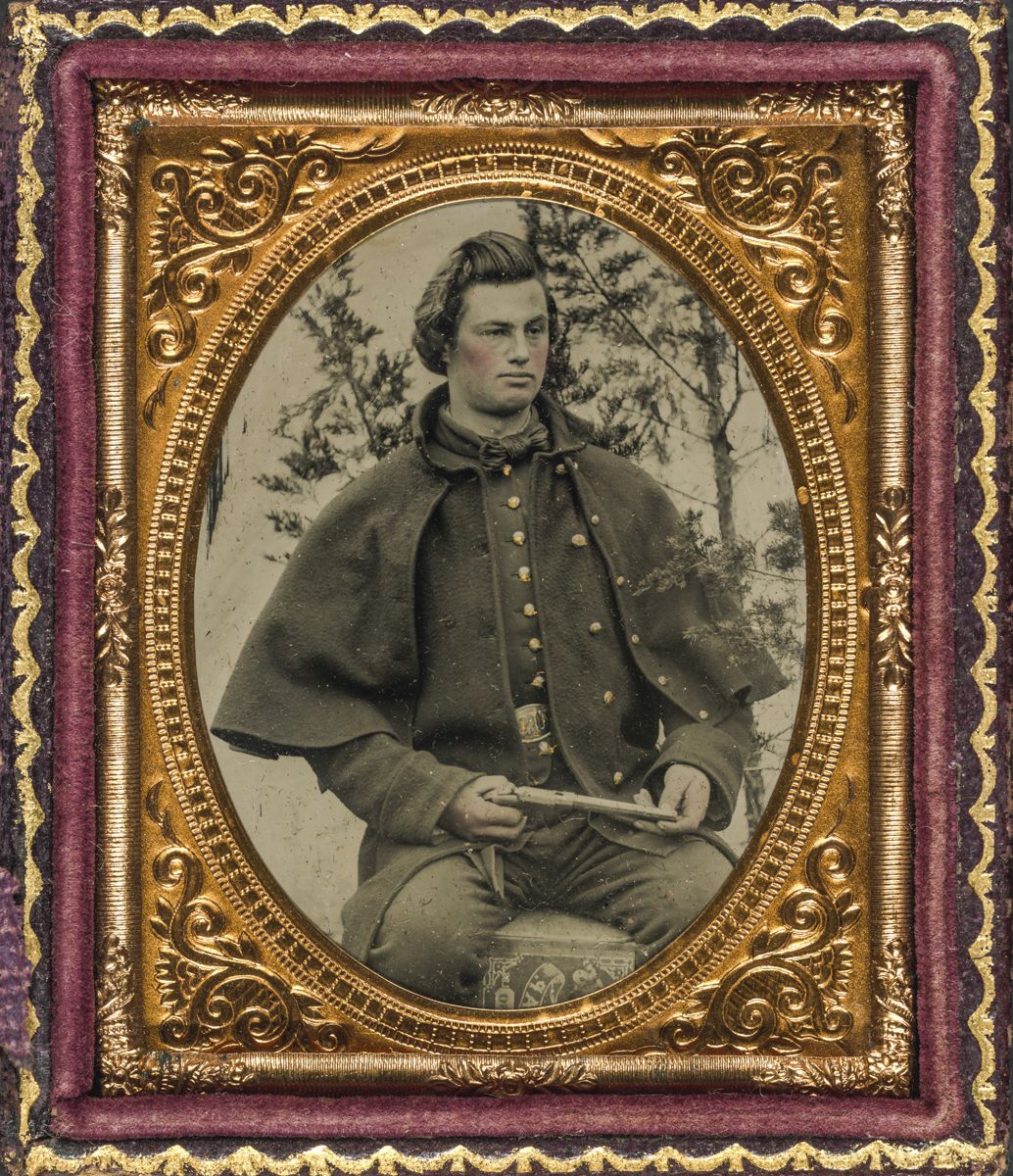
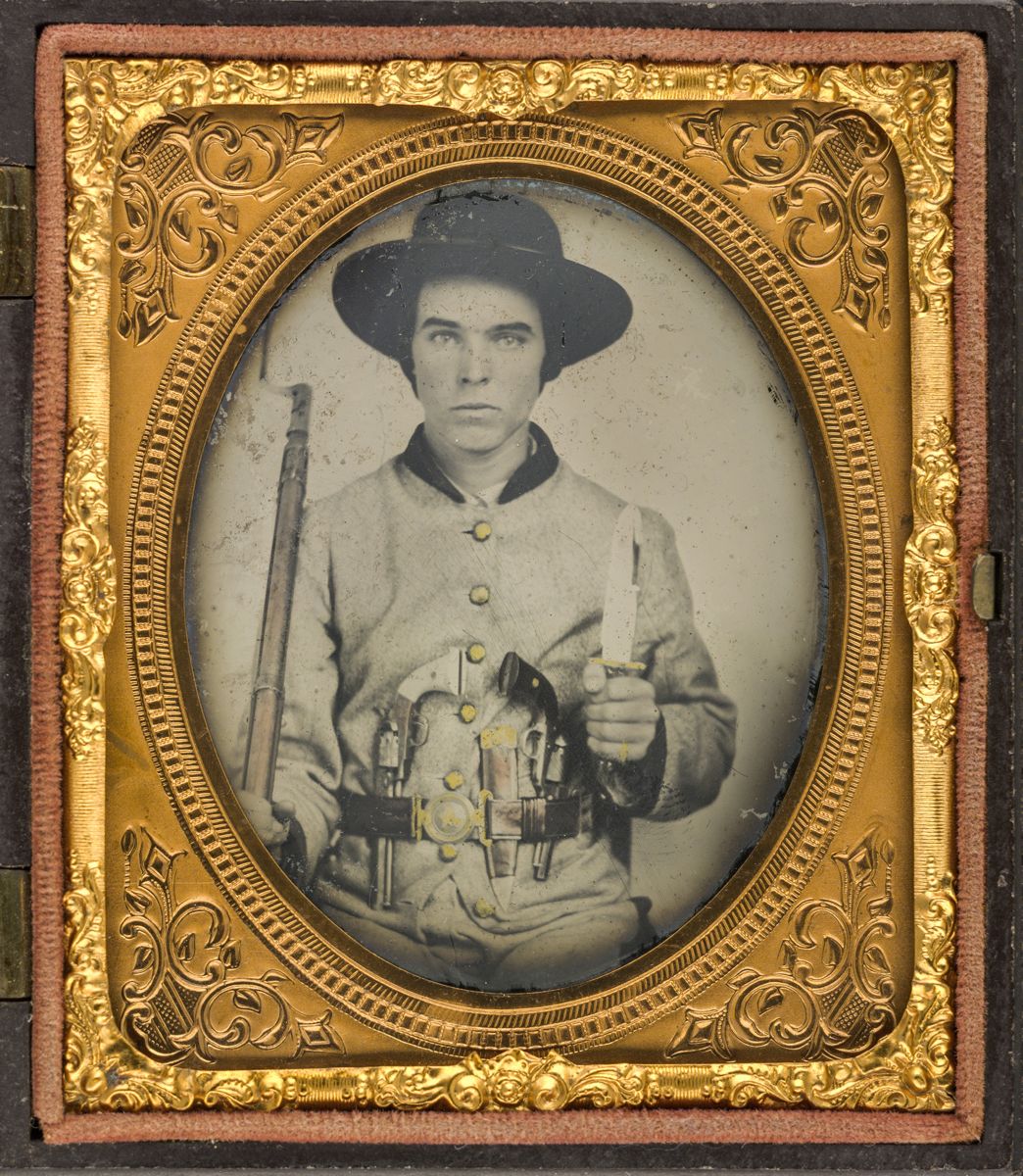
Infantry Use Of Handguns “In addition, every one of us had his gun, cartridge-box, knapsack and three days’ rations, a pistol on each side and a long Bowie knife that had been presented to us by William Wood of Columbia, Tenn.” – Sam Watkins, Co. H, 1st Tenn. “I have spoken of the rapid improvements made in arms… Revolvers were no exception and Colt’s revolver which monopolized the field for some time was soon crowded in the race by Smith & Wesson, Remington and others. Thousands were sold monthly and the newly fledged soldier who did not possess a revolver, either by his own purchase or as a present from solicitous relatives was something of a curiosity …” – Josh Billings Hardtack and Coffee Questions about revolvers arise when reading passages like those highlighted above. The writers’ recollections seem to be supported by early war images of armed soldiers, most of whom have a pistol or revolver either tucked in their belt or grasped in one hand flat across the torso. If that many soldiers had them, what happened to them and were they used at all? A study of period images is a good way to pick up small details for an accurate Civil War impression. Obviously, images taken in the field are preferable to studio images, though they can be harder to distinguish details. Were some revolvers photographer’s props? If so, the photographers had quite a large variety on hand. Colts are common, but as stated above other varieties of handguns can be identified including imports, pepperboxes, pocket revolvers, and single shot pistols. The next point is one made clear by both quotes in the heading. The pistols in the possession of infantry on both sides were non-regulation and not government issued. Watkins stated his pistols were a present from a benefactor back home, and Billings stated that pistols were either self-purchased or sent by relatives. Both quotes state unequivocally that many infantry soldiers started out armed with at least one revolver. Conversely, the revolver is rarely mentioned in terms of its use by enlisted men during an actual battle engagement. There are anecdotal stories of soldiers getting into a fracas and resorting to a settlement of the dispute with their handguns, sometimes hitting innocent bystanders. These are usually recorded about drunken soldiers on leave, or in a semi-permanent camp situation, but not on the march. As a result, some officers prohibited enlisted men from carrying revolvers. One of the rare instances where an infantry soldier is known to have fired his own revolver is noted in a diary by Jacob Smith, a 107th Ohio infantryman at Gettysburg. A Confederate color bearer would not relinquish his grasp on the flag after being hit seven times. When a Union officer came to take the colors… “The color-bearer being severely wounded, dropped on one knee holding to his flag with such a firm grip, that Adjutant Young who was trying to wrench it from him could not do it. The color-bearer had a large Navy revolver in his right hand. I saw him pull the trigger and shoot the Adjutant through the shoulder blade; the Adjutant in turn planted his saber in the color-bearer’s breast. The color-bearer held on to the flag and saber with a firm grip until he dropped over dead, never loosening his grasp until he drew his last breath.” In another instance, during a foraging patrol in West Tennessee on March 16, 1863, a few Union soldiers come across a Confederate patrol of equal size…Theodore Upson noted in his diary, “He jumped behind a tree and shot one of them and he threw down his gun (musket), snatched his revolver out of his blouse, and shot another… Lowrie shot him four times with a Sharps [pepperbox] pistol.” One could well understand why non-regulation arms may have been more widely used by color guards due to their specific need for close range self-defense.
The West Tennessee account concerns only a few men out on patrol. What about enlisted men in battle? There are several reasons why pistols may have played a diminished role, if any role at all in full scale infantry encounters between the Confederate and Union armies. First, the Civil War-era black powder handgun was primarily a short-range defensive weapon. Colt stated that their revolvers were “as effective as a common rifle” at 200 yards, but this seems unlikely. The reality is that at 200 yards the effectiveness of a riflemusket is between 64% and 82% shooting at a man size target on a firing range (6). Battlefield hits were undoubtedly much fewer since the “targets” fired back. Hence, one has trouble imagining any revolver hitting four or five out of their six shots at that range in a battle situation. So, if not accurate to 200 yards as claimed, what was the practical range of a cap and ball revolver? There is recorded evidence of a duel between “Wild Bill” Hickok and a gambler named David Tutt Jr., on July 21, 1865. Hickok killed Tutt with a single shot from one of his two, famous Colt Model 1851 .36 caliber Navy revolvers. The fight was noteworthy because of the “great distance” involved, estimated at 75 yards. Hickok was considered a very capable marksman, so the 75 yard figure is probably a realistic upper limit of the effective range of a cap and ball revolver. According to Paddy Griffith, the average distance between armies during a Civil War infantry battle was 127 yards, over fifty yards beyond the revolver’s effective range. Further, while pistols and revolvers fired quickly, reloading was time consuming and would be nearly impossible in the heat of battle, which is why mounted Cavalry carried four or five. If this much is correct and if as a result revolvers were not very useful to enlisted men on the battlefield, one might reasonably expect that the men would seek to dispose of their revolvers as with any other excess weight. Josh Billings noted in his memoirs, more or less confirming this theory: “The thought did not appear to find lodgment in the brain of the average soldier that by the time government provided him with what arms, ammunition and equipment that was thought necessary for him to have he would then be loaded with about all he could bear without adding a personal armory (revolver) and magazine (lead balls, different size caps and loose powder). Nor did he realize that afterwards… by the time he had done his duty faithfully and well with the arms the government had put in his hands there would be little opportunity or need, even if his personal ambition still held out, to fall back on his personal arsenal…The troops of 1861-62 took out hundreds of revolvers only to lose them, give them
One of “Wild Bill” Hickok’s Model 1851 Colt Navy revolvers (he had at least two pair) manufactured in 1868. This gun brought $616,875 at Rock Island in May 2022. (Photos courtesy Rock Island Auction Company.)
CivilWarNews.com away or throw them away; and as many regiments were forbidden by their colonels to wear them, a large number were sent back North. Revolvers were probably cheaper in Virginia in those years than in any other state in the Union.” This passage partially answers for us what some soldiers may have done with their revolvers if they were not allowed to carry or use them (“send them back North”). The number of surviving specimens suggests that at least some were shipped home with other unneeded private possessions or war souvenirs. However, another possibility is confirmed by Sam Watkins in the passages he records about the arduous journey with Stonewall Jackson marching in the Allegheny mountains near Warm Springs, Va., in late 1861 and early 1862: “No sooner would we arrive at a place that seemed to be the top than another view of a higher, and yet higher mountain would rise before us. From the foot to the top of the mountain the soldiers lined the road, broken down and exhausted. First one blanket was thrown away, and then another; now and then a good pair of pants, old boots and shoes, Sunday hats, pistols and Bowie knives strewed the road. Old bottles and jugs and various and sundry articles were lying pell-mell everywhere.” Based on this account, some pistols were obviously discarded as excess baggage. Let me hasten to add that because a handgun survived the war does not necessarily mean that it was carried throughout the entire term of enlistment by a soldier, taken on campaign, or used during battles. Some contradictory period evidence from diaries suggests that not all soldiers discarded or shipped their revolvers home. Some soldiers were still buying revolvers for themselves late in the war. L. Elmer Hackett was “on the moov” towards Atlanta and wrote as an entry in his diary for July 13, 1864: “I traded my watch for A rolver [revolver] to day. There was between 1 and 2 hundred rebs marched to the rear to day. I got a letter from home.” Private Hackett wrote of the revolver purchase as matter-offactly as he recorded his letters from home or a $1 purchase of toback [tobacco] a few days later. This suggests soldiers were bartering goods, and handguns were among those items. If pistols were retained, were they carried tucked in the belt as demonstrated in so many period photos? It would not take great imagination to accept that even those who retained their handguns probably secured them in a knapsack or some other place besides tucked in the waist belt. Speaking as one who has seen a few revolvers (loaded with blanks) at battle enactments tucked in waist belts; the thought has occurred to me that in the event of an accidental discharge a painful and embarrassing injury to the lower midsection would result, one that would be hard to explain when you got home. Being an experienced and pragmatic group of men, veteran Civil War soldiers may have considered tucking the revolver someplace besides their waist belt while on the march for this and other equally good reasons. If so, period accounts are largely silent on the matter. It is reasonably clear from period accounts that there were privately purchased, nonregulation revolvers carried, if not frequently used, by infantry on both sides. The practice was less widespread among more experienced soldiers especially on the march, but carrying a pistol was not unknown among veterans either if we can trust period accounts. Craig L. Barry was born in Charlottesville, Va. He holds his BA and Masters degrees from UNC (Charlotte). Craig served The Watchdog Civil War Quarterly as Associate Editor and Editor from 2003–2017. The Watchdog published books and columns on 19th-century material. He is the author of several books including The Civil War Musket: A Handbook for Historical Accuracy (2006, 2011), The Unfinished Fight: Essays on Confederate Material Culture Vol. I and II (2012, 2013). He has also published four books in the Suppliers to the Confederacy series on English Arms & Accoutrements, Quartermaster stores and other European imports.