
Confederate Fort Fisher Undergoes Major Facelift
By Chris E. Fonvielle Jr. · Originally published November 2023 · pp. 1–5
Confederate Fort Fisher Undergoes Major Facelift By Chris E. Fonvielle Jr. Fort Fisher has not seen this much ongoing construction since the Civil War. The Confederate army originally built it to protect commerce vessels that smuggled vital military supplies through the U.S. Navy’s blockade of Wilmington on the Cape Fear River in southeastern North Carolina. By 1864, Confederate and Union observers alike considered Fort Fisher the strongest and best armed fortification in the country. Today approximately one million people annually tour the remaining earthworks and museum at the Fort Fisher State Historic Site. Thanks to the bipartisan efforts of Representatives Ted Davis [R] and Deb Butler [D] of New Hanover County, North Carolina’s State Historic Sites, the Fort Fisher State Historic Site, and the Friends of Fort Fisher, North Carolina’s General Assembly subsidized more than $25 million for a new 22,000 square foot interpretative and educational center. Work got underway late last year, with the Department of Natural and
Computer generated rendering of Fort Fisher’s new Visitor Center. three years, commerce vessels had been smuggling military arms and equipment and civilian goods from Europe into Wilmington to assist the Confederate war effort. The Tar Heel seaport was perfectly situated for blockade running as it was near the British transshipment points of Bermuda and Nassau, through which went most of the business.
Computer generated rendering of Fort Fisher’s reconstructed artillery batteries.
Cultural Resources expecting to dedicate the facility in the spring of 2024. It will be nearly three times larger than the current one, which opened in 1965. The Friends of Fort Fisher then plan to reconstruct two massive artillery batteries, bulldozed during World War II, to their 1865 appearance. In 1942, the U.S. Army established an advanced anti-aircraft training facility with a landing strip for small military airplanes at Fort Fisher as an auxiliary base to Camp Davis in Holly Ridge, north of Wilmington. North Carolina’s State Historic Sites’ objective is to offer historians, enthusiasts, and vacationers a broader, more inclusive understanding of Fort Fisher’s fascinating past. You can help make that happen. General Robert E. Lee sent an urgent message to military authorities in late 1864: “If Wilmington falls, I cannot maintain my army.” The message was clear. The survival of the Army of Northern Virginia, and thus the Confederacy, depended upon the survival of Wilmington as a blockade running seaport. For
Great Britain emerged as the Confederacy’s primary trading partner. Wilmington soon became the favorite port of call for blockade runners as geography favored their success. They could enter and exit the Cape Fear River by one of two passageways— Old Inlet at the mouth of the waterway or New Inlet six miles to the northeast, separated by Bald Head Island and Frying Pan Shoals. Union blockading vessels found it virtually impossible to intercept or destroy blockade runners that traded guns for cotton at Wilmington, where at least 106 different steamers enjoyed an astounding success rate of about 85 percent. Once supplies reached Wilmington’s docks, twentyeight miles upriver from Old Inlet, quartermasters distributed some locally, but forwarded the majority by rail to the Virginia battlefront. The most important line was the Wilmington and Weldon Railroad that stretched from Wilmington to Goldsboro and then to Weldon, North Carolina, where it connected with the Petersburg and Weldon Railroad. The Wilmington and Weldon Railroad served as
General Lee’s main supply route during the last year of the war, and became known as “Lee’s Lifeline” and “Lifeline of the Confederacy.” To defend Wilmington, Confederate engineers exploited enslaved African American and free Native American laborers to assist the army in building a vast network of fortifications. To safeguard New Inlet, blockade runners’ favorite entryway, they erected the strongest defensive work in the Confederacy—Fort Fisher. In September 1861, the army named the works still under construction for Colonel Charles F. Fisher of the 6th Regiment N.C. Troops killed in the war’s first major land battle at Manassas, Virginia the previous July. Fort Fisher’s elevated gun batteries, made of beach sand spread atop heavily timbered bombproofs or ordnance magazines, rose high above the Atlantic Ocean, and heavy seacoast cannon mounted in them kept Union warships at bay. Observers dubbed Fort Fisher the “Gibraltar of the South.” Map of Fort Fisher. After Union forces captured New Bern and Beaufort, North Carolina, and retook Norfolk in the spring of 1862, Wilmington became the closest seaport to Virginia. “To close the port of Wilmington is undoubtedly the most important and effective demonstration that can be made,” exclaimed U.S. Secretary of the Navy Gideon Welles. “If of less prestige than the capture of Richmond, it would be as damaging to the Rebels.” Yet for most of the war the U.S. War Department and the Lincoln administration rebuffed Welles’s requests for support for an assault on Wilmington, which they considered of little strategic value compared to Richmond, Chattanooga, and Vicksburg. As a result, the U.S. Navy shifted its attention to Charleston, the birthplace of secession and the war, and the object of more popular and political interests. The government’s indifference toward Wilmington changed in the summer of 1864. In August, Admiral David G. Farragut sealed Mobile Bay, Alabama to blockade running, leaving
Wilmington as the only major seaport open to trade with the outside world. Its capture would end blockade running there, but also build Union momentum at a crucial point in the long, bloody war. President Lincoln finally agreed to Welles’s proposal to go after Wilmington, now the Confederacy’s most important city, but deferred final approval to Lt. Gen. Ulysses S.
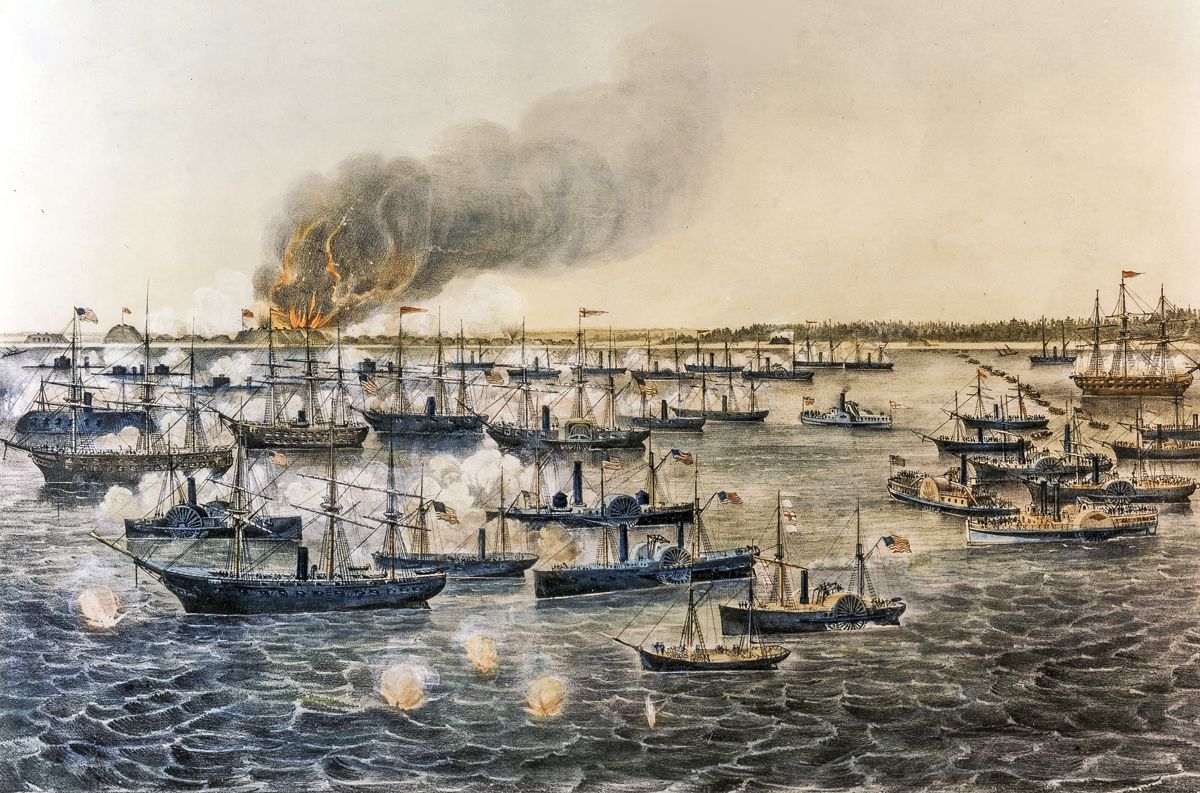
Grant, commander of U.S. Army forces. Grant initially expressed little enthusiasm as it would require him to provide a large expeditionary force to assist the navy. But he soon came to appreciate Welles’s argument that the deadlock in Virginia would be broken if Wilmington were closed to blockade running, thus denying General Lee the weapons, food, and clothing his Army of Northern Virginia so desperately needed. The expedition was a go. Admiral David D. Porter commanded the naval task force that targeted Fort Fisher and the closure of New Inlet to blockade running. He assembled a grand armada of sixty-four warships mounting a total of 627 cannon, the kind of firepower experts believed necessary to reduce the mighty earthen stronghold. On Christmas Eve and Christmas Day 1864, Porter’s vessels fired more than 20,000 projectiles at the immense sand bastion in what turned out to be the largest naval bombardment of the Civil War. Even so, the stout Confederate defenses and defenders held. The Union’s defeat at Fort Fisher was offset by Gen. William T. Sherman’s capture of Savannah, Georgia, on December 21, 1864. For his part, Grant was glad to see Sherman safely on the coast and eager to transfer his powerful 60,000-man legion by sea to Virginia for a final CivilWarNews.com showdown with Lee. But Sherman had other plans. He proposed to march his battle hardened army to the Old Dominion by way of the Carolinas, destroying railroads and supply stores and “smash things generally” as he had done so effectively in his March to the Sea across Georgia earlier that autumn. If Sherman could advance as far north as Goldsboro, North Carolina, then “Lee’s Lifeline” would be severed and his army in position to hit Lee with an uppercut while Grant continued to jab him from the east. Sherman predicted that his movement would force Lee out of Petersburg and into open country where he and Grant together could converge on and defeat him. Grant liked Sherman’s ambitious plan and confidence in it. The crowning benefit might well be the collapse of the Confederacy. Agreeing to the Carolinas Campaign, as historians call it, Grant determined
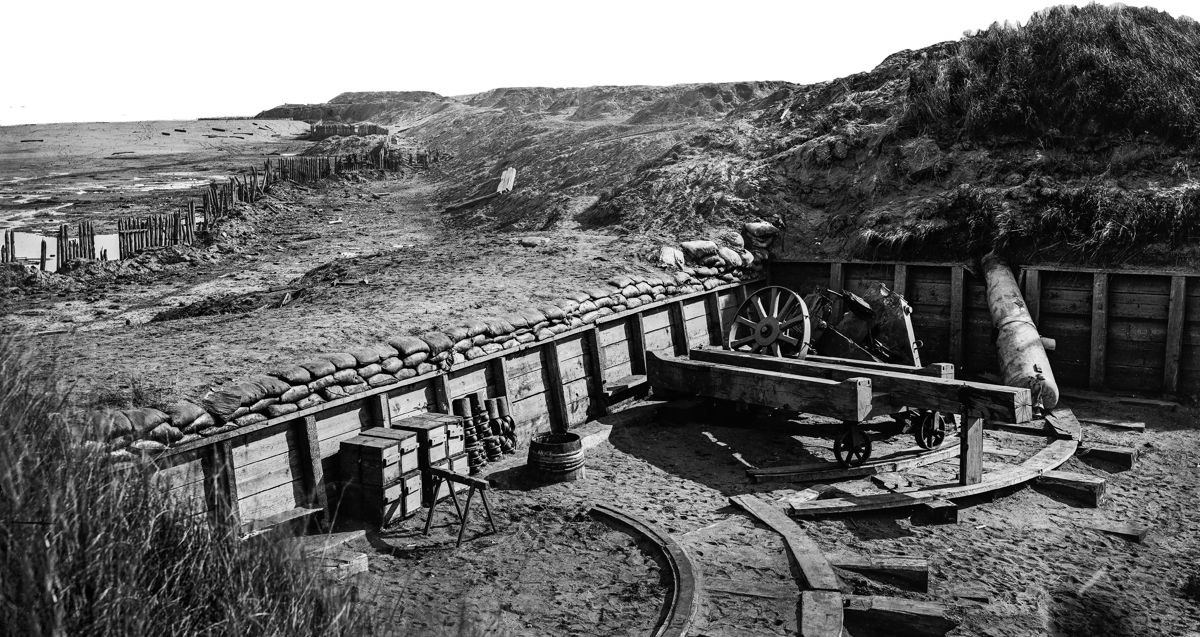
Fort Fisher’s land face showing the massive earthen fortifications. (Library of Congress)
to guarantee its success by furnishing Sherman’s army with provisions and reinforcements, or a haven on the seacoast if need be, halfway between Savannah and Petersburg. Wilmington took on a whole new meaning for Grant. The city must be captured, starting with Fort Fisher. Admiral Porter’s fleet, slightly scaled down to fifty-eight ships, and U.S. Army transports bearing 9,600 soldiers under the command of Brig. Gen. Alfred H. Terry, reached Fort Fisher late on the night of January 12, 1865. They renewed their bombardment early the next morning. For twoand-a-half days the U.S. Navy fired almost as many projectiles as in the Christmas attack, but with much more effectiveness. The Confederates returned fire as best they could, but ran low on ammunition and gunpowder and suffered an increasing number of casualties among the garrison. As Porter’s warships pummeled Fort Fisher, Terry’s infantry, including two brigades of U.S. Colored
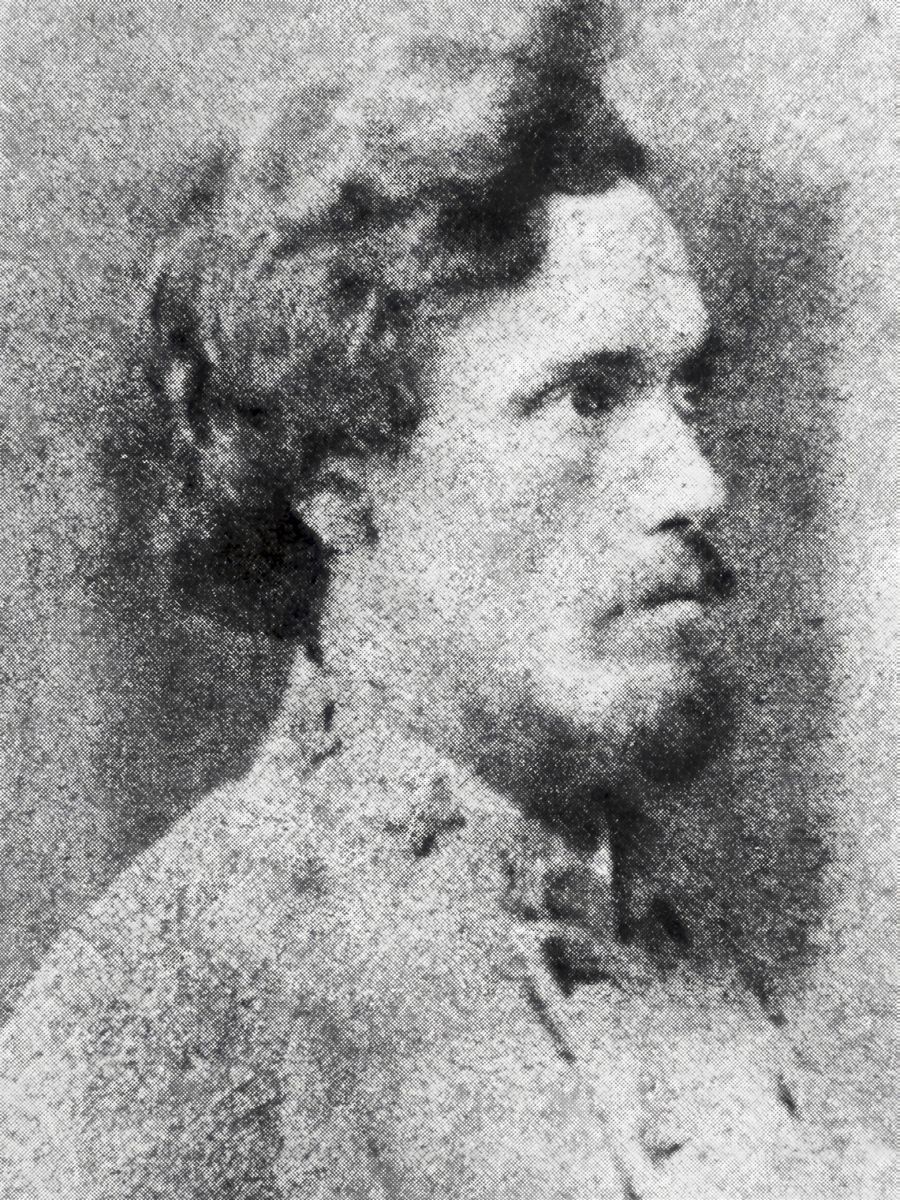
Troops, landed. After positioning his army over the following two days, he launched a ground assault late on the afternoon of January 15. A shore party of more than 2,200 volunteer sailors and Marines from various ships in the fleet also stormed the fort. The Confederate defenders, led by Colonel William Lamb and Maj. Gen. W.H.C. Whiting, rushed to meet the assault. They turned back the poorly armed and disorganized naval column that had advanced down the beach, but soon became embroiled in hand-to-hand combat with Union army forces that had secured a lodgment on the fort’s ramparts. The savage, closequarters fighting raged for more than five hours before the greatly outnumbered and outgunned Southerners surrendered late on the night of January 15, 1865. After receiving reinforcements three weeks later, the Federals then launched an attack upriver that led to Wilmington’s capture on February 22, 1865. No longer able to supply his depleted and embattled troops by way of the Wilmington and Weldon Railroad, and threatened by two numerically superior armies, General Lee evacuated his army from Petersburg. The dire situation was just as he had predicted if Wilmington fell. Grant followed closely on Lee’s heels, battling him to Appomattox Courthouse where, on April 9, Lee surrendered. The Union victory at Fort Fisher and Wilmington severed Lee’s lifeline and guaranteed the success of Sherman’s Carolinas Campaign. The Friends of Fort Fisher recently embarked on a capital campaign to raise $3.5 million for reconstructing that portion of the works, including bombproofs, demolished during the Second World War. “The restored earthworks and a new interpretive center will be welcome additions to Fort Fisher,” remarked site manager Jim Steele. Sponsorships, naming rights, and recognition on a Donor Board are available to major contributors, but any and all monetary gifts will be greatly appreciated. For more information, please contact: The Friends of Fort Fisher, Inc. 1610 Fort Fisher Blvd., South Kure Beach, NC 28440. Phone: (910) 251-7340 www.friendsoffortfisher.org Dr. Chris E. Fonvielle Jr. is Professor Emeritus in the Dept. of History at UNC Wilmington. He has studied and written extensively on the Civil War in southeastern North Carolina. www.chrisfonvielle.com.