
The Graphic War
Sherman’s March
By Salvatore Cilella · Originally published May 2023 · pp. 22–23
Sherman’s March
The Graphic War highlights prints and printmakers from the Civil War discussing their meaning and the print maker or artist’s goals.
Perhaps the most talented and most prolific artist of the 19th century is a least known figure of the 21st century. Felix Octavius Carr Darley, “for more than 40 years, dominated American book and magazine publishing, becoming one of the best-known illustrators of his time. By collaborating closely with writers such as Washington Irving, Darley helped popularize such American icons as the Pilgrim, the Pioneer, the Minuteman, and the Yankee Peddler.” His life spanned most of the century, 1822–1888.1
Darley was, in today’s parlance, a “workaholic.” His prodigious output of drawings was truly remarkable. Largely self-taught, Darley began his career in his hometown of Philadelphia when he was hired by a local publishing company where he became a jack-of-all-trades. After moving to New York, he began working for Harper’s Weekly.
As his reputation grew, he signed on to provide drawings for new publications. As an artist and draughtsman, he provided work that was easily adaptable to engraving, etching, and lithography. More than 500 of his drawings appeared in Lossing’s History of the United States. His lithographic work consisted of illustrations for Washington Irving’s “The Legend of Sleepy Hollow.” In January 1843, he contracted with Edgar Allan Poe to provide him with illustrations for Poe’s ill-fated literary Journal, The Stylus. Before the Civil War, Darley illustrated works for legendary American authors James Fenimore Cooper, Nathaniel Hawthorne, Henry Wadsworth Longfellow, and Washington Irving.2
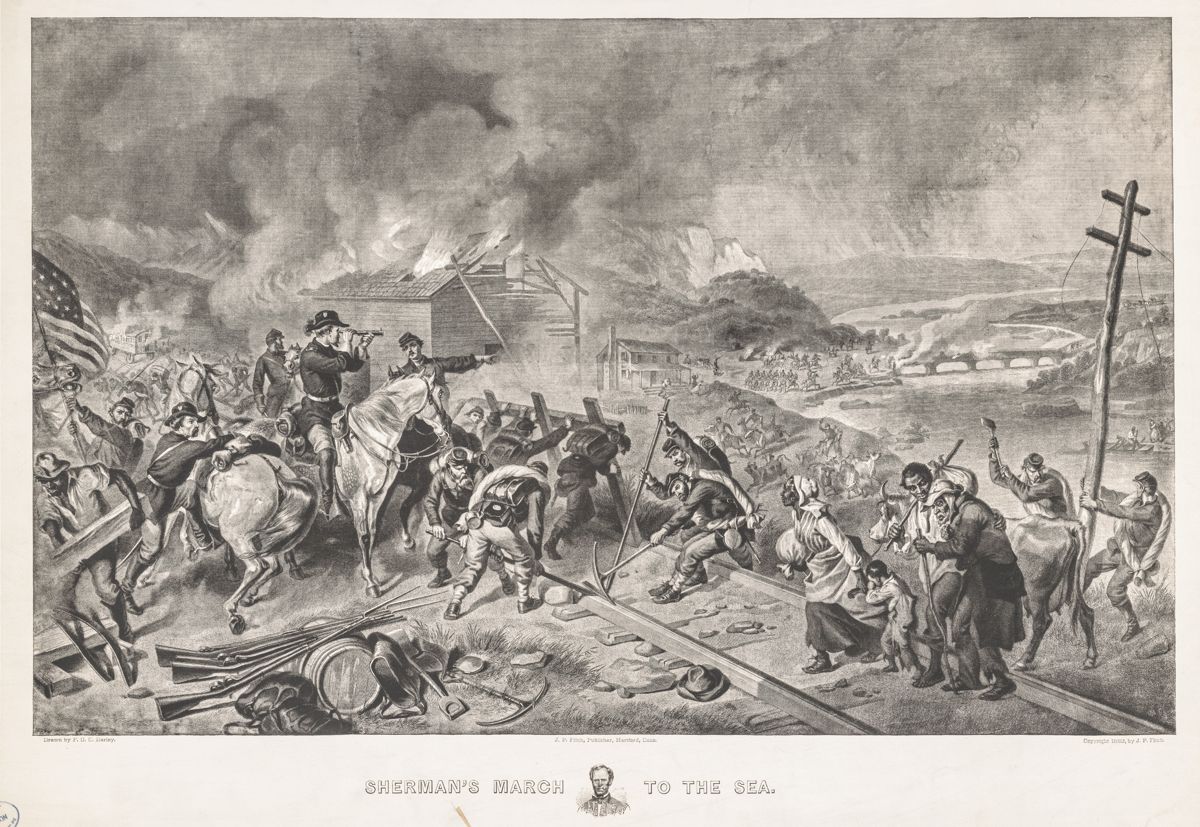
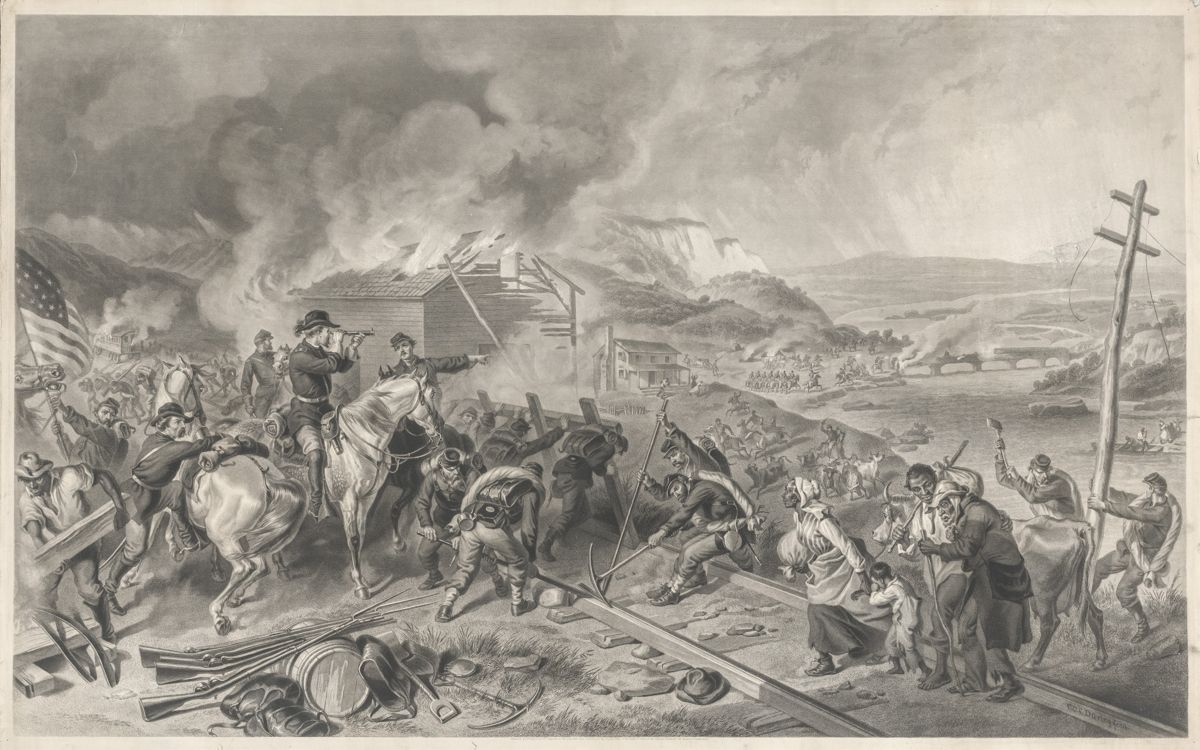
During the war, he produced several images of Washington but few of Lincoln. He tended to concentrate on Federal military leaders such as George McClellan. One of his greatest if not largest work (32x40 inches) was On the March to the Sea. As author Nancy Finlay notes, the print, engraved by A. H. Ritchie “appears to sanction and even glorify the havoc produced by the Union troops as they advanced, ripping up railroad ties, cutting telegraph wires, burning property—and freeing slaves.”3 General Sherman is central to the picture as he sits atop his horse to the left of the scene, telescope in hand focused forward determining his next steps.
Engraver Alexander Hay Ritchie (1822–1895), a Scottish artist, was also an engraver who specialized in mezzotints. With Sherman’s march, Ritchie settled on line engraving which was “the most highly esteemed reproductive process in the mid-to late nineteenth century, even though the engraver was obliged to use dense patterns of lines and hatching to interpret the shadow areas for which Darley generally used wash in his original drawings.”4
Ritchie’s engraving was based on Darley’s original study illustration which he drew in 1865 and named A Cavalry Raid. It is pencil and charcoal on paper and measures 25 by 42 inches, nearly identical to the finished engraving. The original is in the West Point Museum, U. S. Military Academy.5
Eventually Darley’s work fell out of fashion; by 1900, he was superseded by artists who favored authenticity and realism and was replaced by such luminary American illustrators as N. C. Wyeth and Maxfield Parrish. “Darley was enormously productive, publishing nearly 4,000 drawings for books, periodicals, newspapers, and bank notes. With the advent of photolithography in the late nineteenth century, his style of black and white line engraving went out of fashion and he is little known today.”6 In 1883, Darley’s work was reproduced once more, this time as a smaller lithograph produced by J. P. Fitch of Hartford, Conn., and publishedby H. H. Willes. In their version, Fitch and Willes have added a bust portrait of Sherman to the title margin. Both lithographer and printer/ publisher are unknown and have faded from the historical record. Darley died in 1888 in Claymont, Del., and is buried in Mount Auburn Cemetery in Cambridge, Mass.
Endnotes:
-
“Inventing the American Past: The Art of F.O.C. Darley,” Sept. 11–Nov. 21, 1999. The Brandywine River Museum in the Resource Library. According to his tombstone, Darley was born in 1821. Nancy Finlay, Inventing the American Past: The Art of F. O. C. Darley, The New York Public Library Co., 1999, 35. Published for the Exhibition presented at the New York Public Library…and at Brandywine River Museum, Chadds Ford, Pa…. 1999. Author Henry Pitz writes that Darley was born June 23, 1822. Henry Pitz, The Brandywine Tradition, New York: Houghton Mifflin Co.,1969, 29.
-
Pitz, The Brandywine Tradition, 28-32.
-
Finlay, Ibid., 28.
-
Ibid., 33.
-
Harold Holzer, Mark E. Neely, Jr. The Union Image: Popular Prints of the Civil War North, Chapel Hill: The University of North Carolina Press, 2000, 227.
-
Winterthur Museums, Biographical Statement. http://findingaid.winterthur.org/html/HTML_ Finding_Aids/COL0242.htm.
After 43 years in the museum field, Cilella devotes his time collecting American prints and maps and writing. His most recent books are Upton’s Regulars: A History of the 121st New York Volunteers in the Civil War (U. Press Kansas, 2009). His two-volume Correspondence of Major General Emory Upton, (U. of Tennessee Press, 2017), received the 2017–2018 American Civil War Museum’s Founders Award for outstanding editing of primary source materials. Upton’s love letters 1868-70, (Till Death Do Us Part) was published in 2020 by the Oklahoma University Press. His current book, the memoirs of Dewitt Clinton Beckwith of Upton’s Regulars (McFarland Press) was released Spring 2023.
1868 original engraving by artist F.O.C. Darley and engraver A. H. Ritchie (engraving). (Library of Congress)