
The Graphic War
Winslow Homer “The Sharpshooter”
By Salvatore Cilella · Originally published March 2023 · pp. 26–27
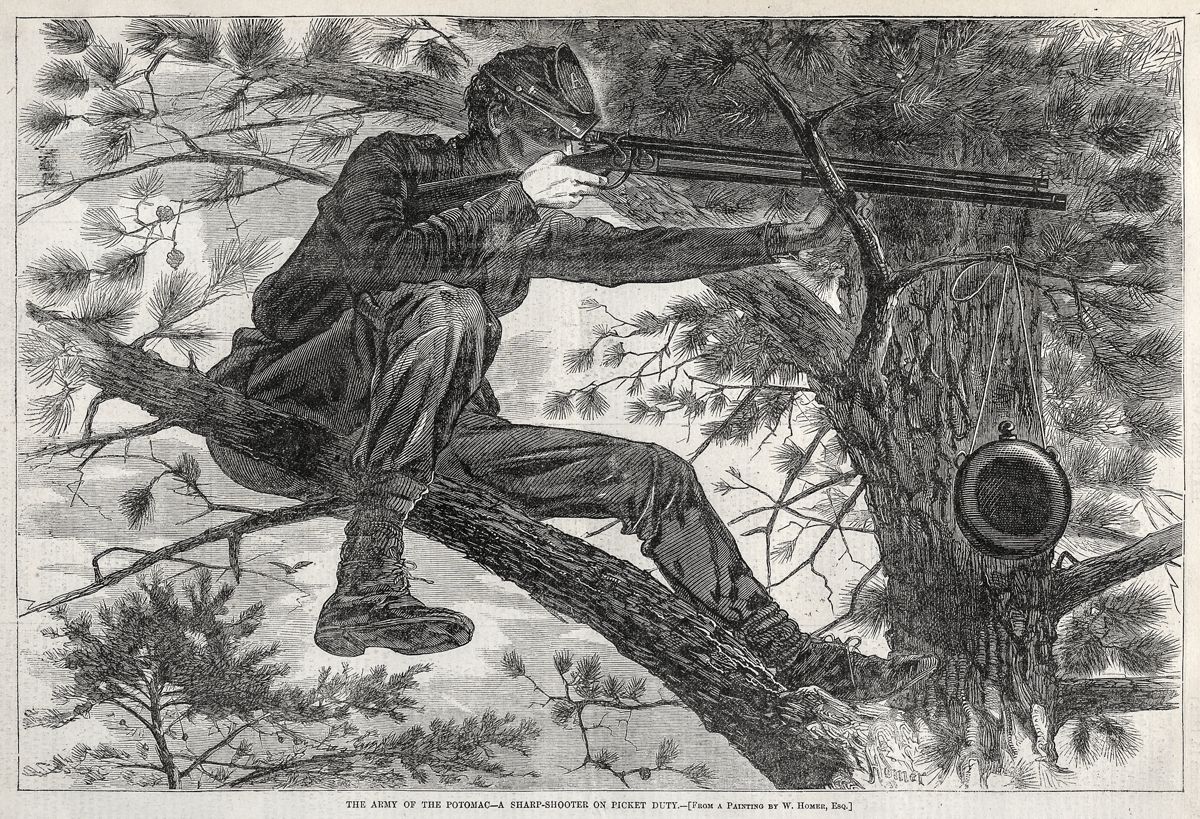
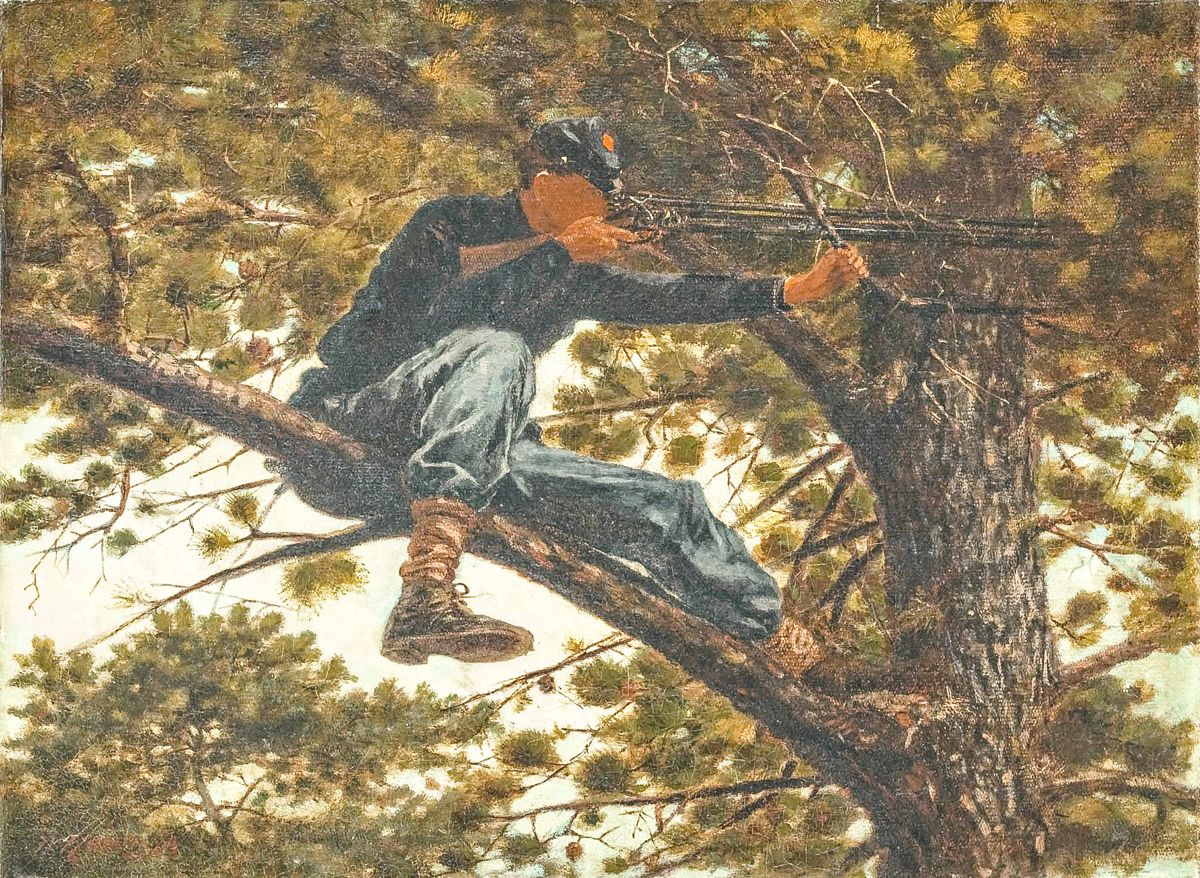
Winslow Homer “The Sharpshooter” The Graphic War highlights prints and printmakers from the Civil War discussing their meaning and the print maker or artist’s goals. American Winslow Homer is perhaps the most distinguishable artist of the 19th century. His late century paintings of postCivil War America are easily recognized as masterpieces of genre interpretations. They featured every day Americans quietly going about their lives throughout the last quarter of the century. Later in life he concentrated on the sea and its marvels and perils. He began his artistic journey as an illustrator. He saw his first engraving published in Boston’s Ballou’s Pictorial Drawing-Room Companion in 1857. With the establishment of the new, brash Harper’s Weekly in New York City, and the decision by Ballou’s to drop illustrated articles, Homer found himself, at the advent of the Civil War, working for the new and most popular weekly in America. He captured mid19th Century America through his work for both employers. His subjects were every day Americans going about their lives “riding, picnicking, and bathing in summer, in winter skating and sleighing.” As one author stated: “the prevailing tone was less of sentiment than of innocent gaiety, with crowds of children giving the outings a family air.”1 With the onset of war, Homer became more than an illustrator; he was a “reporter” with the title of “artist-correspondent.” Although he was still in his twenties and with little or no battlefield experience, he managed to insert himself into “the many facets” of the war and “still convey a remarkably broad picture of the” war “as it moved…year after year.” He managed to depict the human side of the war “recognizing the home front as well as the battlefield, the hijinks along with the violence, and …sympathetic.”2 His range of topics included the frenetic interior scene entitled “The Great Russian Ball” to graphic illustrations of combat, “A Cavalry Charge,” and “A Bayonet Charge.” Perhaps his most dramatic engraving came from his own painting. In what is often attributed as his first oil on canvas, Homer exhibited “The Sharpshooter,” a Berdan SharpShooter, in 1864. He had been working on it in 1862 when he produced an engraving of it for Harper’s Weekly. The engraving was entitled “The Army of the Potomac—A Sharpshooter on Picket Duty.” For one author, Homer’s step from “A Bayonet Charge” to the Sharpshooter “was a long step artistically.”3 Both versions of the subject include a solitary soldier, in a tree firing his long-sighted rifle toward an enemy soldier. It is unclear what type of rifle Homer was depicting in either version. Colonel Hiram Berdan’s 1st and
2nd Volunteer Sharpshooters were equipped with the Sharps New Model 1859 rifle. Berdan wanted to ensure that his men, who were especially outfitted in green uniforms to blend into the environment, had the most effective firepower available. Berdan requested that the “standard Sharps model with a few modifications” delivered to his men were to have “double ‘set’ triggers” with the elimination of the “spring loaded catch at the rear of the trigger guard plate that secured the combination trigger guard and lever in the closed position. The ‘set’ trigger involved a second trigger, the rear most, that could be pulled to take up the majority of the trigger pull weight, leaving a very light pull on the front trigger to fire the rifle. The lightweight pull of this ‘hair trigger’ added to the accuracy of the rifles in the hands of the trained marksmen.4 The November 15, 1862, wood engraving shows a sharpshooter in the trees taking aim at a faroff target. A canteen hangs off a branch and the soldier’s kepi sports an “A” indicating his company. When Homer submitted his oil painting to the U. S. Sanitary Commission in Brooklyn in 1864, after the image had been engraved in Harper’s, he entitled it “Berdan Sharpshooter,” with subtle, minor changes. The painting shows the soldier in the trees with much more foliage than the engraving. His company designation has been replaced by the diamond red badge of III Corps and the canteen has been deleted. The subject matter of Homer’s engraving and oil painting created a moral dilemma for him. It was not unique to him as many saw the act of sharpshooting as unfair and unequal, secretive, and almost criminal. Some thirty years later, he revealed his uneasiness with the whole idea of a sniper, “I looked through one of their rifles once when they were in a peach orchard in front of Yorktown in April 1862. This is what I saw (here he sketched a person in the cross hairs of the Sharps Rifle)—not a soldier—but a camp follower & artist, the above impression struck me as being as near murder as anything I ever could think of in connection with the army & always had a horror of that branch of the service.”5 Despite his moral unease with the art, engraving and oil painting, “The Sharpshooter” remains one of Homer’s iconic works depicting the Civil War, and perhaps inadvertently, it’s horror and tragedy. 1.
Endnotes:
Lloyd Goodrich, Winslow Homer’s America, New York, Tudor Publishing Co., 1969, 12. Philip c. Beam, Winslow Homer’s Magazine Engravings,
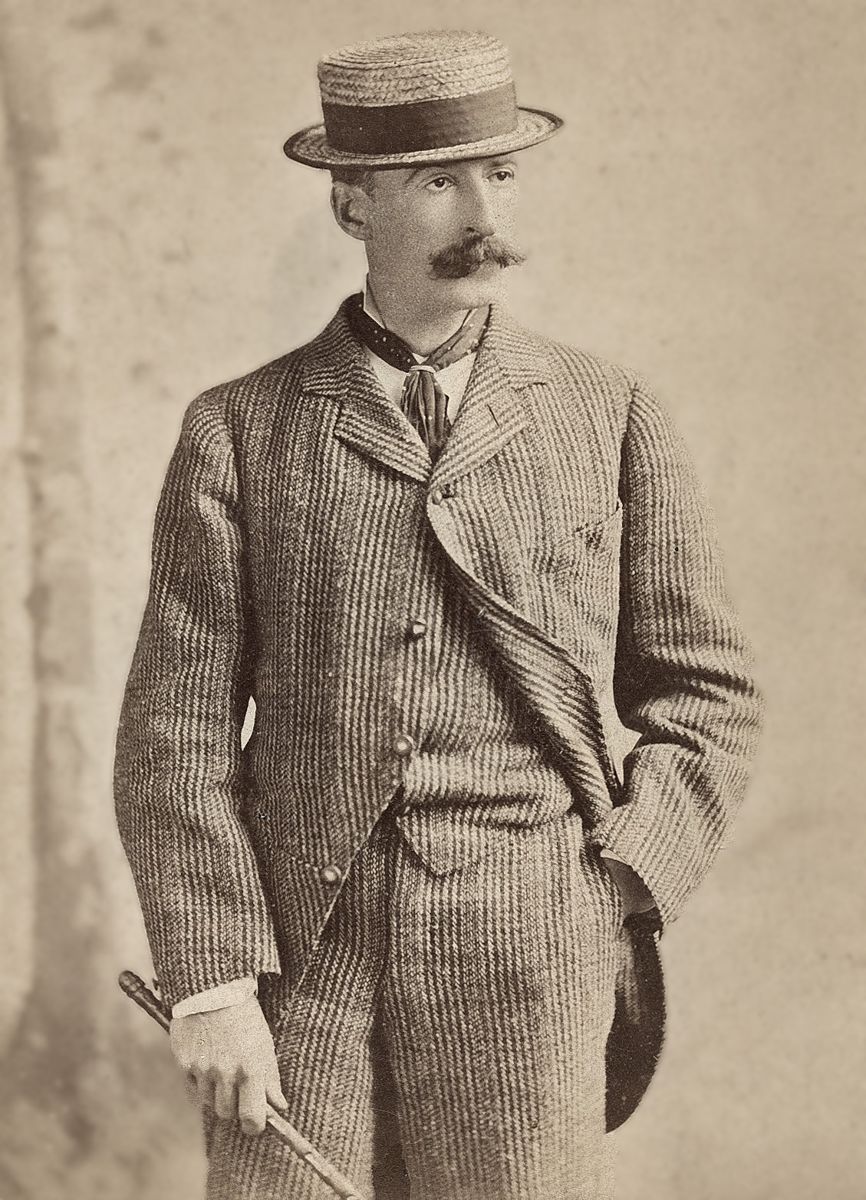
Winslow Homer, 19th century photograph. (Public domain)
New York, Harper Row, 1979, 13. Barbara Gelman, The Wood Engravings of Winslow Homer, New York, bounty Books, 1969, x. Tim Prince, https://collegehillarsenal.com/berdansharpshooters-sharps-rifle
CivilWarNews.com 5.
Winslow Homer letter to George C. Briggs, February 19, 1896 as cited in William R. Cross, Winslow Homer: American Passage, New York, Farrar, Straus, and Giroux, 2022, 87-88.
After 43 years in the museum field, Cilella devotes his time collecting American prints and maps and writing. His most recent books are Upton’s Regulars: A History of the 121st New York Volunteers in the Civil War (U. Press Kansas, 2009). His two-volume Correspondence of Major General Emory
Upton, (U. of Tennessee Press, 2017), received the 2017–2018 American Civil War Museum’s Founders Award for outstanding editing of primary source materials. Upton’s love letters to his wife 1868-70, (Till Death Do Us Part) was published in
2020 by the Oklahoma University Press. His current book, the memoirs of Private Dewitt Clinton Beckwith of Upton’s Regulars for McFarland Press will be released this Spring.
Winslow Homer’s oil painting, “The Sharpshooter.” (Courtesy Amon Carter Museum of Art, Forth Worth Texas)