
The Graphic War
The Union Refugees
By Salvatore Cilella · Originally published June 2023 · pp. 24–25
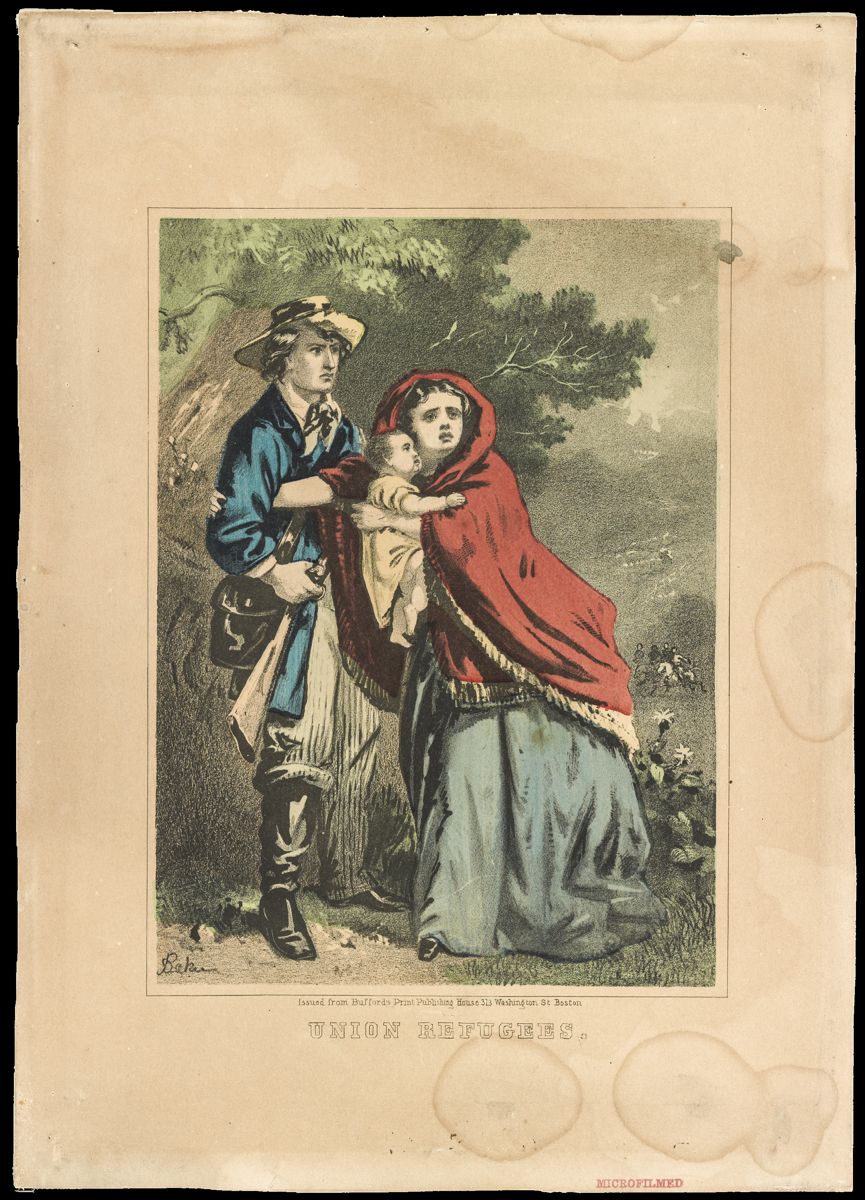
The Union Refugees
The Graphic War highlights prints and printmakers from the Civil War discussing their meaning and the print maker or artist’s goals.
When first encountering this lithograph, one has to be puzzled by its subject matter and title: The Union Refugees. Surely, this family must not be fleeing the Union! Additionally, they are not runaway slaves leaving the bondage in the Confederacy. In fact, these are southerners, loyal to the Union fleeing to the safety of Federal lines. They are victims, as in every conflict, of the disruption of war. According to author Clayton Butler “White southern Unionists illustrate better than most of their contemporaries the terms of attachment to the Union in nineteenth-century America,” and the north’s concept of liberty “worth fighting for.” Or, in the case of this lithograph, worth fleeing to.1
Particularly hard hit during the Civil War was the state of Arkansas, although most southern states dealt with Union loyalists within their political boundaries. According to the Encyclopedia of Arkansas, the war’s need for supplies and food “left many citizens utterly destitute, threatened with starvation.” As a result, military suppression of dissidents “turned thousands of Arkansans into refugees who sought the charity of bare sustenance within Union lines or by leaving Arkansas altogether.” Those who fled were no better off than those who stayed. Those left behind “suffered from the depredations of guerilla bands.”2
Even before the War, secession managed to divide Arkansans “with most loyal Unionists residing in the Ozark Mountains in northern Arkansas.” Most families were destitute and could not afford to have their male head of household absent.3 Regardless, once Missouri was rendered “safe” for the Union, “thousands of loyal Union men organized into what ultimately totaled seventeen units of Arkansas regulars that served in the Federal war effort.” After the war, the term refugee applied to another class of citizen, the defeated Confederate who sought refuge in South America.4
Other southern states suffered the loss of “refugees.” Virginia was not much different although it was closer to Union lines. Three classes of refugees fled the state: slaves, Confederates and white Unionists. “White and black Unionists and dissidents who fled to Union lines contributed to the war effort.”5 White refugees “did not necessarily support the Union cause; they primarily did not want to support the Confederate cause by risking their lives on the battlefield. As refugees in the North, white dissidents often fared better than blacks. While blacks were often confined to “contraband camps,” white Northern-born refugees could capitalize upon family connections to secure livelihoods throughout the North. White Northerners were often more sympathetic to and accommodating of, white refugees than black refugees.”6
Why the lithographic firm of John H. Bufford elected to publish this print is a mystery. The creator of the print was a relatively obscure artist, Joseph E. Baker. Early lithographic historian Harry Peters thought Baker “a very competent artist and lithographer who did ‘The March of Miles Standish’ for Armstrong, ‘Abraham Lincoln’ and theatrical portraits for Bufford, theatrical portraits for Forbes, cartoons, etc. He was an apprentice at Bufford’s with J. Foxcroft Cole and Winslow Homer.” He thought Baker’s large portrait of Lincoln taken from life by Springfield Illinois resident Charles Barry was “outstanding.”7
The print was probably published late in the war, although it is undated. The title margin reveals Bufford’s business was at 313 Washington Street in Boston, an address he occupied between 1856 and 1864. Bufford had worked previously for Nathaniel Currier. According to Peters, “Bufford… represents all the perplexities of these early lithographers with their various cross-hookups with artist and publishers. His work is almost invariably good, his sense of the essential in the general field seems to have been second only to that of Currier and Ives, his importance can be seen, and his contribution to Americana is in the very first rank.”8 Further “The house of Bufford was one of the major lithographic establishments of the period, and produced an enormous mass of lithographs of all kinds and degrees of excellence.”9
One can only imagine the fate of the small nuclear family depicted in Baker and Bufford’s poignant lithograph. Did they return home, did they fight for the Union, did they throw in their lot with the Confederacy, did they support emancipation after the war or leave for South America?
Endnotes:
-
Clayton Butler, True Blue: White Unionists in the Deep South During the Civil War and Reconstruction. Baton Rouge: Louisiana State University Press, 2022, 1.
-
“Civil War Refugees,” Encyclopedia of Arkansas, https://encyclopediaofarkansas. n e t / e n t r i e s / civil-war-refugees-6389/
-
Ibid.
-
Ibid.
-
“Refugees during the Civil War,” Encyclopedia Virginia, https://encyclopediavirginia.org/entries/refugees-during-the-civil-war/
-
Ibid.
-
Harry Peters, America on Stone, 87,119.
-
Ibid., 127.
-
Ibid., 118.
After 43 years in the museum field, Cilella devotes his time collecting American prints and maps and writing. His most recent books are Upton’s Regulars: A History of the 121st New York Volunteers in the Civil War (U. Press Kansas, 2009). His two-volume Correspondence of Major General Emory Upton, (U. of Tennessee Press, 2017), received the 2017–2018 American Civil War Museum’s Founders Award for outstanding editing of primary source materials. Upton’s love letters 1868-70, (Till Death Do Us Part) was published in 2020 by the Oklahoma University Press. His current book, the Memoirs of Dewitt Clinton Beckwith of Upton’s Regulars (McFarland Press) was released this Spring.