
Through The Lens
The Bravest Brigade
By Stephanie Hagiwara · Originally published June 2023 · pp. 16–17
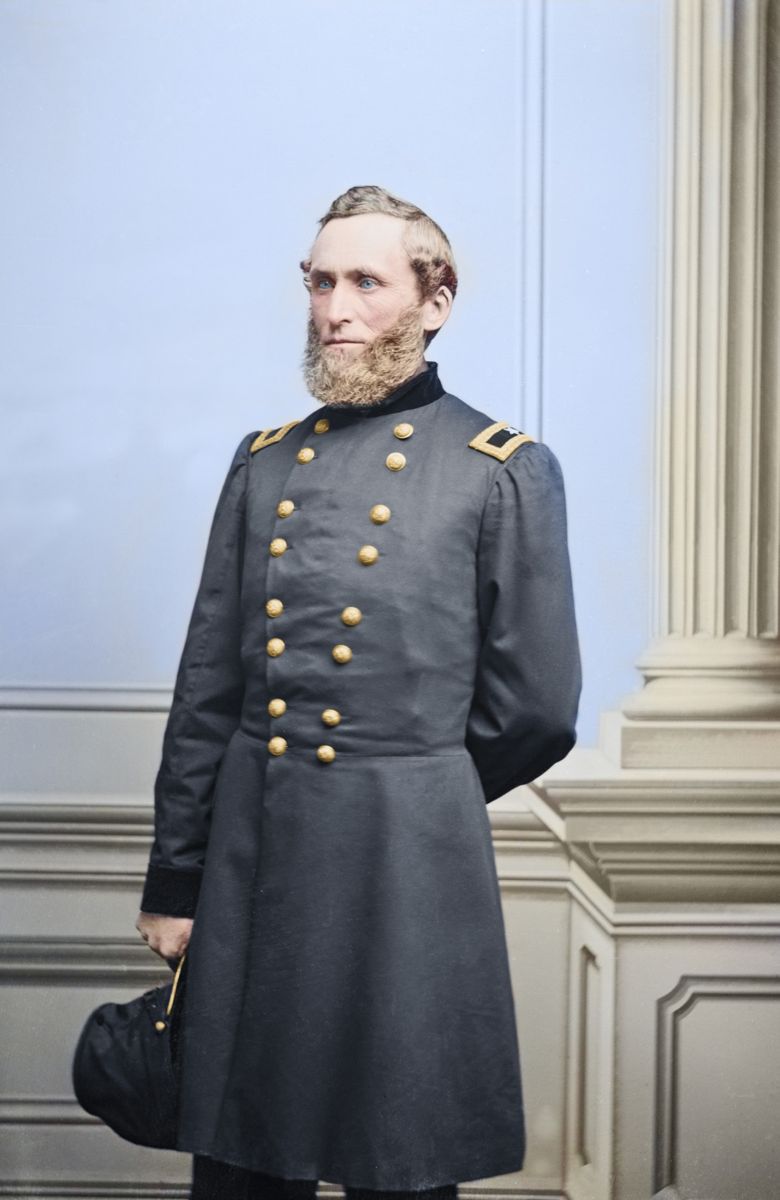
The Bravest Brigade “Beauregard is not such a fool as to leave his base of operations and attack us in ours. There is no enemy nearer than Corinth.” – U.S. Gen. William T. Sherman In March 1862, attention turned towards “the vertebrae of the Confederacy,” Corinth, Miss. Considered by both sides as essential to the Confederacy’s survival, Corinth was a major Confederate railroad hub and logistics center. In preparation for attacking Corinth, U.S. Gen. Ulysses S. Grant, Army of the Tennessee, had assembled 40,000 men at Pittsburgh Landing, Tenn. Gen. Don Carlos Buell’s Army of the Ohio, 35,000 men, was coming from Nashville, Tenn., to reinforce the attack.
C.S. Gen. Albert Sidney Johnston’s, Army of Central Kentucky, 17,000 men, joined Gen. P.G.T. Beauregard’s, Army of the Mississippi, 35,000, men to defend Corinth. Having officially taken command of the combined force, Johnston determined that he needed to attack the Federals before Buell joined Grant. Between bad weather and the greenness of the men, it took longer than expected for the Confederates to travel the 20-miles north. The Battle of Shiloh, Tenn., April 6-7, 1862, began before dawn. Pickets’ claims that the Confederates were nearby had been ignored. Having failed to convince his superior officer, Brigadier Gen. Benjamin Prentiss to strengthen their position, Col. Everest Peabody, 25th Mo., authorized a reconnaissance force of 300 men. Encountering
C.S. Gen. William Hardee’s skirmishers, the Federals pushed them across Farley field to join the main Confederate force. The Federals fell back as Hardee’s men moved forward. The Southern advance slowed as the men plundered Federal camps for food and souvenirs. The divisions of generals William T. Sherman and Prentiss were closest to Corinth, first attacked and with the least experienced men. As the enemy approached Sherman’s Division, a colonel yelled “Retreat! Save yourselves!,” then led the running. Sherman was able to gather enough men to hold his ground against four successive charges before giving way during the fifth. The battle had opened before either side was ready. The sounds of gunfire ended Beauregard’s attempt to call off the attack.
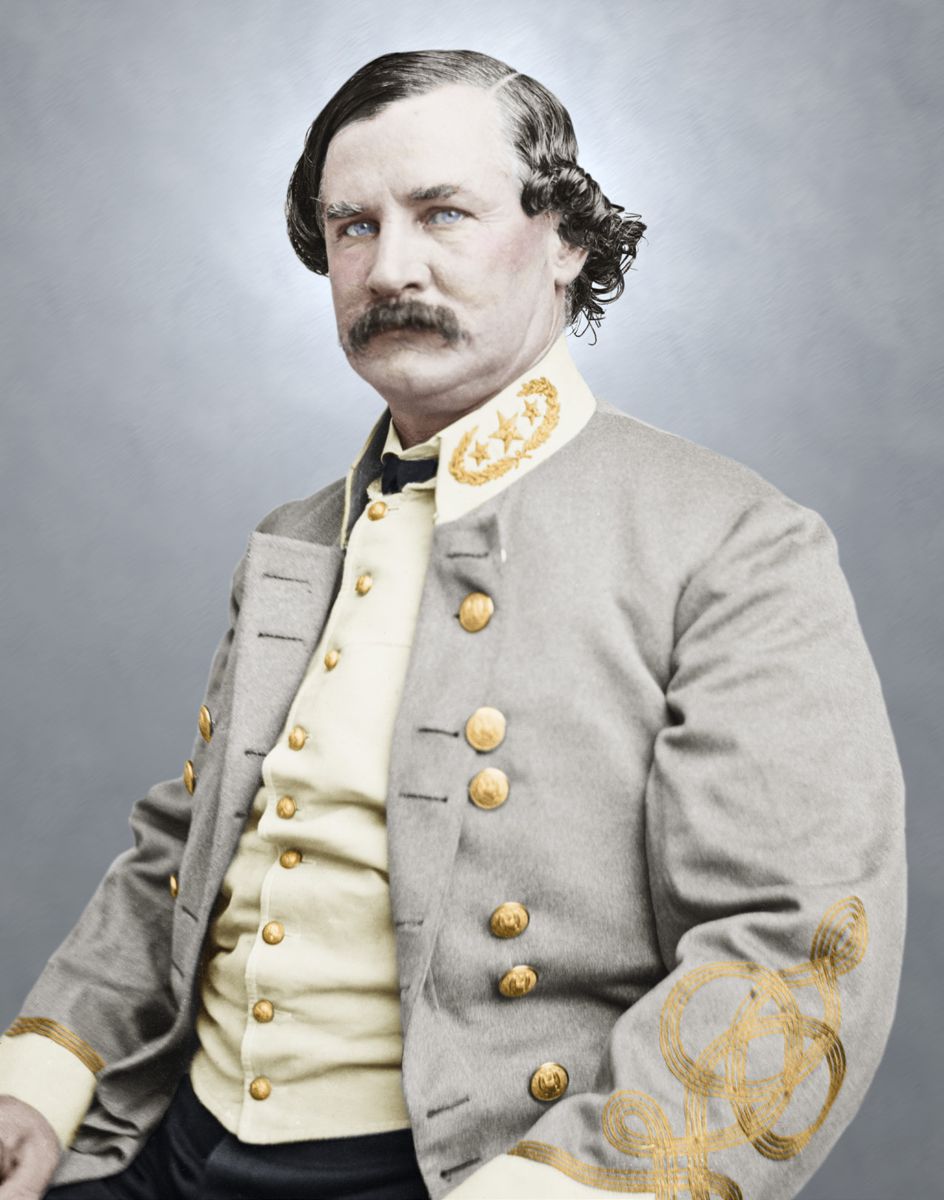
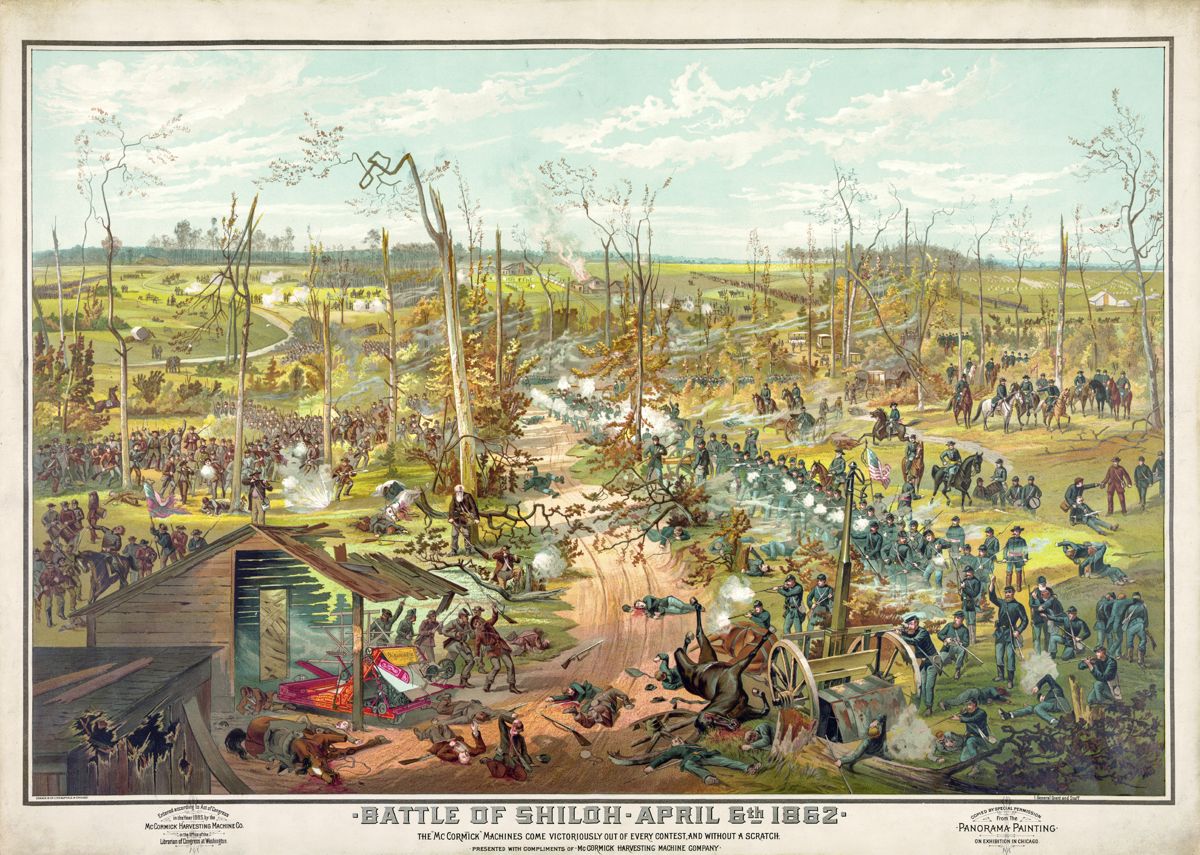
Johnston was sensitive to usurping command of Beauregard’s larger army in a location previously agreed as Beauregard’s. He had graciously assigned Beauregard the commander’s position behind the battleline while Johnston rode up front with his troops. Johnston devised his attack plan to accommodate the inexperience of the troops; he assumed it would be followed. Beauregard interpreted his own assignment as agreement to his complicated, three wave attack plan. Grant, hearing the guns, rode his horse up the bluff to investigate. Grant had injured his ankle and took a crutch with him. Intercepting retreating men, his first act was to establish a straggler line with a battery of guns. By 10:00 a.m., he reached Sherman, who had been wounded twice and needed more ammunition. Next to Sherman, Grant visited Gen. John McClernand, near Shiloh Chapel. Afterwards, Grant rode over to Prentiss. He was positioned at what would become known as the Hornets’ Nest, a wagon track, a.k.a. the sunken road, near heavy woods with a thick undergrowth and fields on either side. The hickory and oak trees to his front allowed the Federals to shoot describing the action. Thousands of visitors paid 50 cents each to see it. The painting’s popularity inspired an advertisement with a McCormick Harvester & Twine Binder, unscathed amid the panorama. In 1894, the battlefield of Shiloh was named a national park. David W. Reed, 12th Iowa’s historian, was appointed as the park’s commissioner. Reed placed monuments to tell the story of the Hornets’ Nest and other positions. Modern scholars debate whether the importance of the Hornets’ Nest was genuine or hypothetical. Grant would later describe Prentiss as “a brave and very earnest soldier. No man in the service was more sincere in his devotion to the cause for which we were battling; none more ready to make sacrifices or risk life in it.” Everything considered, Prentiss had held the Hornets’ Nest at all hazards. As he surrendered his Grant told Prentiss to “maintain that position at all hazards.” He would interpret the order literally. Prentiss had been commissioned a brigadier general on the same day as Grant. Grant’s former army rank made him senior to Prentiss. Sorting out the seniority issue had caused tension between the men. The Rebel yell announced the arrival of C.S. Col. R.G. Shaver’s men at the Hornets’ Nest. The Federals kept low to the ground as the Confederates ran out of ammunition firing over their heads. The Federals poured metal hail on the departing men. One of Gen. Benjamin Cheatham’s batteries fired on Prentiss’ men with four Napoleons and two 6-pounders. The Hornets’ Nest was interfering with Johnston’s plan to wheel his army left and advance. Johnston watched the fighting and corrected the aim of a battery. He moved forward to lead a charge towards a peach orchard on the left. Johnston, mortally wounded in the advance, passed command to Beauregard. Beauregard sent in Col. Randall Gibson’s Brigade, part of Gen. Daniel Ruggles Division to attack the left side of the Hornets’ Nest. Gibson’s three charges were met with withering fire, and he withdrew his men for the day. Uncoordinated infantry attacks did not dislodge Prentiss. Ruggles gathered 51 artillery pieces for a massive barrage.
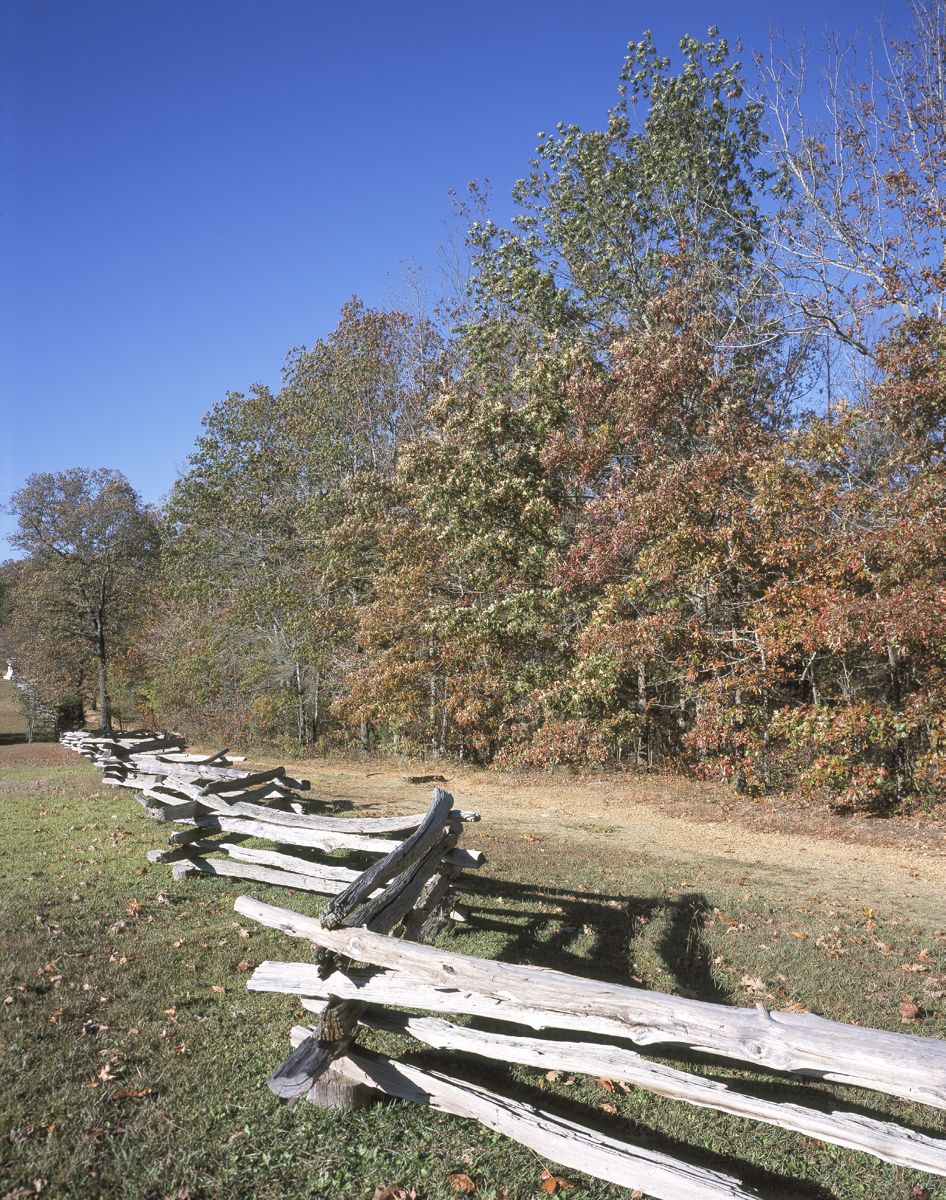
About 4 p.m. the guns opened fire. The Confederate infantry advanced. The Federals returned fire. The “whole earth seemed in a blaze—the sharp, ringing crash of our musketry—our batteries belching forth their shot and shell, and roaring like the deep toned thunder,” recalled U.S. Pvt. William Swan, 3rd Iowa Infantry. The Confederates made between 8 – 14 separate assaults on the Hornets’ Nest. After seven hours, Prentiss still held his position between Sherman and McClernand. Running out of ammunition, both generals were falling back, exposing Prentiss’s flanks. Prentiss stayed, allowing the other units and batteries to retreat. Rushing forward, the Confederates mixed with the Federals, both sides still firing. Prentiss finally had to “yield the fight.” The assertion that the “Hornets’ Nest” saved the day at Shiloh spread through Iowa veteran reunions in the 1880’s. In 1885, French artist Théophile Poilpot was commissioned to paint a panorama painting of the Battle of Shiloh. Poilpot chose to focus on the Hornets’ Nest. His team photographed the battlefield, interviewed veterans, and collected 2,000 carte de viste photographs of the combatants. The 50 feet high and 400 feet long painting was displayed in a specially constructed building in Chicago. Shrubs, weapons, and trees were placed at the base of the canvas. Prentiss gave lectures
2,200 men, Prentiss had ridden around the field, waving the white flag. He had rose in his stirrups and proclaimed to the Confederates, “Yell boys, you have a right to shout for you have captured the bravest brigade [sic division] in the U. S. Army.” Sources: Cunningham, O. Edward. Shiloh and the Western Campaign of 1862: Savas Beatie, 2009 Nevin, David, and the Editors of Time-Life Books. The Road to Shiloh: Early Battles in the West: Time-Life Books, Alexandria: VA, 1983 Stephanie Hagiwara is the editor for Civil War in Color.com and Civil War in 3D.com. She also writes a column for History in Full Color.com that covers stories of photographs of historical interest from the 1850’s to the present. Her articles can be found on Facebook, Tumblr and Pinterest.