
This And That
The War Before the War – A Young Artillery Officer in Mexico
By Gould Hagler · Originally published July 2023 · pp. 20–22
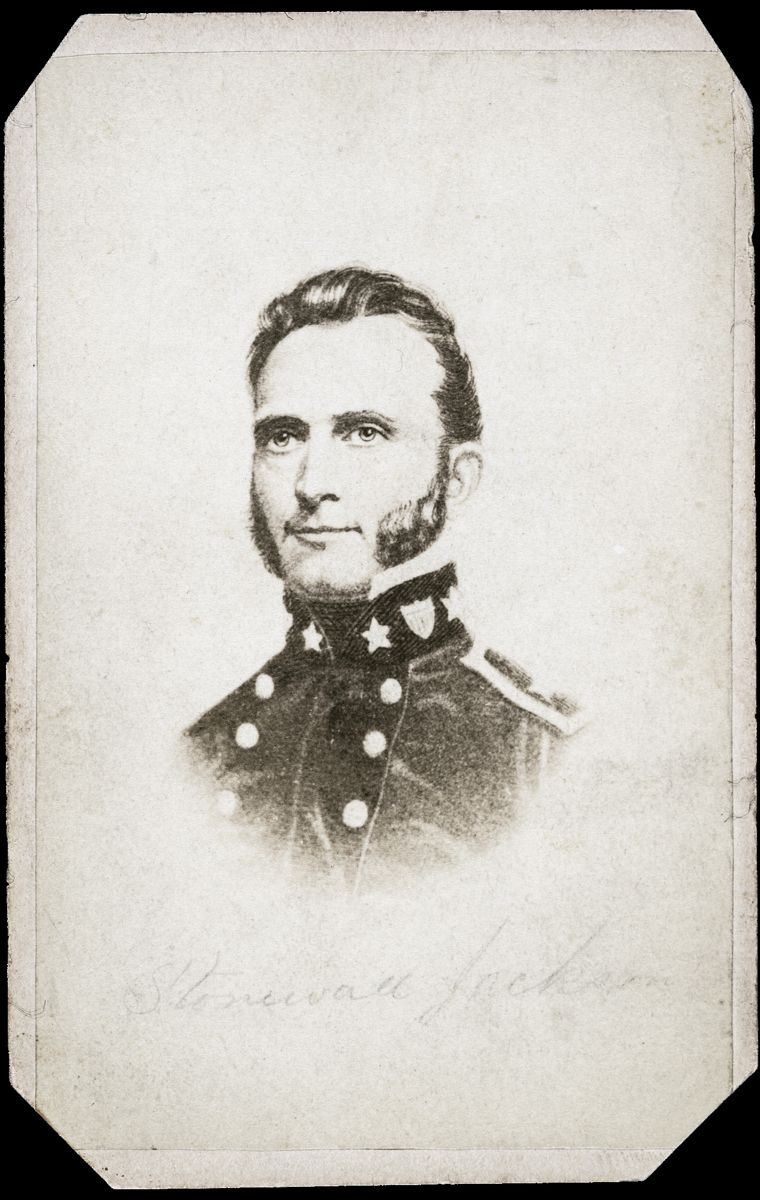
The War Before the War – A Young Artillery Officer in Mexico In 2019 I wrote three columns, under the title “The Wars after the War,” recounting the experiences of several Federal officers who led troops against hostile Indian tribes in the 1870s. This column, and some as-yet-undetermined number of others, will turn to the war before the War, the Mexican War. We all know about the Mexican War, don’t we? The United States won; Mexico lost and ceded much of its territory to the U.S. Most of us have heard the joke that we got the part with paved roads.
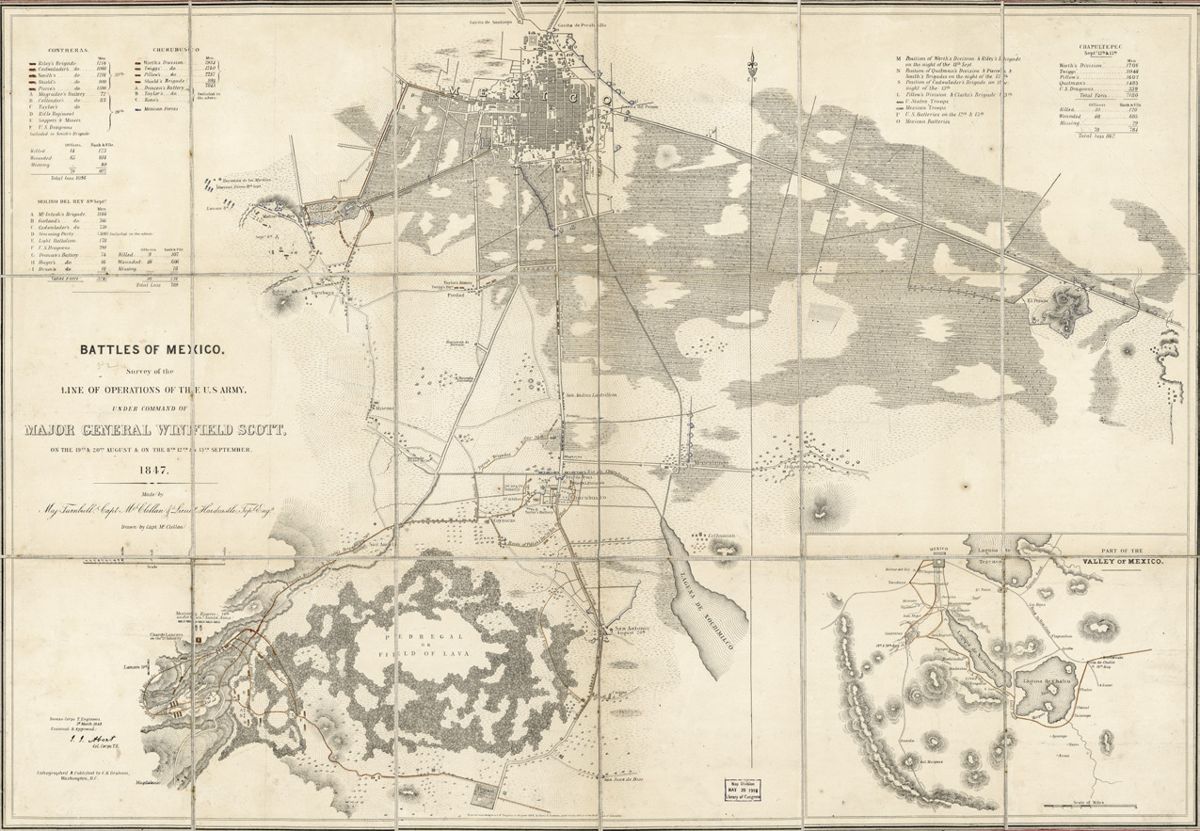
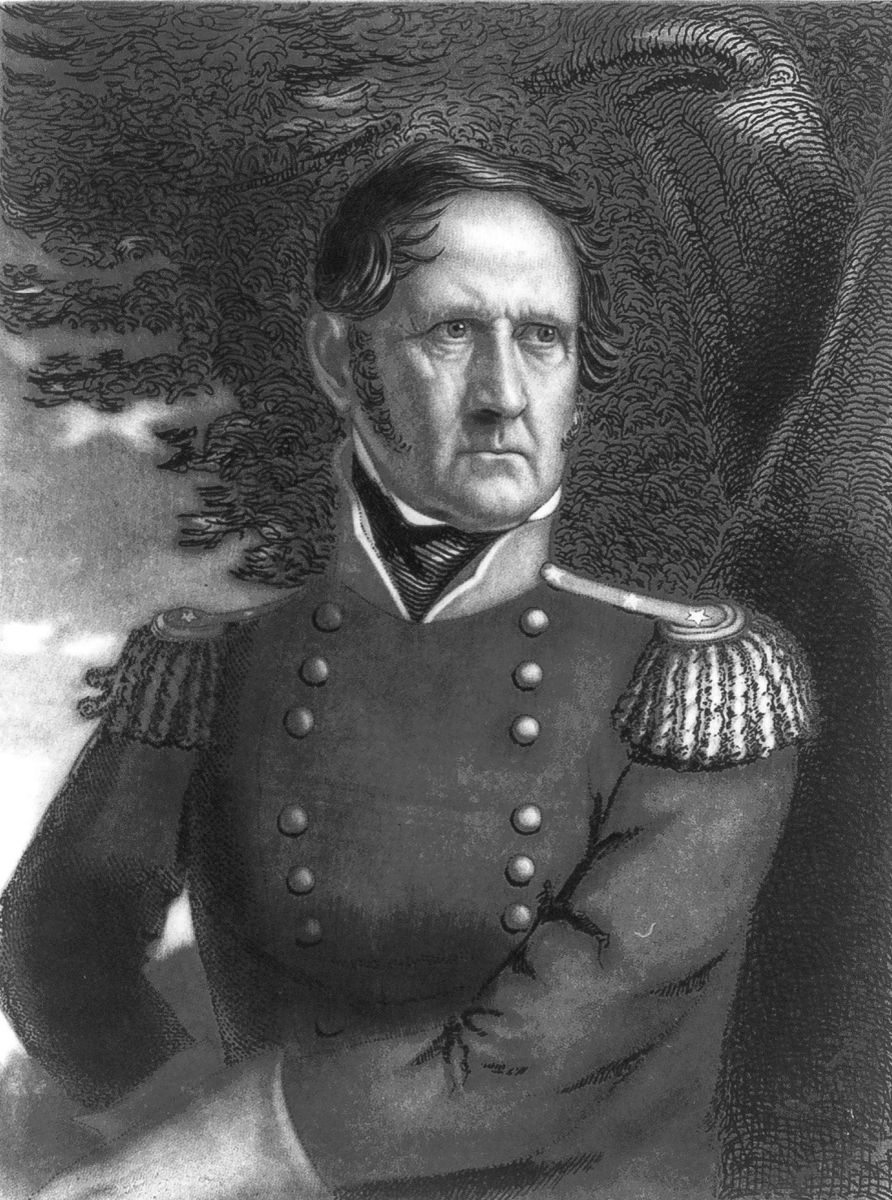
We also know that the war served as a training ground for many young officers who rose to high rank in the Civil War, and beyond that? Well, beyond that I suspect most of us know very little. So, let’s go back to the 1840s and examine the experiences of some of these officers known to all CWN readers for their exploits a decade and a half later. We begin this month with a young man just out of West Point, a native of Virginia’s mountainous west, an orphan who entered the military academy badly unprepared. He succeeded by dint of hard work and determination, graduating in 1846 ranked 17th in a class of 59. In his 1997 biography of Stonewall Jackson, James I. Robertson Jr., devoted a chapter to Thomas Jackson’s service in the Mexican War. Most of what follows is based on this chapter. Upon graduation Jackson was assigned to the artillery, as he had hoped. He received orders to report to Capt. Francis Taylor, commanding Co. K of the 1st Artillery Regiment. Soon Jackson was at sea, bound for Point Isabel, Texas*, where the fighting with Mexico had begun. Captain Taylor’s detachment landed on September 24 and headed inland. The artillerymen fought heat, insects, rain, mud, and mountains as they labored to get their guns and themselves to Maj. Gen. Zachary Taylor’s army in Monterrey. However, when they arrived their guns were not put to use. There were rumors that Mexico was giving up. Jackson feared he had missed the fight. The regiment soon returned to the coast, but home was not the destination. The 1st Regiment gov/item/2018593090. Readers may wish to use the link below to view an excellent map showing the vicinity of Mexico City and the lines of operation in September 1847. The website of the Library of Congress allows the viewer to zoom in and see the details: the Pedregal lava field, Chapultepec Castle, the causeways and much more. and other elements of Taylor’s army were headed for Veracruz. The Mexicans had not quit and there would be a great deal of fighting before they did. While U.S. forces under Taylor continued to wage war in the north of Mexico, the main effort would begin at Veracruz, under a force commanded by Maj. Gen. Winfield Scott. On March 9, 1847, Scott launched his amphibious landing. In four waves his 13,500-man army (in Robertson’s words) “bobbed ashore in surfboats.”
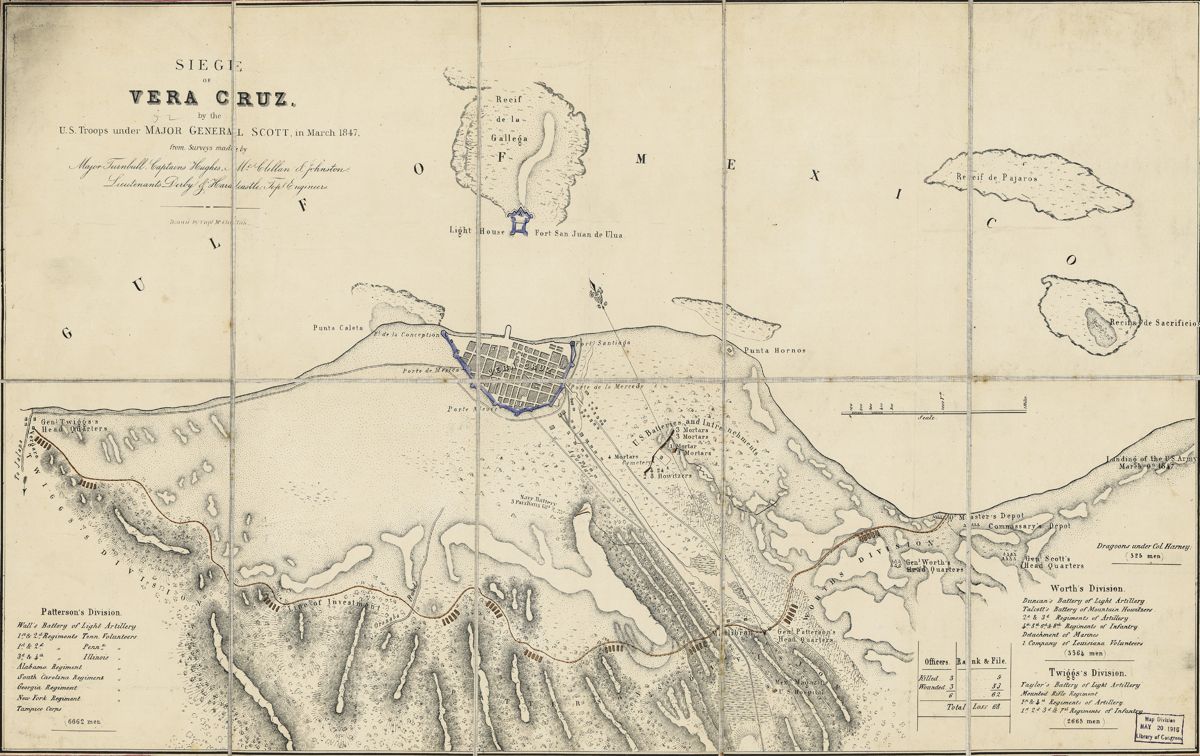
There was no opposition. Bvt. Second Lieut. Thomas Jackson and his regiment bobbed onto the beach with the others; the U.S. forces now had a foothold on the mainland without the loss of a single man. Scott chose to take Veracruz by regular approaches rather than risk a costly assault against the fortified city. Trenches were dug and artillery was put in place. The guns opened up on March 22. The defenders replied in kind. In his first time in combat Jackson was conspicuous for his composure under fire as he commanded his guns. A West Point classmate later recalled how Jackson calmly braved “a hurricane of bullets” during the battle. In a letter to his sister Laura, Jackson described the role of Co. K in the siege and told her of a near-encounter with “a cannon ball that came within about five steps of me.” The guns of the 1st Artillery were light field pieces that contributed to the effort, but the heavy work was done by big naval guns brought ashore. The Mexicans capitulated on March 27. In the letter to his sister Jackson wrote of the excellent performance of the U.S. forces and expressed his disappointment that the surrendering Mexicans were paroled. This newly-minted brevet lieutenant may not have considered the difficulties of guarding and feeding over 4,000 men; however, the letter provides some insight into the mind of the future leader, who (again in Robertson’s words) “thought in terms of unrelenting offensives and complete victory.” Early the next month Scott moved inland over terrain that favored the Mexican defenders.
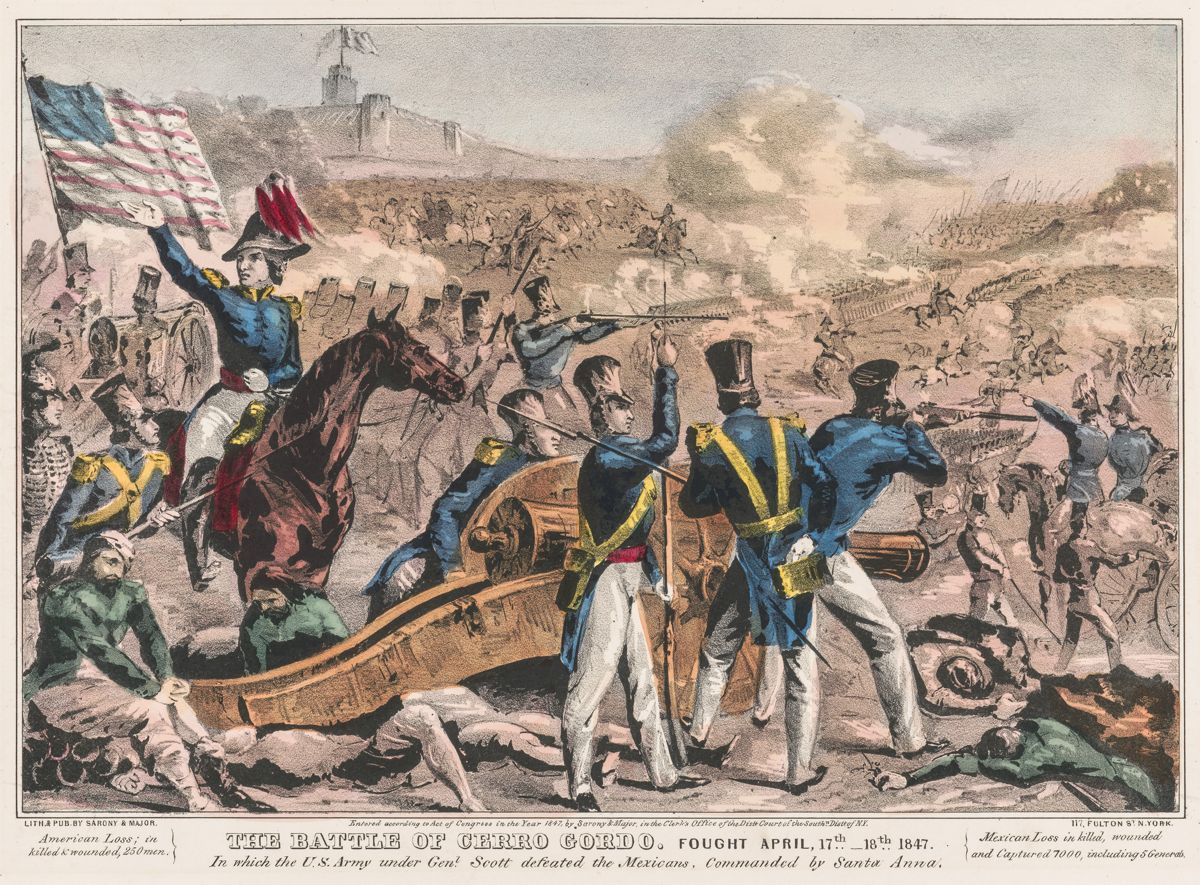
The first fight came at Cerro Gordo. The Americans succeeded in this battle by means of a flank attack, using a route scouted out by a captain on Scott’s staff named Lee, a Virginian like Jackson. At Cerro Gordo Jackson again performed with skill and bravery. When the Mexicans broke and fled westward, Co. K pursued for a dozen miles. Getting the guns in position was no easy task. Capt. Taylor’s report stated that “through the exertions of Lieut. Jackson, the caissons were brought up early in the night. It may be proper for me to add that the difficulties of getting the Artillery over the hills at Cerro Gordo were great. Taking out the horses, the pieces were drawn up by men by means of picket ropes attached to the carriages.” Jackson was promoted from brevet second lieutenant to regular second lieutenant. He was assigned to a new company which remained in Jalapa on garrison duty, a job not to his liking. During this time he served on courts martial and began to study the Spanish language. In June he was sent back into action and was transferred to a company commanded by Capt. John Bankhead Magruder. Magruder was known to be bold and aggressive in battle. Commanding guns in this “flying artillery” unit, Jackson could anticipate activity far more exciting than court martial duty and Spanish lessons. After a pause in Puebla the artillerymen took their guns to the place where the Mexican positioned their next line. Scott’s force of 10,700 faced a larger army ensconced in a strong position. A frontal assault was not a good option; however, there seemed no feasible way to get on the enemy’s flank. The same Captain Lee again went to work. He took a small force to find a way through a large lava field, known as the Pedregal, which at first seemed impassable. As at Cerro Gordo, Lee managed to find a way. With a great deal of work the path was made passable for infantry and artillery. As Magruder’s gunners and other artillerymen muscled their way through the Pedregal they came under fire from Mexican artillery placed in a wellfortified position. The division commander ordered the artillery to unlimber and return fire. In this three-hour duel Lt. Jackson displayed “indomitable sticking qualities,” a fellow officer wrote. He went where he was ordered to go and stayed there “without a thought of withdrawing.” The infantry again flanked the defenders and the next day again
CivilWarNews.com forced the Mexicans back, ever closer to Mexico City. Jackson once more had shown his mettle and his attitude about orders. His performance earned another quick promotion.
The Battle of Cerro Gordo. (Library of Congress)
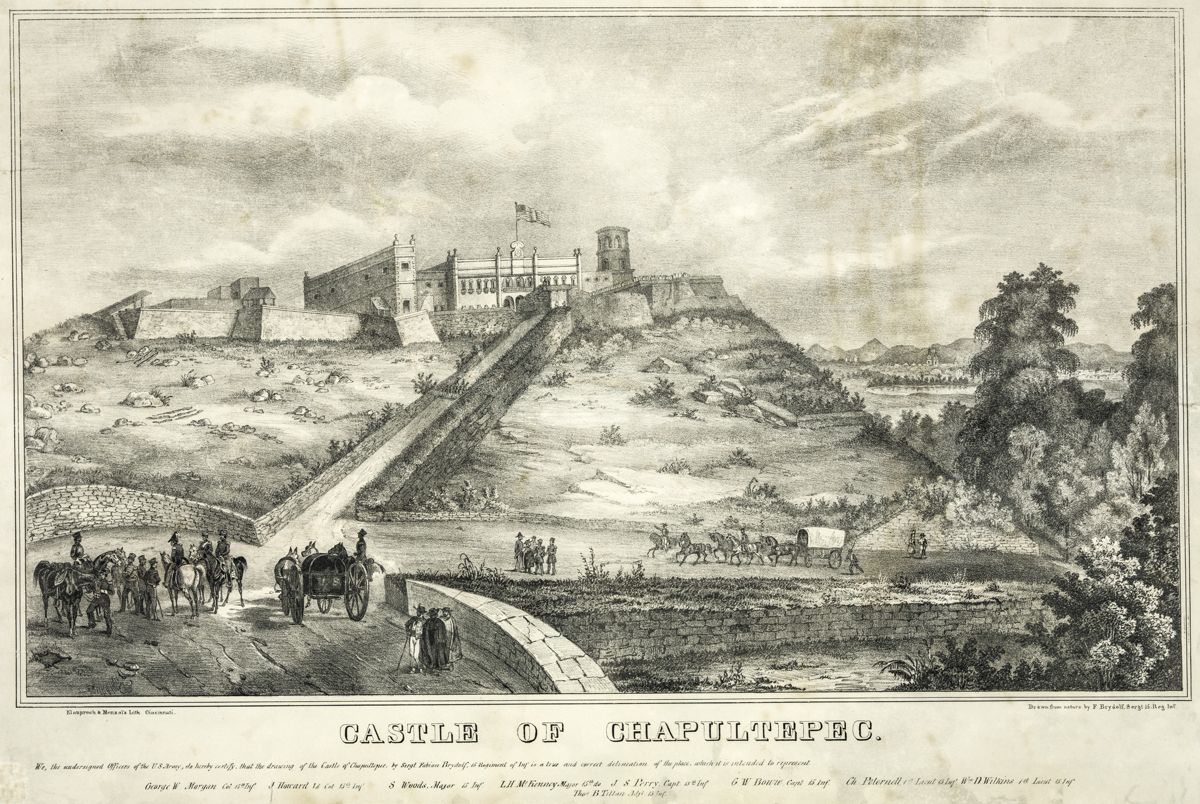
Chapultepec Castle (Library of Congress)
After a two-week truce the fighting resumed. Jackson was again in action at Molino del Rey, a site thought to be the location of a cannon foundry. The artillery played a small role here, but from his guns Jackson observed the infantry’s frontal assault. Although successful, the attack was costly. It was pointless as well: there was no cannon foundry and no reason to attack the position.
Inadequate reconnaissance, faulty intelligence, poor tactics, high cost, no gain, lessons learned by the young lieutenant. The war’s decisive battle was fought on September 13 at
Chapultepec Castle, a formidable obstacle three miles southwest of Mexico City. The castle stood on a hill about 200 feet above the plain and guarded the narrow causeways which were the only routes into the capital from the south and west. On the 12th and early on the 13th Scott’s artillery bombarded the position. At 8:30 a.m. American infantry attacked. At Chapultepec, more than at any other battle in the war, Thomas Engineers. (Library of Congress)
Jackson displayed the soldierly attributes of bravery under fire, leadership, initiative, discipline, and relentless determination. Jackson, now a first lieutenant, commanded two six pounders in a force of infantry and artillery placed at the far left of the American line. Advancing along a causeway on the fortress’s north side, the troops met heavy fire, artillery and musketry, coming from a redoubt on the causeway and from the castle above. Immediately, one of Jackson’s two six-pounders was damaged. All 12 horses were killed or disabled. Artillerymen scattered to seek what little protection they could find. Jackson stood in the roadway and rallied the men. First the undamaged gun, then the other, were put into position and returned fire. Infantry soon overran the Mexican redoubt. Jackson improvised, cobbling together some limbers to pull his guns along the causeway. Jackson’s men and others “whose ardor had exceeded their orders” pursued the enemy to the gates of the city. Meanwhile the castle itself had fallen. The battle was won. Mexican forces evacuated the city and the Americans entered unopposed on the 14th. After the city fell there was a truce that lasted until the Treaty of Guadalupe Hidalgo was signed. In the intervening months and beyond, the army occupied a peaceful city. It was pleasant duty. Jackson used the time profitably. He continued his study of Spanish, sticking with it until he became fluent. He read histories of Mexico in both English and Spanish. He also read Shakespeare, presumably in the original English. He dined with prominent Mexican families and met some of their charming daughters. Jackson was involved in two matters of honor, but not as one of the duelists. His journey of faith, begun under the influence of Capt. Francis Taylor, continued. He developed an unlikely friendship with an archbishop and explored Catholicism. As we all know, however, he ultimately decided on Presbyterianism. In the military sphere, he served as his company’s quartermaster and commissary officer and was promoted to the rank of brevet major. He observed the conditions in military hospitals and was distressed by what he saw. He noted “the several sharp rivalries that erupted on the command level relative to battle plans and conduct.” In June 1848 Jackson left Mexico City with the 1st Artillery. In July he reached New Orleans, the same port from which he had sailed nearly two years earlier. In this war before the War, Thomas Jackson, like many other young officers, developed his skills and learned valuable lessons on the military craft. These lessons would be applied, in the larger and more sanguinary conflict, as he fought against many of the officers who had been his compatriots in Mexico. Many others, of course, would be Jackson’s comrades-in-arms in this later war, including Capt. Lee, with whom he had a close and famous association. *Whether this was the Texas coast or the Mexican coast was one of the important issues over which the war was being fought. Mexico did not recognize Texas’s claim to the territory south of the Neuces River. Anyway, when Taylor, Jackson and company arrived it was occupied by U.S. troops, not by forces of the region’s other claimants. Gould Hagler is a retired lobbyist living in Dunwoody, Ga. He is a past president of the Atlanta Civil War Round Table and the author of Georgia’s Confederate Monuments: In Honor of a Fallen Nation, published by Mercer University Press in 2014. Hagler speaks frequently on this topic and others related to different aspects of the Civil War and has been a regular contributor to CWN since 2016. His email is [email protected].