
This And That
Close to Home
By Gould Hagler · Originally published January 2023 · pp. 26–27
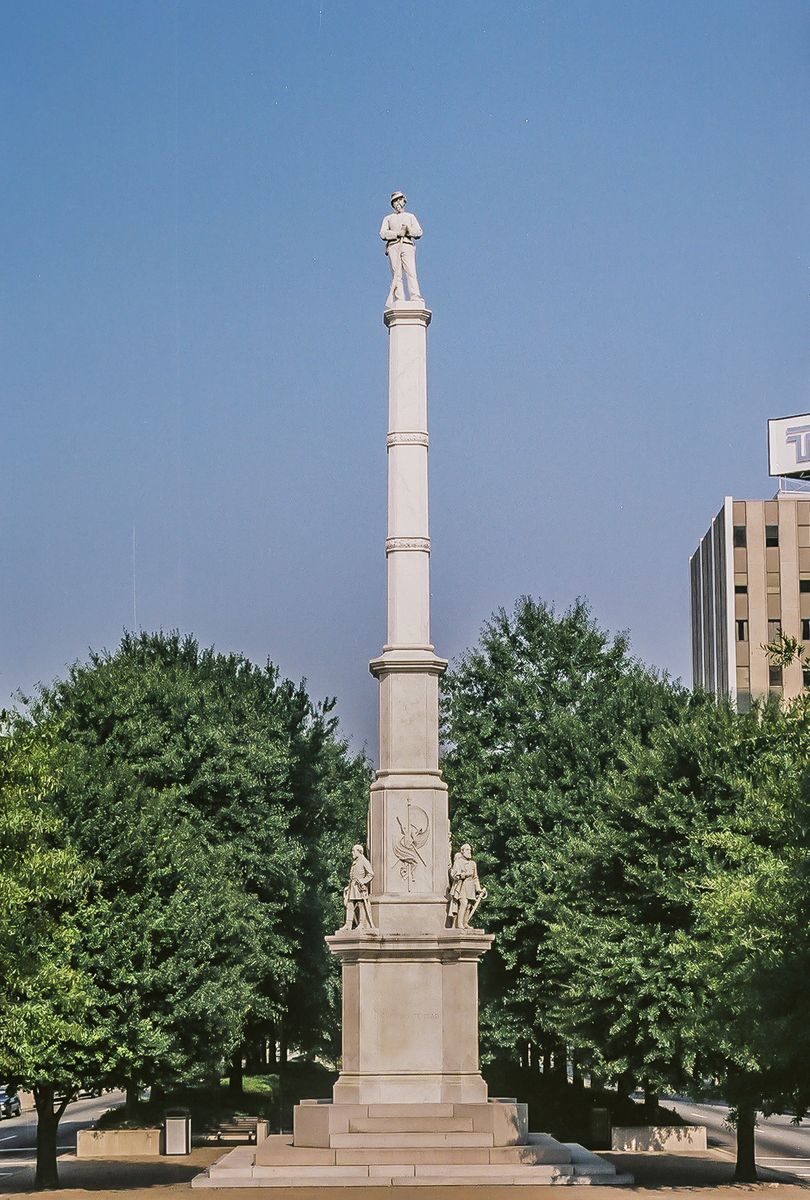
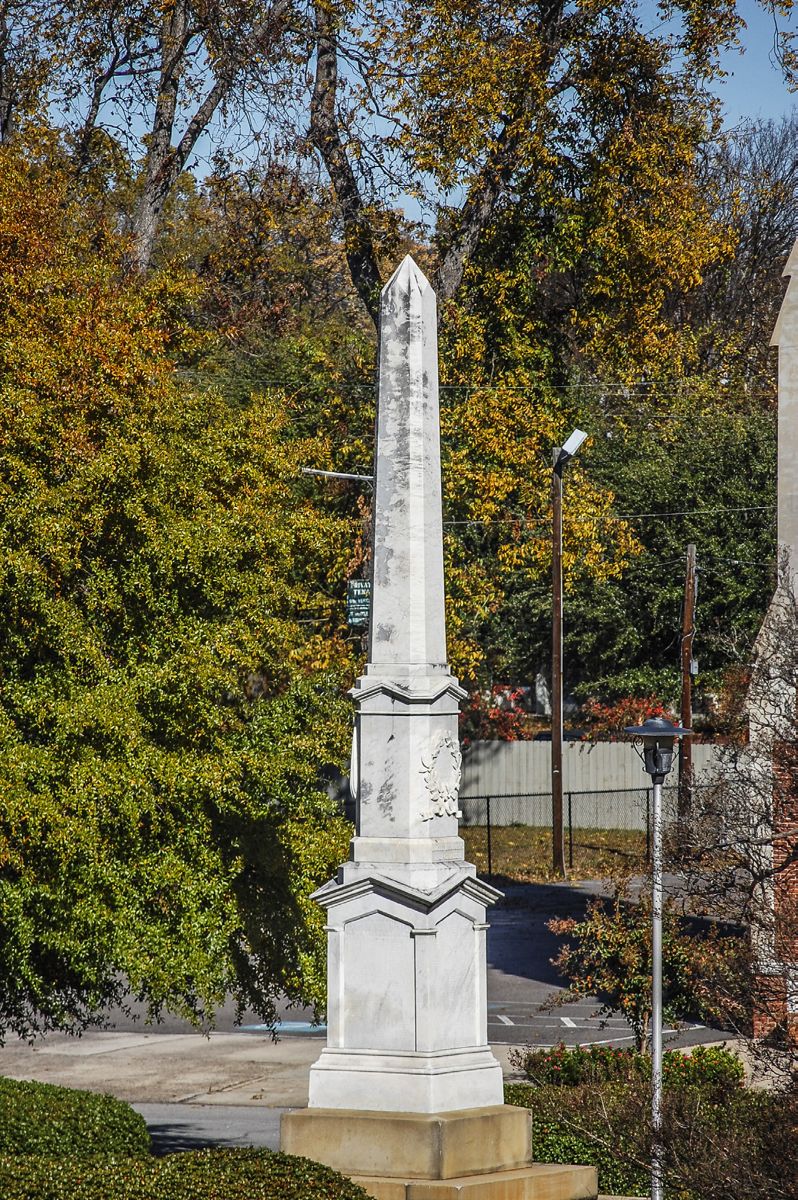
Close to Home A grand Confederate monument stands on Broad Street in Augusta, Ga. It towers over the cars and people below and, at 76 feet, is taller than most nearby buildings. A statue of a common soldier standing at rest crowns the marble column. Below are four generals, Lee, Jackson, W.H.T. Walker, and Thomas Cobb. The memorial was erected by the Ladies Memorial Association in 1878 at a cost of $17,000, roughly $500,000 in today’s money, a vast sum for a Southern city after the Civil War. This imposing structure, however, is not the sole Confederate monument in Richmond County. Two other memorials, far more modest than the one on Broad Street, convey an even more poignant message about the cost four years of war imposed on the people of this Georgia county. Greene Street, just two blocks south of Broad, is a long, beautiful avenue with a gardenlike median. A walk through this garden from west to east leads you past numerous monuments honoring men and women from all aspects of Augusta’s history, from one dedicated to the three Georgians who signed the Declaration of Independence to one honoring four Southern poets. Near the end of your stroll, after passing Fifth Street, you will encounter an obelisk built in 1873 by the Cenotaph Club and the Saint James’ Sabbath while trapped in a dismal prison. During the Civil War over a quarter of a million men lost their lives in service to the Confederacy. Over 300,000 Union soldiers and sailors died. Numbers this huge tell of a vast armed struggle and remind us of the monstrous scale and long duration of the war. These big numbers tell us a lot, but the smaller numbers carry a different, and perhaps a more profound, kind of meaning. They scale the tragedy down from the level of the nation to the level of the community, the neighborhood, the church, and the family. The short lists of names from the Saint James’ Sabbath School in town and from the Linwood Sunday School in the countryside make an impression that is immediate and intensely personal. These letters inscribed in stone paint an image of a minister of God preaching to a congregation dressed in black. Everyone in church, including the clergyman, is in mourning. Everyone has lost a family member, a friend, or a comrade-in-arms. Perhaps the minister is preaching on the themes of the two inscriptions on the Greene Street cenotaph. Immortalis est veritas read the words on one surface; Truth is immortal. On another face Dulce et decorum est pro patria mori is inscribed; It is sweet and honorable to die for one’s country. I have always been puzzled by the first adjective in this quote. Perhaps some members of the congregation find it as odd as I do. A version of this article appeared earlier in the Blue and Gray Dispatch.
the Sabbath School who fell. Twenty-four names are inscribed here, names of men who prayed together in this single Methodist Church. Other surfaces list the other war dead of the county. The names are so numerous that they overflow the tablets designed for them and spill to the base below. Altogether nearly 300 men from this one community are honored by this modest cenotaph. Another mournful monument, one perhaps even sadder than this one, is difficult to find. It is in a section of Richmond County which for many decades has been part of Fort Gordon. Before the area was acquired by the United States Government it contained farms, crossroads hamlets, and numerous country churches with their cemeteries. The churches are long gone, of course, but the cemeteries remain. At the intersection of two dirt roads is cemetery # 30, which contains the oldest Confederate monument in Georgia. It was built in June 1866 by the Linwood Sunday School. The War claimed the lives of 23 men from this tiny community. Like their comrades and fellow Christians from Saint James’, these men were killed in battle, died of wounds after days or weeks of suffering, succumbed to disease in camp or hospital, or went from this life to the next
Gould Hagler is a retired lobbyist living in Dunwoody, Ga. He is a past president of the Atlanta Civil War Round Table and the author of Georgia’s Confederate Monuments: In Honor of a Fallen Nation, published by Mercer University Press in 2014. Hagler speaks frequently on this topic and others related to different aspects of the Civil War and has been a regular contributor to CWN since 2016. His email is [email protected].