
USS Casco – A Spar Torpedo Boat of the Potomac Flotilla
By Joan Wenner, J.D. · Originally published February 2023 · p. 6
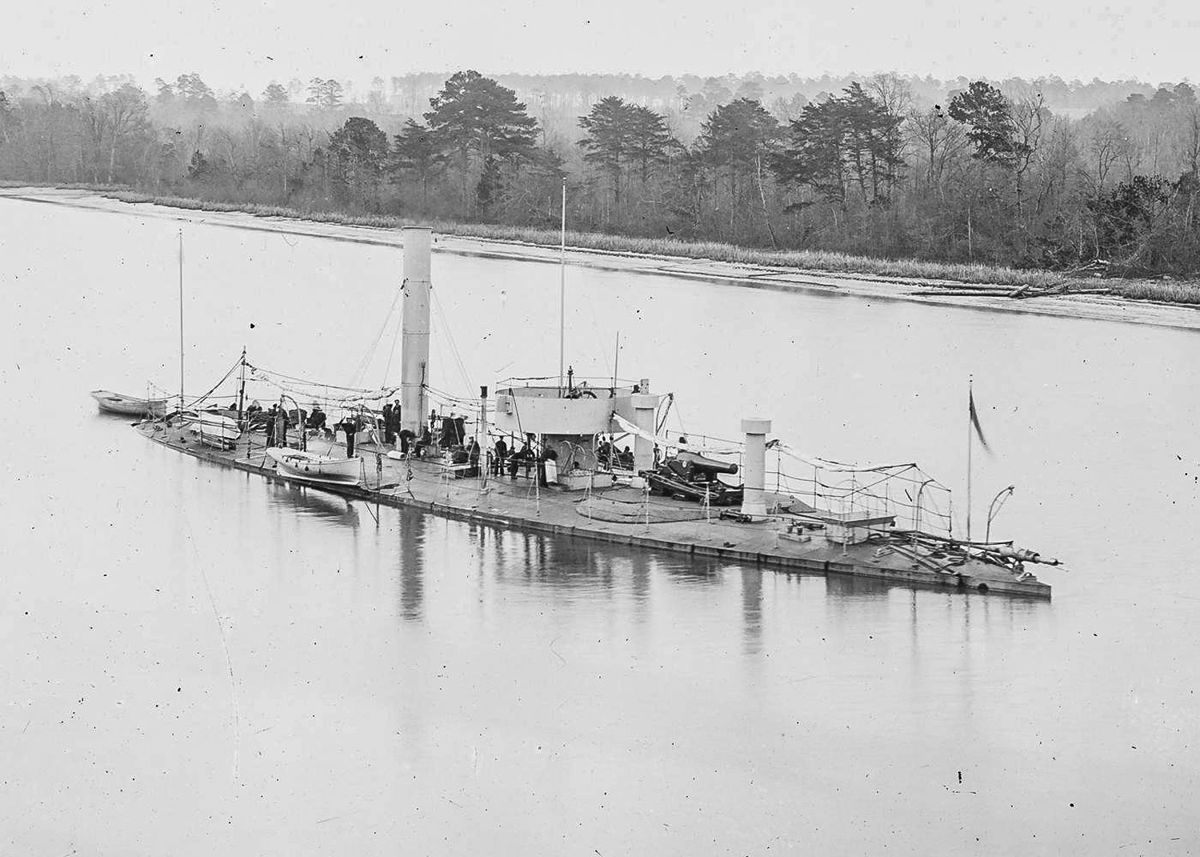
The USS Casco, first of particular class of twenty 1175ton light draft monitors was built at Boston. When launched in May 1864, it was found that the ship’s design was seriously flawed due to the turret’s weight. It was then completed, by raising the deck almost two feet, as a spar torpedo vessel, without the monitor-type ironclad turret, and then commissioned in early December 1864. Subsequently assigned duty on the James River near Dutch Gap in early 1865, the torpedo gear was mounted on the bow and the ship additionally armed with an XI-inch Dahlgren pivot mounted on its curved deck. (Readers interested in Dahlgren should go to the Library of Congress collection and see a photograph of Rear Admiral John A. Dahlgren, U.S. Navy, standing by a Dahlgren on the USS Pawnee in Charleston.) The Casco served on the James until April 1865, then spent the last week of the war with the Potomac Flotilla, together with other warships that included four “double-ender” Sassacus Class gunboats, two screw gunboats, and two monitors plus a variety of civilian steamers and sailing vessels that can be seen in the Collections of the National Archives in a photograph by the Matthew Brady organization. The flotilla, was also known as the Potomac Squadron. It was a unit of the U.S. Navy created in the early days of the war to secure communications on the Chesapeake Bay, the Potomac and its tributaries, as well as disrupting
USS Casco on the James River. She was armed with one XI-inch Dahlgren smoothbore, and a spar torpedo mounted on the bow. (National Archives Identifier (NAID) 530265)
Confederate communications and shipping especially in the southern Maryland area. The small fleet had been proposed by the commander of the USS North Carolina, James H. Ward, said to be the first USN officer killed in the war. He was shot by Confederates while sighting a gun at Mathis Point, Va., during June 1861 while sighting a bow gun. The USS Casco was decommissioned June 19, 1865, at the Washington Navy Yard, D.C., and given the new name Hero, renamings being common at the time. Broken up and scrapped in 1875, the name Casco was later used for a WWII ship.
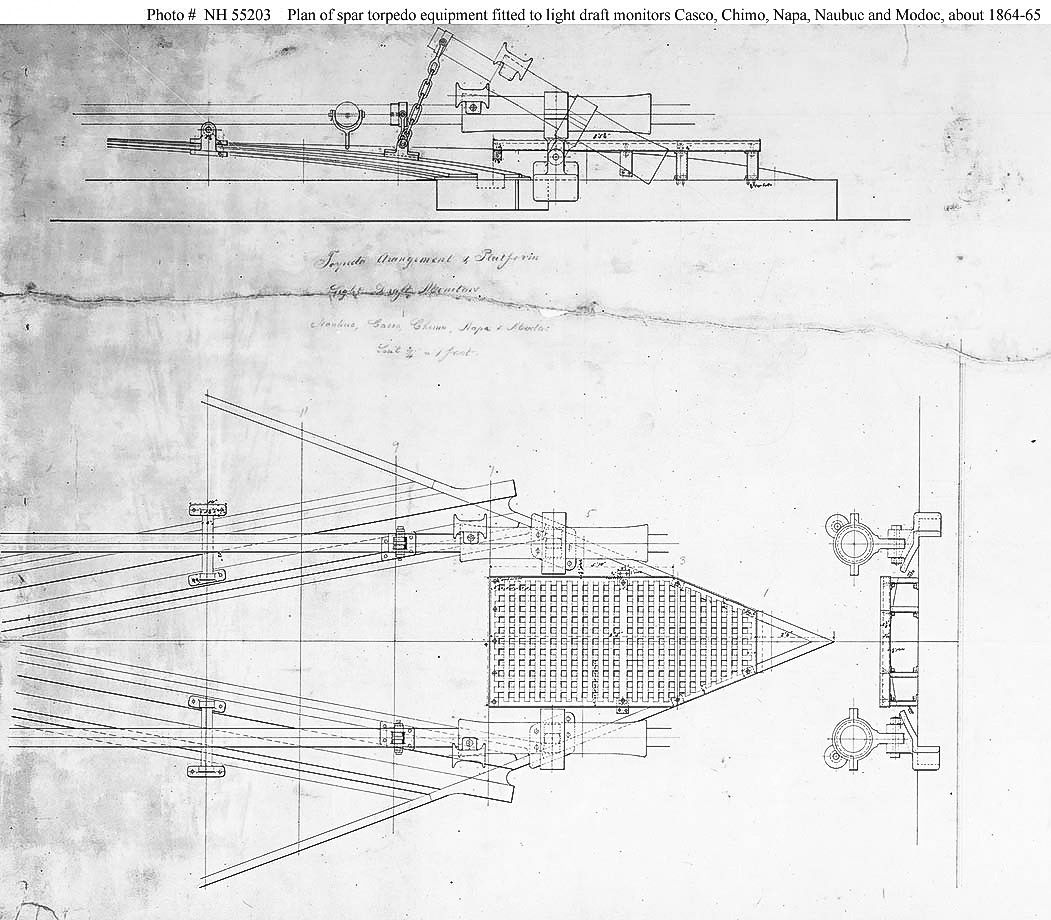
Spar torpedoes were also successfully fitted to some Confederate vessels, most notably the submersible H.L. Hunley which used its spar torpedo to sink the USS Housatonic, and the David class surface torpedo boats. The U.S. Navy used spar torpedoes on small boats where a spar was held in place at the bow by a complex system of yokes, ropes, and gears to permit accurate placing of the torpedo. The boat torpedo was to be immersed to a depth of at least 10 feet and could safely be exploded 22 feet away horizontally. The Union crews used surface boats to bring torpedoes into contact with the underwater part of an enemy hull, most famously when William Cushing sank the CSS Albemarle. (Images of two Confederate Spar Torpedo boats can be seen at: weaponsandwarfare. c o m / 2 0 1 8 / 0 1 / 1 7 / the-spar-torpedo).
There was also the Union’s steam tug USS Linda on the James River that had been rigged with a spar on which was rigged a 150-pound torpedo. If needed she would attack by lowering the torpedo into the water and running abeam an enemy vessel and detonating the torpedo by pulling a lanyard. Joan Wenner, J.D., is a native New Yorker presently residing in eastern coastal North Carolina and longtime contributor to the Civil War News with a law degree. Published in numerous history publications, she has a special interest in naval operations and military courts of inquiry. Comments are welcomed at [email protected].