
Critic's Corner
“Cheer, Boys, Cheer”: Sam Watkins in the Winter of ’63-‘64
By Stephen Davis · Originally published February 2023 · pp. 28–29
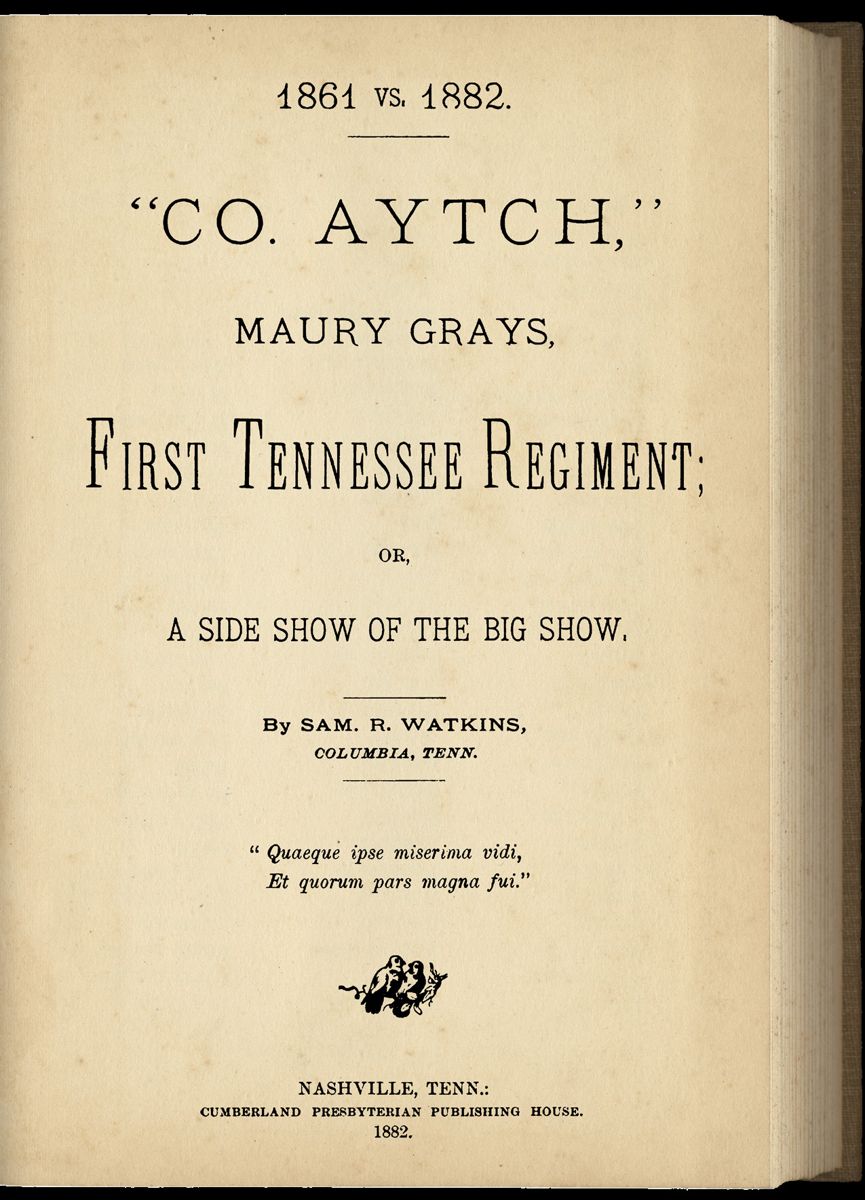
“Cheer, Boys, Cheer”: Sam Watkins in the Winter of ’63-‘64 The histories of the Lost Cause are all written out by “big bugs,” Generals and renowned historians, and like the fellow who called a turtle a “cooter,” being told that no such word as cooter was in Webster’s dictionary, remarked that he had as much right to make a dictionary as Mr. Webster or any other man; so have I to write a history.1
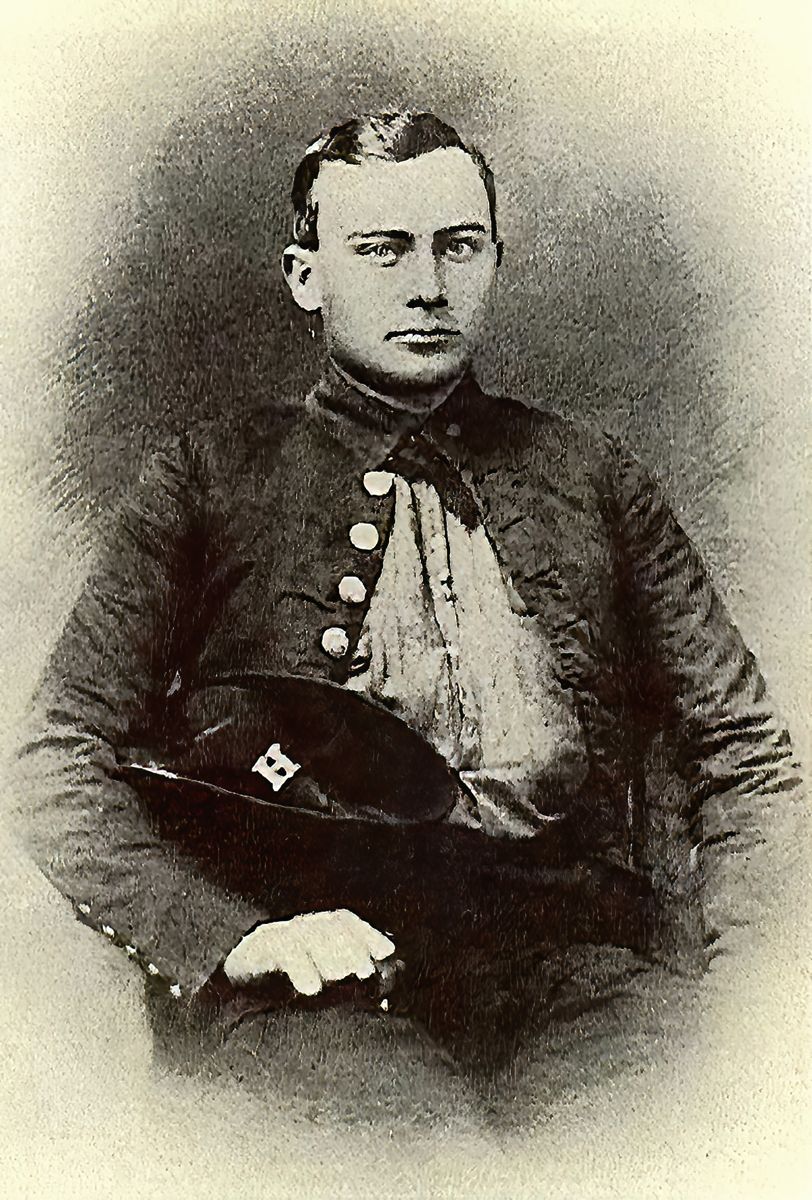
And boy did he. Samuel Rush Watkins was born on June 26, 1839 near Columbia, Tennessee. He attended college there and was twenty-one when the war broke out. Just weeks after Sumter he volunteered to join a local company, the Maury Grays, that became Company H of the 1st Tennessee. Private Watkins saw the elephant at Shiloh, followed Bragg to Perryville, and was slightly wounded at Murfreesboro. He suffered through the rout at Missionary Ridge, then was wounded at Atlanta. He survived Hood’s tragic raid into Tennessee, though wounded at Nashville. At some point in the war he suffered a third wound.2 True to the colors, he surrendered with Johnston in North Carolina. After the war veterans of both sides, sensing that their experiences would be the dramatic highlight of their lives, went to work writing and seeing to the publication of their memoirs. Some of these appeared at first as articles in local newspapers. Thus Watkins’ recollections were serialized in his hometown
Columbia Herald, 1881-82.3 The author stitched them together as a volume which at one time he thought he would entitle Sam’s Book.4 Fifteen hundred copies were printed, both in hardcover ($1.25) and paperback (75 cents). More recently a descendant found Watkins’ personal copy, in the front of which he had written
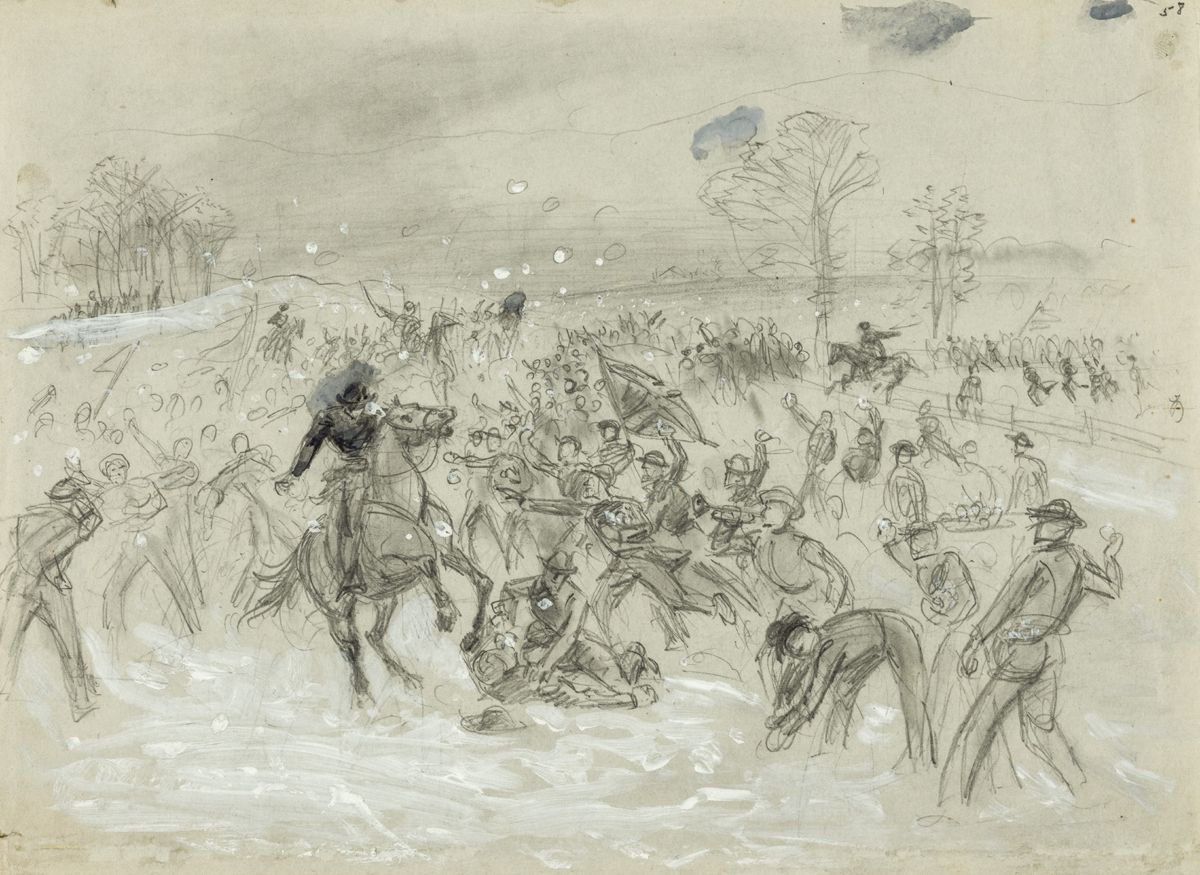
Co. H (Co Aytch) Reb. Memoirs of a Private Soldier C.S.A. or Anecdotes and incidents of A Webfoot by An old army veteran What he saw What he thought & how he felt 5 Watkins planned to issue a second edition of his book in 1892, but that never came about.6 Instead, Watkins turned to writing articles, notably for Confederate Veteran, whose first issue came out in January 1893 from Sumner “Sam” Cunningham in Nashville. In the September 1893 number there appeared Watkins’ first piece, “Snow Battle at Dalton— Little Jimmie White.” The famous snow fight occurred as the Army of Tennessee quartered during the winter of 1863-64 in north Georgia. Watkins’ article dealt less with the soldiers’ snow battle than with the accidental death of one of Sam’s friends, a fourteen-yearold whose legs had been crushed by a caisson.7 There was not much to do in winter quarters, as Watkins recalled in a piece appearing in the Veteran for November 1909. But card games, especially poker and chuck-a-luck, helped while away the time. “A few men would read their Bibles and hymn books,” Watkins observed, “but not many.” In camp there was one soldier who was extraordinarily lucky at playing cards, fleecing everyone out of their money. One of Watkins’ comrades, Tom Tuck, suspected the card sharp of cheating, so he demanded to see the deck of cards. Sure enough, they were marked. Tuck had threatened to shoot the sharpster if he was bilking, and he kept his word. The cheater tried to escape, but Tuck followed, firing twice with his pistol. Watkins remembered the victim’s “shriek of mortal agony.”8 Co. “Aytch” offers tons of stories like the snowball fight at Dalton—just the sort of reminiscence one would expect
Samuel Rush Watkins. from a raconteur like Sam Watkins. Our memoirist recalled how some scamps packed rocks in their snowballs, causing “an occasional knock down, and sometimes an ugly wound.” In the middle of the snowball battle, soldiers stopped for a moment to watch the execution of a deserter. Sam remembered that the firing squad’s volley wounded, but did not kill its target, so “the whole affair had to be gone over again”—this time, with deadly effect. Then there was the time when during a prayer meeting—that winter saw a lot of revivals in the Army of Tennessee—a tree that had caught fire overhead fell upon ten men engaged in fervent prayer. The worshipers had asked that their souls be delivered up on high. “God had heard their prayers,” was Watkins’ laconic comment. With rations sparse, veterans kept their eyes out for dietary supplement. So when out on an excursion, someone spotted “a fine fat sow” in a farmer’s yard, Sam was among those sent inside to engage the owners’ attention while the men outside made off with the pork-on-hoof. He was chagrined to learn, in conversation with the lady of the place, that her husband and three sons had all died in the war. Filled with remorse, he pulled out a new Confederate $100 bill, which he offered her. No, she would not take it; “she was perfectly willing to give the soldiers everything she had.” Sam placed the money on the table and left. “I have never in my life made a raid upon anybody else,” he confessed.9 Music and song can sometimes take the bite out of winter’s cold. Thus could Watkins remember the words of a wartime air that was very popular among Southerners, “Cheer, Boys, Cheer.” Cheer, boys, cheer, we are marching on to battle! Cheer, boys, cheer, for our sweethearts and our wives! Cheer, boys, cheer, we’ll nobly do our duty, And give to the South our hearts, our arms, our lives. Old Lincoln, with his hireling hosts, Will never whip the South, Shouting the battle cry of freedom. “Shouting the battle cry of freedom” are lyrics best remembered from the Northern air, “The Battle Cry of Freedom,” but here we see that singing Confederates could also share in those lofty lines. Henry Russell’s song “Cheer, Boys, Cheer” was published in Nashville and Memphis in 1861. The song was also called “The Song of Southern Boys,” and the chorus, which Rebels knew well, ran “Cheer, boys, cheer, for country, mother country, / Cheer, boys, cheer, the willing strong right hand / Cheer, boys, cheer, there’s wealth for honest labor / Cheer, boys, cheer, for the new and happy land!” “Cheer, Boys, Cheer” is unknown today, but it remained popular for years after the war. As reported in Confederate Veteran, in the 1890s during the dedication of a Confederate monument in Owensboro, Kentucky, the main orator for the event referred to Southern soldiers: “Through the vista of years we see them again as they struggle in their icy trenches or charge through the ‘untrodden snow’ at Fort Donelson; again we hear them singing, ‘Cheer, boys, cheer, we’ll march away to battle,’ as they lead the charge of Albert Sidney Johnston’s army through Grant’s camps at Shiloh.” At this point, Veteran editor S. A. Cunningham inserted, “Just here a group of well-trained voices arose suddenly upon the platform and sang that old-time thrilling war song, and the innovation gave renewed interest to the splendid address.”10 Notes 1.
Sam R. Watkins, Co. “Aytch” Maury Grays, First Tennessee Regiment or, A Side Show of the Big Show, ed. by Ruth Hill Fulton McAllister (Franklin TN:
Providence House Publishers, 2007 [1882]), 6. 2. “Samuel Rush Watkins,” Confederate Veteran, vol. 9, no. 9 (September 1901), 419. 3. Roy P. Basler, “Introduction” in Sam R. Watkins, “Co. Aytch”: A Side Show of the Big Show (New York: Collier Books, 1962) [1882], 8. 4. Andrew B. Miller, “Publisher’s Preface to the 2007 Edition” in McAllister, ed., Co. “Aytch,” xviii. 5. Frontispiece in McAllister, ed., Co. “Aytch.” 6. McAllister, “Preface,” in ibid., xix. 7. S. R. Watkins, “Snow Battle at Dalton—Little Jimmie White,” Confederate Veteran, vol. 1, no. 9 (September 1893), 261-62; Steve Davis, “The Great Snow Battle of 1864,” Civil War Times Illustrated, vol. 15, no. 3 (June 1976), 32-35. 8. S. R. Watkins, “A Gambler at Cards in Dalton, Ga.,” Confederate Veteran, vol. 17, no. 11 (November 1909), 559. 9. McAllister ed., Co.“Aytch,” 143-48. 10. McAllister, ed., Co.“Aytch,” 159; E. Lawrence Abel, Singing the New Nation: How Music Shaped the Confederacy, 1861–1865 (Mechanicsburg, PA: Stackpole Books, 2000), 300n.54); E. Lawrence Abel, Confederate Sheet Music (Jefferson NC: McFarland & Company, 2004), 38–39; “Confederate Monument at Owensboro,” Confederate Veteran, vol. 8, no. 9 (September 1900), 388–89. Stephen Davis’ next book will be a new edition of Eliza Frances Andrews’ War-Time Journal of a Georgia Girl, first published in 1900. It will appear this winter from Mercer University Press.